Technical and Vocational Education Market Size & Growth Forecast 2027–2036, By Segments (Course Type, Learning Mode, Organization, End Use), Regional Demand Trends (North America, Asia Pacific, Europe), Key Country Insights (U.S., Japan, South Korea, Germany, France, Italy), and Competitive Landscape
Market Size and Growth Outlook
Technical and Vocational Education Market size was valued at USD 977.3 billion in 2026 and is anticipated to grow at a 9.5% CAGR from 2027 to 2036, reaching USD 2.42 trillion by 2036. The industry revenue for 2027 is estimated at USD 1.06 trillion.
Get more details on this report
Request Free Sample ReportTechnical and Vocational Education Market Intelligence Snapshot
Regional Market Dynamics
- Europe leads due to established vocational systems, strong industry alignment, structured apprenticeship models, and certification frameworks that ensure job-ready skills and sustain steady institutional enrollment and employer participation.
- Asia Pacific growth is driven by rising demand for job-ready skills, rapid industrial expansion, and broader workforce participation in skills training, with an 11.31% CAGR across the region.
Segment Momentum
- STEM accounted for 74.88% of the market in 2026, supported by strong alignment with industrial skill requirements, technical occupations, and hands-on workforce preparation that institutions and learners consistently prioritize.
- Online is the fastest-growing learning mode because it expands access, reduces location barriers, and enables efficient delivery of theory-based instruction and modular coursework to a broader learner base.
Market Expansion Drivers
- Rising AI-driven personalized learning platforms enhancing vocational training accessibility and effectiveness.
- Adoption of VR and AR simulations improving hands-on technical skill development outcomes.
- Government-backed workforce upskilling initiatives accelerating enrollment in vocational education programs.
Leading Market Participants
- Key players in the technical and vocational education market include Coursera, Inc. (United States), Pearson plc (United Kingdom), TÜV Rheinland AG (Germany), Udacity, Inc. (United States), Cegos Group (France), learndirect Limited (United Kingdom), edX LLC (United States), Udemy, Inc. (United States), Babcock International Group PLC (United Kingdom).
Global Market Forecast Snapshot
Market Outlook
- 2026 Market Size: USD 977.3 billion
- 2027 Estimated Market Size: USD 1.06 trillion.
- Projected Market Size: USD 2.42 trillion by 2036
- Growth Forecast: 9.5% CAGR (2027-2036)
Regional and Segment Outlook
- Leading Regional Market: Europe
- High-Growth Regional Hub: Asia Pacific
- Core Revenue Segment: STEM (Course Type) | Offline (Learning Mode) | Public (Organization) | Academic Institutions & Individuals (End Use)
- Emerging Opportunity Segment: Non-STEM (Course Type) | Online (Learning Mode) | Private (Organization) | Corporates (End Use)
Market Growth Drivers and Industry Trends
Rising AI-driven personalized learning platforms enhancing vocational training accessibility and effectiveness
The integration of artificial intelligence into education platforms is enabling more adaptive training experiences, which will drive the technical and vocational education market growth. AI-enabled systems can analyze learner performance, identify areas requiring additional practice, and adjust instructional content according to individual skill levels and learning progress. This approach can make vocational education more accessible by supporting different learning speeds and providing targeted digital resources outside conventional classroom settings. Personalized recommendations, automated assessments, and interactive learning environments can further help trainees concentrate on practical competencies that are relevant to their chosen occupations, while institutions can use learner insights to improve course delivery and training support.
Adoption of VR and AR simulations improving hands-on technical skill development outcomes
Immersive technologies are changing the way technical skills can be taught by allowing learners to practice procedures in simulated environments, strengthening demand across the technical and vocational education market. Virtual and augmented reality applications can recreate machinery operations, industrial processes, maintenance tasks, workplace environments, and other situations that may be difficult or costly to reproduce in traditional training facilities. Trainees can repeatedly practice complex activities while receiving visual guidance and learning from simulated errors without being exposed to the operational risks associated with real equipment. Greater access to realistic hands-on practice can strengthen technical understanding and help learners build confidence before applying their skills in actual workplace environments.
Government-backed workforce upskilling initiatives accelerating enrollment in vocational education programs
Public investment in workforce development is increasing participation in vocational training by addressing the need for workers with practical and job-ready competencies, thereby supporting the technical and vocational education market growth. Government-supported programs can improve access to training through subsidized courses, skills development initiatives, employment-focused education, and targeted programs for workers seeking to transition into emerging occupations. These measures are particularly relevant in industries experiencing changes in technology, production methods, and occupational requirements, where existing workers may need to acquire new technical capabilities. Greater institutional support for reskilling and upskilling can also encourage individuals to pursue vocational programs as a pathway to improved employability and occupational mobility.
| Growth Driver | Impact on CAGR | Regulatory Influence | Geographic Relevance | Adoption Rate | Impact Timeline |
|---|---|---|---|---|---|
| Rising AI-driven personalized learning platforms enhancing vocational training accessibility and effectiveness | 2.00% | Moderate | Europe, Asia Pacific | High | Near Term |
| Adoption of VR and AR simulations improving hands-on technical skill development outcomes | 1.80% | Moderate | North America, Europe | High | Mid Term |
| Government-backed workforce upskilling initiatives accelerating enrollment in vocational education programs | 1.60% | High | Asia Pacific, Europe | High | Mid Term |
Unlock insights tailored to your business with our bespoke market research solutions.
Click to get your customized report now.
Regional Demand Dynamics
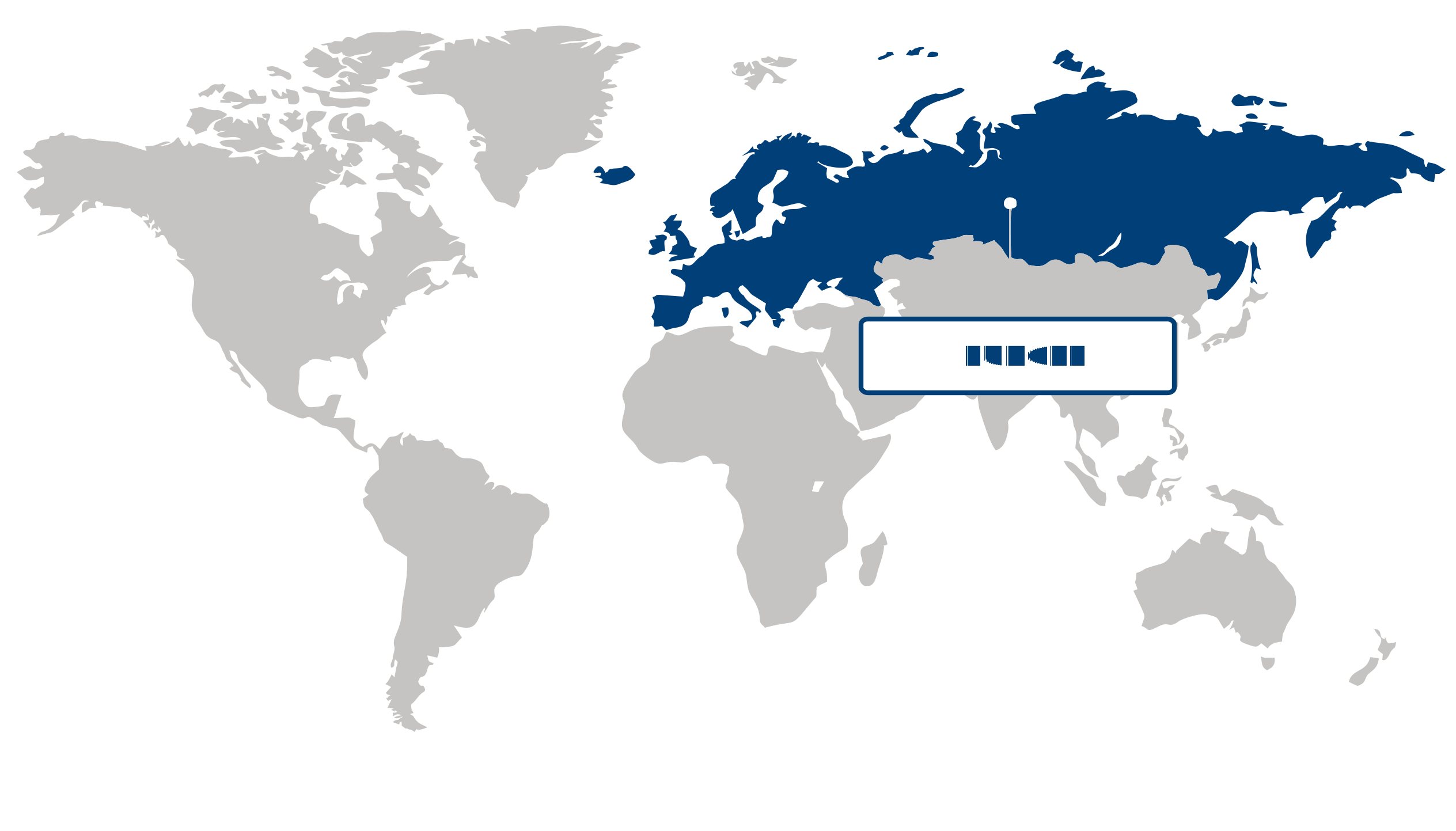
Europe (Largest Region)
Europe accounted for a 33.92% share of the technical and vocational education market in 2026, reflecting the region's strong emphasis on workforce development and skills-oriented education. Established vocational training systems, close links between education providers and industry, and policies focused on employability contribute to sustained demand for technical education. The need to address evolving occupational requirements and strengthen workforce capabilities across manufacturing, services, and technology-oriented sectors further reinforces the region's position.
Asia Pacific (Fastest-Growing Region)
Asia Pacific is expected to experience the fastest growth in the technical and vocational education market, supported by expanding industrial activity, a large and increasingly diverse workforce, and rising demand for job-ready skills. Rapid economic development is increasing the need for trained personnel across manufacturing, construction, technology, and service industries. Governments and educational institutions are also placing greater emphasis on vocational pathways to improve employability and align training with changing labor-market requirements, supporting broader adoption of technical and skills-based education.
| Parameter | North America | Asia Pacific | Europe | Latin America | MEA |
|---|---|---|---|---|---|
| Innovation Hub i Scale Nascent Developing Advanced | |||||
| Cost-Sensitive Region i Scale Low Medium High | |||||
| Regulatory Environment i Scale Restrictive Neutral Supportive | |||||
| Demand Drivers i Scale Weak Moderate Strong | |||||
| Development Stage i Scale Emerging Developing Developed | |||||
| Adoption Rate i Scale Low Medium High | |||||
| New Entrants / Startups i Scale Sparse Moderate Dense | |||||
| Macro Indicators i Scale Weak Stable Strong |
Key Country Insights
Germany 🇩🇪
Apprenticeship System IntegrationGermany’s technical and vocational education system is deeply integrated with structured apprenticeship pathways across industrial sectors. Training providers in Germany emphasize dual education models combining classroom instruction with hands-on workplace experience.
France 🇫🇷
Structured Certification PathwaysIn France, technical and vocational education is shaped by formal certification systems and state-supported training frameworks. Institutions focus on standardized qualifications linked to construction, engineering, and service-sector employability.
Italy 🇮🇹
Regional Training DiversificationItaly’s vocational education market reflects strong regional variation in training delivery and industry alignment. Programs in Italy emphasize practical skill development for manufacturing, craftsmanship, and SME-driven employment sectors.
Japan 🇯🇵
Workforce Aging AdaptationIn Japan, vocational education is increasingly focused on reskilling and upskilling programs to address workforce aging and labor shortages. Institutions prioritize precision manufacturing, robotics, and service-sector technical training.
South Korea 🇰🇷
Digital Skill AccelerationSouth Korea’s vocational education landscape is driven by rapid digital transformation and demand for advanced technical skills. Programs in South Korea emphasize coding, automation, and applied engineering competencies aligned with industrial innovation.
United States 🇺🇸
Industry-Aligned Skill TrainingIn the U.S., technical and vocational education is increasingly structured around industry partnerships and workforce readiness programs. Institutions focus on aligning curricula with manufacturing, healthcare, and digital skills demand to improve job placement outcomes.
Segment Leadership and Growth Trends
Technical and Vocational Education Market Share (%), by Course Type, 2026
Go beyond the chart, access full insights & data tables
Request Free Sample ReportCourse Type Segment Analysis: STEM (Largest Segment) vs Non-STEM (Fastest-Growing Segment)
The STEM segment accounted for the largest share of the technical and vocational education market at 74.88% in 2026, reflecting strong demand for technical competencies aligned with engineering, information technology, manufacturing, science, and other skill-intensive occupations. Employers increasingly require workers with practical capabilities in technology-driven environments, encouraging learners to pursue vocational pathways that combine technical knowledge with job-oriented training. The expansion of automation, digitalization, and advanced production systems is further strengthening the importance of STEM-focused vocational education.
Non-STEM courses are gaining momentum as vocational education providers broaden their offerings to address workforce requirements beyond highly technical occupations. Growing demand for practical skills in areas such as business services, administration, hospitality, creative fields, and other service-oriented activities is creating additional opportunities for non-STEM programs. Greater emphasis on employability, flexible career pathways, and diversified workforce development is supporting the expansion of this segment.
Learning Mode Segment Analysis: Offline (Largest Segment) vs Online (Fastest-Growing Segment)
Offline learning remained the largest segment of the technical and vocational education market in 2026, supported by the importance of hands-on instruction, instructor interaction, and access to physical equipment in practical training environments. Many vocational disciplines require learners to perform demonstrations, operate machinery, practice technical procedures, or participate in supervised workshops, making classroom and facility-based education particularly valuable. Established institutional infrastructure and direct engagement between instructors and learners continue to reinforce the relevance of offline training.
Online learning is expanding rapidly as learners and training providers increasingly seek flexible and accessible education models. Digital delivery enables students to access instructional content remotely, accommodate different schedules, and combine theoretical learning with other professional or educational commitments. Improvements in digital learning platforms and growing acceptance of remote education are encouraging vocational institutions to integrate online formats, particularly for coursework that can be delivered effectively without continuous access to physical training facilities.
| Segment | Sub-Segment | Largest Segment | Fastest Growing |
|---|---|---|---|
| Course Type | STEM, Non-STEM | STEM | Non-STEM |
| Learning Mode | Online, Offline | Offline | Online |
| Organization | Public, Private | Public | Private |
| End Use | Academic Institutions & Individuals, Corporates | Academic Institutions & Individuals | Corporates |
Competitive Landscape and Market Positioning
Top players in the technical and vocational education market:
1. Coursera Inc. (United States)
2. Pearson plc (United Kingdom)
3. TÃœV Rheinland AG (Germany)
4. Udacity Inc. (United States)
5. Cegos Group (France)
6. learndirect Limited (United Kingdom)
7. edX LLC (United States)
8. Udemy Inc. (United States)
9. Babcock International Group PLC (United Kingdom)
The technical and vocational education market is undergoing transformation through the integration of digital learning platforms and industry-aligned training programs. Educational providers are expanding remote learning capabilities, simulation-based training, and skill certification models to improve workforce readiness. Partnerships between training institutions and employers are also strengthening curriculum relevance and employment outcomes.
| Company | Market Share | Company Revenue | Revenue CAGR (%) | Product Portfolio | Geographic Presence | Innovation / R&D Focus | Strategic Developments |
|---|---|---|---|---|---|---|---|
| Coursera Inc. (United States) | |||||||
| Pearson plc (United Kingdom) | |||||||
| TÜV Rheinland AG (Germany) | |||||||
| Udacity Inc. (United States) | |||||||
| Cegos Group (France) | |||||||
| learndirect Limited (United Kingdom) | |||||||
| edX LLC (United States) | |||||||
| Udemy Inc. (United States) | |||||||
| Babcock International Group PLC (United Kingdom). |
Industry Development/News
| Company Name | Date | Key Development |
|---|---|---|
| Youlife Group Inc. | Jun-26 | Youlife Group announced a strategic expansion of its vocational training ecosystem, positioning itself as a blue-collar lifetime service provider. The initiative seeks to align training pathways with shifting labor demands in China, strengthening the company’s role in delivering technical and vocational education services and improving workforce readiness. |
| European Union | May-26 | The European Union launched the BizConnect Training of Trainers programme under the SCOPE-HE initiative in partnership with ASEAN. The effort focuses on strengthening collaboration between TVET institutions and industry, aiming to align vocational curricula with green and digital transitions while enhancing graduate employability across Southeast Asian markets. |
| Ministry of Industry (Egypt) | May-26 | The Ministry of Industry, in partnership with the Sawiris Foundation, is developing a national vocational education programme to improve graduate quality. The initiative aims to align training standards with international industry requirements, ultimately strengthening the competitiveness of the Egyptian technical workforce in the global labor market. |
| Government of Burkina Faso | May-26 | In collaboration with UNICEF and Japan, the government inaugurated eight technical and vocational schools. This infrastructure expansion supports long-term educational outcomes, providing increased capacity for vocational training to more than 50,000 children and adolescents, significantly broadening access to technical education in the region over the next 15 years. |
| Government of Ghana | May-26 | The government integrated the St. Matthew Technical Vocational Institute into the public TVET system. By converting the facility into a state-run institution, the government is expanding its public sector footprint in vocational training delivery and increasing access to structured technical education within the Kassena-Nankana West District. |
| Government of Nigeria | Sep-25 | The government approved N158 billion in funding to support technical, vocational, and digital skills training for 650,000 youths. This large-scale investment is designed to enhance workforce readiness, address national unemployment, and improve overall labor market employability through targeted skills development interventions across the country. |
| Ibex Technologies | Oct-24 | Ibex Technologies signed a Memorandum of Understanding with the Federal Technical and Vocational Training Institute in Ethiopia. The partnership focuses on scaling vocational training capacity and advancing technology-driven skills development, supporting the local workforce through specialized training initiatives tailored to industrial advancement requirements. |
| Acumatica, Inc. | Jul-24 | Acumatica expanded its College Education Program to provide students with hands-on experience using its cloud ERP software. By integrating its ERP solution and Learning Management System into college curricula, the company is bridging the gap between academic theory and practical enterprise operations, preparing students for digital-native roles. |
| Babcock | Jun-24 | Babcock entered a strategic partnership with the Air and Space Institute in the UK to integrate aviation industry insights into vocational education. The collaboration provides students with practical training and direct access to apprenticeship pathways, enhancing industry-aligned talent development within the aerospace and defense vocational sectors. |
| Amazon Web Services | Apr-24 | Amazon Web Services launched the Skills to Jobs Tech Alliance in Brazil and Colombia to address regional tech talent gaps. By collaborating with academic institutions and governments to align curricula with industry needs, the initiative aims to build a pipeline of job-ready talent with specialized cloud and technology skills. |
Customize Your Report
Explore examples of how this report can be tailored to different research needs, including custom segments, additional topics or chapters, and related reports. Click a section of the wheel or its numbered marker to explore the available options.
Technical and Vocational Education Market — Custom Segments
| Segment | Sub-Segment |
|---|---|
| Qualification Level | Certificate Programs, Diploma Programs, Associate Degrees, Advanced Diplomas |
| Funding Source | Government-Funded, Employer-Funded, Student-Funded, Institution-Funded |
| Industry Vertical | Manufacturing & Engineering, Information Technology, Healthcare, Construction & Infrastructure, Automotive & Transportation, Hospitality & Services |
Technical and Vocational Education Market — Custom TOC
| Custom Chapter | Custom Details |
|---|---|
| Workforce Skill Gap and Future Occupation Mapping |
|
| Employer Partnership and Industry Collaboration Benchmark |
|
| Corporate Upskilling and Reskilling Demand Assessment |
|
Need a different cut of the data?
Request Custom ResearchHow large is the technical and vocational education market?
How is the technical and vocational education industry projected to perform over the next decade?
How are AI-powered learning platforms reshaping demand in the technical and vocational education market?
Why are immersive simulation technologies gaining strategic importance in the technical and vocational education market?
Why do STEM courses dominate the technical and vocational education market?
How is online learning driving growth in the technical and vocational education market?
Why does Europe lead the technical and vocational education market?
How is Asia Pacific driving growth in technical and vocational education market?
Who holds a significant market share in the technical and vocational education landscape?
Our Clients
"The report provided us with a clear direction, and the level of detail was beyond what we expected. I would definitely recommend their services to others."
Haier Appliances
"The collaboration with Fundamental Business Insights has added significant value to our decision-making process, and we look forward to continuing this partnership for our future market research requirements."
Luxottica Group S.p.A.
"The team at FBI delivered an exceptional research report. The insights on industry innovations were particularly impressive and added a lot of value to the overall report."
Nike
Our Research Team & Methodology
Every Fundamental Business Insights report is built by a dedicated vertical research team, validated through a structured primary-and-secondary methodology, and reviewed for accuracy before it reaches you.
Research Team Overview
Prepared by the Consumer Goods & Services Research Team
Delivery
Published
Demand
Available
Support
Trust & Compliance
Research Domains
10 coverage areasResearch Intelligence
| Source | Reference |
|---|---|
| International Organization for Standardization (ISO) | www.iso.org |
| ASTM International | www.astm.org |
| U.S. Consumer Product Safety Commission (CPSC) | www.cpsc.gov |
| European Commission – Consumer Safety | ec.europa.eu/safety-gate |
| Consumer Technology Association (CTA) | www.cta.tech |
| National Retail Federation (NRF) | nrf.com |
| World Retail Congress | www.worldretailcongress.com |
| World Travel & Tourism Council (WTTC) | wttc.org |
| UN Tourism | www.unwto.org |
| Personal Care Products Council (PCPC) | www.personalcarecouncil.org |
| Cosmetics Europe | cosmeticseurope.eu |
| International Housewares Association (IHA) | www.housewares.org |
| American Apparel & Footwear Association (AAFA) | www.aafaglobal.org |
| World Federation of the Sporting Goods Industry (WFSGI) | wfsgi.org |
| Juvenile Products Manufacturers Association (JPMA) | www.jpma.org |
| Pet Industry Joint Advisory Council (PIJAC) | pijac.org |
| International Council of Toy Industries (ICTI) | www.toy-icti.org |
| International Association of Amusement Parks and Attractions (IAAPA) | iaapa.org |
| Organisation for Economic Co-operation and Development (OECD) | www.oecd.org |
| World Bank Data | data.worldbank.org |
Research Workflow & Quality Assurance
Data Collection
Verified information gathered through primary and secondary research.
Data Triangulation
Cross-validation using multiple independent data sources.
Forecast Modelling
Market estimates developed using historical trends and analytical models.
Analyst Validation
Findings reviewed by domain experts for accuracy and consistency.
Editorial & Quality Review
Final editorial, quality, and compliance checks before publication.
Final Publication
Released after successful completion of the internal review process.
Report Coverage
📊 Market Assessment
- Market Size & Forecast
- Market Segmentation
- Regional Analysis
- Growth Drivers & Challenges
- Market Dynamics
🏢 Competitive Intelligence
- Competitive Landscape
- Company Profiles
- Competitive Benchmarking
- Mergers & Acquisitions
- Market Share Analysis or Key Company Strategies
🔍 Strategic Analysis
- Value Chain Analysis
- Porter's Five Forces
- PESTLE Analysis
- Pricing Trends
- Supply-Demand Analysis
🚀 Future Outlook
- Technology Landscape
- Regulatory Landscape
- Investment & Funding Landscape
- Emerging Opportunities
- Future Market Outlook
Have a question about this report or need a custom scope?
Request Customization