Residue Testing Market Size & Forecasts 2026-2035, By Segments (Technology, Type, Food Tested), Growth Opportunities, Innovation Landscape, Regulatory Shifts, Strategic Regional Insights (U.S., Japan, China, South Korea, UK, Germany, France), and Competitive Dynamics (Thermo Fisher Scientific, PerkinElmer, Agilent Technologies, Waters Corporation, Shimadzu)
Market Size and Growth Outlook
Residue Testing Market size is predicted to expand from USD 1.79 billion in 2025 to USD 3.94 billion by 2035, with growth underpinned by a CAGR above 8.2% between 2026 and 2035. The industry revenue outlook for 2026 is USD 1.92 billion.
Get more details on this report
Request Free Sample ReportResidue Testing Market Intelligence Snapshot
Regional Market Dynamics
Segment Momentum
Market Expansion Drivers
Leading Market Participants
Global Market Forecast Snapshot
Market Outlook
Regional and Segment Outlook
Market Growth Drivers and Industry Trends
Tighter standards and enforcement from agencies such as the European Food Safety Authority (EFSA), U.S. Food and Drug Administration (FDA), European Medicines Agency (EMA), and U.S. Environmental Protection Agency (EPA) are elevating mandatory monitoring and third‑party certification, driving routine and specialized analysis. This regulatory momentum increases demand for accredited labs, traceable methods, and chain‑of‑custody services in the residue testing market. Established players can leverage accreditation, scale, and integrated reporting to win long‑term contracts with processors and regulators; new entrants can differentiate through niche accreditations or rapid compliance-only services. Given recent guidance updates from EFSA and FDA and expanded inspection programs at EPA, regulatory-driven volumes and demand for documented methods will remain a structural growth factor.
Technological Advancements in High-Sensitivity and Rapid Testing Equipment
Improvements in high‑resolution mass spectrometry, rapid LC‑MS/MS workflows, and portable sensor platforms announced by Thermo Fisher Scientific, Agilent Technologies, and Waters Corporation are compressing turnaround times and lowering detection limits, enabling broader screening across supply chains. Adoption of automated sample prep and laboratory information management systems accelerates throughput and traceability in the residue testing market. Incumbents can monetize instrument‑plus‑service bundles and method libraries; startups can exploit point‑of‑need kits and software analytics to access decentralized testing nodes. With manufacturers continuing to publish performance data in corporate press releases and regulators increasingly accepting validated rapid methods, technological integration into routine surveillance is an observable near‑term trajectory.
Growth of Industrial and Agricultural Sectors in Emerging Economies
Expanding agro‑industrial activity documented by the Food and Agriculture Organization of the United Nations (FAO) and investment‑led industrial growth tracked by the World Bank are increasing sample volumes, export compliance requirements, and domestic monitoring needs in markets such as India and Brazil (Ministry of Agriculture & Farmers Welfare; Brazilian Ministry of Agriculture). This volume growth feeds demand for local laboratory capacity, training, and supply chain testing services in the residue testing market. Large diagnostics and equipment suppliers can expand via regional distribution and training programs; local laboratories and service entrants can capture margin by offering rapid, cost‑competitive testing tailored to export standards. As FAO and World Bank data show continued sector expansion, capacity build‑out and localized service models will be practical responses to sustained testing demand.
Industry Restraints:
Regulatory Fragmentation and Validation Burdens
Divergent residue limits, method validation expectations, and accreditation requirements across jurisdictions slow commercial scale-up and cross-border trade: U.S. Food and Drug Administration (FDA) guidance demands robust method validation for food and drug residues, the European Food Safety Authority (EFSA) applies different risk assessment tolerances, and the Codex Alimentarius Commission maintains separate maximum residue limits used in many export markets. These overlapping rules force manufacturers and testing labs into repeated method redeployment, increased laboratory accreditation costs (ISO/IEC 17025), and prolonged market entry timelines. Incumbents with large R&D and compliance budgets can absorb these costs; smaller vendors and innovators face higher barriers and delayed revenue. Absent rapid regulatory harmonization or streamlined mutual recognition, these validation and fragmentation pressures will continue to channel investment toward well-capitalized players and slow adoption of new testing platforms in the near to medium term.
Supply Chain Disruptions and Skilled-Labor Shortages
Intermittent instrument and reagent lead times and a shrinking pool of qualified analysts constrain throughput and agility: Thermo Fisher Scientific documented pandemic-era supply chain stress and extended lead times in its 2020 Annual Report, while the Association of Public Health Laboratories (APHL) has highlighted persistent laboratory workforce shortages affecting capacity and turnaround. These bottlenecks raise operating costs, force prioritization of high-margin contracts, and hinder rapid scaling for both contract testing labs and pesticide/toxin monitoring services. Established firms can mitigate risk via multi-sourcing and inventory investment; new entrants and regional labs struggle to secure equipment and talent, reducing competitive diversity. Expect continued pressure on margins and consolidation incentives until supply chains diversify and training pipelines materially expand in the medium term.
| Growth Driver | Impact on CAGR | Regulatory Influence | Geographic Relevance | Adoption Rate | Impact Timeline |
|---|---|---|---|---|---|
| Regulatory push for food, pharmaceutical, and environmental residue testing | 2.50% | Short term (≤ 2 yrs) | North America, Europe; Spillover: Asia Pacific | High | Fast |
| Technological advancements in high-sensitivity and rapid testing equipment | 2.80% | Medium term (2–5 yrs) | Europe, Asia Pacific | Medium | Moderate |
| Growth of industrial and agricultural sectors in emerging economies | 2.00% | Long term (5+ yrs) | Asia Pacific, Latin America; Spillover: MEA | Low | Moderate |
Unlock insights tailored to your business with our bespoke market research solutions.
Click to get your customized report now.
Regional Demand Dynamics
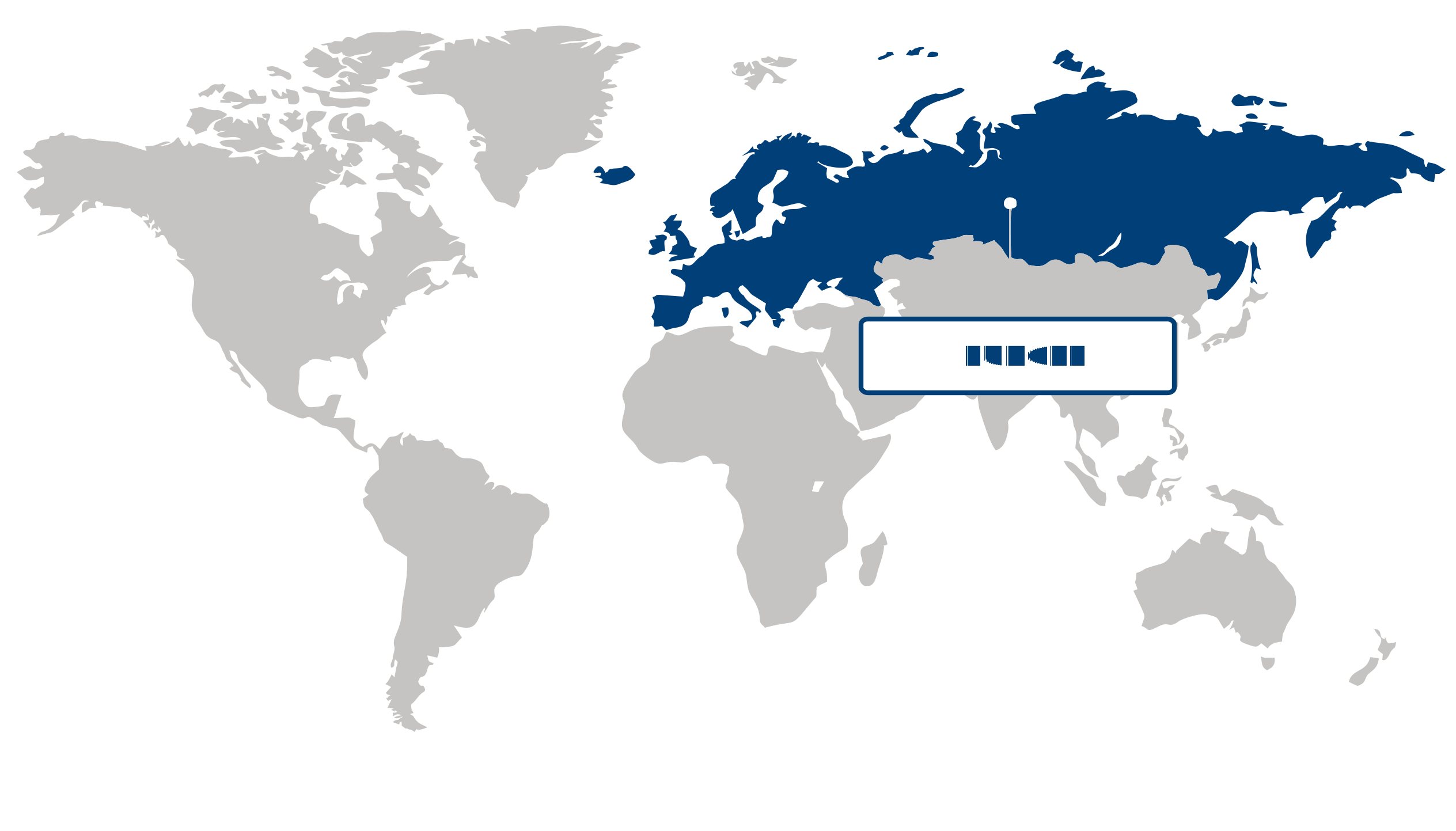
Europe captured 34.8% of the residue testing market in 2025 and stands as the largest regional market by share; this leadership is rooted in stringent food-safety rules and systematic pesticide surveillance that raise demand for routine and specialized analyses. European Commission initiatives such as the Farm to Fork strategy and ongoing pesticide monitoring overseen by the European Food Safety Authority (EFSA) have expanded regulatory sampling and reporting requirements, while private laboratory networks like Eurofins and Bureau Veritas provide the testing capacity to meet that demand. High consumer expectations for traceability, growing investments in laboratory automation, and coordinated cross-border enforcement create a resilient commercial environment. These dynamics position Europe to capture additional value from upgraded laboratory services, digital traceability platforms, and expanded compliance testing mandates.
Germany anchors the region’s laboratory and quality-assurance ecosystem and the residue testing market through a dense network of accredited labs and technically sophisticated public agencies. Federal bodies such as the Bundesinstitut für Risikobewertung (BfR) and the Federal Ministry of Food and Agriculture (BMEL) regularly publish guidance and support surveillance programs that increase sample throughput and demand for method development. Large service providers including Eurofins and regional players operate advanced mass‑spectrometry facilities in Germany, enabling rapid turnaround for pesticide panels and emerging contaminants. For investors and service providers, Germany’s scale of analytical capacity and procurement by industrial food processors make it an efficient hub to support wider European testing needs.
France functions as a regulatory focal point and the residue testing market is shaped by pronounced public scrutiny and robust national monitoring programs. The French Agency for Food, Environmental and Occupational Health & Safety (ANSES) and the French Ministry of Agriculture have driven high-profile reviews of pesticide approvals and produced national monitoring results that prompt increased laboratory sampling and alternative-residue investigations. Strong consumer demand for organic and locally verified produce amplifies private-sector testing services, while networks of accredited laboratories supply both compliance and retailer-driven verification testing. Strategically, France’s combination of regulatory vigilance and consumer-driven verification creates persistent demand for advanced residue analytics that complements broader European compliance and market-access strategies.
Asia Pacific Market Analysis:
Asia Pacific emerged as the fastest-growing region in the residue testing market, registering a CAGR of 9.84%, driven by modernization of regulatory frameworks and increasing food exports. Regulators across the region—including the Ministry of Health, Labour and Welfare (MHLW) and the Ministry of Agriculture, Forestry and Fisheries (MAFF) in Japan and the General Administration of Customs of the People's Republic of China (GACC)—are updating maximum residue limits and inspection protocols, elevating demand for accredited laboratories and high-throughput instrumentation. International bodies such as the Food and Agriculture Organization (FAO) have documented rising intra‑regional food trade, and national agencies are linking export competitiveness to tighter safety verification. These dynamics are accelerating adoption of advanced mass spectrometry, automation, and digital sample‑tracking, creating scalable service and instrument opportunities across supply chains and testing networks in the region.
Japan acts as a regulatory and technology-adoption leader in the residue testing market, where stringent domestic standards and premium food exports create outsized demand for high‑precision testing. The Ministry of Health, Labour and Welfare (MHLW) and the Ministry of Agriculture, Forestry and Fisheries (MAFF) have recently refined residue limits and guidance, prompting food processors and exporters to invest in accredited testing; Japan External Trade Organization (JETRO) notes growth in specialty food exports that require rigorous certification. Domestic instrument makers such as Shimadzu Corporation and established analytical labs are introducing targeted solutions for throughput and compliance, reinforcing Japan’s role as a model market for validation, traceability, and premium-service positioning—an approach regional players can emulate to meet cross‑border export requirements.
China functions as both a demand and enforcement center in the residue testing market, where scale of agricultural production and export control reforms are driving lab capacity expansion. The China National Center for Food Safety Risk Assessment (CFSA) and the General Administration of Customs (GACC) have issued tighter inspection regimes and guidance that increase routine and pre‑export screening; General Administration of Customs trade data underscores expanding agri‑food shipments requiring certification. Global testing firms such as SGS and regional service providers report capacity investments to handle volume and regulatory complexity. For investors and strategists, China’s combination of high sample volumes, evolving standards, and growing cross‑border shipments signals opportunity for scalable laboratory networks, automated workflows, and partnership models that can be exported across Asia Pacific.
North America Market Trends:
North America held a substantial share of the residue testing market, reflecting a large, heterogeneous food system with concentrated processing hubs, heavy trade flows and coordinated public monitoring that increase testing throughput and complexity. Ongoing programmatic activity by the U.S. Food and Drug Administration and the United States Department of Agriculture Pesticide Data Program, alongside routine surveillance by the Canadian Food Inspection Agency, has institutionalized demand for accredited laboratories; at the same time private lab networks such as Eurofins Scientific and SGS have publicly increased North American capacity to serve both regulatory and retail supply-chain needs. Combined consumer insistence on transparency, tighter enforcement tolerance and investments in laboratory capacity position the region as a high-opportunity market for integrated testing platforms and service consolidation.
The United States remained the primary market for the residue testing market, driven by a dense commercial testing ecosystem, advanced analytical capability adoption and sizable private-sector spend on trace-level screening. Platform vendors and contract labs—examples include Thermo Fisher Scientific and Waters Corporation supplying high-throughput LC‑MS solutions and Eurofins Scientific expanding service footprints—illustrate how instrumentation upgrades and digital laboratory workflows are accelerating turnaround and breadth of analyte panels. State-level niche demands, notably in emerging sectors such as cannabis and specialty imports monitored by customs laboratories, create commercialization pathways that can be scaled regionally, making U.S. innovations a strategic template for North American expansion.
| Parameter | North America | Asia Pacific | Europe | Latin America | MEA |
|---|---|---|---|---|---|
| Innovation Hub i Scale Nascent Developing Advanced | |||||
| Cost-Sensitive Region i Scale Low Medium High | |||||
| Regulatory Environment i Scale Restrictive Neutral Supportive | |||||
| Demand Drivers i Scale Weak Moderate Strong | |||||
| Development Stage i Scale Emerging Developing Developed | |||||
| Adoption Rate i Scale Low Medium High | |||||
| New Entrants / Startups i Scale Sparse Moderate Dense | |||||
| Macro Indicators i Scale Weak Stable Strong |
Segment Leadership and Growth Trends
Residue Testing Market Share (%), by Technology, 2026
Go beyond the chart, access full insights & data tables
Request Free Sample ReportChromatography dominated the residue testing market as the largest share in 2025, driven by the high accuracy and sensitivity requirements in food safety testing that favor LC‑MS/MS and GC‑MS platforms. The segment leads because regulators and reference laboratories require trace-level quantitation and multi-residue capabilities, a trend reflected in Thermo Fisher Scientific and Agilent Technologies press releases emphasizing chromatography-based solutions. Customer demand for reproducible, validated workflows, laboratory automation and digital data management, plus secure supply chains for columns and solvents, reinforce chromatography’s role among segments. This creates strategic openings for instrument OEMs to expand service contracts and for niche providers to supply consumables, software and method packages. Given continuing regulatory emphasis from the US Food and Drug Administration (US FDA) and the European Food Safety Authority (EFSA) and advances in hyphenated techniques, chromatography should remain central in the near to medium term.
Analysis by Type
Pesticides residues represented largest share in the residue testing market in 2025, reflecting stringent global regulations on pesticide residue limits and intensified monitoring programs. The segment leads because enforcement and surveillance by the United States Department of Agriculture Pesticide Data Program (USDA PDP), the European Food Safety Authority (EFSA) and Codex Alimentarius require broad-spectrum, validated testing across supply chains. Rising consumer concern about chemical residues and retailer requirements from companies such as Walmart and Tesco have increased testing frequency and third-party verification, shaping demand across segments. This favors large lab networks like Eurofins and SGS to scale capacity and provides room for startups to commercialize rapid field assays and analytics. As regulatory milestones and sustainable agriculture initiatives persist, pesticide residue testing will remain a core compliance and market-access requirement.
Analysis by Food Tested
Fruits & Vegetables held largest share in the residue testing market in 2025, propelled by heightened consumer awareness regarding food contamination and targeted surveillance of fresh produce. The segment leads because monitoring programs such as the USDA Pesticide Data Program, initiatives by the Food and Agriculture Organization (FAO) and analyses by EFSA prioritize produce, while retailers and buyers demand traceability and certificate-backed assurance. Shifts toward fresh consumption, perishability-driven testing points in the cold chain, and preference for organic or verified produce influence testing patterns among segments and encourage rapid screening adoption. This creates opportunities for contract labs, on‑farm testing services and digital traceability providers. Continued public attention, regulatory focus on produce safety and trade-related controls indicate the segment will retain relevance near term.
| Segment | Sub-Segment | Largest Segment | Fastest Growing |
|---|---|---|---|
| Technology | Chromatography, Spectroscopy, Immunoassay, Others | ||
| Type | Pesticides Residues, Toxins, Heavy Metals, Food Allergens, Others | ||
| Food Tested | Meat & Poultry, Dairy Products, Processed Food, Fruits & Vegetables, Cereals, Grains & Pulses, Nuts, Seed & Spice, Others |
Competitive Landscape and Market Positioning
The competitive landscape is characterized by active enhancement of technical depth and end‑to‑end offerings among the top firms. Several have broadened portfolios to couple high‑sensitivity instrumentation with sample preparation and informatics, while others have scaled laboratory footprints to provide faster turnaround and audited quality systems. Parallel initiatives include rolling out targeted assays and refining automation to raise throughput, and strengthening channels that link instrument performance with laboratory services. Those moves raise the bar for newcomers, incentivize interoperability of methods, and shift buyer decisions toward providers that can demonstrate both analytical rigor and operational reliability.
Strategic / Actionable Recommendations for Regional Players
North America: Leverage proximity to major instrument vendors and a dense base of pharmaceutical and food manufacturers by forming selective provider relationships that bundle advanced instrumentation with method development and informatics. Emphasize modular automation for high‑volume workflows and develop competencies around regulatory compliance to win larger contracts and shorten validation cycles.
Asia Pacific: Build regional testing hubs that combine cost‑efficient throughput with localized assay panels tailored to export markets. Pursue cooperative arrangements with global laboratories and academic centers to accelerate technology transfer and validate regionally relevant methods, while prioritizing scalable sample‑preparation solutions to serve diverse supply chains.
Europe: Differentiate through certified traceability, sustainability of workflows, and high‑precision analytical services that meet stringent trade and regulatory requirements. Integrate niche molecular assays and advanced sample handling to offer consultancy‑led value propositions for exporters and specialty food producers, leveraging partnerships with established service networks to broaden geographic reach.
| Company | Market Share | Company Revenue | Revenue CAGR (%) | Product Portfolio | Geographic Presence | Innovation / R&D Focus | Strategic Developments |
|---|---|---|---|---|---|---|---|
| No companies available. | |||||||
Industry Development/News
| Company Name | Date | Key Development |
|---|
Customize Your Report
Explore examples of how this report can be tailored to different research needs, including custom segments, additional topics or chapters, and related reports. Click a section of the wheel or its numbered marker to explore the available options.
Residue Testing Market — Custom Segments
| Segment | Sub-Segment |
|---|---|
| No segment data available. | |
Residue Testing Market — Custom TOC
| Custom Chapter | Custom Details | ||
|---|---|---|---|
| No custom TOC data available. | |||
Need a different cut of the data?
Request Custom ResearchWhat is the market valuation of residue testing?
What are the growth projections for the residue testing industry?
What is the leading region in terms of residue testing market share?
Which region shows the most rapid acceleration in the residue testing sector?
What factors give chromatography segment a competitive edge in the residue testing sector?
Which is the largest sub-segment within the type segment for residue testing industry?
Why does fruits & vegetables sub-segment dominate the food tested segment of residue testing sector?
Which companies dominate the residue testing landscape?
Our Clients
"The report provided a thorough look at market trends, technological advancements, and the competitive landscape. The depth of insights was really valuable."
ITC Limited
"We would highly recommend Fundamental Business Insights & Consulting to anyone looking for reliable, detailed, and comprehensive market research in the Food industry."
Tyson Foods
"The clarity and presentation of the information were commendable. The report was delivered timely, which made the overall experience smooth and convenient."
Mondelēz International
Our Research Team & Methodology
Every Fundamental Business Insights report is built by a dedicated vertical research team, validated through a structured primary-and-secondary methodology, and reviewed for accuracy before it reaches you.
Research Team Overview
Prepared by the Food & Beverage Research Team
Delivery
Published
Demand
Available
Support
Trust & Compliance
Research Domains
10 coverage areasResearch Intelligence
| Source | Reference |
|---|---|
| Food and Agriculture Organization (FAO) | www.fao.org |
| World Health Organization (WHO) | www.who.int |
| U.S. Food & Drug Administration (FDA) | www.fda.gov |
| European Food Safety Authority (EFSA) | www.efsa.europa.eu |
| U.S. Department of Agriculture (USDA) | www.usda.gov |
| Codex Alimentarius Commission | www.fao.org/fao-who-codexalimentarius |
| International Organization for Standardization (ISO) | www.iso.org |
| AOAC INTERNATIONAL | www.aoac.org |
| Institute of Food Technologists (IFT) | www.ift.org |
| International Dairy Foods Association (IDFA) | www.idfa.org |
| International Sweeteners Association (ISA) | www.sweeteners.org |
| International Probiotics Association (IPA) | internationalprobiotics.org |
| Good Food Institute (GFI) | gfi.org |
| American Feed Industry Association (AFIA) | www.afia.org |
| International Feed Industry Federation (IFIF) | ifif.org |
| Specialty Food Association (SFA) | www.specialtyfood.com |
| Brewers Association | www.brewersassociation.org |
| International Bottled Water Association (IBWA) | bottledwater.org |
| International Alliance for Dietary/Food Supplement Associations (IADSA) | www.iadsa.org |
| OECD Agriculture & Food | www.oecd.org/agriculture |
Research Workflow & Quality Assurance
Data Collection
Verified information gathered through primary and secondary research.
Data Triangulation
Cross-validation using multiple independent data sources.
Forecast Modelling
Market estimates developed using historical trends and analytical models.
Analyst Validation
Findings reviewed by domain experts for accuracy and consistency.
Editorial & Quality Review
Final editorial, quality, and compliance checks before publication.
Final Publication
Released after successful completion of the internal review process.
Report Coverage
📊 Market Assessment
- Market Size & Forecast
- Market Segmentation
- Regional Analysis
- Growth Drivers & Challenges
- Market Dynamics
🏢 Competitive Intelligence
- Competitive Landscape
- Company Profiles
- Competitive Benchmarking
- Mergers & Acquisitions
- Market Share Analysis or Key Company Strategies
🔍 Strategic Analysis
- Value Chain Analysis
- Porter's Five Forces
- PESTLE Analysis
- Pricing Trends
- Supply-Demand Analysis
🚀 Future Outlook
- Technology Landscape
- Regulatory Landscape
- Investment & Funding Landscape
- Emerging Opportunities
- Future Market Outlook
Have a question about this report or need a custom scope?
Request Customization