Oil Refining Market Size & Growth Forecast 2027–2036, By Segments (Product, Complexity Type, Fuel Type, Application), Regional Demand Trends (North America, Asia Pacific, Europe), Key Country Insights (U.S., Japan, South Korea, Germany, France, Italy), and Competitive Landscape
Market Size and Growth Outlook
Oil Refining Market size was more than USD 637.4 billion in 2026 and is set to grow at a 2.66% CAGR between 2027 and 2036, attaining USD 828.75 billion by 2036. The industry revenue for 2027 is assessed at USD 651.68 billion.
Get more details on this report
Request Free Sample ReportOil Refining Market Intelligence Snapshot
Regional Market Dynamics
- Europe held the largest regional share in 2026 due to its mature refining infrastructure, integrated fuel distribution networks, and large complex refineries serving diverse domestic and export markets efficiently.
- Asia Pacific is projected to grow at a 5.02% CAGR, supported by refinery capacity expansions, increasing fuel consumption, and stronger demand for transportation fuels and petrochemical feedstocks.
Segment Momentum
- Middle Distillates remain the largest and fastest-growing product segment because they align with steady transport, industrial, and commercial fuel demand, enabling refiners to optimize product yields, utilization, and dependable offtake.
- Deep Conversion is both the largest and fastest-growing complexity segment as it converts heavier fractions into higher-demand refined products, improving refinery flexibility, efficiency, and product slate optimization.
Market Expansion Drivers
- Sustained transportation fuel demand supporting refinery capacity expansion in emerging economies.
- Integration of petrochemical production improving refinery margin diversification and product flexibility.
- Conversion of legacy assets into biorefineries accelerating sustainable aviation fuel production investments.
Leading Market Participants
- Prominent companies in the oil refining market include Valero Energy Corporation (United States), Marathon Petroleum Corporation (United States), Phillips 66 (United States), Saudi Arabian Oil Company (Saudi Arabia), Exxon Mobil Corporation (United States), Shell plc (United Kingdom), Chevron Corporation (United States), China Petroleum & Chemical Corporation (China), Reliance Industries Limited (India), TotalEnergies SE (France).
Global Market Forecast Snapshot
Market Outlook
- 2026 Market Size: USD 637.4 billion
- 2027 Estimated Market Size: USD 651.68 billion.
- Projected Market Size: USD 828.75 billion by 2036
- Growth Forecast: 2.66% CAGR (2027-2036)
Regional and Segment Outlook
- Leading Regional Market: Europe
- High-Growth Regional Hub: Asia Pacific
- Core Revenue Segment: Middle Distillates (Product) | Deep Conversion (Complexity Type) | Gasoline (Fuel Type) | Transportation (Application)
- Emerging Opportunity Segment: Middle Distillates (Product) | Deep Conversion (Complexity Type) | Liquefied Petroleum Gas (LPG) (Fuel Type) | Petrochemical (Application)
Market Growth Drivers and Industry Trends
Sustained transportation fuel demand supporting refinery capacity expansion in emerging economies
Persistent requirements for gasoline, diesel, jet fuel, and other transportation fuels are supporting refinery investment in developing and rapidly industrializing economies. The oil refining market is benefiting from continued mobility needs associated with expanding vehicle fleets, freight transportation, aviation activity, and industrial development, particularly in regions where domestic fuel consumption is increasing. Refinery capacity additions and upgrades can help countries strengthen local fuel supply and reduce dependence on imported refined products while allowing producers to respond to changing regional consumption patterns. Investments in refining infrastructure are therefore being supported by the need for dependable transportation fuel availability alongside broader economic and infrastructure development.
Integration of petrochemical production improving refinery margin diversification and product flexibility
Refineries are increasingly integrating petrochemical operations to capture greater value from crude oil feedstocks and diversify their product portfolios. The oil refining market is supported by this integration because refinery operators can direct feedstocks and intermediate products toward petrochemical manufacturing in addition to traditional transportation fuels, creating greater flexibility in responding to shifts in product demand. Petrochemical integration can also strengthen utilization of refinery streams and provide access to higher-value products used in plastics, chemicals, synthetic materials, and other industrial applications. This approach enables operators to balance exposure across fuel and chemical markets while making more efficient use of existing processing infrastructure.
Conversion of legacy assets into biorefineries accelerating sustainable aviation fuel production investments
The conversion of existing refining assets into biorefineries is creating new opportunities for producers seeking to participate in lower-carbon fuel markets. Within the oil refining market, repurposing selected legacy facilities can provide an established infrastructure base for processing renewable feedstocks and producing sustainable aviation fuel, while potentially reducing the need to develop entirely new facilities. Existing logistics networks, storage systems, processing capabilities, and workforce expertise can support the transition toward alternative fuel production, making asset conversion an attractive pathway for refining operators. Growing interest in sustainable aviation fuel is consequently encouraging refiners to evaluate modifications and repurposing strategies for facilities that can accommodate renewable feedstocks and related processing technologies.
| Growth Driver | Impact on CAGR | Regulatory Influence | Geographic Relevance | Adoption Rate | Impact Timeline |
|---|---|---|---|---|---|
| Increasing demand for refined petroleum products | 1.50% | Short term (≤ 2 yrs) | North America, Europe | Medium | Fast |
| Technological advancements in refining processes | 1.50% | Medium term (2–5 yrs) | North America, Asia Pacific | Low | Moderate |
| Expansion of refinery infrastructure in emerging regions | 1.40% | Long term (5+ yrs) | Asia Pacific, Latin America | Low | Slow |
| Sustained transportation fuel demand supporting refinery capacity expansion in emerging economies | 2.10% | Moderate | Asia Pacific, Middle East, Latin America | High | Near Term |
| Integration of petrochemical production improving refinery margin diversification and product flexibility | 1.80% | Moderate | Asia Pacific, North America | High | Mid Term |
| Conversion of legacy assets into biorefineries accelerating sustainable aviation fuel production investments | 1.50% | High | Europe, North America | Emerging | Long Term |
Unlock insights tailored to your business with our bespoke market research solutions.
Click to get your customized report now.
Regional Demand Dynamics
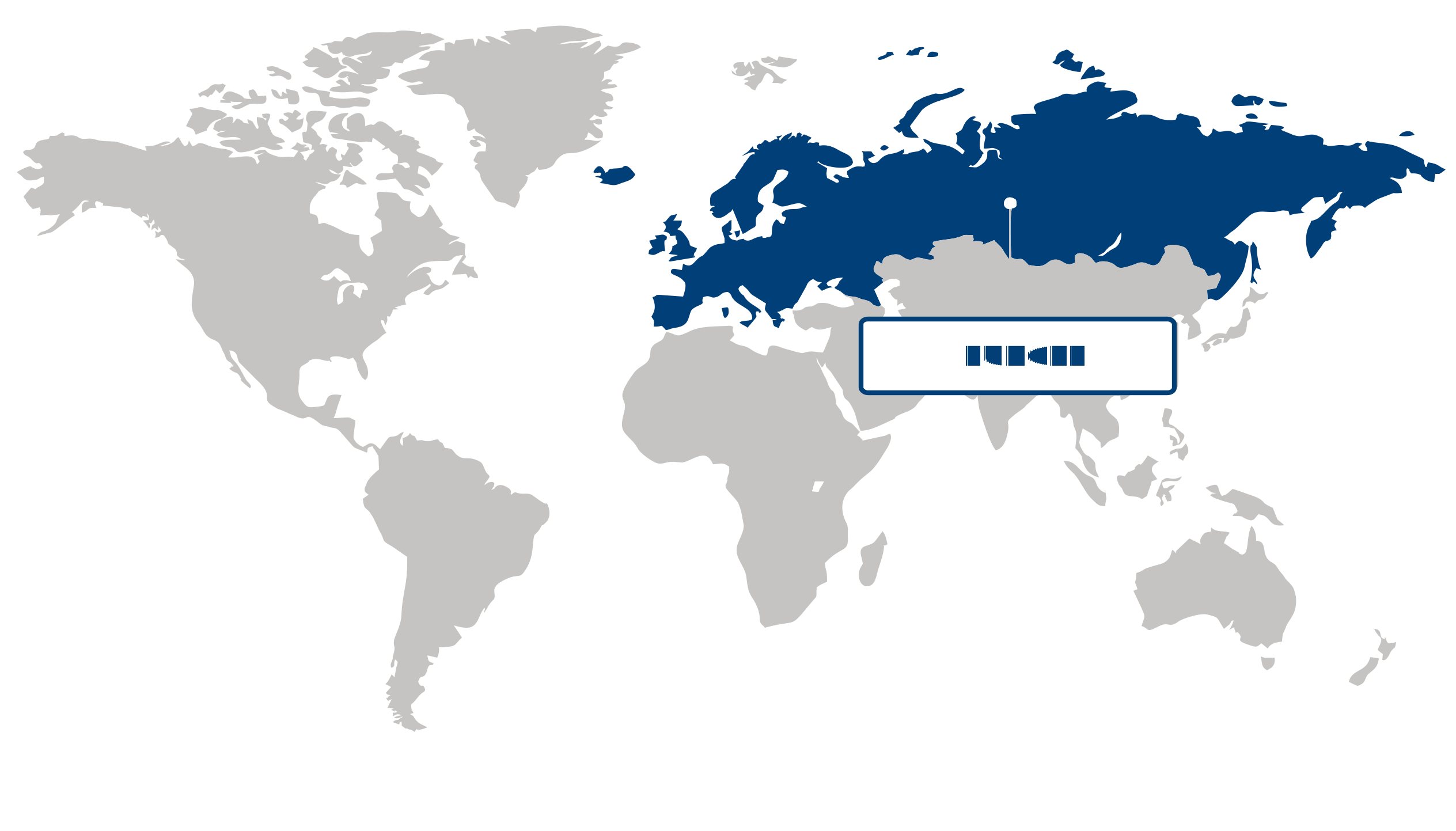
Europe (Largest Region)
Europe maintained the largest position in the oil refining market in 2026, supported by an established refining infrastructure, sophisticated downstream processing capabilities, and strong demand for refined petroleum products across transportation and industrial applications. The region's mature energy infrastructure enables refineries to process diverse crude feedstocks and produce a broad range of fuels and petrochemical intermediates. Refinery modernization and investments focused on operational efficiency, emissions management, and production flexibility are shaping the regional industry. In addition, established logistics networks and integrated industrial clusters support efficient movement and processing of refined products, helping sustain Europe's prominent market position amid evolving energy and environmental requirements.
Asia Pacific (Fastest-Growing Region)
Asia Pacific is the fastest-growing region, driven by expanding industrial activity, rising transportation demand, and continued development of refining and petrochemical infrastructure. Rapid urbanization and economic development are increasing energy consumption across multiple end-use sectors, while expanding manufacturing and mobility requirements support demand for refined fuels. Investments in refinery modernization and new processing capabilities are strengthening regional supply capacity and improving the ability to produce higher-value petroleum products. Growing integration between refining and petrochemical operations is also creating opportunities for greater feedstock utilization and product diversification. These structural trends, combined with expanding domestic energy needs, are supporting strong momentum for the regional oil refining market.
| Parameter | North America | Asia Pacific | Europe | Latin America | MEA |
|---|---|---|---|---|---|
| Innovation Hub i Scale Nascent Developing Advanced | |||||
| Cost-Sensitive Region i Scale Low Medium High | |||||
| Regulatory Environment i Scale Restrictive Neutral Supportive | |||||
| Demand Drivers i Scale Weak Moderate Strong | |||||
| Development Stage i Scale Emerging Developing Developed | |||||
| Adoption Rate i Scale Low Medium High | |||||
| New Entrants / Startups i Scale Sparse Moderate Dense | |||||
| Macro Indicators i Scale Weak Stable Strong |
Key Country Insights
Germany 🇩🇪
Low-Emission RefiningGermany prioritizes refinery modernization that supports lower-emission fuel production and improved energy efficiency. German operators increasingly integrate alternative feedstocks and advanced process technologies to strengthen refinery competitiveness under evolving environmental standards.
France 🇫🇷
Energy Transition AlignmentFrance is aligning refinery operations with cleaner fuel production and evolving industrial sustainability objectives. French refining companies continue upgrading facilities to improve operational efficiency while supporting broader energy transition initiatives.
Italy 🇮🇹
Integrated Refinery NetworkItaly leverages integrated refining and logistics infrastructure to support fuel distribution and industrial supply chains. Italian refiners continue investing in facility upgrades and operational resilience to maintain reliable production across multiple fuel segments.
Japan 🇯🇵
Operational Efficiency FocusJapan emphasizes refinery optimization, maintenance reliability, and efficient processing of diverse crude supplies. Japanese refiners continue improving operational performance while adapting facilities to changing fuel consumption patterns and petrochemical integration opportunities.
South Korea 🇰🇷
Export-Oriented ProcessingSouth Korea operates highly integrated refining facilities that support both domestic consumption and international product supply. South Korean refiners continue enhancing process flexibility and high-value product output to respond to changing regional demand patterns.
United States 🇺🇸
Refinery ModernizationThe U.S. oil refining market focuses on operational efficiency, cleaner fuel production, and refinery upgrades. U.S. refiners continue investing in process optimization and digital technologies to improve operational flexibility while meeting evolving fuel quality requirements.
Segment Leadership and Growth Trends
Oil Refining Market Share (%), by Product, 2026
Go beyond the chart, access full insights & data tables
Request Free Sample ReportProduct Segment Analysis: Middle Distillates (Largest & Fastest-Growing Segment)
The middle distillates segment led the oil refining market as both the largest and fastest-growing product category, supported by sustained demand for transportation fuels and industrial energy applications. Diesel, jet fuel, and other middle distillate products remain essential across road transportation, aviation, logistics, and commercial activity, creating a broad and resilient demand base. Refiners continue to prioritize middle distillate production because of their importance to economic activity and the need to maintain reliable fuel availability. The segment's leading position in 2026 also reflects the flexibility of refining operations to adjust product yields in response to changing consumption patterns, while ongoing transportation and industrial activity supports continued demand for these refined products.
Complexity Type Segment Analysis: Deep Conversion (Largest & Fastest-Growing Segment)
Deep conversion held the largest position in the oil refining market in 2026 while also representing the fastest-growing complexity category, reflecting the increasing importance of advanced refining capabilities. Deep-conversion facilities enable refiners to process heavier and lower-value crude streams into higher-value transportation fuels and other refined products, improving refinery flexibility and overall product economics. Growing emphasis on maximizing valuable fuel yields, optimizing crude utilization, and adapting to changing product demand is encouraging investment in sophisticated conversion technologies. This trend strengthens the role of deep-conversion configurations as refiners seek greater operational flexibility and improved competitiveness amid evolving feedstock and fuel-market conditions.
| Segment | Sub-Segment | Largest Segment | Fastest Growing |
|---|---|---|---|
| Product | Fuel Oil, Light Distillates, Middle Distillates, Others | Middle Distillates | Middle Distillates |
| Complexity Type | Hydro-Skimming, Topping, Conversion, Deep Conversion | Deep Conversion | Deep Conversion |
| Fuel Type | Gasoline, Kerosene, Liquefied Petroleum Gas (LPG), Gasoil, Others | Gasoline | Liquefied Petroleum Gas (LPG) |
| Application | Marine Bunker, Transportation, Aviation, Petrochemical, Agriculture, Electricity, Residential & Commercial, Rail & Domestic Waterways, Others | Transportation | Petrochemical |
Competitive Landscape and Market Positioning
Prominent players in the oil refining market:
1. Valero Energy Corporation (United States)
2. Marathon Petroleum Corporation (United States)
3. Phillips 66 (United States)
4. Saudi Arabian Oil Company (Saudi Arabia)
5. Exxon Mobil Corporation (United States)
6. Shell plc (United Kingdom)
7. Chevron Corporation (United States)
8. China Petroleum & Chemical Corporation (China)
9. Reliance Industries Limited (India)
10. TotalEnergies SE (France)
The oil refining market is evolving through process optimization and advanced refining technologies that improve yield efficiency. Continuous innovation in catalytic and conversion systems is enhancing production output and environmental performance. Collaborative operational initiatives are strengthening refinery integration, while efficiency improvements are shaping competitiveness across the oil refining market.
| Company | Market Share | Company Revenue | Revenue CAGR (%) | Product Portfolio | Geographic Presence | Innovation / R&D Focus | Strategic Developments |
|---|---|---|---|---|---|---|---|
| Valero Energy Corporation (United States) | |||||||
| Marathon Petroleum Corporation (United States) | |||||||
| Phillips 66 (United States) | |||||||
| Saudi Arabian Oil Company (Saudi Arabia) | |||||||
| Exxon Mobil Corporation (United States) | |||||||
| Shell plc (United Kingdom) | |||||||
| Chevron Corporation (United States) | |||||||
| China Petroleum & Chemical Corporation (China) | |||||||
| Reliance Industries Limited (India) | |||||||
| TotalEnergies SE (France). |
Industry Development/News
| Company Name | Date | Key Development |
|---|---|---|
| Venezuela | May-26 | Venezuela has released draft energy regulations and new contract frameworks to incentivize foreign investment. The initiative aims to stabilize and modernize the country’s refining and upstream infrastructure by updating fiscal, operational, and technical terms to attract international partners and expand domestic processing capacity. |
| Libya | May-26 | The Zawiya refinery has resumed full production capacity following a temporary shutdown induced by regional instability. The restart demonstrates the ongoing operational sensitivity of refining assets in conflict-prone areas and underscores the critical impact of local security conditions on maintaining consistent downstream fuel production and supply continuity. |
| Russia | May-26 | Persistent drone strikes on Russian refining infrastructure have significantly impacted national processing capabilities, affecting approximately one-third of total refining output. These disruptions have caused notable declines in refinery utilization rates and created severe operational constraints across the domestic fuel supply chain, impacting regional supply availability. |
| Galp and Moeve | May-26 | Galp and Moeve have announced a merger to consolidate their respective refining and energy operations. This strategic combination is designed to improve operational efficiencies and achieve economies of scale, significantly strengthening the combined entity’s competitive positioning within the global downstream market. |
| Petrobras | Mar-26 | Petrobras has accelerated a US$15 billion downstream investment program centered on the modernization and expansion of its Brazilian refinery portfolio. This capital-intensive strategy includes specific facility upgrades in Minas Gerais designed to enhance operational efficiency, increase processing capacity, and bolster domestic refined fuel production output. |
| Kazakhstan | Feb-26 | Kazakhstan has formalised an aggressive national strategy to expand domestic oil refining, gas processing, and petrochemical output. The plan targets a processing capacity of 40 million tons per year by 2033, utilizing a combination of facility modernization and new infrastructure construction to achieve greater fuel self-sufficiency. |
| Iraq | Jan-25 | Iraq successfully increased its national oil refining capacity to 1.54 million barrels per day through a series of infrastructure development projects. This capacity expansion is a core component of the country’s efforts to improve energy security, reduce reliance on fuel imports, and effectively meet rising internal demand for refined products. |
| Sunoco LP | Jan-25 | Sunoco LP and SunocoCorp LLC finalized the acquisition of Parkland Corporation, a move intended to expand the company’s downstream and fuel distribution footprint. This acquisition strengthens Sunoco's market presence and integrates additional operational assets, supporting a broader strategy of portfolio diversification and market scale within the downstream sector. |
Customize Your Report
Explore examples of how this report can be tailored to different research needs, including custom segments, additional topics or chapters, and related reports. Click a section of the wheel or its numbered marker to explore the available options.
Oil Refining Market — Custom Segments
| Segment | Sub-Segment |
|---|---|
| Ownership Model | National Oil Companies, Private Refiners, Joint Ventures |
| Crude Oil Type | Light Crude, Medium Crude, Heavy Crude |
| Refinery Capacity | Small-Scale Refineries, Medium-Scale Refineries, Large-Scale Refineries, Mega Refineries |
Oil Refining Market — Custom TOC
| Custom Chapter | Custom Details |
|---|---|
| Refinery Transition Strategy Assessment |
|
| Refining Asset Optimization Opportunities |
|
| Carbon Reduction Pathway Assessment |
|
Need a different cut of the data?
Request Custom ResearchWhat is the current size of the oil refining market?
How much is the oil refining industry expected to grow by 2036?
How is transportation fuel demand shaping refinery investment and capacity expansion strategies?
Why is integration between refining and petrochemical production becoming strategically important in the oil refining market?
Why are Middle Distillates the leading product segment in the oil refining market?
Which refinery complexity type is expanding the fastest in the oil refining market?
Why is Europe the leading region in the oil refining market?
What is driving oil refining market growth in Asia Pacific?
Who are the leading players in the oil refining landscape?
Our Clients
"The information presented in the report was genuinely insightful. The data was clear and easy to understand, which made it much easier to interpret the findings."
Amara Raja Group
"The responsiveness and professionalism exhibited by the team were exemplary. They were readily available to address queries, provide clarifications, and offer additional insights."
ONGC
"The reports offered a comprehensive analysis of various segments within the market. The detailed insights into market trends, and regulatory landscapes were excellent."
TotalEnergies
Our Research Team & Methodology
Every Fundamental Business Insights report is built by a dedicated vertical research team, validated through a structured primary-and-secondary methodology, and reviewed for accuracy before it reaches you.
Research Team Overview
Prepared by the Energy & Power Research Team
Delivery
Published
Demand
Available
Support
Trust & Compliance
Research Domains
10 coverage areasResearch Intelligence
| Source | Reference |
|---|---|
| International Energy Agency (IEA) | www.iea.org |
| U.S. Energy Information Administration (EIA) | www.eia.gov |
| International Renewable Energy Agency (IRENA) | www.irena.org |
| International Electrotechnical Commission (IEC) | www.iec.ch |
| International Organization for Standardization (ISO) | www.iso.org |
| IEEE | www.ieee.org |
| CIGRE (International Council on Large Electric Systems) | www.cigre.org |
| World Energy Council (WEC) | www.worldenergy.org |
| U.S. Department of Energy (DOE) | www.energy.gov |
| International Atomic Energy Agency (IAEA) | www.iaea.org |
| American Petroleum Institute (API) | www.api.org |
| Society of Petroleum Engineers (SPE) | www.spe.org |
| Hydrogen Council | hydrogencouncil.com |
| Battery Council International (BCI) | batterycouncil.org |
| Global Wind Energy Council (GWEC) | gwec.net |
| SolarPower Europe | www.solarpowereurope.org |
| World Bioenergy Association (WBA) | worldbioenergy.org |
| International Hydropower Association (IHA) | www.hydropower.org |
| Edison Electric Institute (EEI) | www.eei.org |
| National Renewable Energy Laboratory (NREL) | www.nrel.gov |
Research Workflow & Quality Assurance
Data Collection
Verified information gathered through primary and secondary research.
Data Triangulation
Cross-validation using multiple independent data sources.
Forecast Modelling
Market estimates developed using historical trends and analytical models.
Analyst Validation
Findings reviewed by domain experts for accuracy and consistency.
Editorial & Quality Review
Final editorial, quality, and compliance checks before publication.
Final Publication
Released after successful completion of the internal review process.
Report Coverage
📊 Market Assessment
- Market Size & Forecast
- Market Segmentation
- Regional Analysis
- Growth Drivers & Challenges
- Market Dynamics
🏢 Competitive Intelligence
- Competitive Landscape
- Company Profiles
- Competitive Benchmarking
- Mergers & Acquisitions
- Market Share Analysis or Key Company Strategies
🔍 Strategic Analysis
- Value Chain Analysis
- Porter's Five Forces
- PESTLE Analysis
- Pricing Trends
- Supply-Demand Analysis
🚀 Future Outlook
- Technology Landscape
- Regulatory Landscape
- Investment & Funding Landscape
- Emerging Opportunities
- Future Market Outlook
Have a question about this report or need a custom scope?
Request Customization