Plastic Waste Pyrolysis Oil Market Size & Growth Forecast 2027–2036, By Segments (Process, End Use, Feedstock), Regional Demand Trends (North America, Asia Pacific, Europe), Key Country Insights (U.S., Japan, South Korea, Germany, France, Italy), and Competitive Landscape
Market Size and Growth Outlook
Plastic Waste Pyrolysis Oil Market size was over USD 737.94 Million in 2026 and is likely to grow at 5.83% CAGR between 2027 and 2036, exceeding USD 1.3 Billion by 2036. The industry revenue for 2027 is estimated at USD 774.47 Million.
Get more details on this report
Request Free Sample ReportPlastic Waste Pyrolysis Oil Market Intelligence Snapshot
Regional Market Dynamics
- Asia Pacific held 38.02% in 2026, supported by substantial plastic waste generation, industrial activity, urbanization, and investment in waste-to-resource technologies.
- Europe is projected to grow fastest as stringent waste policies, circularity initiatives, and efforts to reduce virgin fossil-based feedstocks encourage advanced recycling investments.
Segment Momentum
- Slow pyrolysis held a 58.3% share in 2026 due to higher liquid oil yield, stable operations, and suitability for commercial-scale plastic recycling facilities.
- The chemicals segment is growing fastest as pyrolysis oil gains importance as a sustainable feedstock for petrochemical intermediates and value-added chemical production.
Market Expansion Drivers
- Favourable government initiatives supporting chemical recycling and circular economy deployment
- Rising municipal solid waste generation driving alternative fuel recovery systems adoption
- Rapid industrialization increasing demand for waste-to-fuel conversion infrastructure investments
Leading Market Participants
- Major companies in the plastic waste pyrolysis oil market include Agilyx Corporation (USA), Quantafuel ASA (Norway), Enerkem Inc. (Canada), Nexus Circular (USA), OMV Aktiengesellschaft (Austria), Klean Industries Inc. (Canada), Fortum Oyj (Finland), Ensyn Corporation (Canada), Niutech Environment Technology Corporation (China), RESYNERGI Inc. (USA)
Global Market Forecast Snapshot
Market Outlook
- 2026 Market Size: USD 737.94 Million
- 2027 Estimated Market Size: USD 774.47 Million
- Projected Market Size: USD 1.3 Billion by 2036
- Growth Forecast: 5.83% CAGR (2027-2036)
Regional and Segment Outlook
- Leading Regional Market: Asia Pacific
- High-Growth Regional Hub: Europe
- Core Revenue Segment: Slow (Process) | Fuel (End Use) | Low Density Polyethylene (LDPE) (Feedstock)
- Emerging Opportunity Segment: Fast (Process) | Chemicals (End Use) | Polypropylene (PP) (Feedstock)
Market Growth Drivers and Industry Trends
Favourable government initiatives supporting chemical recycling and circular economy deployment
Supportive regulatory frameworks promoting resource efficiency and sustainable waste management will drive the plastic waste pyrolysis oil market growth by encouraging broader adoption of chemical recycling technologies. Governments in many regions are implementing policies that reduce dependence on landfilling while promoting the recovery of valuable materials from post-consumer plastic waste. These initiatives often create a favorable environment for investments in advanced recycling infrastructure, permitting processes, and research focused on circular economy solutions. Regulatory emphasis on reducing plastic pollution has also encouraged industries to incorporate recycled feedstocks into production processes, strengthening the commercial relevance of pyrolysis-derived oil within evolving waste management strategies.
Rising municipal solid waste generation driving alternative fuel recovery systems adoption
Increasing volumes of municipal solid waste are prompting authorities and waste management organizations to explore more efficient resource recovery approaches, and the plastic waste pyrolysis oil market benefits from this shift toward alternative fuel generation. Conventional disposal methods face growing operational and environmental challenges, creating opportunities for technologies that convert non-recyclable plastic waste into useful energy resources. Pyrolysis offers an approach that complements existing waste management systems by extracting value from materials that are difficult to process through mechanical recycling. The need to reduce landfill dependence while improving waste utilization is encouraging municipalities and private operators to evaluate waste-to-fuel solutions as part of integrated waste handling programs.
Rapid industrialization increasing demand for waste-to-fuel conversion infrastructure investments
Expanding industrial activity is generating higher volumes of plastic waste while simultaneously increasing demand for alternative energy resources, creating conditions that will boost the plastic waste pyrolysis oil market demand across industrial economies. Manufacturing facilities, logistics networks, and urban infrastructure development contribute to rising waste generation, encouraging investments in facilities capable of converting discarded plastics into usable fuel products. Industrial stakeholders are also recognizing the value of integrating waste conversion technologies into broader sustainability initiatives that improve resource utilization and reduce environmental impacts. These developments are supporting greater deployment of processing equipment, storage systems, and associated infrastructure required for commercial-scale pyrolysis operations.
| Growth Driver | Impact on CAGR | Regulatory Influence | Geographic Relevance | Adoption Rate | Impact Timeline |
|---|---|---|---|---|---|
| Favourable government initiatives supporting chemical recycling and circular economy deployment | 2.3% | High | Europe, Asia Pacific | Medium | Mid Term |
| Rising municipal solid waste generation driving alternative fuel recovery systems adoption | 2.1% | High | Asia Pacific, Latin America | Medium | Near Term |
| Rapid industrialization increasing demand for waste-to-fuel conversion infrastructure investments | 1.9% | Moderate | Asia Pacific, Middle East & Africa | Medium | Mid Term |
Unlock insights tailored to your business with our bespoke market research solutions.
Click to get your customized report now.
Regional Demand Dynamics
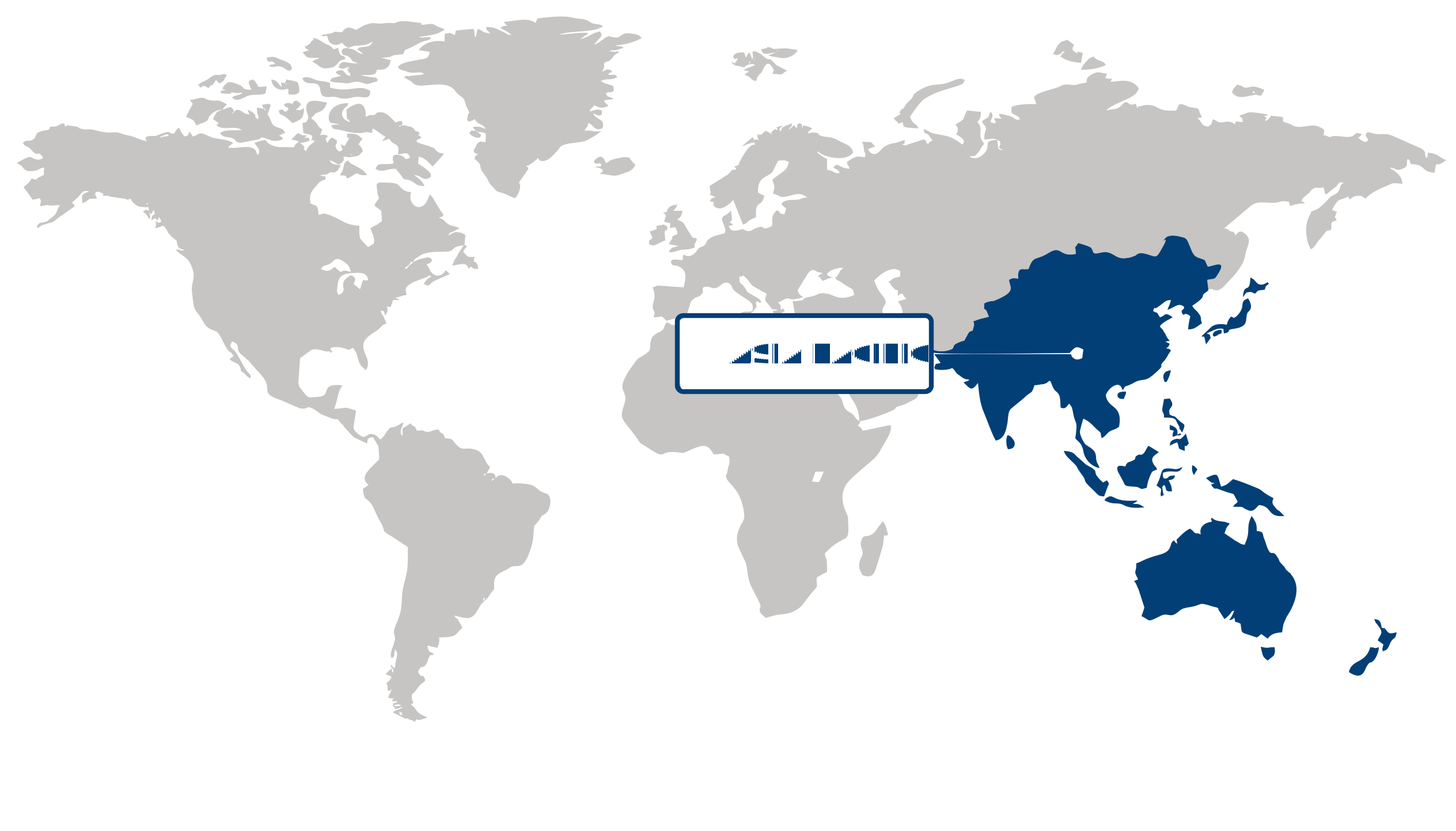
Asia Pacific (Largest Region)
Holding the largest share of the plastic waste pyrolysis oil market, Asia Pacific accounted for 38.02% in 2026, supported by substantial plastic waste generation, expanding industrial activity, and increasing attention to waste-to-resource technologies. Rapid urbanization and limitations in conventional waste management systems are encouraging greater interest in technologies capable of converting difficult-to-recycle plastic waste into usable energy products. Growing environmental concerns and efforts to strengthen circular-economy practices are also supporting investments in plastic waste processing and chemical recycling infrastructure, creating a broader demand base for pyrolysis oil.
Europe (Fastest-Growing Region)
Europe is projected to be the fastest-growing region in the plastic waste pyrolysis oil market, supported by stringent waste management policies, increasing emphasis on circularity, and growing efforts to reduce dependence on virgin fossil-based feedstocks. Regulatory pressure to improve plastic recovery and reduce landfill and incineration reliance is encouraging investment in advanced recycling technologies. The region's focus on resource efficiency and lower-carbon industrial processes is further strengthening interest in pyrolysis as a pathway for converting plastic waste into valuable secondary feedstocks and energy-related products.
| Parameter | North America | Asia Pacific | Europe | Latin America | MEA |
|---|---|---|---|---|---|
| Innovation Hub i Scale Nascent Developing Advanced | |||||
| Cost-Sensitive Region i Scale Low Medium High | |||||
| Regulatory Environment i Scale Restrictive Neutral Supportive | |||||
| Demand Drivers i Scale Weak Moderate Strong | |||||
| Development Stage i Scale Emerging Developing Developed | |||||
| Adoption Rate i Scale Low Medium High | |||||
| New Entrants / Startups i Scale Sparse Moderate Dense | |||||
| Macro Indicators i Scale Weak Stable Strong |
Key Country Insights
United States 🇺🇸
Circular Feedstock InnovationThe U.S. is expanding plastic waste pyrolysis capacity through collaborations between recyclers, petrochemical companies, and technology providers. Commercial efforts focus on improving feedstock consistency and integrating pyrolysis oil into existing refining and chemical production infrastructure.
Germany 🇩🇪
Advanced Recycling IntegrationGermany emphasizes plastic waste pyrolysis as part of its advanced recycling strategy, supported by strict waste management practices. Companies are prioritizing certified recycled feedstocks and process efficiency to align pyrolysis oil with circular manufacturing objectives.
Japan 🇯🇵
Resource Recovery FocusJapan is advancing plastic waste pyrolysis to maximize resource recovery from difficult-to-recycle plastics. Industrial stakeholders are investing in efficient conversion technologies and quality assurance measures to support broader chemical recycling initiatives across the country.
South Korea 🇰🇷
Petrochemical Circular SolutionsSouth Korea is integrating plastic waste pyrolysis oil into petrochemical value chains as manufacturers pursue circular raw material options. Investments are directed toward scalable processing technologies and partnerships that strengthen recycled feedstock availability for domestic production.
France 🇫🇷
Sustainable Conversion ProjectsFrance is encouraging plastic waste pyrolysis projects that complement national recycling objectives and industrial decarbonization efforts. Market participants are concentrating on traceable feedstock sourcing and reliable oil quality to support downstream chemical applications.
Italy 🇮🇹
Industrial Recycling ExpansionItaly is strengthening plastic waste pyrolysis through investments that connect waste collection with industrial recycling facilities. Businesses are improving processing capabilities to convert mixed plastic streams into valuable feedstocks for chemical and manufacturing sectors.
Segment Leadership and Growth Trends
Plastic Waste Pyrolysis Oil Market Share (%), by Process, 2026
Go beyond the chart, access full insights & data tables
Request Free Sample ReportProcess Segment Analysis: Slow (Largest Segment) vs Fast (Fastest-Growing Segment)
The slow process segment dominated the plastic waste pyrolysis oil market with a 58.3% share in 2026. Its leadership is supported by its ability to maximize liquid oil yield while maintaining stable operating conditions, making it well suited for commercial-scale pyrolysis facilities. The process is widely adopted because it efficiently converts mixed plastic waste into usable oil with relatively lower operational complexity, encouraging its use in waste-to-resource initiatives and industrial recycling operations.
The fast process segment is expected to witness the fastest growth as producers increasingly seek higher processing efficiency and shorter reaction times to improve plant productivity. Ongoing technological advancements in reactor design and process optimization are enhancing conversion performance, while rising investments in advanced recycling technologies are accelerating the adoption of fast pyrolysis for large-scale plastic waste management.
End Use Segment Analysis: Fuel (Largest Segment) vs Chemicals (Fastest-Growing Segment)
Holding the largest share of the plastic waste pyrolysis oil market, the fuel segment accounted for 58.72% in 2026. Pyrolysis oil is increasingly utilized as an alternative fuel in industrial applications due to its potential to recover value from plastic waste while reducing dependence on conventional fossil-based fuels. Growing emphasis on circular economy practices and waste reduction strategies has further strengthened demand for fuel applications.
The chemicals segment is projected to register the fastest growth, driven by increasing interest in using pyrolysis oil as a feedstock for producing petrochemical intermediates and other value-added chemical products. Rising investments in chemical recycling infrastructure and greater industry focus on sustainable raw materials are encouraging manufacturers to integrate recycled feedstocks into chemical production processes.
Feedstock Segment Analysis: Low Density Polyethylene (LDPE) (Largest Segment) vs Polypropylene (PP) (Fastest-Growing Segment)
In the plastic waste pyrolysis oil market, the low density polyethylene (LDPE) feedstock segment held a 37.91% share in 2026. The dominance of LDPE is attributed to its widespread use in packaging films, bags, and flexible plastic products, which generates substantial recyclable waste streams suitable for pyrolysis. Its favorable conversion characteristics and broad availability make it a preferred feedstock for commercial recycling operations.
The polypropylene (PP) feedstock segment is expected to expand at the fastest pace due to the increasing availability of polypropylene waste from packaging, automotive, and consumer goods applications. Growing efforts to recover higher-value plastics and advancements in sorting and recycling technologies are improving the feasibility of processing polypropylene through pyrolysis, supporting rapid segment growth.
| Segment | Sub-Segment | Largest Segment | Fastest Growing |
|---|---|---|---|
| Process | Fast, Flash, Slow | Slow | Fast |
| End Use | Fuel, Chemicals, Heat & Power, Others | Fuel | Chemicals |
| Feedstock | Low Density Polyethylene (LDPE), High Density Polyethylene (HDPE), Polypropylene (PP), Others | Low Density Polyethylene (LDPE) | Polypropylene (PP) |
Competitive Landscape and Market Positioning
Key companies in the plastic waste pyrolysis oil market:
- Agilyx Corporation (USA)
- Quantafuel ASA (Norway)
- Enerkem, Inc. (Canada)
- Nexus Circular (USA)
- OMV Aktiengesellschaft (Austria)
- Klean Industries, Inc. (Canada)
- Fortum Oyj (Finland)
- Ensyn Corporation (Canada)
- Niutech Environment Technology Corporation (China)
- RESYNERGI, Inc. (USA)
The plastic waste pyrolysis oil market is developing around the ability of producers to convert waste streams into reliable feedstock alternatives while addressing quality and scalability challenges. Competitive differentiation is emerging through process efficiency, feedstock flexibility, and the ability to produce outputs suitable for broader industrial applications. As circular economy initiatives gain importance, companies with stronger technology capabilities and more consistent processing approaches are positioning themselves to capture demand from sustainability-focused industries.
| Company | Market Share | Company Revenue | Revenue CAGR (%) | Product Portfolio | Geographic Presence | Innovation / R&D Focus | Strategic Developments |
|---|---|---|---|---|---|---|---|
| Agilyx Corporation (USA) | |||||||
| Quantafuel ASA (Norway) | |||||||
| Enerkem Inc. (Canada) | |||||||
| Nexus Circular (USA) | |||||||
| OMV Aktiengesellschaft (Austria) | |||||||
| Klean Industries Inc. (Canada) | |||||||
| Fortum Oyj (Finland) | |||||||
| Ensyn Corporation (Canada) | |||||||
| Niutech Environment Technology Corporation (China) | |||||||
| RESYNERGI Inc. (USA) |
Industry Development/News
| Company Name | Date | Key Development |
|---|---|---|
| Neste | Apr-24 | Neste successfully completed its inaugural processing run of tire-derived pyrolysis oil, generating a high-grade chemical feedstock for downstream plastics manufacturing. |
| Viridor | Feb-24 | Viridor acquired Quantafuel ASA to expand its advanced recycling capabilities and support circularity initiatives across four major plastics categories. |
| New Hope Energy | Jan-24 | New Hope Energy signed a multi-year feedstock agreement with TotalEnergies to supply material supporting polypropylene polymer production at the La Porte, Texas facility. |
| Alterra Energy | Feb-23 | Alterra Energy entered into a licensing agreement with a subsidiary of Freepoint Eco-Systems Holdings LLC to deploy its pyrolysis technology at a 192,000-metric-ton-per-year processing facility along the United States Gulf Coast. |
Customize Your Report
Explore examples of how this report can be tailored to different research needs, including custom segments, additional topics or chapters, and related reports. Click a section of the wheel or its numbered marker to explore the available options.
Plastic Waste Pyrolysis Oil Market — Custom Segments
| Segment | Sub-Segment |
|---|---|
| Pyrolysis Plant Scale | Small-Scale Plants, Medium-Scale Plants, Large-Scale Plants |
| Waste Collection Source | Municipal and Household Waste, Commercial and Industrial Waste, Post-Consumer Plastic Collection, Waste Management Facilities |
| Oil Sales Model | Captive Consumption, Merchant Sales, Contracted Offtake |
Plastic Waste Pyrolysis Oil Market — Custom TOC
| Custom Chapter | Custom Details |
|---|---|
| Pyrolysis Oil Offtake Strategy |
|
| Feedstock Security & Sourcing Assessment |
|
| Refinery Integration Opportunity |
|
Need a different cut of the data?
Request Custom ResearchHow big is the plastic waste pyrolysis oil market?
What is the anticipated CAGR of the plastic waste pyrolysis oil industry?
How are government policies influencing investment in the plastic waste pyrolysis oil market?
Why is waste-to-fuel infrastructure becoming a strategic priority in the plastic waste pyrolysis oil market?
Why does the slow process segment lead the plastic waste pyrolysis oil market?
How is the chemicals segment creating new growth opportunities for plastic waste pyrolysis oil?
What makes Asia Pacific the largest plastic waste pyrolysis oil market?
Why is Europe expected to be the fastest-growing region?
Who are the major participants shaping the plastic waste pyrolysis oil landscape?
Our Clients
"The information presented in the report was genuinely insightful. The data was clear and easy to understand, which made it much easier to interpret the findings."
Amara Raja Group
"The responsiveness and professionalism exhibited by the team were exemplary. They were readily available to address queries, provide clarifications, and offer additional insights."
ONGC
"The reports offered a comprehensive analysis of various segments within the market. The detailed insights into market trends, and regulatory landscapes were excellent."
TotalEnergies
Our Research Team & Methodology
Every Fundamental Business Insights report is built by a dedicated vertical research team, validated through a structured primary-and-secondary methodology, and reviewed for accuracy before it reaches you.
Research Team Overview
Prepared by the Energy & Power Research Team
Delivery
Published
Demand
Available
Support
Trust & Compliance
Research Domains
10 coverage areasResearch Intelligence
| Source | Reference |
|---|---|
| International Energy Agency (IEA) | www.iea.org |
| U.S. Energy Information Administration (EIA) | www.eia.gov |
| International Renewable Energy Agency (IRENA) | www.irena.org |
| International Electrotechnical Commission (IEC) | www.iec.ch |
| International Organization for Standardization (ISO) | www.iso.org |
| IEEE | www.ieee.org |
| CIGRE (International Council on Large Electric Systems) | www.cigre.org |
| World Energy Council (WEC) | www.worldenergy.org |
| U.S. Department of Energy (DOE) | www.energy.gov |
| International Atomic Energy Agency (IAEA) | www.iaea.org |
| American Petroleum Institute (API) | www.api.org |
| Society of Petroleum Engineers (SPE) | www.spe.org |
| Hydrogen Council | hydrogencouncil.com |
| Battery Council International (BCI) | batterycouncil.org |
| Global Wind Energy Council (GWEC) | gwec.net |
| SolarPower Europe | www.solarpowereurope.org |
| World Bioenergy Association (WBA) | worldbioenergy.org |
| International Hydropower Association (IHA) | www.hydropower.org |
| Edison Electric Institute (EEI) | www.eei.org |
| National Renewable Energy Laboratory (NREL) | www.nrel.gov |
Research Workflow & Quality Assurance
Data Collection
Verified information gathered through primary and secondary research.
Data Triangulation
Cross-validation using multiple independent data sources.
Forecast Modelling
Market estimates developed using historical trends and analytical models.
Analyst Validation
Findings reviewed by domain experts for accuracy and consistency.
Editorial & Quality Review
Final editorial, quality, and compliance checks before publication.
Final Publication
Released after successful completion of the internal review process.
Report Coverage
📊 Market Assessment
- Market Size & Forecast
- Market Segmentation
- Regional Analysis
- Growth Drivers & Challenges
- Market Dynamics
🏢 Competitive Intelligence
- Competitive Landscape
- Company Profiles
- Competitive Benchmarking
- Mergers & Acquisitions
- Market Share Analysis or Key Company Strategies
🔍 Strategic Analysis
- Value Chain Analysis
- Porter's Five Forces
- PESTLE Analysis
- Pricing Trends
- Supply-Demand Analysis
🚀 Future Outlook
- Technology Landscape
- Regulatory Landscape
- Investment & Funding Landscape
- Emerging Opportunities
- Future Market Outlook
Have a question about this report or need a custom scope?
Request Customization