Dried Herbs Market Size & Growth Forecast 2027–2036, By Segments (Form, Application, Distribution Channel, Type), Regional Demand Trends (North America, Asia Pacific, Europe), Key Country Insights (U.S., Japan, South Korea, Germany, France, Italy), and Competitive Landscape
Market Size and Growth Outlook
Dried Herbs Market size was valued at USD 4.25 Billion in 2026 and is anticipated to grow at 5.51% CAGR from 2027 to 2036, attaining USD 7.27 Billion by 2036. The industry revenue for 2027 is estimated at USD 4.45 Billion.
Get more details on this report
Request Free Sample ReportDried herbs Market Intelligence Snapshot
Regional Market Dynamics
- Europe benefits from strong culinary traditions, established food processing and retail sectors, and widespread dried herb use across households, foodservice, sauces, and prepared foods.
- Expanding food processing, packaged food categories, urbanization, and demand for convenient cooking ingredients are broadening dried herb adoption across household and foodservice applications.
Segment Momentum
- Food and beverages accounted for 54.38% of the market in 2026, driven by extensive use in processed foods, sauces, bakery products, ready meals, and beverages to enhance flavor, aroma, and nutritional value.
- Online retail is the fastest-growing channel as consumers increasingly prefer digital grocery shopping, benefiting from wider product selection, doorstep delivery, detailed product information, and growing demand for premium and organic dried herbs.
Market Expansion Drivers
- Rising consumer preference for natural and organic ingredients driving dried herb demand
- Increasing adoption of plant-based diets boosting culinary herb consumption globally
- Long shelf life and storage convenience driving household and foodservice adoption
Leading Market Participants
- Key companies in the dried herbs market include McCormick & Company, Inc. (United States), The Fuchs Group (Germany), Euroma B.V. (Netherlands), Paulig Group (Finland), British Pepper & Spice Co. Ltd. (United Kingdom), Olam Food Ingredients (Singapore), Kerry Group plc (Ireland), Döhler Group (Germany), Sensient Technologies Corporation (United States), Hela Spice (Germany)
Global Market Forecast Snapshot
Market Outlook
- 2026 Market Size: USD 4.25 Billion
- 2027 Estimated Market Size: USD 4.45 Billion
- Projected Market Size: USD 7.27 Billion by 2036
- Growth Forecast: 5.51% CAGR (2027-2036)
Regional and Segment Outlook
- Leading Regional Market: Europe
- High-Growth Regional Hub: Asia Pacific
- Core Revenue Segment: Whole (Form) | Food and Beverages (Application) | Supermarket and Hypermarket (Distribution Channel) | Basil (Type)
- Emerging Opportunity Segment: Powdered (Form) | Pharmaceuticals (Application) | Online Retail (Distribution Channel) | Mint (Type)
Market Growth Drivers and Industry Trends
Rising consumer preference for natural and organic ingredients driving dried herb demand
Consumers are increasingly selecting foods prepared with recognizable and naturally sourced ingredients as interest in clean-label products continues to expand across retail and foodservice channels. This trend will drive the dried herbs market growth by encouraging the use of naturally processed herbs that enhance flavor without relying on artificial additives or synthetic ingredients. Food manufacturers and home cooks alike are incorporating a wider variety of dried herbs into everyday recipes to satisfy evolving expectations for authentic taste, ingredient transparency, and minimally processed food products.
Increasing adoption of plant-based diets boosting culinary herb consumption globally
The growing popularity of plant-based eating patterns has increased the importance of herbs and seasonings in creating flavorful and diverse meal options. The dried herbs market is supported by this dietary shift because dried herbs play a central role in enhancing the taste, aroma, and visual appeal of vegetable-based dishes, meat alternatives, soups, sauces, and grain-based preparations. Expanding culinary experimentation across households and foodservice establishments has also encouraged broader use of herb blends inspired by regional and international cuisines.
Long shelf life and storage convenience driving household and foodservice adoption
Extended product stability and ease of storage make dried herbs an attractive choice for both consumers and commercial kitchens seeking dependable ingredients with reduced spoilage risk. This characteristic will boost the dried herbs market demand by enabling retailers, restaurants, and households to maintain a diverse inventory of seasonings without the limitations associated with fresh herbs. Convenient storage, consistent availability throughout the year, and simplified inventory management have further strengthened the role of dried herbs in routine cooking and large-scale food preparation.
| Growth Driver | Impact on CAGR | Regulatory Influence | Geographic Relevance | Adoption Rate | Impact Timeline |
|---|---|---|---|---|---|
| Rising consumer preference for natural and organic ingredients driving dried herb demand | 2.2% | Low | Europe, North America, Asia Pacific | High | Near Term |
| Increasing adoption of plant-based diets boosting culinary herb consumption globally | 1.9% | Low | Europe, North America | High | Near Term |
| Long shelf life and storage convenience driving household and foodservice adoption | 1.6% | Low | Asia Pacific, Latin America | High | Near Term |
Unlock insights tailored to your business with our bespoke market research solutions.
Click to get your customized report now.
Regional Demand Dynamics
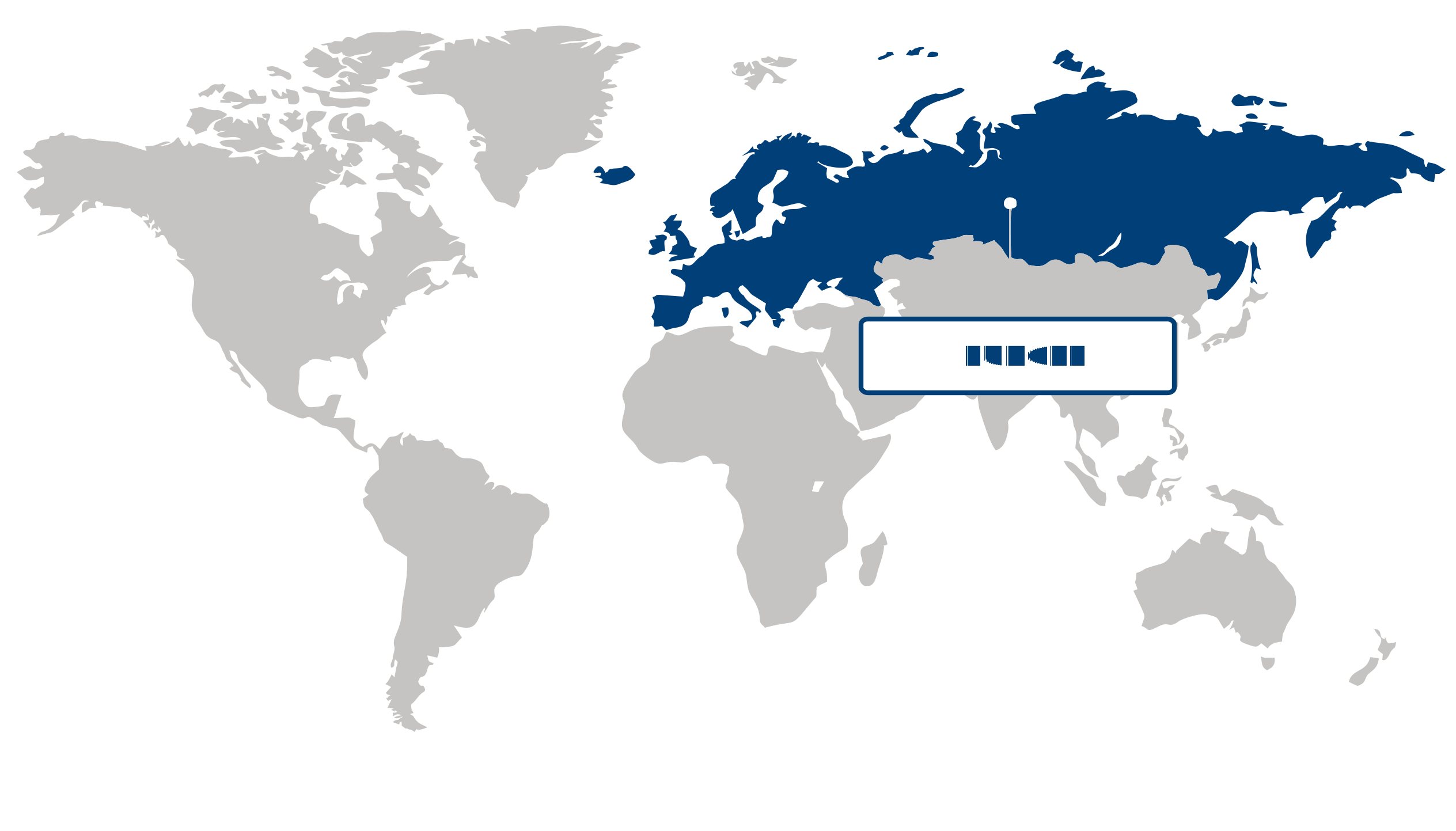
Europe (Largest Region)
Europe led the dried herbs market in 2026, supported by strong culinary traditions, widespread consumption of herb-based foods, and established demand for convenient natural flavoring ingredients. Dried herbs are extensively used across household cooking, foodservice, processed foods, sauces, seasonings, and prepared meals, providing a broad and diversified consumption base. Consumer interest in natural ingredients and clean-label food products is also encouraging manufacturers to incorporate recognizable herbs into formulations. The region's developed food processing and retail sectors further support product availability, while demand for convenient cooking ingredients continues to sustain the use of dried herbs across both domestic and commercial applications.
Asia Pacific (Fastest-Growing Region)
Asia Pacific is expected to be the fastest-growing region, fueled by expanding food processing industries, changing dietary preferences, and rising demand for convenient packaged foods. The region's diverse culinary traditions provide a broad foundation for herb consumption, while modernization of food production is increasing the use of standardized dried ingredients in prepared products. Urbanization and busier lifestyles are also encouraging consumers to choose convenient cooking and seasoning solutions. Growing retail penetration and the expansion of packaged food categories are improving access to dried herbs, while increasing interest in international cuisines is creating additional applications across household and foodservice consumption.
| Parameter | North America | Asia Pacific | Europe | Latin America | MEA |
|---|---|---|---|---|---|
| Innovation Hub i Scale Nascent Developing Advanced | |||||
| Cost-Sensitive Region i Scale Low Medium High | |||||
| Regulatory Environment i Scale Restrictive Neutral Supportive | |||||
| Demand Drivers i Scale Weak Moderate Strong | |||||
| Development Stage i Scale Emerging Developing Developed | |||||
| Adoption Rate i Scale Low Medium High | |||||
| New Entrants / Startups i Scale Sparse Moderate Dense | |||||
| Macro Indicators i Scale Weak Stable Strong |
Key Country Insights
United States 🇺🇸
Premium Culinary DemandThe U.S. dried herbs market is supported by packaged foods, home cooking, and foodservice applications seeking consistent flavor quality. Buyers increasingly value organic sourcing, traceability, and convenient packaging formats across retail and industrial channels.
Germany 🇩🇪
Quality Ingredient StandardsGermany places strong emphasis on certified dried herbs with reliable quality and controlled sourcing for food manufacturing and retail. Demand favors suppliers offering consistent processing methods and compliance with stringent food safety expectations.
Japan 🇯🇵
Functional Flavor SelectionJapan incorporates dried herbs into premium culinary products, seasoning blends, and health-oriented food applications. The market rewards suppliers capable of delivering refined flavor profiles and dependable product consistency for domestic manufacturers.
South Korea 🇰🇷
Convenience Food ApplicationsSouth Korea is expanding the use of dried herbs across convenience meals, sauces, and modern foodservice concepts. Manufacturers seek stable ingredient quality and packaging formats that support efficient production and longer shelf life.
France 🇫🇷
Gourmet Recipe FocusFrance values dried herbs that complement premium culinary traditions and specialty food production. Buyers emphasize aroma retention, authentic origin, and carefully processed products that enhance quality across retail and professional kitchens.
Italy 🇮🇹
Mediterranean Ingredient SupplyItaly maintains consistent demand for dried herbs used in traditional cuisine, packaged foods, and foodservice. The market favors reliable herb varieties with preserved flavor characteristics that support authentic recipe development and product differentiation.
Segment Leadership and Growth Trends
Dried herbs Market Share (%), by Form, 2026
Go beyond the chart, access full insights & data tables
Request Free Sample ReportForm Segment Analysis: Whole (Largest Segment) vs Powdered (Fastest-Growing Segment)
The whole form segment dominated the dried herbs market, accounting for 35.96% of the market share in 2026. Whole dried herbs are widely preferred because they retain their natural aroma, flavor, and essential oils for longer periods, making them suitable for both household and commercial food preparation. Their extended shelf life and versatility across culinary applications encourage widespread adoption by food manufacturers, restaurants, and consumers seeking high-quality herbal ingredients with minimal processing.
The powdered form segment is projected to witness the fastest growth as demand rises for convenient and ready-to-use ingredients in packaged foods, seasoning blends, and functional products. Powdered herbs offer ease of incorporation into formulations, consistent flavor distribution, and simplified storage, making them increasingly attractive for food processors and pharmaceutical manufacturers. Growing consumer preference for convenience and value-added products is further supporting the expansion of this segment.
Application Segment Analysis: Food and Beverages (Largest Segment) vs Pharmaceuticals (Fastest-Growing Segment)
Holding 54.38% of the dried herbs market in 2026, the food and beverages application segment remained the largest. Dried herbs are extensively used to enhance flavor, aroma, and nutritional value across processed foods, ready meals, sauces, bakery products, and beverages. Rising consumer interest in natural ingredients and clean-label products continues to strengthen demand, while manufacturers increasingly utilize dried herbs to meet evolving preferences for authentic and health-conscious food offerings.
The pharmaceuticals application segment is anticipated to record the fastest growth as herbal ingredients gain wider acceptance in traditional and complementary healthcare products. Increasing demand for plant-derived formulations, dietary supplements, and natural therapeutic ingredients is encouraging greater utilization of dried herbs in pharmaceutical manufacturing. Ongoing research into botanical ingredients and growing awareness of herbal wellness further contribute to the segment's expansion.
Distribution Channel Segment Analysis: Supermarket and Hypermarket (Largest Segment) vs Online Retail (Fastest-Growing Segment)
The dried herbs market was led by the supermarket and hypermarket distribution channel, which captured 43.46% of the market share in 2026. These retail formats offer consumers extensive product assortments, trusted brands, competitive pricing, and the opportunity to compare products before purchase. Strong retail infrastructure and the convenience of one-stop shopping continue to support the dominance of supermarkets and hypermarkets for dried herb sales.
The online retail segment is expected to experience the fastest growth as consumers increasingly embrace digital shopping platforms for grocery and specialty food purchases. Wider product availability, doorstep delivery, detailed product information, and the convenience of online ordering are driving adoption. Expanding e-commerce penetration and growing demand for premium and organic dried herbs are further accelerating sales through online channels.
| Segment | Sub-Segment | Largest Segment | Fastest Growing |
|---|---|---|---|
| Form | Whole, Powdered, Crushed, Flakes, Minced | Whole | Powdered |
| Application | Food and Beverages, Personal Care and Cosmetics, Pharmaceuticals, Aromatherapy and Essential Oils, Animal Feed, Others | Food and Beverages | Pharmaceuticals |
| Distribution Channel | Supermarket and Hypermarket, Convenience Stores, Specialty Stores, Online Retail, Direct Sales, Others | Supermarket and Hypermarket | Online Retail |
| Type | Basil, Oregano, Rosemary, Thyme, Parsley, Mint, Bay Leaves, Chives, Coriander/cilantro, Dill, Others | Basil | Mint |
Competitive Landscape and Market Positioning
Top players in the dried herbs market:
- McCormick & Company, Inc. (United States)
- The Fuchs Group (Germany)
- Euroma B.V. (Netherlands)
- Paulig Group (Finland)
- British Pepper & Spice Co., Ltd. (United Kingdom)
- Olam Food Ingredients (Singapore)
- Kerry Group plc (Ireland)
- Döhler Group (Germany)
- Sensient Technologies Corporation (United States)
- Hela Spice (Germany)
The dried herbs market is becoming more quality-driven as buyers seek greater consistency in flavor, aroma, and ingredient traceability across food manufacturing, retail, and foodservice applications. Competitive differentiation increasingly depends on processing methods that preserve product characteristics while meeting stringent quality and safety expectations, encouraging investment in advanced drying, cleaning, and packaging capabilities. Suppliers are also expanding specialized product portfolios tailored to regional culinary preferences and premium formulations, creating competitive advantages for producers that combine dependable sourcing with rigorous quality management.
| Company | Market Share | Company Revenue | Revenue CAGR (%) | Product Portfolio | Geographic Presence | Innovation / R&D Focus | Strategic Developments |
|---|---|---|---|---|---|---|---|
| McCormick & Company Inc. (United States) | |||||||
| The Fuchs Group (Germany) | |||||||
| Euroma B.V. (Netherlands) | |||||||
| Paulig Group (Finland) | |||||||
| British Pepper & Spice Co. Ltd. (United Kingdom) | |||||||
| Olam Food Ingredients (Singapore) | |||||||
| Kerry Group plc (Ireland) | |||||||
| Döhler Group (Germany) | |||||||
| Sensient Technologies Corporation (United States) | |||||||
| Hela Spice (Germany) |
Industry Development/News
| Company Name | Date | Key Development |
|---|---|---|
| Urbal Tea | Mar-25 | Urbal Tea initiated a temporary suspension of its retail café operations to reallocate resources toward production activities. This strategic pivot aims to expand the company's internal manufacturing capacity and support the long-term scalability of its core tea and herbal product business lines. |
| Portobello Capital | Mar-25 | Portobello Capital completed the acquisition of HFI as part of a strategic investment initiative. The transaction, advised by EY Abogados, signifies a focused expansion into the food ingredients sector, potentially enhancing the firm's competitive positioning and operational footprint within the broader herbs and seasonings market. |
Customize Your Report
Explore examples of how this report can be tailored to different research needs, including custom segments, additional topics or chapters, and related reports. Click a section of the wheel or its numbered marker to explore the available options.
Dried herbs Market — Custom Segments
| Segment | Sub-Segment |
|---|---|
| Organic Certification | Certified Organic, Conventional |
| Buyer Type | Food Manufacturers, Foodservice Operators, Retail Consumers, Ingredient and Industrial Buyers |
| Quality Grade | Standard Grade, Premium Grade, Specialty Grade |
Dried herbs Market — Custom TOC
| Custom Chapter | Custom Details |
|---|---|
| Culinary Flavor Trend Intelligence |
|
| Organic & Clean-Label Premiumization |
|
| Herb Sourcing Risk Management |
|
Need a different cut of the data?
Request Custom ResearchWhat is the market size of dried herbs?
How is the dried herbs industry projected to perform over the next decade?
How are clean-label food preferences shaping demand in the dried herbs market?
Why are dried herbs gaining broader adoption across households and foodservice?
Why is the food and beverages segment the largest application in the dried herbs market?
Which distribution channel is growing the fastest in the dried herbs market?
Why does Europe lead the dried herbs market?
How is Asia Pacific supporting faster dried herbs market growth?
Which organizations are considered leaders in the dried herbs landscape?
Our Clients
"The report provided a thorough look at market trends, technological advancements, and the competitive landscape. The depth of insights was really valuable."
ITC Limited
"We would highly recommend Fundamental Business Insights & Consulting to anyone looking for reliable, detailed, and comprehensive market research in the Food industry."
Tyson Foods
"The clarity and presentation of the information were commendable. The report was delivered timely, which made the overall experience smooth and convenient."
Mondelēz International
Our Research Team & Methodology
Every Fundamental Business Insights report is built by a dedicated vertical research team, validated through a structured primary-and-secondary methodology, and reviewed for accuracy before it reaches you.
Research Team Overview
Prepared by the Food & Beverage Research Team
Delivery
Published
Demand
Available
Support
Trust & Compliance
Research Domains
10 coverage areasResearch Intelligence
| Source | Reference |
|---|---|
| Food and Agriculture Organization (FAO) | www.fao.org |
| World Health Organization (WHO) | www.who.int |
| U.S. Food & Drug Administration (FDA) | www.fda.gov |
| European Food Safety Authority (EFSA) | www.efsa.europa.eu |
| U.S. Department of Agriculture (USDA) | www.usda.gov |
| Codex Alimentarius Commission | www.fao.org/fao-who-codexalimentarius |
| International Organization for Standardization (ISO) | www.iso.org |
| AOAC INTERNATIONAL | www.aoac.org |
| Institute of Food Technologists (IFT) | www.ift.org |
| International Dairy Foods Association (IDFA) | www.idfa.org |
| International Sweeteners Association (ISA) | www.sweeteners.org |
| International Probiotics Association (IPA) | internationalprobiotics.org |
| Good Food Institute (GFI) | gfi.org |
| American Feed Industry Association (AFIA) | www.afia.org |
| International Feed Industry Federation (IFIF) | ifif.org |
| Specialty Food Association (SFA) | www.specialtyfood.com |
| Brewers Association | www.brewersassociation.org |
| International Bottled Water Association (IBWA) | bottledwater.org |
| International Alliance for Dietary/Food Supplement Associations (IADSA) | www.iadsa.org |
| OECD Agriculture & Food | www.oecd.org/agriculture |
Research Workflow & Quality Assurance
Data Collection
Verified information gathered through primary and secondary research.
Data Triangulation
Cross-validation using multiple independent data sources.
Forecast Modelling
Market estimates developed using historical trends and analytical models.
Analyst Validation
Findings reviewed by domain experts for accuracy and consistency.
Editorial & Quality Review
Final editorial, quality, and compliance checks before publication.
Final Publication
Released after successful completion of the internal review process.
Report Coverage
📊 Market Assessment
- Market Size & Forecast
- Market Segmentation
- Regional Analysis
- Growth Drivers & Challenges
- Market Dynamics
🏢 Competitive Intelligence
- Competitive Landscape
- Company Profiles
- Competitive Benchmarking
- Mergers & Acquisitions
- Market Share Analysis or Key Company Strategies
🔍 Strategic Analysis
- Value Chain Analysis
- Porter's Five Forces
- PESTLE Analysis
- Pricing Trends
- Supply-Demand Analysis
🚀 Future Outlook
- Technology Landscape
- Regulatory Landscape
- Investment & Funding Landscape
- Emerging Opportunities
- Future Market Outlook
Have a question about this report or need a custom scope?
Request Customization