Vehicle Roadside Assistance Market Size & Growth Forecast 2027–2036, By Segments (Service Type, Vehicle Type, Provider), Regional Demand Trends (North America, Asia Pacific, Europe), Key Country Insights (U.S., Japan, South Korea, Germany, France, Italy), and Competitive Landscape
Market Size and Growth Outlook
Vehicle Roadside Assistance Market size was over USD 28.9 billion in 2026 and is likely to grow at a 5.04% CAGR between 2027 and 2036, reaching USD 47.25 billion by 2036. The industry revenue for 2027 is assessed at USD 30.13 billion.
Get more details on this report
Request Free Sample ReportVehicle Roadside Assistance Market Intelligence Snapshot
Regional Market Dynamics
- Europe leads with 37.84% share supported by established automotive service networks, insurance-linked assistance models, and strong integration between insurers, OEMs, and service providers.
- Asia Pacific is growing at 5.76% CAGR due to rising vehicle ownership, expansion of organized assistance services, and increasing adoption of app-enabled and OEM-backed support platforms.
Segment Momentum
- Towing accounted for 34.13% of the market in 2026 because vehicle immobilization often requires transport when breakdowns, battery failures, or accidents prevent safe operation.
- Commercial Vehicles are the fastest-growing segment as fleet operators increasingly prioritize rapid roadside support to minimize downtime and maintain delivery and transport schedules.
Market Expansion Drivers
- Increasing vehicle ownership and traffic congestion driving demand for emergency roadside support services.
- Integration of AI, telematics, and GPS improving response efficiency and service accuracy.
- Rising electric vehicle adoption increasing demand for specialized battery and charging assistance services.
Leading Market Participants
- Major companies in the vehicle roadside assistance market include American Automobile Association, Inc. (United States), Allianz Partners SAS (France), Agero, Inc. (United States), ARC Europe Group (Belgium), Allstate Insurance Company (United States), GEICO Corporation (United States), Viking Assistance Group AS (Norway), Liberty Mutual Insurance Company (United States), SOS International A/S (Denmark), Allstate Insurance Company (National General Holdings Corp.) (United States).
Global Market Forecast Snapshot
Market Outlook
- 2026 Market Size: USD 28.9 billion
- 2027 Estimated Market Size: USD 30.13 billion.
- Projected Market Size: USD 47.25 billion by 2036
- Growth Forecast: 5.04% CAGR (2027-2036)
Regional and Segment Outlook
- Leading Regional Market: Europe
- High-Growth Regional Hub: Asia Pacific
- Core Revenue Segment: Towing (Service Type) | Passenger Cars (Vehicle Type) | Auto Manufacturer (Provider)
- Emerging Opportunity Segment: Tire Replacement (Service Type) | Commercial Vehicles (Vehicle Type) | Motor Insurance (Provider)
Market Growth Drivers and Industry Trends
Increasing vehicle ownership and traffic congestion driving demand for emergency roadside support services
The vehicle roadside assistance market is benefiting from rising vehicle ownership and increasingly congested road conditions, which can increase the likelihood of breakdown-related disruptions and delays. Drivers rely on roadside support for services such as towing, battery assistance, tire changes, fuel-related emergencies, and vehicle recovery when unexpected problems occur. Higher vehicle usage also increases the need for accessible assistance across highways, urban roads, and longer-distance travel routes. Service providers are responding by developing broader coverage networks and faster dispatch capabilities to support motorists facing mechanical or operational issues away from repair facilities.
Integration of AI, telematics, and GPS improving response efficiency and service accuracy
Technological integration is transforming the vehicle roadside assistance market as AI, telematics, and GPS systems improve the ability of service providers to identify vehicle locations, understand breakdown circumstances, and coordinate appropriate assistance. Connected vehicle information can provide useful details about vehicle condition and incident location, allowing dispatch systems to assign suitable service personnel and equipment more efficiently. GPS-enabled tracking also improves communication between drivers and assistance teams, reducing uncertainty during roadside incidents. AI-supported routing and dispatch can further help providers manage service requests according to location, urgency, and available resources.
Rising electric vehicle adoption increasing demand for specialized battery and charging assistance services
Increasing electric vehicle adoption is creating new requirements within the vehicle roadside assistance market because EV breakdowns can involve battery-related and charging-specific challenges that differ from those of conventional vehicles. Drivers may require assistance when battery charge is depleted, charging equipment is unavailable, or vehicle-specific technical issues prevent normal operation. Roadside providers are therefore developing capabilities for mobile charging, EV-compatible recovery, battery support, and specialized towing procedures. The need for trained personnel and equipment suited to electric powertrains is becoming more important as EVs become a larger part of the vehicle fleet.
| Growth Driver | Impact on CAGR | Regulatory Influence | Geographic Relevance | Adoption Rate | Impact Timeline |
|---|---|---|---|---|---|
| Increasing vehicle ownership and traffic congestion driving demand for emergency roadside support services | 1.80% | Moderate | Europe, North America, Asia Pacific | High | Near Term |
| Integration of AI, telematics, and GPS improving response efficiency and service accuracy | 1.70% | Moderate | Europe, North America | High | Mid Term |
| Rising electric vehicle adoption increasing demand for specialized battery and charging assistance services | 1.50% | Moderate | Europe, Asia Pacific | Emerging | Long Term |
Unlock insights tailored to your business with our bespoke market research solutions.
Click to get your customized report now.
Regional Demand Dynamics
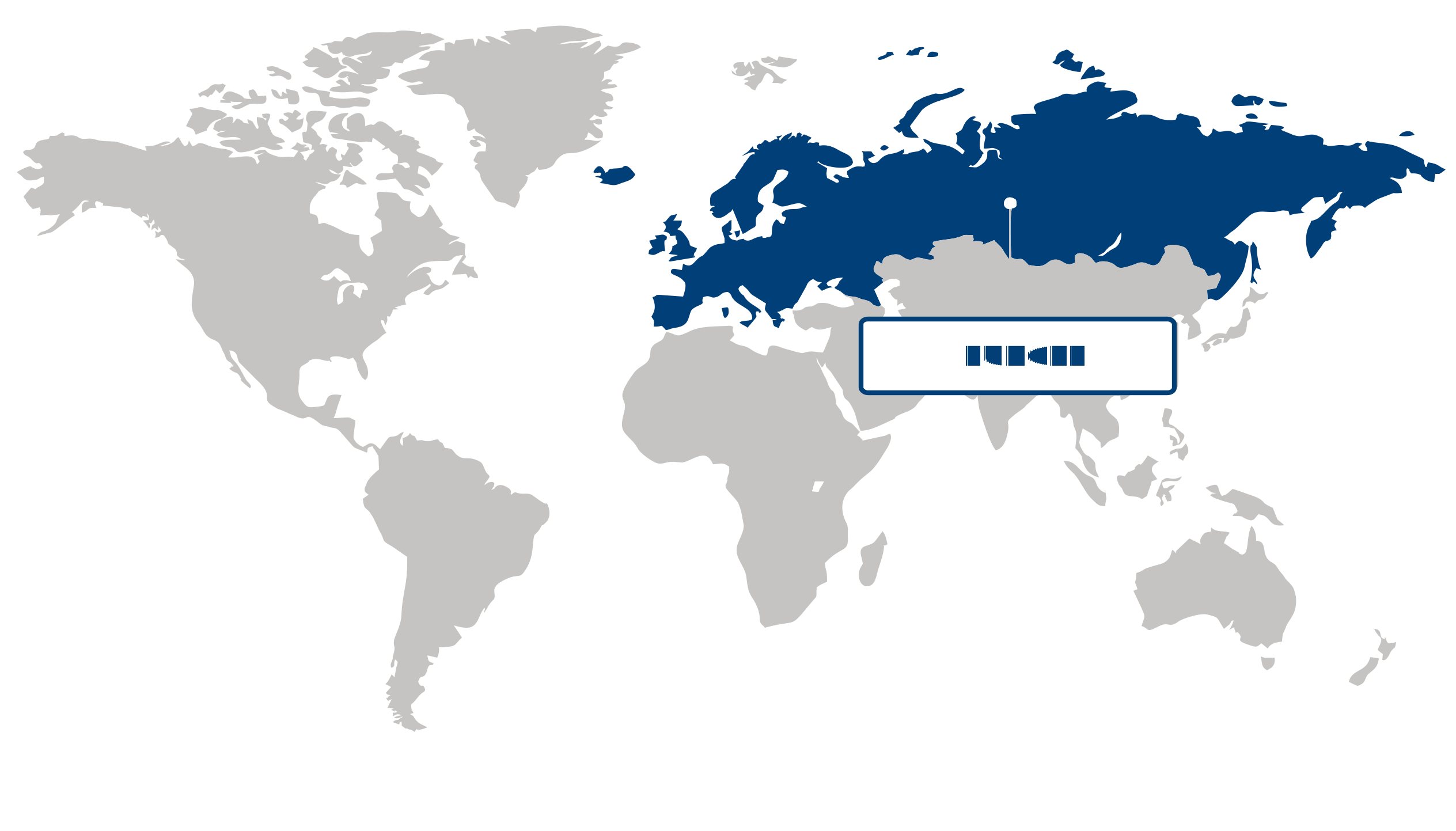
Europe (Largest Region)
Europe accounted for the largest share of the vehicle roadside assistance market at 37.84% in 2026, supported by a well-developed automotive ecosystem, extensive road infrastructure, and established demand for vehicle support services. High vehicle ownership, strong emphasis on road safety, and consumer expectations for reliable mobility services contribute to steady utilization of roadside assistance for breakdowns, accidents, battery failures, tire issues, and other vehicle-related incidents. The region's mature insurance and automotive service structures also encourage integration of roadside assistance with broader mobility and vehicle protection offerings. Furthermore, increasing vehicle complexity is strengthening demand for specialized technical support, while connected-vehicle capabilities are enabling faster incident identification, location tracking, and more efficient service dispatch. These factors collectively sustain Europe's leading market position.
Asia Pacific (Fastest-Growing Region)
Asia Pacific is emerging as the fastest-growing region, fueled by expanding vehicle ownership, urban mobility needs, and rapid development of road and transportation infrastructure. Growing automotive activity across emerging economies is broadening the addressable customer base for roadside assistance, while congested urban environments and longer-distance travel are increasing the importance of dependable breakdown support. Digital platforms and mobile applications are also improving access to assistance by enabling quicker service requests, location sharing, and real-time communication between motorists and service providers. Rising consumer expectations for convenient mobility services, alongside the increasing penetration of connected and technologically advanced vehicles, is further encouraging the modernization of roadside assistance offerings across the region.
| Parameter | North America | Asia Pacific | Europe | Latin America | MEA |
|---|---|---|---|---|---|
| Innovation Hub i Scale Nascent Developing Advanced | |||||
| Cost-Sensitive Region i Scale Low Medium High | |||||
| Regulatory Environment i Scale Restrictive Neutral Supportive | |||||
| Demand Drivers i Scale Weak Moderate Strong | |||||
| Development Stage i Scale Emerging Developing Developed | |||||
| Adoption Rate i Scale Low Medium High | |||||
| New Entrants / Startups i Scale Sparse Moderate Dense | |||||
| Macro Indicators i Scale Weak Stable Strong |
Key Country Insights
Germany 🇩🇪
Premium Mobility SupportGermany prioritizes roadside assistance services that complement advanced vehicle technologies and manufacturer-supported mobility programs. Service providers across Germany continue strengthening diagnostics, connected vehicle support, and specialized assistance for increasingly sophisticated passenger vehicles.
France 🇫🇷
Multi-Channel AssistanceFrance continues enhancing roadside assistance through insurance partnerships and digital customer service channels. Providers in France emphasize flexible assistance programs that support conventional and electric vehicles while improving operational efficiency and customer experience during roadside incidents.
Italy 🇮🇹
Regional Service CoverageItaly focuses on expanding dependable roadside assistance across urban and regional transportation networks. Service providers in Italy prioritize responsive dispatch, broad towing capabilities, and digital service management to accommodate diverse vehicle ownership patterns and travel requirements.
Japan 🇯🇵
Efficient Response NetworkJapan emphasizes reliable roadside assistance supported by dense service networks and efficient operational coordination. Vehicle owners in Japan increasingly expect digital request management, rapid dispatch capabilities, and dependable support that minimizes disruption to daily mobility.
South Korea 🇰🇷
Smart Assistance IntegrationSouth Korea expands roadside assistance through connected vehicle platforms and mobile-first customer engagement. Service providers in South Korea increasingly integrate predictive diagnostics, digital communication tools, and EV-specific support to improve service responsiveness and customer convenience.
United States 🇺🇸
Connected Mobility ServicesThe U.S. roadside assistance market increasingly integrates connected vehicle technologies with digital service dispatch and mobile support platforms. Service providers in the U.S. focus on faster response coordination, subscription-based offerings, and support for both conventional and electric vehicles.
Segment Leadership and Growth Trends
Vehicle Roadside Assistance Market Share (%), by Service Type, 2026
Go beyond the chart, access full insights & data tables
Request Free Sample ReportService Type Segment Analysis: Towing (Largest Segment) vs Tire Replacement (Fastest-Growing Segment)
Towing represented the largest share of the vehicle roadside assistance market, accounting for 34.13% in 2026. Towing remains a fundamental roadside service because vehicle breakdowns, accidents, mechanical failures, and immobilization can require immediate transportation to a repair facility. The increasing number of vehicles on roads and greater consumer expectations for rapid emergency support continue to sustain demand for dependable towing services, particularly when vehicles cannot be safely driven.
Tire replacement is gaining traction as motorists increasingly seek rapid assistance for punctures, damaged tires, and other tire-related breakdowns. Growing road travel and the need to minimize vehicle downtime are encouraging roadside assistance providers to expand convenient tire-related services. Mobile service capabilities and greater emphasis on quick incident resolution are further supporting adoption of tire replacement as part of comprehensive roadside assistance offerings.
Vehicle Type Segment Analysis: Passenger Cars (Largest Segment) vs Commercial Vehicles (Fastest-Growing Segment)
Passenger cars accounted for the largest share of the vehicle roadside assistance market in 2026, supported by the broad need for emergency assistance among individual motorists. Passenger vehicles are frequently used for commuting, personal travel, and long-distance journeys, creating recurring requirements for services such as towing, battery assistance, tire support, and emergency repairs. Consumer preference for reliable mobility and quick response during vehicle breakdowns continues to reinforce demand within this segment.
Commercial vehicles are gaining importance as businesses place greater emphasis on fleet uptime and uninterrupted transportation operations. Breakdowns involving delivery, logistics, and service vehicles can disrupt schedules and increase operational costs, making timely roadside support particularly valuable. The expansion of commercial mobility and increasingly organized fleet operations is encouraging greater use of roadside assistance services tailored to business vehicles.
| Segment | Sub-Segment | Largest Segment | Fastest Growing |
|---|---|---|---|
| Service Type | Towing, Tire Replacement, Fuel Delivery, Lockout/Replacement Key Service, Battery Assistance, Others | Towing | Tire Replacement |
| Vehicle Type | Passenger Cars, Commercial Vehicles | Passenger Cars | Commercial Vehicles |
| Provider | Motor Insurance, Auto Manufacturer, Automotive Clubs, Independent Warranty Providers | Auto Manufacturer | Motor Insurance |
Competitive Landscape and Market Positioning
Top players in the vehicle roadside assistance market:
1. American Automobile Association Inc. (United States)
2. Allianz Partners SAS (France)
3. Agero Inc. (United States)
4. ARC Europe Group (Belgium)
5. Allstate Insurance Company (United States)
6. GEICO Corporation (United States)
7. Viking Assistance Group AS (Norway)
8. Liberty Mutual Insurance Company (United States)
9. SOS International A/S (Denmark)
10. Allstate Insurance Company (National General Holdings Corp.) (United States)
The vehicle roadside assistance market is evolving through enhanced digital coordination and faster response systems. Service improvements are focusing on reducing downtime and improving customer support efficiency. Expanding service networks are increasing accessibility across regions. Technology-enabled assistance platforms are improving operational responsiveness and reliability.
| Company | Market Share | Company Revenue | Revenue CAGR (%) | Product Portfolio | Geographic Presence | Innovation / R&D Focus | Strategic Developments |
|---|---|---|---|---|---|---|---|
| American Automobile Association Inc. (United States) | |||||||
| Allianz Partners SAS (France) | |||||||
| Agero Inc. (United States) | |||||||
| ARC Europe Group (Belgium) | |||||||
| Allstate Insurance Company (United States) | |||||||
| GEICO Corporation (United States) | |||||||
| Viking Assistance Group AS (Norway) | |||||||
| Liberty Mutual Insurance Company (United States) | |||||||
| SOS International A/S (Denmark) | |||||||
| Allstate Insurance Company (National General Holdings Corp.) (United States). |
Industry Development/News
| Company Name | Date | Key Development |
|---|---|---|
| AAA | Jan-26 | AAA expanded its mobile EV charging service to 45 U.S. metropolitan markets with a USD 42 million investment in 350 additional charging units. The initiative, supporting Level 2 and DC fast charging, brings its nationwide mobile EV fleet to 520 units, providing critical range-extension support as the U.S. electric vehicle population scales. |
| HONK Technologies | Dec-25 | HONK Technologies secured USD 85 million in Series D funding to scale its roadside assistance marketplace and enter international markets, including the UK and Australia, in early 2026. The investment supports the expansion of its network to 45,000+ providers and enhances its AI-driven dispatch optimization, reflecting significant growth in digital-first service demand. |
| Agero | Nov-25 | Agero partnered with a major telematics provider to integrate automatic roadside assistance dispatch into connected vehicle systems. The initiative enables proactive service dispatch through remote diagnostics without manual driver intervention. Starting with 2.8 million connected vehicles in January 2026, the program is slated to scale to over 12 million vehicles by late 2027. |
| Force Motors Limited | Oct-25 | Force Motors launched a three-year complimentary roadside assistance program across India. The initiative provides 24/7 emergency support—including towing, battery jump-starts, and flat-tire assistance—for all vehicle models, aimed at enhancing after-sales service coverage and strengthening customer convenience and vehicle uptime in the domestic market. |
| ADAC | Sep-25 | ADAC deployed 50 hydrogen fuel cell electric patrol vehicles as part of a fleet electrification and sustainability strategy. Targeting 500 zero-emission patrol vehicles by 2028, the initiative uses fuel cell technology to provide longer operational ranges and faster refueling, optimizing the company's ability to provide service to both conventional and electric vehicles. |
| Progressive Insurance | Aug-25 | Progressive Insurance integrated roadside assistance requests directly into its Snapshot telematics mobile application. This integration provides policyholders with one-touch service access, real-time GPS location sharing, and ETA visibility. The consolidation eliminates the need for separate applications, streamlining the customer experience while generating valuable service data for underwriting and retention programs. |
| RAC Limited | Jul-25 | RAC Limited launched "RAC Patrol Elite," a premium, lifestyle-oriented service tier. Priced at GBP 180 annually, the tier offers a guaranteed 30-minute urban response time, 500-mile European towing, and mobile health checks. The service is designed to attract affluent customers and increase average revenue per member through enhanced, high-convenience breakdown coverage. |
| IAG | Jun-25 | IAG completed a strategic alliance with the Royal Automobile Club of Western Australia, acquiring RAC Insurance for USD 400 million. The deal includes a 20-year distribution agreement valued at USD 950 million, significantly consolidating IAG's position in the regional insurance and roadside assistance service sector through a long-term partnership model. |
| India Yamaha Motor | May-25 | India Yamaha Motor introduced a five-year roadside assistance program as part of its 40-year milestone celebrations. Providing comprehensive services such as emergency medical support and minor repairs, the initiative complements the company’s 10-year warranty program, reflecting a strategic focus on long-term after-sales support and enhancing the customer ownership experience in the Indian market. |
| Bosch | Feb-25 | Bosch acquired Roadside Protect, adding a network of 12,000 towing partners to its portfolio. This acquisition significantly strengthens the company’s digital roadside assistance platform in North America, enhancing its ability to deliver integrated, tech-enabled service solutions to automotive OEMs, insurance carriers, and fleet operators. |
Customize Your Report
Explore examples of how this report can be tailored to different research needs, including custom segments, additional topics or chapters, and related reports. Click a section of the wheel or its numbered marker to explore the available options.
Vehicle Roadside Assistance Market — Custom Segments
| Segment | Sub-Segment |
|---|---|
| Membership Model | Pay-Per-Use, Annual Membership, Insurance-Linked Membership, Manufacturer- or Dealer-Linked Membership |
| Sales Channel | Direct Provider Sales, Insurance & Warranty Channels, Automotive Dealer Channels, Digital & App-Based Channels |
| Coverage Model | Basic Roadside Coverage, Comprehensive Roadside Coverage, Premium Roadside Coverage, Fleet-Specific Coverage |
Vehicle Roadside Assistance Market — Custom TOC
| Custom Chapter | Custom Details |
|---|---|
| Connected Vehicle Assistance Evolution |
|
| Electric Vehicle Roadside Support Readiness |
|
| Mobility Partnership Opportunity Assessment |
|
Need a different cut of the data?
Request Custom ResearchWhat is the market valuation of vehicle roadside assistance?
What is the projected value of the vehicle roadside assistance industry by 2036?
How are digital technologies reshaping service efficiency in the vehicle roadside assistance market?
How is electric vehicle adoption changing investment priorities in roadside assistance services?
Why is Towing the leading service type in the vehicle roadside assistance market?
Which vehicle type is growing fastest in the vehicle roadside assistance market?
Why does Europe dominate the vehicle roadside assistance market?
What factors are fueling growth in Asia Pacific roadside assistance market?
Which companies dominate the vehicle roadside assistance landscape?
Our Clients
"The team surpassed our expectations with the report depth. The actionable insights provided proved crucial in navigating market challenges."
Tata Motors
"We found the report to be very informative. The expertise and attention to market nuances significantly influenced our business direction."
DENSO Corporation
"The consumer survey findings were quite good. We now have a clearer picture of the customer churning and retention strategy."
HL Mando
Our Research Team & Methodology
Every Fundamental Business Insights report is built by a dedicated vertical research team, validated through a structured primary-and-secondary methodology, and reviewed for accuracy before it reaches you.
Research Team Overview
Prepared by the Automotive & Transportation Research Team
Delivery
Published
Demand
Available
Support
Trust & Compliance
Research Domains
10 coverage areasResearch Intelligence
| Source | Reference |
|---|---|
| International Organization of Motor Vehicle Manufacturers (OICA) | www.oica.net |
| SAE International | www.sae.org |
| International Energy Agency (IEA) | www.iea.org |
| International Transport Forum (ITF) | www.itf-oecd.org |
| International Road Federation (IRF) | www.irf.global |
| International Organization for Standardization (ISO) | www.iso.org |
| United Nations Economic Commission for Europe (UNECE) | unece.org |
| National Highway Traffic Safety Administration (NHTSA) | www.nhtsa.gov |
| U.S. Department of Transportation (USDOT) | www.transportation.gov |
| European Automobile Manufacturers' Association (ACEA) | www.acea.auto |
| Society of Indian Automobile Manufacturers (SIAM) | www.siam.in |
| International Air Transport Association (IATA) | www.iata.org |
| International Civil Aviation Organization (ICAO) | www.icao.int |
| International Maritime Organization (IMO) | www.imo.org |
| International Union of Railways (UIC) | uic.org |
| American Public Transportation Association (APTA) | www.apta.com |
| International Federation of Robotics (IFR) | ifr.org |
| CharIN | www.charin.global |
| World Shipping Council | www.worldshipping.org |
| International Federation of Freight Forwarders Associations (FIATA) | fiata.org |
Research Workflow & Quality Assurance
Data Collection
Verified information gathered through primary and secondary research.
Data Triangulation
Cross-validation using multiple independent data sources.
Forecast Modelling
Market estimates developed using historical trends and analytical models.
Analyst Validation
Findings reviewed by domain experts for accuracy and consistency.
Editorial & Quality Review
Final editorial, quality, and compliance checks before publication.
Final Publication
Released after successful completion of the internal review process.
Report Coverage
📊 Market Assessment
- Market Size & Forecast
- Market Segmentation
- Regional Analysis
- Growth Drivers & Challenges
- Market Dynamics
🏢 Competitive Intelligence
- Competitive Landscape
- Company Profiles
- Competitive Benchmarking
- Mergers & Acquisitions
- Market Share Analysis or Key Company Strategies
🔍 Strategic Analysis
- Value Chain Analysis
- Porter's Five Forces
- PESTLE Analysis
- Pricing Trends
- Supply-Demand Analysis
🚀 Future Outlook
- Technology Landscape
- Regulatory Landscape
- Investment & Funding Landscape
- Emerging Opportunities
- Future Market Outlook
Have a question about this report or need a custom scope?
Request Customization