Timber Laminating Adhesives Market Size & Growth Forecast 2027–2036, By Segments (Application, Resin Type, End User), Regional Demand Trends (North America, Asia Pacific, Europe), Key Country Insights (U.S., Japan, South Korea, Germany, France, Italy), and Competitive Landscape
Market Size and Growth Outlook
Timber Laminating Adhesives Market size stood at USD 1.11 Billion in 2026 and is predicted to grow at 6.57% CAGR from 2027 to 2036, attaining USD 2.1 Billion by 2036. The industry revenue for 2027 is calculated at USD 1.17 Billion.
Get more details on this report
Request Free Sample ReportTimber Laminating Adhesives Market Intelligence Snapshot
Regional Market Dynamics
- Europe led in 2026, supported by its established timber construction and woodworking sectors, engineered wood adoption, and emphasis on sustainable, high-performance construction materials.
- Asia Pacific is expanding through construction activity, urbanization, engineered wood adoption, infrastructure investment, and modernization of wood processing and construction practices.
Segment Momentum
- Floor beams accounted for 34.13% share in 2026 due to their need for durable adhesive bonding in structural timber systems and increasing adoption of engineered wood construction.
- The commercial segment is growing fastest as developers increasingly use engineered wood in offices, retail, and hospitality projects to support sustainable and flexible construction designs.
Market Expansion Drivers
- Rising engineered wood adoption increasing demand for high-performance structural adhesives
- Demand for low-VOC and formaldehyde-free adhesives driven by regulatory compliance
- Growth of sustainable construction materials improving bio-based adhesive adoption
Leading Market Participants
- Prominent players in the timber laminating adhesives market include Henkel AG & Co. KGaA (Germany), H.B. Fuller Company (United States), Sika AG (Switzerland), Akzo Nobel N.V. (Netherlands), Ashland Global Holdings Inc. (United States), 3M Company (United States), Hexion Inc. (United States), Jowat SE (Germany), Dynea AS (Norway), Kiilto Oy (Finland)
Global Market Forecast Snapshot
Market Outlook
- 2026 Market Size: USD 1.11 Billion
- 2027 Estimated Market Size: USD 1.17 Billion
- Projected Market Size: USD 2.1 Billion by 2036
- Growth Forecast: 6.57% CAGR (2027-2036)
Regional and Segment Outlook
- Leading Regional Market: Europe
- High-Growth Regional Hub: Asia Pacific
- Core Revenue Segment: Floor Beams (Application) | Melamine Formaldehyde (Resin Type) | Residential (End User)
- Emerging Opportunity Segment: Trusses and Supporting Columns (Application) | Polyurethane (Resin Type) | Commercial (End User)
Market Growth Drivers and Industry Trends
Rising engineered wood adoption increasing demand for high-performance structural adhesives
The growing preference for engineered wood products in residential, commercial, and infrastructure projects is creating sustained demand for advanced bonding solutions that ensure structural integrity and long-term durability. The timber laminating adhesives market is benefiting from this shift as products such as cross-laminated timber, glued laminated timber, and laminated veneer lumber require high-performance adhesives capable of delivering strong load-bearing characteristics and reliable adhesion under varying environmental conditions. Manufacturers are increasingly focusing on formulations that provide consistent bonding strength, moisture resistance, and compatibility with modern engineered wood production processes to support the expanding use of prefabricated timber components.
Demand for low-VOC and formaldehyde-free adhesives driven by regulatory compliance
Stricter environmental regulations and indoor air quality standards are encouraging manufacturers to develop adhesive technologies with reduced emissions and improved sustainability profiles. This trend will drive the timber laminating adhesives market growth as wood product manufacturers seek low-VOC and formaldehyde-free formulations that comply with evolving regulatory requirements while meeting customer expectations for healthier building materials. The transition toward environmentally responsible production is also prompting investment in innovative resin systems that maintain mechanical performance and bonding reliability without compromising compliance with increasingly stringent environmental specifications.
Growth of sustainable construction materials improving bio-based adhesive adoption
The expanding use of sustainable building materials is encouraging greater incorporation of renewable and environmentally responsible adhesive solutions across timber construction applications. Within this evolving landscape, the timber laminating adhesives market is supported by rising adoption of bio-based formulations that complement the sustainability objectives of engineered wood products. Construction firms and material manufacturers are integrating renewable raw materials into adhesive development to reduce dependence on fossil-based inputs while maintaining the durability, processing efficiency, and performance characteristics required for structural timber manufacturing.
| Growth Driver | Impact on CAGR | Regulatory Influence | Geographic Relevance | Adoption Rate | Impact Timeline |
|---|---|---|---|---|---|
| Rising engineered wood adoption increasing demand for high-performance structural adhesives | 1.9% | High | North America, Europe | High | Near Term |
| Demand for low-VOC and formaldehyde-free adhesives driven by regulatory compliance | 1.7% | High | Europe, Asia Pacific | High | Mid Term |
| Growth of sustainable construction materials improving bio-based adhesive adoption | 1.5% | High | Global | High | Mid Term |
Unlock insights tailored to your business with our bespoke market research solutions.
Click to get your customized report now.
Regional Demand Dynamics
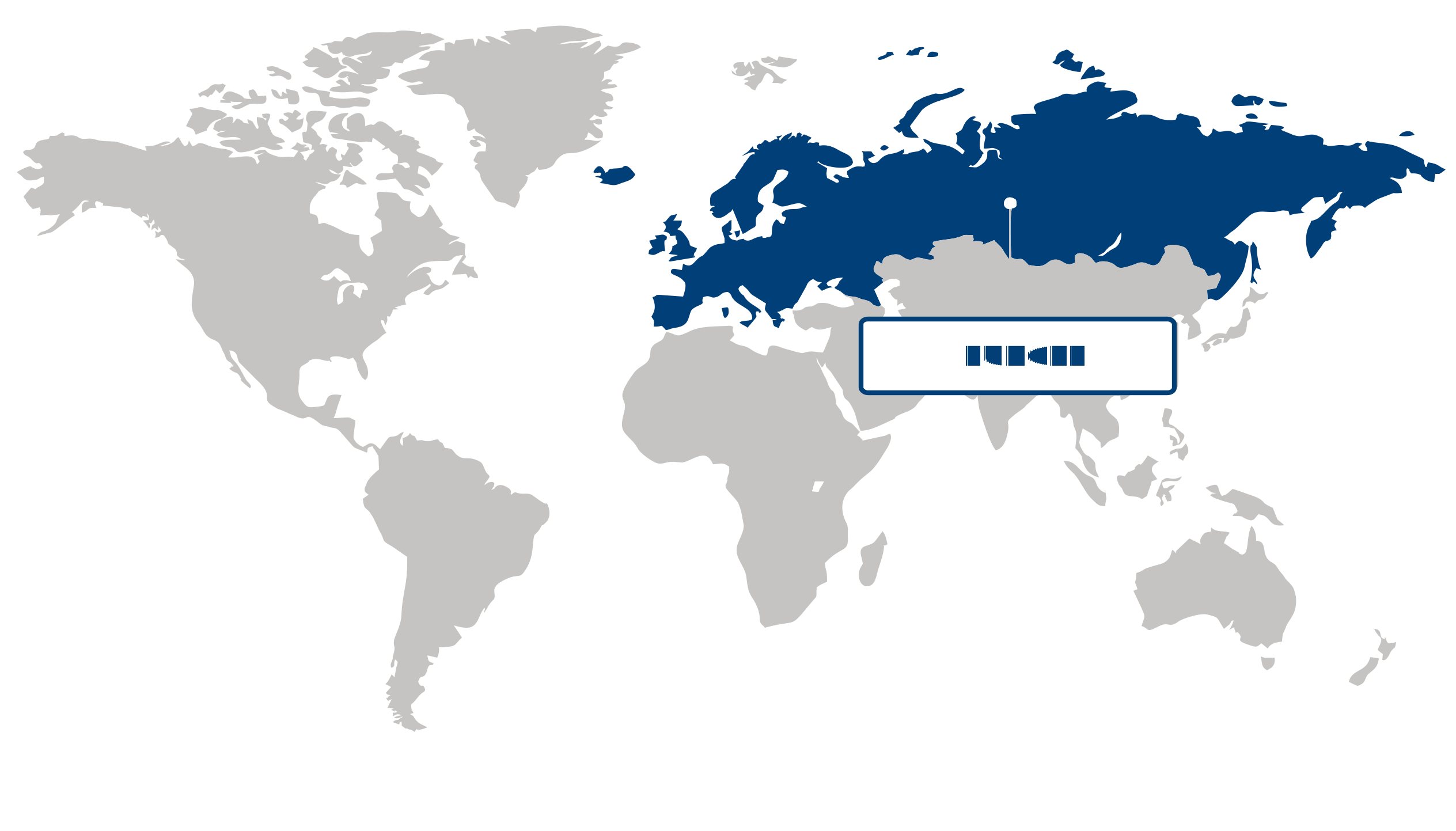
Europe (Largest Region)
Europe held the largest position in the timber laminating adhesives market in 2026, reflecting the region's established timber construction sector, strong woodworking industry, and broad adoption of engineered wood products. Growing interest in sustainable construction materials is supporting the use of laminated timber components in residential, commercial, and structural applications, which in turn creates demand for reliable bonding solutions. The region's focus on building performance, material efficiency, and environmentally responsible construction practices is further encouraging the use of advanced adhesives in timber processing and engineered wood manufacturing.
Asia Pacific (Fastest-Growing Region)
Asia Pacific is anticipated to be the fastest-growing region, driven by expanding construction activity, increasing urbanization, and rising adoption of engineered wood products. Growing investments in residential and commercial infrastructure are creating new applications for laminated timber, while improvements in wood processing and manufacturing capabilities are supporting regional adhesive consumption. In addition, increasing interest in sustainable building materials and the modernization of construction practices are encouraging greater use of timber-based structural solutions, creating favorable opportunities for timber laminating adhesives.
| Parameter | North America | Asia Pacific | Europe | Latin America | MEA |
|---|---|---|---|---|---|
| Innovation Hub i Scale Nascent Developing Advanced | |||||
| Cost-Sensitive Region i Scale Low Medium High | |||||
| Regulatory Environment i Scale Restrictive Neutral Supportive | |||||
| Demand Drivers i Scale Weak Moderate Strong | |||||
| Development Stage i Scale Emerging Developing Developed | |||||
| Adoption Rate i Scale Low Medium High | |||||
| New Entrants / Startups i Scale Sparse Moderate Dense | |||||
| Macro Indicators i Scale Weak Stable Strong |
Key Country Insights
United States 🇺🇸
Engineered Wood ExpansionThe U.S. supports timber laminating adhesives through increasing use of engineered wood products in residential and commercial construction. Manufacturers are developing adhesive systems that improve structural performance, production efficiency, and compliance with building standards.
Germany 🇩🇪
Structural Timber ExpertiseGermany prioritizes timber laminating adhesives that support precision manufacturing of engineered wood components. German producers focus on durable bonding solutions that meet demanding structural specifications while enabling sustainable construction practices.
Japan 🇯🇵
Space-Efficient ConstructionJapan emphasizes timber laminating adhesives for engineered wood applications that support durable and efficient building solutions. Japanese manufacturers continue improving adhesive performance for seismic resilience, dimensional stability, and consistent manufacturing quality.
South Korea 🇰🇷
Modern Wood ManufacturingSouth Korea is expanding timber laminating adhesive use alongside investment in engineered wood processing and advanced manufacturing. Domestic producers seek adhesive technologies that improve production efficiency and deliver reliable structural bonding performance.
France 🇫🇷
Sustainable Building MaterialsFrance encourages timber laminating adhesives that complement sustainable construction and wider adoption of engineered wood products. French manufacturers prioritize adhesive formulations that provide durable bonding while supporting environmental and performance requirements.
Italy 🇮🇹
Value-Added Wood ProductsItaly applies timber laminating adhesives across structural timber, furniture, and premium wood component manufacturing. Italian producers focus on adhesive solutions that enhance product quality, processing flexibility, and long-term durability for domestic and export markets.
Segment Leadership and Growth Trends
Timber Laminating Adhesives Market Share (%), by Application, 2026
Go beyond the chart, access full insights & data tables
Request Free Sample ReportApplication Segment Analysis: Floor Beams (Largest Segment) vs Trusses and Supporting Columns (Fastest-Growing Segment)
The floor beams segment dominated the timber laminating adhesives market with a share of 34.13% in 2026. Floor beam applications require strong and durable adhesive bonds capable of supporting structural loads over extended periods, making timber laminating adhesives an essential component in engineered wood construction. The increasing adoption of timber-based building materials in residential and commercial projects has contributed to sustained demand within this segment. Additionally, the growing preference for sustainable construction materials continues to support the use of laminated timber floor systems.
Trusses and supporting columns represent the fastest-growing application segment due to the increasing use of engineered wood products in modern architectural and structural designs. These applications require high-performance adhesive systems that can maintain structural integrity under varying load and environmental conditions. As builders and developers seek lightweight yet durable construction solutions, demand for timber laminating adhesives in trusses and supporting columns is expected to expand significantly.
Resin Type Segment Analysis: Melamine Formaldehyde (Largest Segment) vs Polyurethane (Fastest-Growing Segment)
Holding the largest share of the timber laminating adhesives market, the melamine formaldehyde segment accounted for 57.88% in 2026. The segment’s dominance is attributed to its strong bonding performance, durability, and resistance to moisture and environmental stress. These characteristics make melamine formaldehyde adhesives particularly suitable for structural timber applications where long-term reliability is critical. Their extensive use in engineered wood manufacturing and construction projects has solidified their position as the preferred resin type.
The polyurethane segment is projected to be the fastest-growing resin category owing to its versatility, flexibility, and strong adhesion across a wide range of wood substrates. Polyurethane adhesives are increasingly favored in applications requiring enhanced performance and compatibility with evolving manufacturing processes. Growing demand for advanced construction materials and the industry's focus on high-performance bonding technologies are expected to accelerate adoption of polyurethane-based solutions.
End User Segment Analysis: Residential (Largest Segment) vs Commercial (Fastest-Growing Segment)
The residential segment held the largest share of the timber laminating adhesives market in 2026. Demand from this segment is driven by increasing residential construction activities and the growing use of engineered wood products in housing projects. Timber laminating adhesives enable the production of structurally reliable wood components that support modern design requirements while promoting sustainable building practices. Rising consumer interest in environmentally friendly construction materials further strengthens the segment’s market position.
The commercial segment is anticipated to witness the fastest growth as timber-based construction gains wider acceptance in offices, retail facilities, hospitality projects, and other commercial buildings. Architects and developers are increasingly incorporating engineered wood structures to achieve sustainability goals while maintaining design flexibility. This trend is creating substantial opportunities for timber laminating adhesive manufacturers as demand for high-strength bonded wood products continues to rise across commercial construction applications.
| Segment | Sub-Segment | Largest Segment | Fastest Growing |
|---|---|---|---|
| Application | Floor Beams, Roof Beams, Window and Door Headers, Trusses and Supporting Columns, Others | Floor Beams | Trusses and Supporting Columns |
| Resin Type | Melamine Formaldehyde, Phenol Resorcinol Formaldehyde Adhesives, Polyurethane, Emulsion Polymer Isocyanate Adhesives, Others | Melamine Formaldehyde | Polyurethane |
| End User | Residential, Commercial, Industrial, Institutional, Others | Residential | Commercial |
Competitive Landscape and Market Positioning
Prominent players in the timber laminating adhesives market:
- Henkel AG & Co. KGaA (Germany)
- H.B. Fuller Company (United States)
- Sika AG (Switzerland)
- Akzo Nobel N.V. (Netherlands)
- Ashland Global Holdings, Inc. (United States)
- 3M Company (United States)
- Hexion, Inc. (United States)
- Jowat SE (Germany)
- Dynea AS (Norway)
- Kiilto Oy (Finland)
Competition within the timber laminating adhesives market is increasingly centered on developing bonding solutions that align with changing construction requirements and sustainability priorities. Adhesive providers are investing in technologies that enhance structural reliability, moisture resistance, and processing efficiency as engineered wood applications expand across residential and commercial projects. The market is also seeing greater differentiation through environmentally focused formulations and application expertise, with suppliers seeking to strengthen their role as solution partners rather than commodity material providers.
| Company | Market Share | Company Revenue | Revenue CAGR (%) | Product Portfolio | Geographic Presence | Innovation / R&D Focus | Strategic Developments |
|---|---|---|---|---|---|---|---|
| Henkel AG & Co. KGaA (Germany) | |||||||
| H.B. Fuller Company (United States) | |||||||
| Sika AG (Switzerland) | |||||||
| Akzo Nobel N.V. (Netherlands) | |||||||
| Ashland Global Holdings Inc. (United States) | |||||||
| 3M Company (United States) | |||||||
| Hexion Inc. (United States) | |||||||
| Jowat SE (Germany) | |||||||
| Dynea AS (Norway) | |||||||
| Kiilto Oy (Finland) |
Industry Development/News
| Company Name | Date | Key Development |
|---|---|---|
| Arkema | Dec-21 | Arkema announced the proposed acquisition of Permoseal, a South African leader in adhesive solutions for woodworking, packaging, construction, and DIY. The integration of established brands like Alcolin and high-performance adhesives will complement Bostik's portfolio, reinforcing their competitive positioning and market footprint across industrial and construction segments in South Africa and Sub-Saharan Africa. |
| Sika | Aug-21 | Sika acquired Bexel International S.A. de C.V., a prominent manufacturer of tile adhesives and stuccos in Mexico. This strategic acquisition enhances Sika's operational footprint, expands local manufacturing capabilities, and strengthens its market positioning within the rapidly growing Mexican construction and mortar sector. |
Customize Your Report
Explore examples of how this report can be tailored to different research needs, including custom segments, additional topics or chapters, and related reports. Click a section of the wheel or its numbered marker to explore the available options.
Timber Laminating Adhesives Market — Custom Segments
| Segment | Sub-Segment |
|---|---|
| Wood Product Type | Glulam, Cross-Laminated Timber, Laminated Veneer Lumber, Other Engineered Wood Products |
| Moisture Exposure Level | Interior Dry-Service, Protected Exterior, Exposed Exterior |
| Production Process | Cold Pressing, Hot Pressing, Radio-Frequency Pressing, Continuous Pressing |
Timber Laminating Adhesives Market — Custom TOC
| Custom Chapter | Custom Details |
|---|---|
| Adhesive Selection Benchmarking by Wood Product |
|
| Green Building Certification Impact Analysis |
|
| End-user Procurement and Specification Trends |
|
Need a different cut of the data?
Request Custom ResearchHow big is the timber laminating adhesives market?
How is the timber laminating adhesives industry projected to perform over the next decade?
How is engineered wood adoption influencing the timber laminating adhesives market?
Why are sustainable adhesive formulations gaining momentum in the timber laminating adhesives market?
Why are floor beams the leading application segment for timber laminating adhesives?
How is the commercial segment expanding demand for timber laminating adhesives?
Why does Europe lead the timber laminating adhesives market?
How is Asia Pacific driving faster growth in timber laminating adhesives?
Who are the major participants shaping the timber laminating adhesives landscape?
Our Clients
"The report helped us understand emerging consumer trends in our product category. It clarified where to focus innovation for the next product launch."
LyondellBasell
"The regional forecast section was incredibly useful. We were able to identify two new potential partners in Europe thanks to the vendor mapping you included."
SABIC
"We appreciated how actionable the recommendations were. It guided us to improve supply chain resilience."
Olin Corporation
Our Research Team & Methodology
Every Fundamental Business Insights report is built by a dedicated vertical research team, validated through a structured primary-and-secondary methodology, and reviewed for accuracy before it reaches you.
Research Team Overview
Prepared by the Chemicals & Materials Research Team
Delivery
Published
Demand
Available
Support
Trust & Compliance
Research Domains
10 coverage areasResearch Intelligence
| Source | Reference |
|---|---|
| American Chemistry Council (ACC) | www.americanchemistry.com |
| European Chemical Industry Council (Cefic) | cefic.org |
| International Council of Chemical Associations (ICCA) | icca-chem.org |
| European Chemicals Agency (ECHA) | echa.europa.eu |
| U.S. Environmental Protection Agency (EPA) | www.epa.gov |
| ASTM International | www.astm.org |
| International Organization for Standardization (ISO) | www.iso.org |
| National Institute of Standards and Technology (NIST) | www.nist.gov |
| Plastics Industry Association (PLASTICS) | www.plasticsindustry.org |
| European Biplastics | www.european-bioplastics.org |
| The Adhesive and Sealant Council (ASC) | www.ascouncil.org |
| National Association of Corrosion Engineers (AMPP) | www.ampp.org |
| Society of Plastics Engineers (SPE) | www.4spe.org |
| International Fertilizer Association (IFA) | www.fertilizer.org |
| CropLife International | croplife.org |
| Packaging Europe | packagingeurope.com |
| Flexible Packaging Association (FPA) | www.flexpack.org |
| Battery Council International (BCI) | batterycouncil.org |
| International Copper Association (ICA) | internationalcopper.org |
| World Steel Association | worldsteel.org |
Research Workflow & Quality Assurance
Data Collection
Verified information gathered through primary and secondary research.
Data Triangulation
Cross-validation using multiple independent data sources.
Forecast Modelling
Market estimates developed using historical trends and analytical models.
Analyst Validation
Findings reviewed by domain experts for accuracy and consistency.
Editorial & Quality Review
Final editorial, quality, and compliance checks before publication.
Final Publication
Released after successful completion of the internal review process.
Report Coverage
📊 Market Assessment
- Market Size & Forecast
- Market Segmentation
- Regional Analysis
- Growth Drivers & Challenges
- Market Dynamics
🏢 Competitive Intelligence
- Competitive Landscape
- Company Profiles
- Competitive Benchmarking
- Mergers & Acquisitions
- Market Share Analysis or Key Company Strategies
🔍 Strategic Analysis
- Value Chain Analysis
- Porter's Five Forces
- PESTLE Analysis
- Pricing Trends
- Supply-Demand Analysis
🚀 Future Outlook
- Technology Landscape
- Regulatory Landscape
- Investment & Funding Landscape
- Emerging Opportunities
- Future Market Outlook
Have a question about this report or need a custom scope?
Request Customization