Resistant Starch Market Size & Growth Forecast 2027–2036, By Segments (Product, Source, Source-Product, Source-Application, Application), Regional Demand Trends (North America, Asia Pacific, Europe), Key Country Insights (U.S., Japan, South Korea, Germany, France, Italy), and Competitive Landscape
Market Size and Growth Outlook
Resistant Starch Market size was worth USD 1.76 trillion in 2026 and is poised to grow at a 8.46% CAGR between 2027 and 2036, surpassing USD 3.96 trillion by 2036. The industry revenue for 2027 is assessed at USD 1.89 trillion.
Get more details on this report
Request Free Sample ReportResistant Starch Market Intelligence Snapshot
Regional Market Dynamics
- Asia Pacific held a 34.34% share in 2026, supported by its large food processing industry, robust ingredient supply chains, and widespread use of resistant starch across packaged food applications.
- North America is projected to grow at a 10.17% CAGR, driven by product innovation focused on digestive health, fiber enrichment, cleaner-label reformulation, and broader use in packaged foods.
Segment Momentum
- RS2 accounted for a 41.18% share in 2026 because it is widely established in food manufacturing, offering easy integration into formulations without significant processing changes.
- Beans & Legumes are the fastest-growing source segment as manufacturers increasingly diversify ingredient sourcing and seek pulse-based resistant starch for evolving formulation and nutritional requirements.
Market Expansion Drivers
- Growing demand for convenience and packaged foods boosting functional starch ingredient consumption.
- Rising health awareness driving demand for digestive-health and functional food ingredients.
- Expanding processed food applications requiring thickening and stabilizing agents in formulations.
Leading Market Participants
- Leading companies in the resistant starch market include Cargill, Incorporated (United States), Ingredion Incorporated (United States), Tate & Lyle PLC (United Kingdom), Archer Daniels Midland Company (United States), Emsland Group (Germany), MGP Ingredients, Inc. (United States), Roquette Frères S.A. (France), AGRANA Beteiligungs-AG (Austria), BENEO GmbH (Germany), Grain Processing Corporation (United States).
Global Market Forecast Snapshot
Market Outlook
- 2026 Market Size: USD 1.76 trillion
- 2027 Estimated Market Size: USD 1.89 trillion.
- Projected Market Size: USD 3.96 trillion by 2036
- Growth Forecast: 8.46% CAGR (2027-2036)
Regional and Segment Outlook
- Leading Regional Market: Asia Pacific
- High-Growth Regional Hub: North America
- Core Revenue Segment: RS2 (Product) | Grains (Source) | Grains (Source-Product) | Grains (Source-Application) | Soups, Dressings, & Condiments (Application)
- Emerging Opportunity Segment: RS4 (Product) | Beans & Legumes (Source) | Grains (Source-Product) | Grains (Source-Application) | Meat Substitutes (Application)
Market Growth Drivers and Industry Trends
Growing demand for convenience and packaged foods boosting functional starch ingredient consumption
The expanding role of convenient and packaged foods is supporting the resistant starch market as manufacturers seek functional ingredients that can integrate effectively into processed food formulations. Resistant starch can serve formulation needs while fitting into products designed for convenience, encouraging ingredient utilization across food categories where manufacturers balance processing requirements with changing consumer expectations.
Rising health awareness driving demand for digestive-health and functional food ingredients
Growing consumer attention to digestive wellbeing is strengthening the resistant starch market by increasing interest in functional food ingredients associated with health-oriented product development. Food manufacturers are responding by incorporating ingredients that support the functional positioning of their products, creating opportunities for resistant starch across formulations designed to address increasingly health-conscious purchasing preferences.
Expanding processed food applications requiring thickening and stabilizing agents in formulations
The wider use of processed foods is creating additional formulation requirements for ingredients that support consistency, texture, and product stability, contributing to the resistant starch market. Its functional characteristics make it relevant to food formulations requiring thickening and stabilizing capabilities, encouraging manufacturers to consider starch-based solutions as processing applications become more diverse.
| Growth Driver | Impact on CAGR | Regulatory Influence | Geographic Relevance | Adoption Rate | Impact Timeline |
|---|---|---|---|---|---|
| Rising Health-conscious Diets & Resistant Starch Applications | 3.00% | Short term (≤ 2 yrs) | North America, Europe (spillover: Asia Pacific) | Medium | Fast |
| Food Industry Adoption & Functional Foods | 2.50% | Medium term (2–5 yrs) | Europe, Asia Pacific (spillover: North America) | Low | Moderate |
| Regulatory & Safety Guidelines | 3.50% | Long term (5+ yrs) | North America, Europe (spillover: MEA) | High | Moderate |
| Growing demand for convenience and packaged foods boosting functional starch ingredient consumption | 2.30% | Moderate | Asia Pacific, North America | High | Near Term |
| Rising health awareness driving demand for digestive-health and functional food ingredients | 2.10% | Moderate | Europe, Asia Pacific | High | Mid Term |
| Expanding processed food applications requiring thickening and stabilizing agents in formulations | 1.70% | Low | North America, Europe | High | Near Term |
Unlock insights tailored to your business with our bespoke market research solutions.
Click to get your customized report now.
Regional Demand Dynamics
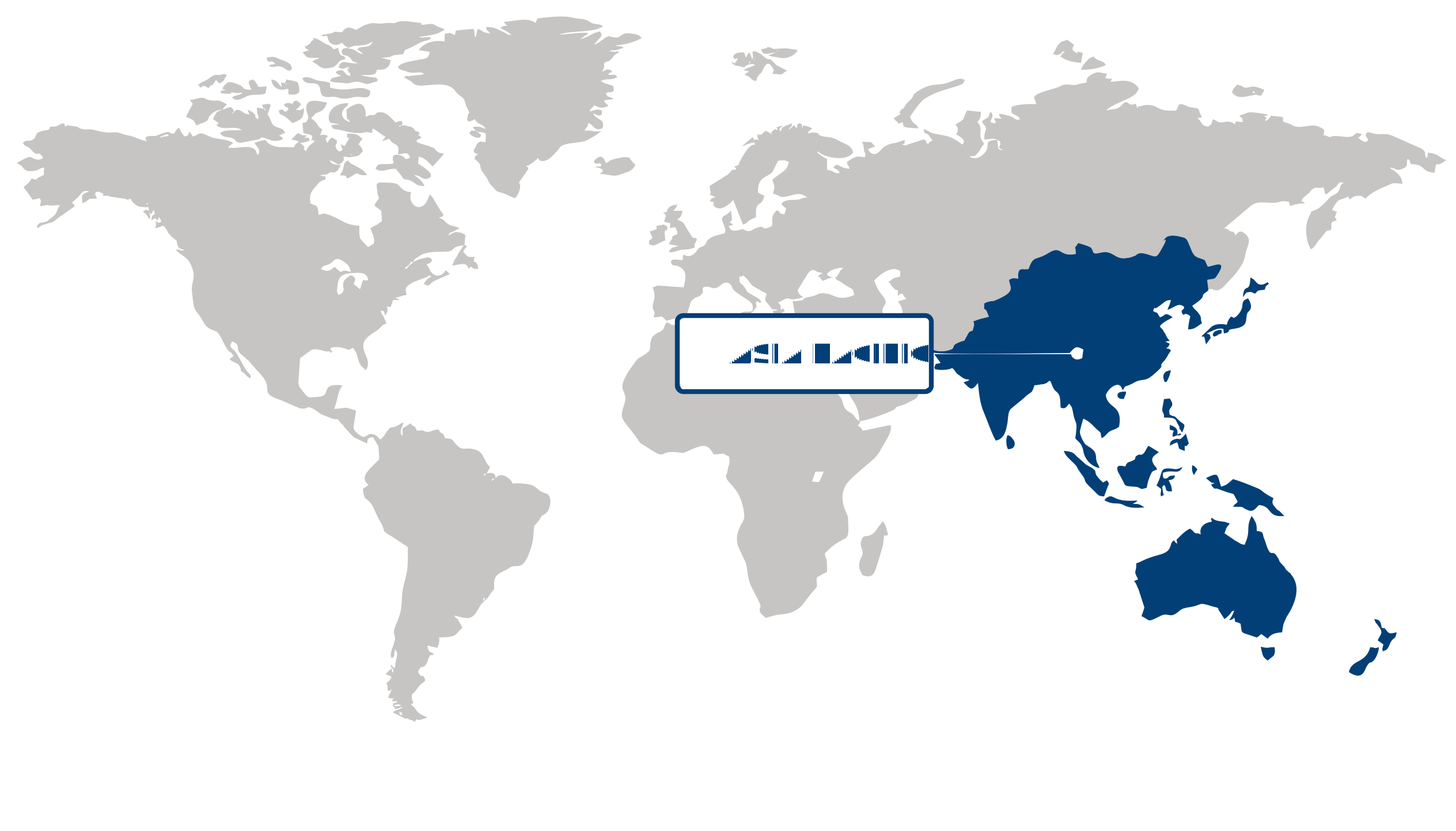
Asia Pacific (Largest Region)
Asia Pacific dominated the resistant starch market with a 34.34% share in 2026, supported by strong consumption of staple foods, expanding processed food production, and increasing interest in functional ingredients that can support digestive and metabolic health. Resistant starch is gaining attention as a dietary fiber source and as an ingredient that can contribute to improved texture and nutritional profiles in food formulations. Rising health awareness is encouraging consumers to seek products associated with better digestive wellness and balanced nutrition, while food manufacturers are incorporating functional ingredients into bakery products, snacks, beverages, and other formulations. The region's large food-processing industry, expanding urban consumer base, and growing interest in healthier eating patterns provide a broad foundation for continued adoption.
North America (Fastest-Growing Region)
North America represents the fastest-growing regional market for resistant starch, fueled by rising consumer interest in gut health, functional nutrition, and better-for-you food products. Increasing awareness of dietary fiber and the relationship between digestive health and overall wellness is encouraging demand for ingredients that offer nutritional benefits without substantially altering familiar food formats. Food manufacturers are also responding by developing products with enhanced fiber content and improved nutritional positioning, creating opportunities for resistant starch across multiple categories. The region's mature functional food industry, strong innovation capabilities, and consumer willingness to adopt health-oriented dietary products are supporting broader incorporation of resistant starch into mainstream formulations.
| Parameter | North America | Asia Pacific | Europe | Latin America | MEA |
|---|---|---|---|---|---|
| Innovation Hub i Scale Nascent Developing Advanced | |||||
| Cost-Sensitive Region i Scale Low Medium High | |||||
| Regulatory Environment i Scale Restrictive Neutral Supportive | |||||
| Demand Drivers i Scale Weak Moderate Strong | |||||
| Development Stage i Scale Emerging Developing Developed | |||||
| Adoption Rate i Scale Low Medium High | |||||
| New Entrants / Startups i Scale Sparse Moderate Dense | |||||
| Macro Indicators i Scale Weak Stable Strong |
Key Country Insights
Germany 🇩🇪
Clean Label IngredientsGermany emphasizes resistant starch applications that align with clean-label and health-focused food formulations. Ingredient suppliers in Germany continue developing functional starch solutions for bakery and processed foods while maintaining product quality and nutritional performance.
France 🇫🇷
Nutritional Ingredient AdoptionFrance is expanding resistant starch usage in food products that support digestive health and nutritional improvement. Manufacturers in France focus on integrating functional starch ingredients into bakery, dairy, and specialty food applications while preserving product appeal.
Italy 🇮🇹
Better-for-You FormulationsItaly is incorporating resistant starch into food products that balance nutrition with consumer taste expectations. Food companies in Italy continue refining formulations for bakery, pasta, and packaged foods to enhance fiber content without compromising product quality.
Japan 🇯🇵
Precision Food FormulationJapan focuses on resistant starch incorporation in functional foods designed for digestive wellness and balanced nutrition. Food manufacturers in Japan prioritize formulation consistency and product quality while expanding applications across convenience and health-oriented food categories.
South Korea 🇰🇷
Health-Focused Product DevelopmentSouth Korea is increasing the use of resistant starch in functional foods and dietary formulations. Producers in South Korea continue developing innovative ingredient blends that enhance nutritional value while maintaining desirable texture and processing performance.
United States 🇺🇸
Functional Nutrition InnovationThe U.S. resistant starch market is driven by demand for fiber-enriched foods and digestive health ingredients. Food manufacturers in the U.S. are incorporating resistant starch into bakery, snack, and nutritional products to improve functionality while supporting clean-label product development.
Segment Leadership and Growth Trends
Resistant Starch Market Share (%), by Product, 2026
Go beyond the chart, access full insights & data tables
Request Free Sample ReportProduct Segment Analysis: RS2 (Largest Segment) vs RS4 (Fastest-Growing Segment)
The RS2 segment held the largest share of the resistant starch market in 2026, accounting for 41.18%, supported by its natural occurrence in foods such as uncooked or minimally processed starch-rich ingredients and its established nutritional relevance. RS2 is valued for its resistance to digestion in the small intestine, allowing it to reach the colon where it can contribute to beneficial fermentation processes. Growing consumer awareness of digestive health, gut microbiome balance, and the role of dietary fiber in overall wellness is strengthening demand for resistant starch ingredients. Food manufacturers are also incorporating RS2 into functional foods, nutrition products, and formulated foods to improve nutritional profiles while responding to increasing interest in health-oriented ingredients.
RS4 is expected to experience the fastest growth as food manufacturers seek modified resistant starch ingredients with more controlled functional and nutritional characteristics. Unlike naturally occurring resistant starches, RS4 can be structurally modified to achieve desired resistance properties while offering greater formulation flexibility across processed food applications. Its potential use in products requiring improved texture, stability, and fiber enrichment is increasing interest among formulators. Growing demand for functional ingredients that can support digestive health without substantially altering the sensory characteristics of finished foods is further encouraging the adoption of RS4.
Source Segment Analysis: Grains (Largest Segment) vs Beans & Legumes (Fastest-Growing Segment)
Grains accounted for the largest share of the resistant starch market in 2026, representing 68.93%, reflecting their broad availability, established food-processing infrastructure, and extensive use as sources of starch-based ingredients. Grain-derived starches can be incorporated into a wide range of food formulations, providing manufacturers with flexibility in developing products containing resistant starch. Increasing consumer interest in dietary fiber, digestive wellness, and functional nutrition is creating additional opportunities for grain-based resistant starch ingredients. Their familiarity across food manufacturing and established supply chains further support continued utilization in processed foods, bakery products, cereals, and nutrition-oriented formulations.
The beans and legumes segment is projected to grow at the fastest pace as consumers increasingly recognize legumes as nutrient-dense sources of plant-based carbohydrates, protein, and dietary fiber. Growing interest in plant-based nutrition and healthier carbohydrate sources is encouraging greater use of legumes in functional food formulations. Beans and legumes can also provide naturally occurring resistant starch, aligning with rising consumer interest in ingredients that support digestive health and satiety. Increasing development of plant-based and clean-label foods is further creating opportunities for resistant starch derived from these sources.
| Segment | Sub-Segment | Largest Segment | Fastest Growing |
|---|---|---|---|
| Product | RS1, RS2, RS3, RS4 | RS2 | RS4 |
| Source | Fruits & Nuts, Grains, Vegetables, Cereal Food, Beans & Legumes, Others | Grains | Beans & Legumes |
| Source-Product | Fruits & Nuts, Grains, Vegetables, Cereal Food, Beans & Legumes, Others | Grains | Grains |
| Source-Application | Fruits & Nuts, Grains, Vegetables, Cereal Food, Beans & Legumes, Others | Grains | Grains |
| Application | Bakery Products, Confectionery, Beverages, Breakfast Cereals, Pasta & Noodles, Dairy Products, Nutrition Bars, Meat & Processed Food, Meat Substitutes, Soups, Dressings, & Condiments, Others | Soups, Dressings, & Condiments | Meat Substitutes |
Competitive Landscape and Market Positioning
Major players in the resistant starch market:
1. Cargill Incorporated (United States)
2. Ingredion Incorporated (United States)
3. Tate & Lyle PLC (United Kingdom)
4. Archer Daniels Midland Company (United States)
5. Emsland Group (Germany)
6. MGP Ingredients Inc. (United States)
7. Roquette Frères S.A. (France)
8. AGRANA Beteiligungs-AG (Austria)
9. BENEO GmbH (Germany)
10. Grain Processing Corporation (United States)
The resistant starch market is gaining traction due to rising interest in digestive health and functional nutrition. In the resistant starch market, formulation advancements are enabling broader food and supplement applications. Collaborative development efforts are enhancing ingredient stability and usability across product categories. Growing consumer awareness of gut health benefits is driving demand expansion across multiple food segments.
| Company | Market Share | Company Revenue | Revenue CAGR (%) | Product Portfolio | Geographic Presence | Innovation / R&D Focus | Strategic Developments |
|---|---|---|---|---|---|---|---|
| Cargill Incorporated (United States) | |||||||
| Ingredion Incorporated (United States) | |||||||
| Tate & Lyle PLC (United Kingdom) | |||||||
| Archer Daniels Midland Company (United States) | |||||||
| Emsland Group (Germany) | |||||||
| MGP Ingredients Inc. (United States) | |||||||
| Roquette Frères S.A. (France) | |||||||
| AGRANA Beteiligungs-AG (Austria) | |||||||
| BENEO GmbH (Germany) | |||||||
| Grain Processing Corporation (United States). |
Industry Development/News
| Company Name | Date | Key Development |
|---|---|---|
| CSIRO & GRDC | May-26 | CSIRO and GRDC have successfully developed four new crop varieties engineered to enhance resistant starch functionality and nutritional profiles. This agricultural biotechnology initiative is designed to improve human health outcomes, reduce the environmental footprint of cultivation, and capture emerging international market opportunities within the functional food and health ingredient sectors. |
| MSP Starch Products Inc. | Apr-26 | MSP Starch Products Inc. expanded its European market presence by securing an exclusive distribution agreement with Germany’s Lehvoss Group for its Solnul resistant potato starch. This partnership facilitates broader access to prebiotic ingredients across Europe, directly supporting the growing consumer demand for gut health solutions and strengthening the company's commercial infrastructure in functional fibers. |
| Momentous | Mar-26 | Momentous launched Fiber+, a performance supplement integrating fermentable fibers and resistant starch. This product introduction leverages clinical research regarding short-chain fatty acid production to support metabolic and digestive health, marking the company’s strategic expansion into the functional nutrition segment focused on microbiome wellness and metabolic performance. |
| ICAR & Himachal Pradesh University | Dec-25 | Researchers at ICAR and Himachal Pradesh University utilized CRISPR-Cas9 gene editing to create high-amylose potatoes by targeting specific starch-branching enzymes. This technological breakthrough significantly increases resistant starch content, representing a high-impact advancement in crop science with the potential to transform functional food applications and enhance the nutritional value of potato-based products. |
| Supergut | Mar-25 | Supergut secured capital from Full Frame Growth Partners and appointed a new CEO to scale its digestive health platform. The investment supports the company’s strategic efforts to capitalize on the convergence of GLP-1-related dietary trends and microbiome-focused nutrition, reinforcing its position as a key player in the functional food market. |
| MSP Starch Products Inc. | Sep-24 | Health Canada recognized MSP Starch Products’ Solnul as a low-dose prebiotic, following clinical validation of its efficacy in promoting beneficial gut bacteria. This regulatory achievement provides significant scientific backing, enhancing the ingredient's competitive positioning and commercial credibility within the highly regulated functional fiber and gut health supplement markets. |
Customize Your Report
Explore examples of how this report can be tailored to different research needs, including custom segments, additional topics or chapters, and related reports. Click a section of the wheel or its numbered marker to explore the available options.
Resistant Starch Market — Custom Segments
| Segment | Sub-Segment |
|---|---|
| Functionality | Glycemic Management, Digestive Health, Prebiotic Support, Texture & Processing Improvement |
| Processing Method | Native Resistant Starch, Physically Modified Resistant Starch, Chemically Modified Resistant Starch, Enzymatically Modified Resistant Starch |
| Distribution Channel | Direct Sales, Distributors & Wholesalers, Specialty Ingredient Suppliers, Online Channels |
Resistant Starch Market — Custom TOC
| Custom Chapter | Custom Details |
|---|---|
| Functional Food Innovation Assessment |
|
| Food Formulation Opportunity Assessment |
|
| Industrial Application Expansion Assessment |
|
Need a different cut of the data?
Request Custom ResearchHow big is the resistant starch market?
What is the expected industry size of resistant starch by 2036?
How is growing demand for convenience and packaged foods influencing adoption of resistant starch ingredients?
Why is health awareness accelerating the use of resistant starch in modern food formulations?
Why is RS2 the leading product segment in the resistant starch market?
Which source segment is growing the fastest in the resistant starch market?
Why is Asia Pacific the largest resistant starch market?
What is driving resistant starch market growth in North America?
Who are the major participants shaping the resistant starch landscape?
Our Clients
"The report provided a thorough look at market trends, technological advancements, and the competitive landscape. The depth of insights was really valuable."
ITC Limited
"We would highly recommend Fundamental Business Insights & Consulting to anyone looking for reliable, detailed, and comprehensive market research in the Food industry."
Tyson Foods
"The clarity and presentation of the information were commendable. The report was delivered timely, which made the overall experience smooth and convenient."
Mondelēz International
Our Research Team & Methodology
Every Fundamental Business Insights report is built by a dedicated vertical research team, validated through a structured primary-and-secondary methodology, and reviewed for accuracy before it reaches you.
Research Team Overview
Prepared by the Food & Beverage Research Team
Delivery
Published
Demand
Available
Support
Trust & Compliance
Research Domains
10 coverage areasResearch Intelligence
| Source | Reference |
|---|---|
| Food and Agriculture Organization (FAO) | www.fao.org |
| World Health Organization (WHO) | www.who.int |
| U.S. Food & Drug Administration (FDA) | www.fda.gov |
| European Food Safety Authority (EFSA) | www.efsa.europa.eu |
| U.S. Department of Agriculture (USDA) | www.usda.gov |
| Codex Alimentarius Commission | www.fao.org/fao-who-codexalimentarius |
| International Organization for Standardization (ISO) | www.iso.org |
| AOAC INTERNATIONAL | www.aoac.org |
| Institute of Food Technologists (IFT) | www.ift.org |
| International Dairy Foods Association (IDFA) | www.idfa.org |
| International Sweeteners Association (ISA) | www.sweeteners.org |
| International Probiotics Association (IPA) | internationalprobiotics.org |
| Good Food Institute (GFI) | gfi.org |
| American Feed Industry Association (AFIA) | www.afia.org |
| International Feed Industry Federation (IFIF) | ifif.org |
| Specialty Food Association (SFA) | www.specialtyfood.com |
| Brewers Association | www.brewersassociation.org |
| International Bottled Water Association (IBWA) | bottledwater.org |
| International Alliance for Dietary/Food Supplement Associations (IADSA) | www.iadsa.org |
| OECD Agriculture & Food | www.oecd.org/agriculture |
Research Workflow & Quality Assurance
Data Collection
Verified information gathered through primary and secondary research.
Data Triangulation
Cross-validation using multiple independent data sources.
Forecast Modelling
Market estimates developed using historical trends and analytical models.
Analyst Validation
Findings reviewed by domain experts for accuracy and consistency.
Editorial & Quality Review
Final editorial, quality, and compliance checks before publication.
Final Publication
Released after successful completion of the internal review process.
Report Coverage
📊 Market Assessment
- Market Size & Forecast
- Market Segmentation
- Regional Analysis
- Growth Drivers & Challenges
- Market Dynamics
🏢 Competitive Intelligence
- Competitive Landscape
- Company Profiles
- Competitive Benchmarking
- Mergers & Acquisitions
- Market Share Analysis or Key Company Strategies
🔍 Strategic Analysis
- Value Chain Analysis
- Porter's Five Forces
- PESTLE Analysis
- Pricing Trends
- Supply-Demand Analysis
🚀 Future Outlook
- Technology Landscape
- Regulatory Landscape
- Investment & Funding Landscape
- Emerging Opportunities
- Future Market Outlook
Have a question about this report or need a custom scope?
Request Customization