Post-harvest Treatment Market Size & Growth Forecast 2027–2036, By Segments (Origin, Application, Product), Regional Demand Trends (North America, Asia Pacific, Europe), Key Country Insights (U.S., Japan, South Korea, Germany, France, Italy), and Competitive Landscape
Market Size and Growth Outlook
Post-harvest Treatment Market size was more than USD 12.86 billion in 2026 and is set to grow at a 9.6% CAGR between 2027 and 2036, reaching USD 32.16 billion by 2036. The industry revenue for 2027 is calculated at USD 13.9 billion.
Get more details on this report
Request Free Sample ReportPost-harvest Treatment Market Intelligence Snapshot
Regional Market Dynamics
- Asia Pacific accounted for a 39.33% market share in 2026, driven by its large fruit and vegetable production base and steady demand for treatments that reduce spoilage and preserve quality.
- North America is forecast to grow at an 8.36% CAGR as producers and distributors increasingly adopt advanced post-harvest technologies to reduce losses, meet quality standards, and extend distribution periods.
Segment Momentum
- Synthetic treatments held a 60.82% market share in 2026 because they provide consistent performance, support longer shelf life, and fit established large-scale storage and transportation practices.
- Fruits and vegetables are the fastest-growing application because their high perishability makes post-harvest treatments essential for reducing spoilage, preserving quality, and extending marketable shelf life across supply chains.
Market Expansion Drivers
- Rising global demand for fresh produce driving post harvest treatment adoption.
- Expanding cold chain infrastructure improving efficiency of perishable produce preservation systems.
- Stringent food safety regulations increasing adoption of residue free treatment solutions.
Leading Market Participants
- Major companies in the post-harvest treatment market include JBT Corporation (United States), Syngenta Crop Protection AG (Switzerland), Bayer AG (Germany), BASF SE (Germany), Nufarm Limited (Australia), Citrosol S.A. (Spain), Hazel Technologies, Inc. (United States), Janssen PMP (Belgium), Futureco Bioscience S.A. (Spain), Decco Worldwide Post-Harvest Holdings B.V. (Netherlands).
Global Market Forecast Snapshot
Market Outlook
- 2026 Market Size: USD 12.86 billion
- 2027 Estimated Market Size: USD 13.9 billion.
- Projected Market Size: USD 32.16 billion by 2036
- Growth Forecast: 9.6% CAGR (2027-2036)
Regional and Segment Outlook
- Leading Regional Market: Asia Pacific
- High-Growth Regional Hub: North America
- Core Revenue Segment: Synthetic (Origin) | Fruits & Vegetables (Application) | Ethylene Blockers (Product)
- Emerging Opportunity Segment: Natural (Origin) | Fruits & Vegetables (Application) | Coatings (Product)
Market Growth Drivers and Industry Trends
Rising global demand for fresh produce driving post harvest treatment adoption
Rising consumer preference for fresh fruits and vegetables is strengthening demand for effective preservation methods, which will drive the post-harvest treatment market by helping maintain produce quality between harvesting, processing, distribution, and retail. As supply chains extend across regions and producers seek to reduce deterioration during handling and transportation, treatments such as controlled-atmosphere solutions, coatings, sanitizers, and other preservation techniques are increasingly important for slowing microbial growth, moisture loss, and physiological deterioration. Greater emphasis on extending shelf life also enables growers, exporters, distributors, and retailers to minimize losses while maintaining the appearance and freshness expected by consumers, particularly for highly perishable produce.
Expanding cold chain infrastructure improving efficiency of perishable produce preservation systems
The development of refrigerated storage, transportation, and distribution networks is creating stronger conditions for the adoption of complementary preservation technologies, supporting the post-harvest treatment market through more controlled handling of temperature-sensitive produce. Improved cold chain infrastructure allows post-harvest treatments to perform more consistently by maintaining appropriate environmental conditions throughout storage and transportation, reducing quality degradation caused by temperature fluctuations and prolonged exposure to unsuitable conditions. As organized food distribution expands and perishable products move through increasingly structured logistics networks, producers and supply-chain operators are combining refrigeration with treatments designed to manage spoilage, dehydration, ripening, and microbial contamination.
Stringent food safety regulations increasing adoption of residue free treatment solutions
Tighter food safety requirements are encouraging producers and supply-chain participants to adopt treatment methods that support produce safety while meeting increasingly demanding regulatory expectations, thereby strengthening the post-harvest treatment market. Greater scrutiny of chemical residues, microbial contamination, and handling practices is prompting the development and use of residue-free and minimally processed treatment alternatives, including physical, biological, and naturally derived preservation approaches. Retailers and food distributors are also placing greater emphasis on traceability and compliance, encouraging suppliers to select technologies that can preserve product quality without creating concerns regarding unacceptable residues or regulatory restrictions.
| Growth Driver | Impact on CAGR | Regulatory Influence | Geographic Relevance | Adoption Rate | Impact Timeline |
|---|---|---|---|---|---|
| Rising global demand for fresh produce driving post harvest treatment adoption | 2.60% | Moderate | Asia Pacific, Latin America, Africa | High | Near Term |
| Expanding cold chain infrastructure improving efficiency of perishable produce preservation systems | 2.30% | Moderate | Asia Pacific, Europe, North America | High | Near Term |
| Stringent food safety regulations increasing adoption of residue free treatment solutions | 2.00% | High | Europe, North America, Asia Pacific | Medium | Mid Term |
Explore Growth Opportunities
Request Free Sample ReportRegional Demand Dynamics
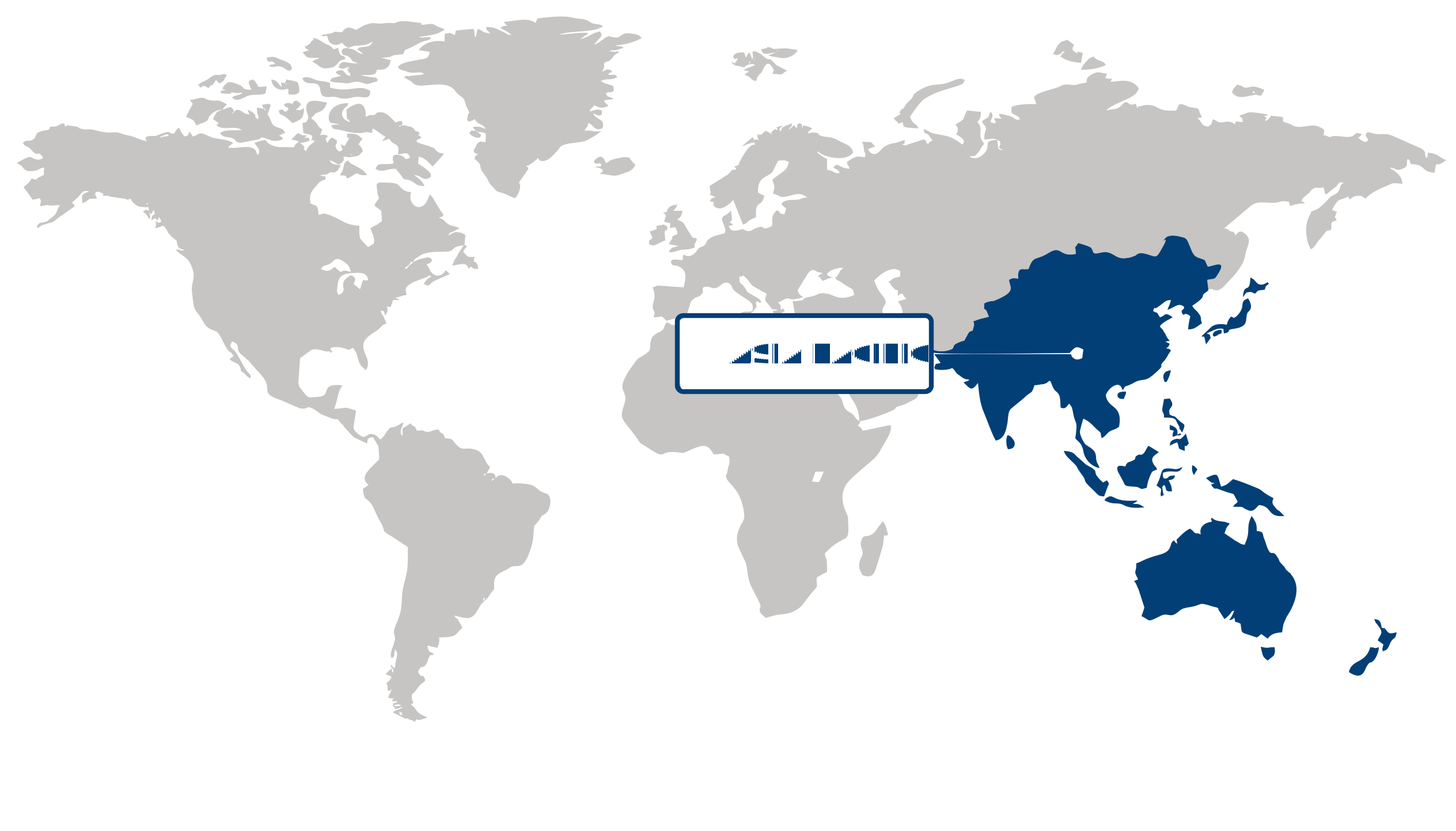
Asia Pacific (Largest Region)
The post-harvest treatment market was led by Asia Pacific in 2026, accounting for a 39.33% share, supported by the region's large agricultural production base and the need to reduce losses occurring between harvesting, storage, transportation, and final consumption. High production volumes of fruits, vegetables, grains, and other perishable commodities create substantial demand for treatments that help preserve quality and extend shelf life. Expanding food processing and organized distribution networks are also encouraging producers and supply-chain participants to adopt improved post-harvest handling practices. In addition, rising food quality expectations, urbanization, and growing awareness of food waste are strengthening investment in technologies that maintain freshness and minimize deterioration. The combination of agricultural intensity and increasing emphasis on efficient food supply chains continues to underpin Asia Pacific's leading position.
North America (Fastest-Growing Region)
North America is emerging as the fastest-growing regional market, driven by increasing emphasis on food safety, quality preservation, and supply-chain efficiency. Producers, processors, and distributors are adopting advanced post-harvest solutions to maintain product quality during storage and transportation while responding to consumer expectations for fresher and longer-lasting food products. Greater attention to reducing food waste is also encouraging the use of preservation and treatment technologies that can improve the usability of agricultural commodities. Furthermore, sophisticated cold-chain infrastructure and an established food processing sector provide favorable conditions for integrating advanced post-harvest treatments. Continued focus on sustainable food production and minimizing losses across the agricultural value chain is expected to support strong regional expansion.
| Parameter | North America | Asia Pacific | Europe | Latin America | MEA |
|---|---|---|---|---|---|
| Innovation Hub i Scale Nascent Developing Advanced | |||||
| Cost-Sensitive Region i Scale Low Medium High | |||||
| Regulatory Environment i Scale Restrictive Neutral Supportive | |||||
| Demand Drivers i Scale Weak Moderate Strong | |||||
| Development Stage i Scale Emerging Developing Developed | |||||
| Adoption Rate i Scale Low Medium High | |||||
| New Entrants / Startups i Scale Sparse Moderate Dense | |||||
| Macro Indicators i Scale Weak Stable Strong |
Key Country Insights
Germany 🇩🇪
Quality Assurance SolutionsGermany emphasizes post-harvest treatment methods that preserve product quality while meeting strict food safety and sustainability expectations. Companies increasingly invest in advanced storage technologies, biological treatments, and precision monitoring systems.
France 🇫🇷
Sustainable Crop PreservationFrance is adopting post-harvest treatment solutions that balance product preservation with sustainability objectives across fruit and vegetable production. French growers increasingly utilize biological treatments and efficient storage systems to minimize post-harvest losses.
Italy 🇮🇹
Export Quality MaintenanceItaly relies on post-harvest treatment technologies to preserve quality for fresh produce supplied to domestic and international markets. Italian producers continue investing in storage optimization, packaging innovation, and treatments that improve product consistency during transport.
Japan 🇯🇵
Fresh Produce ProtectionJapan prioritizes post-harvest treatment solutions that maintain freshness and product quality across domestic distribution channels. Japanese producers increasingly adopt advanced packaging, controlled storage, and preservation technologies for premium agricultural products.
South Korea 🇰🇷
Advanced Storage PracticesSouth Korea is strengthening post-harvest treatment capabilities through improved cold-chain infrastructure and modern storage technologies. Agricultural businesses increasingly integrate preservation solutions that reduce spoilage and support higher-quality produce distribution.
United States 🇺🇸
Supply Chain PreservationThe U.S. continues expanding post-harvest treatment technologies that improve produce quality during storage and long-distance distribution. Food retailers and growers increasingly adopt integrated preservation solutions that reduce waste and extend product shelf life.
Segment Leadership and Growth Trends
Post-harvest Treatment Market Share (%), by Origin, 2026
Go beyond the chart, access full insights & data tables
Request Free Sample ReportOrigin Segment Analysis: Synthetic (Largest Segment) vs Natural (Fastest-Growing Segment)
Synthetic products held the largest position in the post-harvest treatment market, representing a 60.82% share in 2026, supported by their established effectiveness in controlling spoilage, extending shelf life, and maintaining the quality of harvested produce during storage and transportation. Their consistent performance and broad applicability across commercial food supply chains make synthetic treatments an important tool for reducing post-harvest losses. Established handling practices, the need for reliable preservation, and growing pressure to maintain product quality throughout increasingly complex distribution networks continue to support demand for synthetic treatment solutions.
Natural treatments are registering the fastest growth as consumers, food producers, and supply-chain stakeholders increasingly prioritize cleaner and more sustainable approaches to post-harvest preservation. Natural formulations derived from biological or plant-based sources are gaining attention as alternatives that can address quality and shelf-life requirements while aligning with changing preferences around food safety and environmental sustainability. Ongoing development of naturally derived preservation technologies and increasing interest in reducing reliance on conventional chemical treatments are creating favorable conditions for broader adoption across fresh produce supply chains.
Application Segment Analysis: Fruits & Vegetables (Largest & Fastest-Growing Segment)
Fruits & vegetables led the post-harvest treatment market in both size and growth, accounting for a 49.5% share in 2026, owing to the high perishability of fresh produce and the substantial need to preserve appearance, freshness, texture, and nutritional quality after harvesting. These products are particularly vulnerable to microbial deterioration, moisture loss, and physiological changes during handling and distribution, making post-harvest treatments an important component of quality management. Expansion of organized food distribution, longer supply chains, rising demand for fresh produce, and efforts to reduce food waste are strengthening the need for effective preservation solutions. Increasing adoption of natural and sustainable treatment options is also broadening the range of technologies available for fruits and vegetables.
| Segment | Sub-Segment | Largest Segment | Fastest Growing |
|---|---|---|---|
| Origin | Natural, Synthetic | Synthetic | Natural |
| Application | Cereals & Grains, Oilseeds & Pulses, Fruits & Vegetables, Flowers & Ornamentals, Others | Fruits & Vegetables | Fruits & Vegetables |
| Product | Coatings, Cleaners, Fungicides, Insecticides, Ethylene Blockers, Sanitizers, Others | Ethylene Blockers | Coatings |
Unlock insights tailored to your business with our bespoke market research solutions.
Click to get your customized report now.
Competitive Landscape and Market Positioning
Top players in the post-harvest treatment market:
1. JBT Corporation (United States)
2. Syngenta Crop Protection AG (Switzerland)
3. Bayer AG (Germany)
4. BASF SE (Germany)
5. Nufarm Limited (Australia)
6. Citrosol S.A. (Spain)
7. Hazel Technologies Inc. (United States)
8. Janssen PMP (Belgium)
9. Futureco Bioscience S.A. (Spain)
10. Decco Worldwide Post-Harvest Holdings B.V. (Netherlands)
Rising food preservation concerns are strengthening innovation cycles in the post-harvest treatment market. In the post-harvest treatment market, bio-based preservation methods and improved treatment formulations are extending shelf life and reducing losses.
| Company | Market Share | Company Revenue | Revenue CAGR (%) | Product Portfolio | Geographic Presence | Innovation / R&D Focus | Strategic Developments |
|---|---|---|---|---|---|---|---|
| JBT Corporation (United States) | |||||||
| Syngenta Crop Protection AG (Switzerland) | |||||||
| Bayer AG (Germany) | |||||||
| BASF SE (Germany) | |||||||
| Nufarm Limited (Australia) | |||||||
| Citrosol S.A. (Spain) | |||||||
| Hazel Technologies Inc. (United States) | |||||||
| Janssen PMP (Belgium) | |||||||
| Futureco Bioscience S.A. (Spain) | |||||||
| Decco Worldwide Post-Harvest Holdings B.V. (Netherlands). |
Industry Development/News
| Company Name | Date | Key Development |
|---|---|---|
| Produce Investments | May-26 | Produce Investments acquired Biofresh Safestore, a specialist in fixed crop management systems. This acquisition integrates advanced storage optimization and sustainable crop handling technologies into its existing portfolio, significantly strengthening its strategic position in the post-harvest infrastructure sector and supporting long-term, innovation-led growth. |
| Maersk | May-26 | Maersk inaugurated a new packing and cold chain logistics facility in Olmos, Peru. The center enhances its integrated logistics network by providing specialized temperature-controlled handling and packing services, directly optimizing fresh produce supply chains and improving the efficiency of export-oriented post-harvest preservation infrastructure. |
| Citrosol | May-26 | Citrosol introduced the CATsystem, an automated post-harvest technology designed to maintain precise concentrations of fungicides, disinfectants, and food additives. By improving application uniformity, the system enhances crop protection efficiency, significantly reducing spoilage and enabling more controlled, data-driven treatment processes throughout the fresh produce supply chain. |
| Akorn Technology | May-26 | Akorn Technology expanded its global operations into the UAE following a successful FoodTech Challenge win. The company is deploying its natural post-harvest treatment solutions in the region, aimed at extending shelf life and minimizing waste through sustainable, natural coating technologies that address critical post-harvest loss challenges. |
| INI Farms | May-26 | INI Farms successfully executed a 12.6-tonne pomegranate export from India to the United States involving a 37-day transit. This deployment demonstrates a highly controlled post-harvest logistics and packaging capability, proving that advanced handling coordination can maintain perishable quality over extended, complex international supply chains. |
| KitoZyme / Janssen PMP | May-23 | KitoZyme and Janssen PMP entered an exclusive collaboration agreement to evaluate and co-develop KitoZyme’s proprietary technologies for post-harvest applications. The partnership aims to leverage natural-based solutions to enhance crop preservation, combining KitoZyme’s innovative material science with Janssen PMP’s expertise in post-harvest protection. |
| Syngenta AG | Jan-22 | Syngenta AG launched Archive, a specialized fungicide formulated to control diseases affecting produce during the post-harvest stage. This product introduction expands the company’s portfolio of chemical crop protection tools, addressing the critical need for effective disease management to preserve the quality and marketability of produce post-harvest. |
Customize Your Report
Explore examples of how this report can be tailored to different research needs, including custom segments, additional topics or chapters, and related reports. Click a section of the wheel or its numbered marker to explore the available options.
Post-harvest Treatment Market — Custom Segments
| Segment | Sub-Segment |
|---|---|
| Treatment Stage | Pre-Storage Treatment, Storage Treatment, Transport & Distribution Treatment, Retail & Market Treatment |
| Distribution Channel | Direct Sales, Agricultural Cooperatives, Specialty Distributors, Online & Retail Channels |
| Storage Environment | Ambient Storage, Cold Storage, Controlled-Atmosphere Storage |
Post-harvest Treatment Market — Custom TOC
| Custom Chapter | Custom Details |
|---|---|
| Crop-Specific Post-Harvest Loss Reduction Strategies |
|
| Fresh Produce Export Readiness Assessment |
|
| Cold Chain Integration Opportunity Assessment |
|
Need a different cut of the data?
Request Custom ResearchHow much is the post-harvest treatment market worth?
How is the post-harvest treatment industry projected to perform over the next decade?
How is growing global demand for fresh produce driving adoption of post-harvest treatment solutions?
How are stricter food safety regulations influencing treatment selection in the post-harvest treatment market?
Why do synthetic treatments hold the largest share of the post-harvest treatment market?
Why are fruits and vegetables the fastest-growing application in the post-harvest treatment market?
Why is Asia Pacific the leading regional market for post-harvest treatment?
What is driving growth in the North American post-harvest treatment market?
What are the key competitors in the post-harvest treatment landscape?
Our Clients
"The report provided a thorough look at market trends, technological advancements, and the competitive landscape. The depth of insights was really valuable."
ITC Limited
"We would highly recommend Fundamental Business Insights & Consulting to anyone looking for reliable, detailed, and comprehensive market research in the Food industry."
Tyson Foods
"The clarity and presentation of the information were commendable. The report was delivered timely, which made the overall experience smooth and convenient."
Mondelēz International
Our Research Team & Methodology
Every Fundamental Business Insights report is built by a dedicated vertical research team, validated through a structured primary-and-secondary methodology, and reviewed for accuracy before it reaches you.
Research Team Overview
Prepared by the Food & Beverage Research Team
Delivery
Published
Demand
Available
Support
Trust & Compliance
Research Intelligence
Research Workflow & Quality Assurance
Data Collection
Verified information gathered through primary and secondary research.
Data Triangulation
Cross-validation using multiple independent data sources.
Forecast Modelling
Market estimates developed using historical trends and analytical models.
Analyst Validation
Findings reviewed by domain experts for accuracy and consistency.
Editorial & Quality Review
Final editorial, quality, and compliance checks before publication.
Final Publication
Released after successful completion of the internal review process.
Report Coverage
📊 Market Assessment
- Market Size & Forecast
- Market Segmentation
- Regional Analysis
- Growth Drivers & Challenges
- Market Dynamics
🏢 Competitive Intelligence
- Competitive Landscape
- Company Profiles
- Competitive Benchmarking
- Mergers & Acquisitions
- Market Share Analysis or Key Company Strategies
🔍 Strategic Analysis
- Value Chain Analysis
- Porter's Five Forces
- PESTLE Analysis
- Pricing Trends
- Supply-Demand Analysis
🚀 Future Outlook
- Technology Landscape
- Regulatory Landscape
- Investment & Funding Landscape
- Emerging Opportunities
- Future Market Outlook
Have a question about this report or need a custom scope?
Request Customization