Plastics in Personal Protective Equipment Market Size & Forecasts 2026-2035, By Segments (Type, Application), Growth Opportunities, Innovation Landscape, Regulatory Shifts, Strategic Regional Insights (U.S., Japan, China, South Korea, UK, Germany, France), and Competitive Dynamics (3M, Honeywell, DuPont, Ansell, Kimberly-Clark)
Market Size and Growth Outlook
Plastics in Personal Protective Equipment Market size is anticipated to rise from USD 7.87 billion in 2025 to USD 14.5 billion by 2035, reflecting a CAGR surpassing 6.3% over the forecast horizon of 2026-2035. The estimated revenue for 2026 is USD 8.3 billion.
Get more details on this report
Request Free Sample ReportPlastics in Personal Protective Equipment Market Intelligence Snapshot
Regional Market Dynamics
Segment Momentum
Market Expansion Drivers
Leading Market Participants
Global Market Forecast Snapshot
Market Outlook
Regional and Segment Outlook
Market Growth Drivers and Industry Trends
Regulatory tightening and institutional guidance have institutionalized higher baseline demand for protective products, reinforcing procurement cycles and standards for materials. Guidance from the World Health Organization, the U.S. Centers for Disease Control and Prevention, and enforcement by the Occupational Safety and Health Administration (OSHA) have driven specification upgrades that favor reliable polymers and certified assemblies, directly shaping the plastics in personal protective equipment market. Established manufacturers can leverage certified production scale and supply-chain assurance, while new entrants can differentiate through compliance-focused services and rapid third-party certification. As public health agencies and regulators continue to update standards, demand tied to compliance remains a persistent structural support for product innovation and supplier consolidation.
Innovation in Lightweight and Durable Plastics
Advances in polymer formulations and processing reduce wearer fatigue and improve protection, shifting buyer preferences toward higher-performance, lower-weight solutions used in eyewear, visors, and respirator components. Material specialists such as Covestro and BASF and integrated PPE suppliers like 3M spotlight high-strength polycarbonates and engineered thermoplastics that enable slimmer profiles and enhanced durability, affecting the plastics in personal protective equipment market. incumbent resin producers can form co-development partnerships with OEMs to embed materials early in design cycles, while startups can target niche performance attributes (e.g., anti-fog or recyclability). Continued technology-driven product refinement will make comfort and lifecycle performance primary purchase criteria.
Government Support for Industrial Safety Initiatives
Direct procurement, domestic manufacturing incentives, and research funding from agencies and programs are reshaping supply-chain geometry and buyer preferences; examples include initiatives linked to the U.S. Department of Labor, guidance and research from the National Institute for Occupational Safety and Health (NIOSH), and procurement frameworks within the European Commission. Such policy actions influence specifications, onshoring decisions, and stockpile strategy, thereby affecting the plastics in personal protective equipment market. Large suppliers can capture public contract volumes and invest in compliant capacity, while smaller firms can access grant-funded pilot programs to prove technologies. Observable shifts in public procurement and grant programs point to sustained demand for certified, locally sourced solutions.
Industry Restraints:
Certification and Regulatory Compliance Burdens — Complex, multi-jurisdictional certification regimes and evolving chemical restrictions materially slow product development and market entry. Mandatory respirator certification by CDC/NIOSH, FDA emergency use pathways for medical PPE, and chemical restrictions enforced by the European Chemicals Agency (ECHA/REACH) constrain polymer selection, testing cycles, and labeling, while UNEP and WHO guidance on PPE disposal raise end‑of‑life compliance requirements. 3M and Ansell have cited certification timelines in investor communications as drivers of capital allocation to compliance teams. Strategically, incumbents with regulatory expertise and certified manufacturing (e.g., 3M, Honeywell) can absorb lead times; smaller converters and startups face higher cost and time barriers. Expect continued regulatory tightening and pre‑market scrutiny, forcing manufacturers to invest in compliant formulations and third‑party testing partnerships in the near to medium term.
Supply Chain and Resin Volatility — Dependence on concentrated polymer feedstocks and global logistics makes supply reliability a binding constraint for PPE plastics. IHS Markit documented acute polyethylene/polypropylene tightness during COVID‑19, and Dow and BASF public statements referenced feedstock and capacity constraints that limited downstream conversion. 3M and Honeywell reported production ramps hampered at times by raw‑material availability, while UNCTAD and shipping industry data showed persistent transport disruption risks. For market participants, vertically integrated firms gain resilience and margin protection, whereas contract manufacturers and new entrants face volatile input costs and delivery uncertainty. The strategic response—regionalization of supply, long‑term offtakes, and inventory buffering—will continue to shape competitive positioning and capital investment priorities over the next several years.
| Growth Driver | Impact on CAGR | Regulatory Influence | Geographic Relevance | Adoption Rate | Impact Timeline |
|---|---|---|---|---|---|
| Increased PPE demand due to health & safety regulations | 2.50% | Short term (≤ 2 yrs) | North America, Europe; Spillover: Asia Pacific | High | Fast |
|
Explore Growth Opportunities Request Free Sample Report |
|||||
| Innovation in lightweight & durable plastics | 2.00% | Medium term (2–5 yrs) | Europe, Asia Pacific | Medium | Moderate |
|
Explore Growth Opportunities Request Free Sample Report |
|||||
| Government support for industrial safety initiatives | 1.80% | Long term (5+ yrs) | North America; Spillover: MEA | High | Moderate |
|
Explore Growth Opportunities Request Free Sample Report |
Regional Demand Dynamics
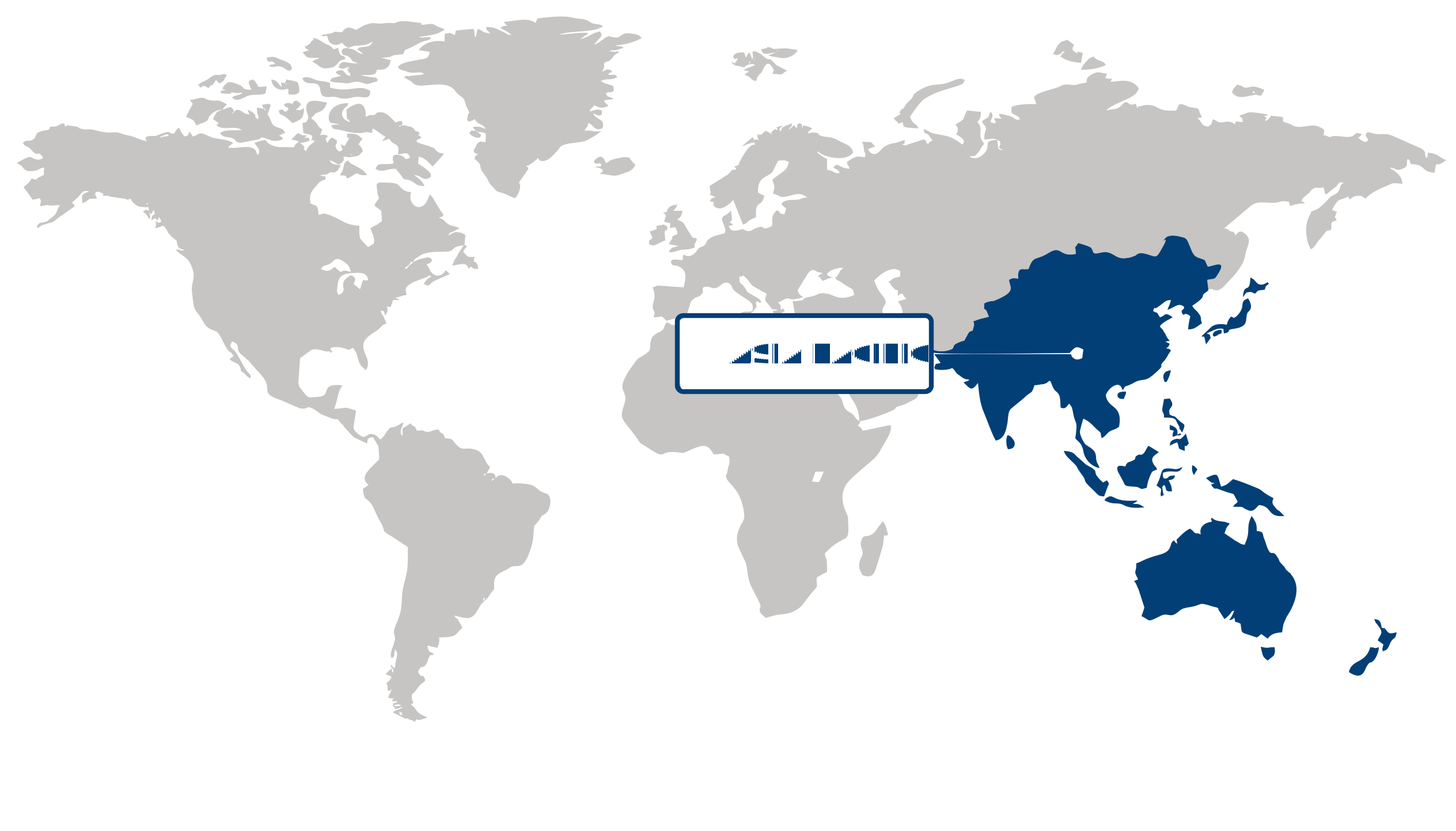
Asia Pacific captured over 48.5% of the global plastics in personal protective equipment market in 2025. This leadership reflects a fast pace of industrialization and a steadily growing regional population that together drive large-scale demand for both disposable and engineered plastic PPE, reinforced by policy-driven manufacturing upgrades and expanded public procurement. Evidence includes Asian Development Bank analysis of manufacturing expansion in Southeast and East Asia, United Nations Department of Economic and Social Affairs population data showing sustained regional populations, and World Health Organization guidance that has institutionalized PPE use across health systems. National initiatives such as China’s Ministry of Industry and Information Technology modernization policies and Japan’s Ministry of Economy, Trade and Industry programs to digitize factories further concentrate capacity and innovation. These dynamics create near-term scale plays and medium-term premium niches, making the region attractive for capacity investments, localized value chains, and material-innovation partnerships.
Japan is positioned as a pivotal hub in Asia Pacific; the plastics in personal protective equipment market benefits from high-precision polymer manufacturing, strict regulatory quality that enables premium product positioning, and steady institutional procurement. Japan’s Ministry of Economy, Trade and Industry (METI) programs to accelerate smart manufacturing and the Ministry of Health, Labour and Welfare (MHLW) standards for medical devices encourage automation, traceability, and higher-margin engineered plastics such as reusable face shields and medical gowns. Japan External Trade Organization (JETRO) documentation on advanced materials exports and corporate investments in contamination-control facilities illustrates how Japanese firms capture specialty segments. Strategically, Japan offers investors and partners opportunities to pilot high-value, eco-improved materials and scale best-practice production that can be exported across the region.
China anchors the region's scale dynamics; the plastics in personal protective equipment market is driven by large domestic consumption and concentrated manufacturing capacity that lower unit costs and enable rapid surge response. Policy signals from the Ministry of Industry and Information Technology (MIIT) and the National Medical Products Administration (NMPA), together with procurement activity cited by the China National Health Commission (NHC), have expanded both domestic output and export readiness. Government manufacturing modernization efforts (including Made in China initiatives) and efficient port logistics support export-oriented supply chains, while local firms increasingly invest in automated molding and sustainable-material trials. For investors, China remains the center for volume plays, regional distribution hubs, and partnerships that can scale new polymer formulations across Asia Pacific.
North America Market Analysis:
North America emerged as the fastest-growing region at a CAGR of 8.82%; the plastics in personal protective equipment market is being reconfigured by an accelerating push toward recycling and adoption of bioplastics that reduce lifecycle impacts. Policy levers such as the U.S. Environmental Protection Agency’s National Recycling Strategy and the U.S. Department of Agriculture’s BioPreferred Program are directing procurement and materials standards toward recycled and biobased feedstocks, while manufacturers like NatureWorks are scaling PLA capacity and specialty resin makers are piloting compostable and mechanically recycled grades. Firms including 3M have cited sustainability targets in their corporate sustainability reports that influence product design and supplier requirements. These dynamics—policy-pull, supplier innovation, and buyer demand—create durable openings for recyclable/biobased PPE components across healthcare, industrial, and public-sector channels.
The U.S. functions as the region’s innovation and procurement hub for the plastics in personal protective equipment market, where federal purchasing and health-system sustainability commitments accelerate uptake of recycled and biobased solutions. Federal programs such as the U.S. Department of Agriculture’s BioPreferred Program and procurement practices tied to the Department of Health and Human Services’ Strategic National Stockpile shape large-volume demand, while the National Institute for Occupational Safety and Health (NIOSH) and FDA requirements guide material approvals and reuse protocols. Private buyers—exemplified by health systems with published sustainability goals—and domestic manufacturers’ investments in recycled-content processing and biopolymer blends create shorter, more traceable supply chains; 3M’s and other suppliers’ sustainability reports document these shifts. Strategically, U.S. procurement scale and regulatory clarity convert regional innovation into repeatable product platforms, anchoring North American leadership in recyclable and biobased PPE.
Europe Market Trends:
Europe maintained a substantial share of the plastics in personal protective equipment market, supported by a mature regulatory framework, entrenched healthcare procurement and industrial scale-up during recent public-health events. The European Commission’s PPE Regulation (EU) 2016/425 and guidance from the European Centre for Disease Prevention and Control have tightened standards and created predictable demand signals, while the European Chemicals Agency’s REACH oversight and the European Commission’s Circular Economy Action Plan are accelerating interest in recyclable polymers. Corporate examples such as 3M press releases on expanded European production and Honeywell statements on capacity increases illustrate operational scaling. Given policy alignment, buyer consolidation and sustainability pressure, Europe offers investors notable opportunities in higher-value, compliant plastics and recycling-enabled PPE solutions.
Germany serves as a leading manufacturing hub in the plastics in personal protective equipment market, leveraging precision engineering, polymer expertise and stringent occupational-safety governance. The Federal Institute for Occupational Safety and Health (BAuA) enforces robust workplace PPE requirements that raise demand for certified plastics designs, and Drägerwerk AG & Co. KGaA has publicly detailed capacity expansions and product certifications to meet hospital and industrial orders. BASF’s materials initiatives and a dense network of specialized contract manufacturers enable rapid prototyping and automated production runs. Strategically, Germany’s manufacturing depth makes it an ideal base to scale compliant, high-margin PPE plastics and to pilot circular-material programs for export across Europe.
France acts as a major demand center in the plastics in personal protective equipment market, driven by centralized healthcare procurement, national stockpiling and active regulatory oversight. The Ministère des Solidarités et de la Santé and Santé publique France have coordinated PPE sourcing and clinical guidance that favor domestically certified solutions, while Agence Nationale de Sécurité du Médicament (ANSM) clarifies device classifications affecting plastic components. French government measures to support local converters during surge periods demonstrate rapid market activation for polymer-based PPE. For investors and strategists, France’s concentrated purchasing and regulatory clarity provide a channel to commercialize compliant, sustainably oriented plastics solutions for large public-health contracts across Europe.
| Parameter | North America | Asia Pacific | Europe | Latin America | MEA |
|---|---|---|---|---|---|
| Innovation Hub i Scale Nascent Developing Advanced | |||||
| Cost-Sensitive Region i Scale Low Medium High | |||||
| Regulatory Environment i Scale Restrictive Neutral Supportive | |||||
| Demand Drivers i Scale Weak Moderate Strong | |||||
| Development Stage i Scale Emerging Developing Developed | |||||
| Adoption Rate i Scale Low Medium High | |||||
| New Entrants / Startups i Scale Sparse Moderate Dense | |||||
| Macro Indicators i Scale Weak Stable Strong |
Segment Leadership and Growth Trends
Plastics in Personal Protective Equipment Market Share (%), by Type, 2026
Go beyond the chart, access full insights & data tables
Request Free Sample ReportPolypropylene (PP) dominated the plastics in personal protective equipment market within the Type segment as the largest share in 2025. PP’s leadership is rooted in its lightweight, durability and cost-efficiency that make it the preferred material in high-volume disposable items such as masks, gowns and liners, directly reflecting the cited growth driver; 3M product literature and DuPont materials science commentary note widespread use of meltblown and spunbond PP in respiratory and gown applications. Customer demand for single-use, low-cost protection, coupled with regulatory enforcement by agencies like the U.S. Occupational Safety and Health Administration (OSHA) and infection-control guidance from the World Health Organization (WHO), has reinforced manufacturer scale-up and supply-chain investment. Strategic opportunities include process optimization and recycled-PP innovations for incumbents and niche entrants targeting sustainable or higher-performance variants. Given ongoing healthcare hygiene priorities and regulatory scrutiny, the PP segment should retain centrality in near- to medium-term PPE sourcing and product development.
Analysis by Application
Protective Clothing represented largest share in 2025 in the plastics in personal protective equipment market within the Application segment. This segment leads because stricter workplace safety regulations and elevated healthcare hygiene standards have driven adoption of plastic-based gowns, coveralls and aprons—an effect underscored by WHO PPE guidance and the European Commission’s PPE Regulation (EU) 2016/425—supporting demand for polymeric solutions that balance barrier performance and disposability. Market preferences for comfort, ease of donning/doffing, and lifecycle costs have pushed suppliers such as DuPont and Honeywell to advance fabric laminates and coating technologies, while procurement policies and nearshoring trends reshape supply chains. Opportunities exist for established firms to bundle certification and sustainability credentials, and for startups to commercialize recyclable or reusable polymeric garments. With persistent infection-control needs, industrial safety mandates, and technology-driven material improvements, protective clothing segments are expected to remain strategically important in the near to medium term.
| Segment | Sub-Segment | Largest Segment | Fastest Growing |
|---|---|---|---|
| Type | Polypropylene (PP), Polyethylene (PE), Polyurethane (PU), Polyvinyl chloride (PVC), Polycarbonate (PC), Others | ||
| Application | Head, Eye & Face Protection, Hearing Protection, Protective Clothing, Respiratory Protection, Protective Footwear, Fall Protection, Hand Protection, Others |
Unlock insights tailored to your business with our bespoke market research solutions.
Click to get your customized report now.
Competitive Landscape and Market Positioning
Competitive dynamics revolve around broadening material capabilities, securing specialty resin streams, and shortening development-to-supply cycles through cross-industry alignments. The Top 10 players are advancing engineered formulations, embedding barrier and antimicrobial functions into films and molded components, and expanding production footprints to meet institutional procurement needs. Emphasis on certification pathways, supplier continuity, and differentiated service models is reshaping purchasing criteria, compressing development timelines, and raising the operational thresholds required for new entrants to scale.
Strategic / Actionable Recommendations for Regional Players
Prioritize collaboration with advanced-materials developers and large institutional buyers to co-develop higher-performance polymer components and accelerate qualification. Selective investment in automation and modular production capacity will help convert R&D into rapid supply for healthcare and industrial tenders while leveraging established distributor relationships to broaden commercial uptake.
Form local manufacturing and sourcing partnerships to capture volume-led opportunities without compromising material quality. Emphasize cost-effective processing innovations, digital inventory controls, and alignment with regional certification norms to serve construction, manufacturing, and growing clinical segments more competitively.
Differentiate through sustainability and regulatory alignment by adopting recyclable or bio-based polymer options and enhanced traceability. Deepen engagement with testing bodies and occupational purchasers to validate premium offerings, and pair products with lifecycle services and training to win high-value industrial and institutional accounts.
| Company | Market Share | Company Revenue | Revenue CAGR (%) | Product Portfolio | Geographic Presence | Innovation / R&D Focus | Strategic Developments |
|---|---|---|---|---|---|---|---|
| No companies available. | |||||||
Industry Development/News
| Company Name | Date | Key Development |
|---|
Customize Your Report
Explore examples of how this report can be tailored to different research needs, including custom segments, additional topics or chapters, and related reports. Click a section of the wheel or its numbered marker to explore the available options.
Plastics in Personal Protective Equipment Market — Custom Segments
| Segment | Sub-Segment |
|---|---|
| No segment data available. | |
Plastics in Personal Protective Equipment Market — Custom TOC
| Custom Chapter | Custom Details | ||
|---|---|---|---|
| No custom TOC data available. | |||
Need a different cut of the data?
Request Custom ResearchHow large is the plastics in personal protective equipment market?
What is the anticipated CAGR of the plastics in personal protective equipment industry?
Which part of the world shows the greatest dominance in the plastics in personal protective equipment market?
What is the fastest growing region in the plastics in personal protective equipment sector?
How much is the polypropylene (PP) segment expected to grow in the plastics in personal protective equipment industry beyond 2025?
What factors give protective clothing segment a competitive edge in the plastics in personal protective equipment sector?
Who holds a significant market share in the plastics in personal protective equipment landscape?
Our Clients
"The report helped us understand emerging consumer trends in our product category. It clarified where to focus innovation for the next product launch."
LyondellBasell
"The regional forecast section was incredibly useful. We were able to identify two new potential partners in Europe thanks to the vendor mapping you included."
SABIC
"We appreciated how actionable the recommendations were. It guided us to improve supply chain resilience."
Olin Corporation
Our Research Team & Methodology
Every Fundamental Business Insights report is built by a dedicated vertical research team, validated through a structured primary-and-secondary methodology, and reviewed for accuracy before it reaches you.
Research Team Overview
Prepared by the Chemicals & Materials Research Team
Delivery
Published
Demand
Available
Support
Trust & Compliance
Research Intelligence
Research Workflow & Quality Assurance
Data Collection
Verified information gathered through primary and secondary research.
Data Triangulation
Cross-validation using multiple independent data sources.
Forecast Modelling
Market estimates developed using historical trends and analytical models.
Analyst Validation
Findings reviewed by domain experts for accuracy and consistency.
Editorial & Quality Review
Final editorial, quality, and compliance checks before publication.
Final Publication
Released after successful completion of the internal review process.
Report Coverage
📊 Market Assessment
- Market Size & Forecast
- Market Segmentation
- Regional Analysis
- Growth Drivers & Challenges
- Market Dynamics
🏢 Competitive Intelligence
- Competitive Landscape
- Company Profiles
- Competitive Benchmarking
- Mergers & Acquisitions
- Market Share Analysis or Key Company Strategies
🔍 Strategic Analysis
- Value Chain Analysis
- Porter's Five Forces
- PESTLE Analysis
- Pricing Trends
- Supply-Demand Analysis
🚀 Future Outlook
- Technology Landscape
- Regulatory Landscape
- Investment & Funding Landscape
- Emerging Opportunities
- Future Market Outlook
Have a question about this report or need a custom scope?
Request Customization