Industrial Protective Fabrics Market Size & Forecasts 2026-2035, By Segments (Product, End-Use, Applications), Growth Opportunities, Innovation Landscape, Regulatory Shifts, Strategic Regional Insights (U.S., Japan, China, South Korea, UK, Germany, France), and Competitive Dynamics (DuPont, 3M, Honeywell, Avon Protection, Lakeland Industries)
Market Size and Growth Outlook
Industrial Protective Fabrics Market size is likely to expand from USD 5.75 billion in 2025 to USD 14.12 billion by 2035, posting a CAGR above 9.4% across 2026-2035. The industry’s revenue potential for 2026 is USD 6.22 billion.
Get more details on this report
Request Free Sample ReportIndustrial Protective Fabrics Market Intelligence Snapshot
Regional Market Dynamics
Segment Momentum
Market Expansion Drivers
Leading Market Participants
Global Market Forecast Snapshot
Market Outlook
Regional and Segment Outlook
Market Growth Drivers and Industry Trends
Escalating modernization and force-protection programs are directly elevating demand in the industrial protective fabrics market as militaries and heavy industries prioritize survivability and worker safety. Observable procurement activity from the U.S. Department of Defense and capability-driven initiatives under NATO, alongside supplier activity such as TenCate and DuPont press releases highlighting ballistic and blast-mitigation contracts, underline this trend. Established suppliers can leverage scale and certification depth to secure long-term contracts, while new entrants can pursue niche certifications (chemical/thermal barriers) and rapid prototype-to-test cycles. Given ongoing defense modernization budgets and tightened workplace-safety enforcement by OSHA and the International Labour Organization, demand is set to remain programme-driven and procurement-led.
Technological innovations in high-performance fabrics
Advances in fiber chemistry, composite laminates and smart coatings are reshaping the industrial protective fabrics market by enabling lighter, multifunctional and digitally compatible protective solutions. Public R&D investments and announcements—from DARPA funding for next-generation fibers to DuPont’s and Honeywell’s product filings (Kevlar, Spectra) and Toray and Teijin technology roadmaps—demonstrate an industry push toward higher performance and integration with sensors/coatings. Incumbents can monetize IP and scale manufacturing, while entrants can partner on co-development or target specialty niches (e.g., electroconductive or self-healing textiles). Observable corporate R&D pipelines and government-funded programs indicate continuing commercialization of higher-performance solutions.
Expansion of end-use industries such as construction and automotive
Broader adoption across construction and automotive sectors is diversifying demand drivers for the industrial protective fabrics market as these industries seek improved occupant safety, lightweighting and worker protection. Regulatory and standards influences—from Euro NCAP safety testing to construction workplace guidance by the International Labour Organization and OSHA—plus supplier engagements by automotive Tier‑1s and OEMs such as Ford Motor Company and component suppliers like Autoneum and major equipment firms including Caterpillar, signal rising specification requirements for advanced textiles. Incumbents can expand into engineered commodity agreements and aftermarket retrofits; new entrants can offer tailored, application-specific solutions and rapid certification support. With continued regulatory focus and OEM material-substitution programs, cross-sector adoption is expected to accelerate along verifiable specification paths.
Industry Restraints:
Regulatory Compliance Burdens — Stringent product and chemical regulations raise costs and extend time‑to‑market for protective fabrics. Standards such as NFPA 2112 and EN ISO 11612 and OSHA PPE requirements demand extensive testing and certification, while European Chemicals Agency (ECHA) restrictions under REACH on PFAS and other additives force material reformulation and supplier qualification. Evidence from ECHA’s PFAS regulatory activity and mandatory certification regimes illustrates recurring redesign and testing cycles that increase unit costs and complexity. Strategically, large incumbents can absorb certification burdens and leverage scale; smaller suppliers and new entrants face higher capital, testing and compliance hurdles. Given persistent regulatory focus on worker safety and chemicals, compliance burdens will remain a gating factor that shapes product portfolios and market entry in the near‑to‑medium term.
Supply Chain Vulnerabilities — Concentrated upstream supply and specialty input dependence create availability and pricing volatility that constrains production ramp‑up. Key feedstocks such as aramid fibers are dominated by producers including DuPont and Teijin, while specialty coatings and additives have faced disruption and regulatory-driven reformulation. The World Health Organization (WHO) documented global PPE shortages during COVID‑19, and manufacturers like 3M and Honeywell publicly reported capacity responses, underscoring systemic fragility. For market participants, incumbents with long-term supplier contracts or vertical integration enjoy resilience; new entrants encounter longer lead times, higher inventory requirements and constrained margins. Expect continued investment in supplier diversification, regional sourcing and strategic inventories, making supply resilience a structural limiter on rapid market expansion.
| Growth Driver | Impact on CAGR | Regulatory Influence | Geographic Relevance | Adoption Rate | Impact Timeline |
|---|---|---|---|---|---|
| Rising demand for protective fabrics in industrial and military applications | 3.00% | Short term (≤ 2 yrs) | North America, Europe | Medium | Fast |
| Technological innovations in high-performance fabrics | 3.00% | Medium term (2–5 yrs) | Asia Pacific, Europe | Medium | Moderate |
| Expansion of end-use industries such as construction and automotive | 3.40% | Long term (5+ yrs) | Asia Pacific, North America | Low | Moderate |
Explore Growth Opportunities
Request Free Sample ReportRegional Demand Dynamics
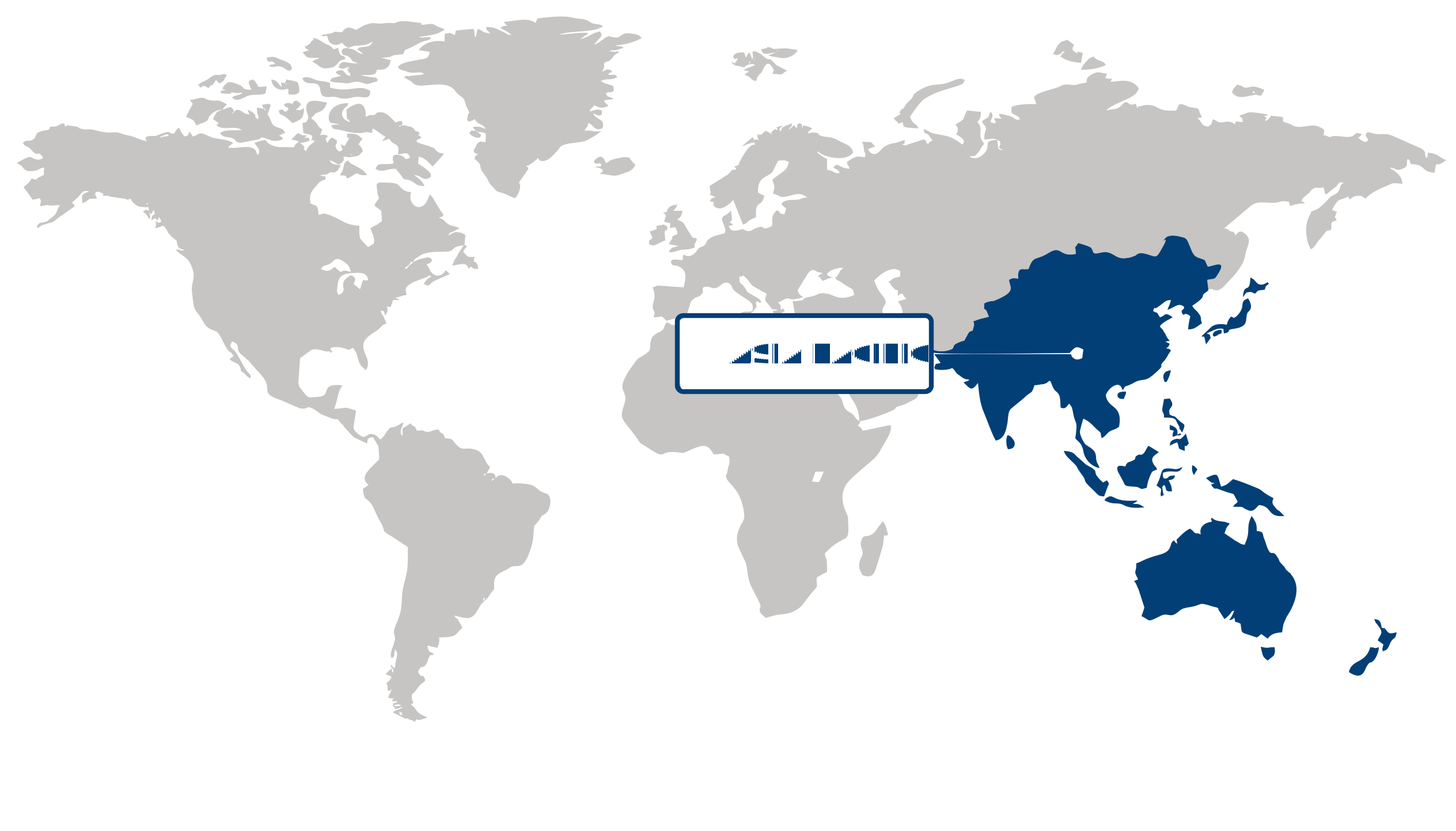
Asia Pacific captured over 36.69% of the global industrial protective fabrics market in 2025 and stands as the largest regional player by share, driven primarily by massive growth in automotive manufacturing and heavy engineering across the region. Robust vehicle output in China and sustained capital spending on industrial projects in Japan and other markets have increased demand for flame-resistant, cut-resistant, and chemical-protective textiles used on assembly lines and in heavy fabrication sites; this trend is visible in production and investment data from the China Association of Automobile Manufacturers (CAAM) and corporate capacity announcements such as Toyota Motor Corporation and BYD. Parallel demand is reinforced by major contracts and order books reported by Mitsubishi Heavy Industries and SANY, while policy signals from the Ministry of Industry and Information Technology (MIIT) and worker-safety guidance from Japan’s Ministry of Health, Labour and Welfare raise specifications for protective gear. These converging dynamics create a favorable runway for higher-specification industrial protective fabrics and value-added textile solutions across Asia Pacific.
Japan is positioned as a pivotal hub in Asia Pacific where the industrial protective fabrics market benefits from advanced manufacturing requirements and stringent workplace-safety expectations: domestic OEMs and tier-1 suppliers require higher-performance fabrics for paint shops, battery assembly, and heavy-equipment maintenance. Evidence includes production-era modernization and safety-focused initiatives reported by the Japan Automobile Manufacturers Association (JAMA) and product-application disclosures from Toyota Motor Corporation and Mitsubishi Heavy Industries. Japan’s regulatory and standards environment raises demand for certified protective textiles, encouraging local suppliers and specialty textile firms to move up the value chain. Strategically, Japan’s focus on high-spec applications complements broader regional scale by creating premium product benchmarks that exporters and regional manufacturers can adopt.
China anchors the Asia Pacific market with volume-driven demand for the industrial protective fabrics market as its automotive scale and heavy machinery builds translate directly into bulk and technical textile requirements. China’s production growth, detailed in CAAM statistics and capacity expansion announcements from companies such as BYD and SAIC Motor, alongside large equipment orders and manufacturing expansion from Sinomach and SANY, have increased procurement of protective fabrics across construction, manufacturing, and automotive supply chains. Policy support from MIIT for industrial upgrading and frequent corporate safety directives amplify specification-driven purchasing, while the country’s dense supplier networks and logistics hubs enable rapid scaling of textile supply. For investors and strategists, China’s combination of volume, policy momentum, and integrated supply chains offers opportunities to capture scale and introduce higher-margin technical fabric products into regional distribution channels.
North America Market Analysis:
North America emerged as the fastest-growing region in the industrial protective fabrics market, registering a CAGR of 11.28%. Growth is being driven by stricter workplace-safety enforcement and rapid adoption of smart protective textiles: the Occupational Safety and Health Administration (OSHA) and the National Institute for Occupational Safety and Health (NIOSH) have elevated standards and research funding that prioritize advanced protective materials. Corporations such as Honeywell International, 3M and DuPont are commercializing sensor-integrated, flame- and chemical-resistant fabrics, while the United States-Mexico-Canada Agreement (USMCA) supports resilient cross-border sourcing and scale. Demand for lower-carbon, reusable solutions—reinforced by U.S. Environmental Protection Agency (EPA) sustainability initiatives—and digital integration in PPE procurement create sizable commercial opportunities across industrial end markets.
The U.S. functions as the innovation and procurement engine for the industrial protective fabrics market, concentrating federal procurement, defense R&D and large-scale industrial buyers. Department of Defense purchasing and programs at the U.S. Army Natick Soldier Research, Development and Engineering Center (NSRDEC) accelerate deployment of mission-specific smart textiles, while OSHA enforcement compels widespread corporate compliance across oil & gas, construction and manufacturing. Product launches and press releases from Honeywell International, 3M and DuPont demonstrate commercialization pathways that de-risk scale-up, and NIOSH standards work helps certify new offerings. Strategic implication: U.S. regulatory rigor, defense procurement and private-sector commercialization together lower barriers for advanced-materials entrants and amplify North American market potential.
Europe Market Trends:
industrial protective fabrics market held a substantial share in Europe, supported by a dense industrial base, evolving procurement practices, and regulatory pressure that favor higher-performance and lower-impact materials. European Commission initiatives such as the Circular Economy Action Plan and Green Deal, together with European Chemicals Agency (ECHA) scrutiny of PFAS, have prompted material reformulation and greater emphasis on durability and recyclability; EU-OSHA guidance and International Labour Organization (ILO) standards reinforce certified use in workplaces. Research from Fraunhofer IFAM and targeted financing from the European Investment Bank (EIB) demonstrate active innovation and commercialization pathways. These converging signals create a meaningful opportunity to scale premium, compliance-driven protective textiles across the region.
industrial protective fabrics market in Germany serves as a regional technology and standards hub, driven by high-specification industrial demand and strict occupational safety frameworks. Guidance and testing expectations set by Bundesanstalt für Arbeitsschutz und Arbeitsmedizin (BAuA) and DGUV raise baseline product requirements, while Fraunhofer IFAM and VDMA members advance material innovation and automated production capabilities. BAuA and DGUV conformity regimes increase buyer willingness to invest in certified, longer‑life solutions, and German OEM procurement preferences historically favor local, high-performance suppliers. Strategic implication: Germany is an ideal launch market for premium, innovation-led products that can be replicated across Europe.
industrial protective fabrics market in France plays a pivotal role through concentrated public procurement and end‑market demand from energy and aerospace clusters. Technical advisories from INRS (Institut National de Recherche et de Sécurité) and the French Ministry of Labour (Ministère du Travail) shape specification and compliance expectations, while major employers such as EDF and Safran publicly emphasize HSE standards that translate into multiyear sourcing programs. INRS guidance and ministry advisories steer adoption toward certified materials, offering suppliers a route to secure long‑duration contracts and to demonstrate compliance-led differentiation for broader European expansion.
| Parameter | North America | Asia Pacific | Europe | Latin America | MEA |
|---|---|---|---|---|---|
| Innovation Hub i Scale Nascent Developing Advanced | |||||
| Cost-Sensitive Region i Scale Low Medium High | |||||
| Regulatory Environment i Scale Restrictive Neutral Supportive | |||||
| Demand Drivers i Scale Weak Moderate Strong | |||||
| Development Stage i Scale Emerging Developing Developed | |||||
| Adoption Rate i Scale Low Medium High | |||||
| New Entrants / Startups i Scale Sparse Moderate Dense | |||||
| Macro Indicators i Scale Weak Stable Strong |
Segment Leadership and Growth Trends
Industrial Protective Fabrics Market Share (%), by Product, 2026
Go beyond the chart, access full insights & data tables
Request Free Sample ReportDurable dominated the industrial protective fabrics market Product segment in 2025 as the largest share, reflecting strong demand for long-lasting protective solutions in industrial settings driven by lifecycle-cost considerations and asset-protection priorities. Leadership stems from the segment’s alignment with manufacturers’ preference for reusable, high-performance textiles that reduce total cost of ownership and waste, a trend reinforced by DuPont product developments and Occupational Safety and Health Administration (OSHA) guidance emphasizing durable personal protective equipment. Supply-chain improvements in polymer processing and textile coatings, plus corporate sustainability commitments, have encouraged procurement teams to favor durable options. This creates advantages for incumbent suppliers with scale and R&D and for niche entrants offering specialty coatings or recycling services, and the segment should remain central near term as firms balance safety, cost efficiency, and circularity objectives.
Analysis by End-Use
Industrial represented largest share in the industrial protective fabrics market End-Use segment in 2025, underpinned by stringent workplace safety regulations across manufacturing sectors and robust demand from heavy industry. The segment leads because regulatory enforcement from agencies such as the Occupational Safety and Health Administration (OSHA) and policy focus from the International Labour Organization (ILO) drive mandated adoption of certified protective textiles, while large industrial buyers prioritize proven suppliers and traceable supply chains. Digital procurement, workforce safety programs, and upskilling initiatives boost demand for higher-spec fabrics. Established firms benefit from compliance credentials and testing capacity, while agile entrants can capture niches with specialized certifications; continued regulatory scrutiny and industrial modernization will keep this segment strategically important through the near to medium term.
Analysis by Applications
Mechanical Protective held largest share in the industrial protective fabrics market Applications segment in 2025 as the principal area of consumption, supported by rising risks of workplace injuries in heavy-duty operations and a shift to higher-performance cut- and abrasion-resistant materials. The segment’s leadership is tied to explicit end-user safety requirements and standards referenced by the National Institute for Occupational Safety and Health (NIOSH) and ANSI, and to product introductions from suppliers such as HexArmor addressing mechanical-hazard exposure. Changing workforce profiles, aging equipment, and OEM maintenance regimes have increased demand for garments that extend worker protection and reduce downtime. Opportunities exist for legacy manufacturers to bundle certification and training services and for startups to differentiate through advanced fiber technologies and digital traceability, keeping the segment central as operational safety and regulatory alignment remain priorities.
| Segment | Sub-Segment | Largest Segment | Fastest Growing |
|---|---|---|---|
| Product | Disposable, Durable | ||
| End-Use | Commercial, Residential, Industrial | ||
| Applications | Limited General-Use, Clean Room, Mechanical Protective, Flame Retardant Apparel, Chemical Defending Garments, Others |
Unlock insights tailored to your business with our bespoke market research solutions.
Click to get your customized report now.
Competitive Landscape and Market Positioning
The competitive landscape is shaped by deliberate expansion of technological depth and channel reach across the top players. Established material houses are extending application engineering and service support to capture specification-led accounts, while specialist PPE manufacturers are tightening upstream relationships to secure differentiated inputs and speed new product introductions. Investment in advanced textile treatments, lighter composite constructions, and improved testing capabilities is observable, and many firms are broadening geographic coverage through tighter commercial links and localized production. These dynamics push larger groups toward integrated, solution-oriented offerings, encourage niche players to double down on certification and customization, and force regional suppliers to optimize cost, quality, and delivery.
Strategic / Actionable Recommendations for Regional Players
For the first region, prioritize deeper alignment with industrial end users and material innovators to move beyond commodity sales. Strengthen technical services around specification support and aftermarket performance verification, and selectively adopt advanced fibres and coatings to win high-value accounts in energy, utilities, and industrial maintenance.
For the second region, accelerate capability building across manufacturing and quality systems to meet rising demand while improving margin capture. Leverage licensing or joint development with technology holders to upgrade product performance, and target infrastructure and construction sub-segments where scale and local responsiveness provide a competitive edge.
For the third region, emphasize premium differentiation through sustainability credentials, niche high-performance offerings, and collaboration with research centres for next‑generation fibres and test protocols. Focus on premium OEM partnerships and certification pathways to defend margin while responding to tightening regulatory and procurement standards.
| Company | Market Share | Company Revenue | Revenue CAGR (%) | Product Portfolio | Geographic Presence | Innovation / R&D Focus | Strategic Developments |
|---|---|---|---|---|---|---|---|
| No companies available. | |||||||
Customize Your Report
Explore examples of how this report can be tailored to different research needs, including custom segments, additional topics or chapters, and related reports. Click a section of the wheel or its numbered marker to explore the available options.
Industrial Protective Fabrics Market — Custom Segments
| Segment | Sub-Segment |
|---|---|
| No segment data available. | |
Industrial Protective Fabrics Market — Custom TOC
| Custom Chapter | Chapter Details | ||
|---|---|---|---|
| No custom TOC data available. | |||
Need a different cut of the data?
Request Custom ResearchHow large is the industrial protective fabrics market?
How will the industrial protective fabrics industry grow in terms of size and CAGR by 2035?
Which region shows the largest market footprint in the industrial protective fabrics market?
Which region is experiencing the fastest growth in the industrial protective fabrics sector?
Why is the durable segment leading in the industrial protective fabrics industry?
Why does industrial sub-segment dominate the end-use segment of industrial protective fabrics sector?
How much is the mechanical protective segment expected to grow in the industrial protective fabrics industry beyond 2025?
Who holds a significant market share in the industrial protective fabrics landscape?
Our Clients
"The report helped us understand emerging consumer trends in our product category. It clarified where to focus innovation for the next product launch."
LyondellBasell
"The regional forecast section was incredibly useful. We were able to identify two new potential partners in Europe thanks to the vendor mapping you included."
SABIC
"We appreciated how actionable the recommendations were. It guided us to improve supply chain resilience."
Olin Corporation
Our Research Team & Methodology
Every Fundamental Business Insights report is built by a dedicated vertical research team, validated through a structured primary-and-secondary methodology, and reviewed for accuracy before it reaches you.
Research Team Overview
Prepared by the Chemicals & Materials Research Team
Delivery
Published
Demand
Available
Support
Trust & Compliance
Research Intelligence
| Source | Reference |
|---|---|
| American Chemistry Council (ACC) | www.americanchemistry.com |
| European Chemical Industry Council (Cefic) | cefic.org |
| International Council of Chemical Associations (ICCA) | icca-chem.org |
| European Chemicals Agency (ECHA) | echa.europa.eu |
| U.S. Environmental Protection Agency (EPA) | www.epa.gov |
| ASTM International | www.astm.org |
| International Organization for Standardization (ISO) | www.iso.org |
| National Institute of Standards and Technology (NIST) | www.nist.gov |
| Plastics Industry Association (PLASTICS) | www.plasticsindustry.org |
| European Biplastics | www.european-bioplastics.org |
| The Adhesive and Sealant Council (ASC) | www.ascouncil.org |
| National Association of Corrosion Engineers (AMPP) | www.ampp.org |
| Society of Plastics Engineers (SPE) | www.4spe.org |
| International Fertilizer Association (IFA) | www.fertilizer.org |
| CropLife International | croplife.org |
| Packaging Europe | packagingeurope.com |
| Flexible Packaging Association (FPA) | www.flexpack.org |
| Battery Council International (BCI) | batterycouncil.org |
| International Copper Association (ICA) | internationalcopper.org |
| World Steel Association | worldsteel.org |
Research Workflow & Quality Assurance
Data Collection
Verified information gathered through primary and secondary research.
Data Triangulation
Cross-validation using multiple independent data sources.
Forecast Modelling
Market estimates developed using historical trends and analytical models.
Analyst Validation
Findings reviewed by domain experts for accuracy and consistency.
Editorial & Quality Review
Final editorial, quality, and compliance checks before publication.
Final Publication
Released after successful completion of the internal review process.
Report Coverage
📊 Market Assessment
- Market Size & Forecast
- Market Segmentation
- Regional Analysis
- Growth Drivers & Challenges
- Market Dynamics
🏢 Competitive Intelligence
- Competitive Landscape
- Company Profiles
- Competitive Benchmarking
- Mergers & Acquisitions
- Market Share Analysis or Key Company Strategies
🔍 Strategic Analysis
- Value Chain Analysis
- Porter's Five Forces
- PESTLE Analysis
- Pricing Trends
- Supply-Demand Analysis
🚀 Future Outlook
- Technology Landscape
- Regulatory Landscape
- Investment & Funding Landscape
- Emerging Opportunities
- Future Market Outlook
Have a question about this report or need a custom scope?
Request Customization