Mining Lubricants Market Size & Growth Forecast 2027–2036, By Segments (Product, Application), Regional Demand Trends (North America, Asia Pacific, Europe), Key Country Insights (U.S., Japan, South Korea, Germany, France, Italy), and Competitive Landscape
Market Size and Growth Outlook
Mining Lubricants Market size stood at USD 7.52 billion in 2026 and is predicted to grow at a 3.61% CAGR from 2027 to 2036, surpassing USD 10.72 billion by 2036. The industry revenue for 2027 is estimated at USD 7.75 billion.
Get more details on this report
Request Free Sample ReportMining Lubricants Market Intelligence Snapshot
Regional Market Dynamics
- Asia Pacific held a 46.32% market share in 2026, supported by extensive mining operations, large equipment fleets, and continuous lubricant demand to maximize equipment reliability and uptime.
- North America is projected to grow at a 4.45% CAGR as mining operators invest in higher-performance lubricants to improve equipment efficiency, extend service life, and reduce maintenance costs.
Segment Momentum
- Synthetic mining lubricants held a 55.69% share in 2026 because they deliver reliable performance under high loads, extreme temperatures, and extended service intervals, helping reduce equipment downtime across mining fleets.
- Rare Earth Mineral is the fastest-growing application segment as expanding extraction and processing activities increase lubricant demand for specialized mining and processing equipment.
Market Expansion Drivers
- Rising shift toward automated lubrication systems improving mining equipment efficiency and uptime.
- Increasing demand for synthetic high-performance lubricants enhancing heavy machinery durability.
- Expansion of large-scale mining operations driving consistent demand for industrial lubrication solutions.
Leading Market Participants
- Top players in the mining lubricants market include Exxon Mobil Corporation (United States), Shell plc (United Kingdom), BP p.l.c. (United Kingdom), Chevron Corporation (United States), TotalEnergies SE (France), FUCHS SE (Germany), BASF SE (Germany), Sinopec Corp. (China), Quaker Houghton (United States), Klüber Lubrication München SE & Co. KG (Germany).
Global Market Forecast Snapshot
Market Outlook
- 2026 Market Size: USD 7.52 billion
- 2027 Estimated Market Size: USD 7.75 billion.
- Projected Market Size: USD 10.72 billion by 2036
- Growth Forecast: 3.61% CAGR (2027-2036)
Regional and Segment Outlook
- Leading Regional Market: Asia Pacific
- High-Growth Regional Hub: North America
- Core Revenue Segment: Synthetic Mining Lubricants (Product) | Iron Ore Mining (Application)
- Emerging Opportunity Segment: Bio-Based Mining Lubricants (Product) | Rare Earth Mineral (Application)
Market Growth Drivers and Industry Trends
Rising shift toward automated lubrication systems improving mining equipment efficiency and uptime
Increasing adoption of automated lubrication systems is driving the mining lubricants market as mining operators seek more consistent lubrication of equipment and machinery. Automated delivery helps maintain appropriate lubricant application across demanding operating environments, supporting equipment efficiency, reducing lubrication-related maintenance requirements, and helping machinery remain operational for longer periods.
Increasing demand for synthetic high-performance lubricants enhancing heavy machinery durability
Demand for advanced synthetic lubricants will propel the mining lubricants market as heavy mining machinery operates under demanding loads and conditions. High-performance formulations are increasingly valued for their ability to support equipment durability and lubrication performance, helping operators manage wear and maintain the functioning of critical machinery used in mining operations.
Expansion of large-scale mining operations driving consistent demand for industrial lubrication solutions
Expansion of large-scale mining operations is creating sustained requirements for industrial lubrication solutions, directly supporting the mining lubricants market. Larger operations typically depend on extensive fleets of heavy equipment and machinery, increasing the need for regular lubrication across operating assets to support equipment performance and ongoing maintenance activities.
| Growth Driver | Impact on CAGR | Regulatory Influence | Geographic Relevance | Adoption Rate | Impact Timeline |
|---|---|---|---|---|---|
| Rising shift toward automated lubrication systems improving mining equipment efficiency and uptime | 1.90% | Moderate | Asia Pacific, Latin America | High | Near Term |
| Increasing demand for synthetic high-performance lubricants enhancing heavy machinery durability | 1.70% | Moderate | Asia Pacific, Middle East & Africa | High | Mid Term |
| Expansion of large-scale mining operations driving consistent demand for industrial lubrication solutions | 1.50% | Low | Global | High | Mid Term |
Unlock insights tailored to your business with our bespoke market research solutions.
Click to get your customized report now.
Regional Demand Dynamics
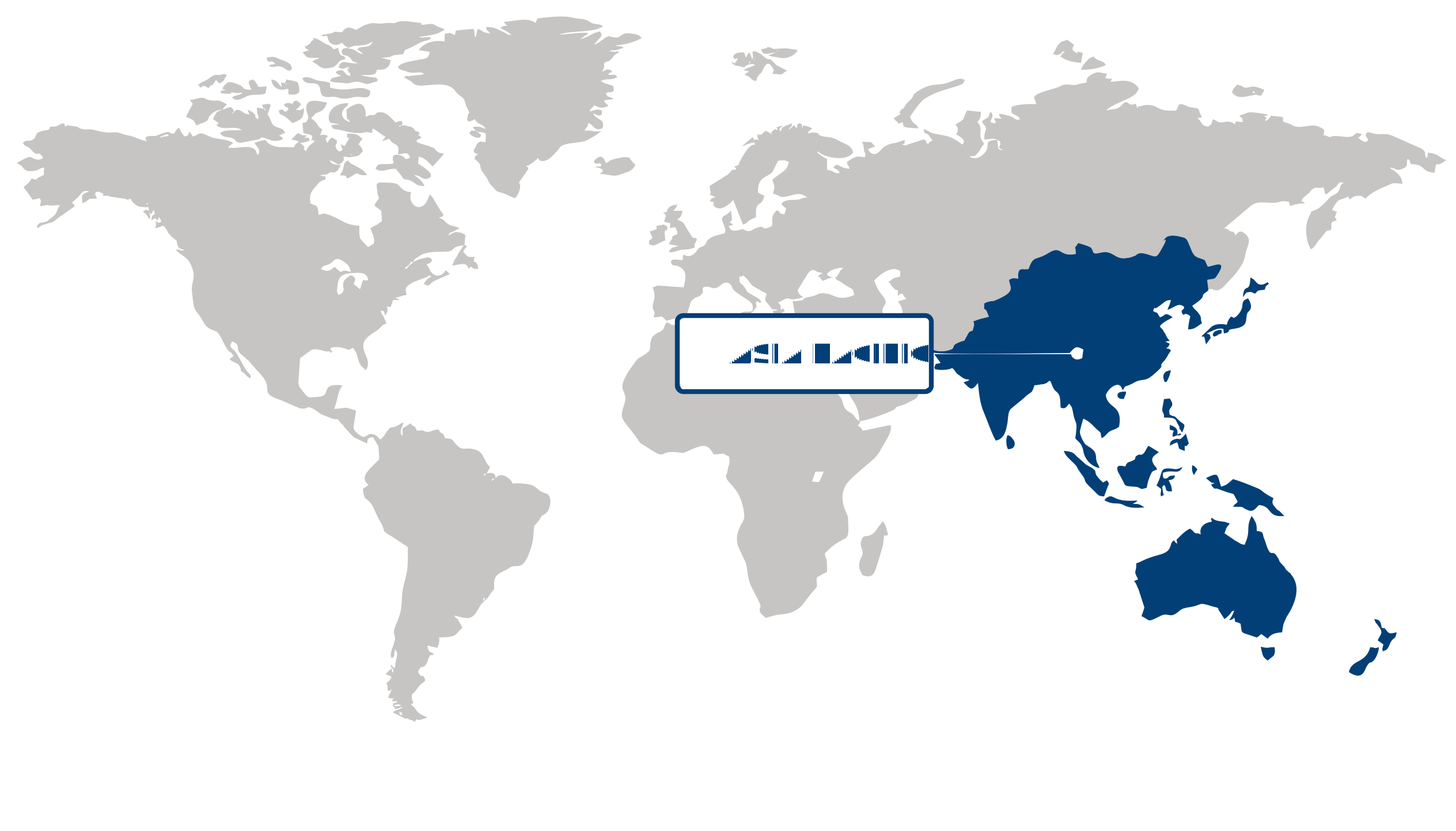
Asia Pacific (Largest Region)
Asia Pacific led the mining lubricants market with a 46.32% share in 2026, reflecting the region's extensive mining activity and the continued use of heavy machinery across mineral extraction and processing operations. Mining equipment operates under demanding conditions involving high loads, dust, temperature variation, and prolonged operating cycles, creating consistent requirements for lubricants that reduce friction, control wear, and protect critical components. Expanding mineral production and infrastructure development are supporting equipment utilization across surface and underground mining operations. At the same time, greater emphasis on equipment reliability, maintenance efficiency, and operating-cost management is encouraging mining operators to adopt higher-performance lubricant formulations designed to extend machinery service life and reduce unplanned downtime.
North America (Fastest-Growing Region)
North America is the fastest-growing region, supported by modernization of mining operations, increasing emphasis on equipment productivity, and the adoption of advanced maintenance practices. Mining operators are placing greater focus on maximizing equipment availability and improving asset performance, strengthening demand for specialized lubricants capable of operating under severe working conditions. Advances in lubricant formulations, including products designed for improved thermal stability, wear protection, and longer service intervals, are further supporting market development. The region's established industrial base and growing attention to operational efficiency and environmental performance are also encouraging the use of higher-quality lubrication solutions across heavy-duty mining equipment.
| Parameter | North America | Asia Pacific | Europe | Latin America | MEA |
|---|---|---|---|---|---|
| Innovation Hub i Scale Nascent Developing Advanced | |||||
| Cost-Sensitive Region i Scale Low Medium High | |||||
| Regulatory Environment i Scale Restrictive Neutral Supportive | |||||
| Demand Drivers i Scale Weak Moderate Strong | |||||
| Development Stage i Scale Emerging Developing Developed | |||||
| Adoption Rate i Scale Low Medium High | |||||
| New Entrants / Startups i Scale Sparse Moderate Dense | |||||
| Macro Indicators i Scale Weak Stable Strong |
Key Country Insights
Germany 🇩🇪
Industrial Performance StandardsIn Germany, mining lubricants are selected with strong emphasis on equipment protection, operational efficiency, and environmental compliance. Industrial users favor premium lubricants that support predictive maintenance programs and meet stringent performance requirements for heavy mining machinery.
France 🇫🇷
Sustainable Equipment CareIn France, mining lubricant procurement increasingly considers environmental performance alongside equipment protection. Operators seek formulations with improved biodegradability and extended service life while maintaining reliable lubrication for heavy-duty mining and quarrying applications.
Italy 🇮🇹
Quarry Operations SupportIn Italy, mining lubricants are primarily utilized across quarrying and industrial mineral extraction activities. Companies emphasize dependable lubrication solutions that reduce component wear, improve equipment availability, and support cost-effective maintenance practices across diverse operating environments.
Japan 🇯🇵
High-Durability FormulationsIn Japan, mining lubricants focus on extending equipment life through advanced synthetic formulations and superior wear protection. Suppliers emphasize lubricant consistency, thermal stability, and compatibility with high-value mining equipment operating under demanding mechanical conditions.
South Korea 🇰🇷
Efficiency-Oriented SupplyIn South Korea, mining lubricants demand is supported by industrial mineral production and equipment servicing activities. Buyers prioritize reliable lubricant performance, optimized maintenance schedules, and products that enhance machinery productivity while minimizing operational downtime.
United States 🇺🇸
Heavy Equipment ReliabilityIn the U.S., mining lubricants demand is driven by the need to maximize equipment uptime across surface and underground mining operations. Operators prioritize high-performance formulations that extend maintenance intervals, improve fuel efficiency, and withstand harsh operating conditions in large-scale extraction sites.
Segment Leadership and Growth Trends
Mining Lubricants Market Share (%), by Product, 2026
Go beyond the chart, access full insights & data tables
Request Free Sample ReportProduct Segment Analysis: Synthetic Mining Lubricants (Largest Segment) vs Bio-Based Mining Lubricants (Fastest-Growing Segment)
Synthetic mining lubricants held a 55.69% share in 2026, making them the largest product segment in the mining lubricants market. Their position is supported by strong performance under demanding mining conditions, where equipment operates under heavy loads, high temperatures, dust exposure, and prolonged operating cycles. Synthetic formulations can provide enhanced thermal stability, wear protection, and equipment reliability, helping mining operators reduce maintenance requirements and protect critical machinery. The need to maximize equipment uptime and maintain productivity across intensive extraction operations continues to support demand for synthetic lubricants.
Bio-Based mining lubricants are the fastest-growing product segment as mining operators place greater emphasis on environmental performance, responsible resource management, and reducing the ecological impact of industrial operations. Bio-based formulations derived from renewable feedstocks can offer an alternative for applications where biodegradability and lower environmental persistence are valued. Increasing sustainability expectations across mining operations are encouraging greater evaluation of environmentally preferable lubrication solutions. Improvements in lubricant performance and growing attention to responsible mining practices are creating favorable conditions for wider adoption of bio-based products.
Application Segment Analysis: Iron Ore Mining (Largest Segment) vs Rare Earth Mineral (Fastest-Growing Segment)
Iron ore mining accounted for a 22.36% share in 2026, making it the largest application segment in the mining lubricants market. Iron ore extraction involves extensive use of heavy machinery, including hauling, drilling, crushing, and material-handling equipment, all of which require reliable lubrication to maintain operational performance. High equipment utilization and demanding working conditions create sustained requirements for lubricants that can protect components against wear, friction, and contamination. Continued activity across iron ore extraction and processing operations therefore supports strong lubricant consumption within this application.
Rare earth mineral represents the fastest-growing application segment as demand for minerals used in advanced technologies, electrification, renewable energy systems, and high-performance components increases. Extraction and processing of rare earth minerals require specialized equipment operating under demanding conditions, creating opportunities for high-performance lubrication solutions. The strategic importance of rare earth resources is also encouraging investment in exploration, extraction, and processing capabilities. As these activities expand, the associated need for equipment reliability and efficient maintenance is supporting faster growth in lubricant demand within rare earth mineral operations.
| Segment | Sub-Segment | Largest Segment | Fastest Growing |
|---|---|---|---|
| Product | Mineral Oil Mining Lubricants, Synthetic Mining Lubricants, Bio-Based Mining Lubricants | Synthetic Mining Lubricants | Bio-Based Mining Lubricants |
| Application | Coal Mining, Iron Ore Mining, Bauxite Mining, Rare Earth Mineral, Precious Metal Mining, Others | Iron Ore Mining | Rare Earth Mineral |
Competitive Landscape and Market Positioning
Major players in the mining lubricants market:
1. Exxon Mobil Corporation (United States)
2. Shell plc (United Kingdom)
3. BP p.l.c. (United Kingdom)
4. Chevron Corporation (United States)
5. TotalEnergies SE (France)
6. FUCHS SE (Germany)
7. BASF SE (Germany)
8. Sinopec Corp. (China)
9. Quaker Houghton (United States)
10. Klüber Lubrication München SE & Co. KG (Germany)
In the mining lubricants market, performance optimization is focused on improving machinery lifespan under extreme operating conditions. Advanced lubricant formulations are enhancing thermal stability and load-bearing capacity. The mining lubricants market is also seeing increased emphasis on environmentally responsible solutions. Continuous innovation is reducing equipment downtime and maintenance frequency.
| Company | Market Share | Company Revenue | Revenue CAGR (%) | Product Portfolio | Geographic Presence | Innovation / R&D Focus | Strategic Developments |
|---|---|---|---|---|---|---|---|
| Exxon Mobil Corporation (United States) | |||||||
| Shell plc (United Kingdom) | |||||||
| BP p.l.c. (United Kingdom) | |||||||
| Chevron Corporation (United States) | |||||||
| TotalEnergies SE (France) | |||||||
| FUCHS SE (Germany) | |||||||
| BASF SE (Germany) | |||||||
| Sinopec Corp. (China) | |||||||
| Quaker Houghton (United States) | |||||||
| Klüber Lubrication München SE & Co. KG (Germany). |
Industry Development/News
| Company Name | Date | Key Development |
|---|---|---|
| Shell plc | Jul-25 | Shell Lubricants acquired a 100% equity stake in Raj Petro Specialities Pvt. Ltd., strengthening its presence in industrial and mining-related lubricant applications. The acquisition expands Shell’s downstream lubricants footprint and supports integration across manufacturing and distribution channels, enhancing scale and customer access in high-demand mining and heavy industry segments. |
| FUCHS | Nov-24 | FUCHS acquired STRUB & Co. AG, strengthening its industrial lubricants portfolio and expanding direct market access in Switzerland. The transaction integrates STRUB’s production and R&D capabilities, reinforcing FUCHS’s specialty lubricants offering and enhancing its competitive positioning in European industrial and mining lubricant applications. |
| FUCHS Group | Apr-24 | FUCHS Group acquired LUBCON Group to strengthen its specialty lubrication capabilities across industrial applications. The acquisition expands its technical expertise in greases, oils, and pastes, supporting broader portfolio development for demanding sectors such as mining, while enhancing product innovation and global distribution capabilities. |
| Exxon Mobil Corporation | Mar-23 | Exxon Mobil Corporation announced an investment of approximately INR 900 crore to establish a lubricant manufacturing facility in Maharashtra’s Raigad industrial region. The plant is expected to enhance domestic production capacity for lubricants, improving supply reliability and supporting industrial demand, including mining applications in the Indian market. |
| Shell | Nov-22 | Shell acquired PANOLIN Group’s eco-friendly lubricants business, expanding its biodegradable lubricant portfolio across hydraulic, gear, and industrial applications. The acquisition strengthens Shell’s positioning in sustainable lubricants, supporting mining and heavy industry customers transitioning toward environmentally compliant lubrication solutions. |
| Total S.A. | Sep-20 | Total S.A. acquired Lubrilog SAS, enhancing its industrial lubricants portfolio with advanced formulations for high-load applications. The acquisition strengthens Total’s presence in sectors such as mining and cement by expanding its expertise in specialty lubrication solutions for critical equipment and operational environments. |
| Idemitsu Kosan Co., Ltd. | Jun-19 | Idemitsu Kosan Co., Ltd. established Idemitsu Lubricants Philippines Inc. to expand its regional lubricant business footprint. The initiative strengthens distribution and commercialization capabilities in Southeast Asia, supporting broader industrial lubricant supply chains and improving access to automotive and industrial lubricant demand in the Philippines. |
Customize Your Report
Explore examples of how this report can be tailored to different research needs, including custom segments, additional topics or chapters, and related reports. Click a section of the wheel or its numbered marker to explore the available options.
Mining Lubricants Market — Custom Segments
| Segment | Sub-Segment |
|---|---|
| Equipment Type | Hydraulic Equipment, Haul Trucks & Heavy-Duty Transport Equipment, Crushers & Conveyors, Drilling Equipment, Excavators & Loaders |
| Lubricant Function | Engine Lubricants, Hydraulic Fluids, Gear & Transmission Lubricants, Greases, Compressor & Circulating Oils |
| Equipment Ownership Model | Mine-Owned Equipment, Contractor-Owned Equipment, Equipment-Leasing Fleets |
Mining Lubricants Market — Custom TOC
| Custom Chapter | Custom Details |
|---|---|
| Mine Electrification Impact Assessment on Lubricant Demand |
|
| Mining Fleet Maintenance Economics Benchmarking |
|
| OEM Approval and Specification Landscape |
|
Need a different cut of the data?
Request Custom ResearchWhat is the market size of mining lubricants?
How is the mining lubricants industry expected to grow over the next 10 years?
How are automated lubrication systems reshaping lubricant demand and maintenance practices in mining operations?
Why is demand shifting toward synthetic high-performance lubricants in heavy mining equipment applications?
Why do synthetic mining lubricants lead the mining lubricants market?
Which application segment is growing fastest in the mining lubricants market?
Why is Asia Pacific the largest regional market for mining lubricants?
What is driving mining lubricants market growth in North America?
Which organizations are considered leaders in the mining lubricants landscape?
Our Clients
"The report helped us understand emerging consumer trends in our product category. It clarified where to focus innovation for the next product launch."
LyondellBasell
"The regional forecast section was incredibly useful. We were able to identify two new potential partners in Europe thanks to the vendor mapping you included."
SABIC
"We appreciated how actionable the recommendations were. It guided us to improve supply chain resilience."
Olin Corporation
Our Research Team & Methodology
Every Fundamental Business Insights report is built by a dedicated vertical research team, validated through a structured primary-and-secondary methodology, and reviewed for accuracy before it reaches you.
Research Team Overview
Prepared by the Chemicals & Materials Research Team
Delivery
Published
Demand
Available
Support
Trust & Compliance
Research Domains
10 coverage areasResearch Intelligence
| Source | Reference |
|---|---|
| American Chemistry Council (ACC) | www.americanchemistry.com |
| European Chemical Industry Council (Cefic) | cefic.org |
| International Council of Chemical Associations (ICCA) | icca-chem.org |
| European Chemicals Agency (ECHA) | echa.europa.eu |
| U.S. Environmental Protection Agency (EPA) | www.epa.gov |
| ASTM International | www.astm.org |
| International Organization for Standardization (ISO) | www.iso.org |
| National Institute of Standards and Technology (NIST) | www.nist.gov |
| Plastics Industry Association (PLASTICS) | www.plasticsindustry.org |
| European Biplastics | www.european-bioplastics.org |
| The Adhesive and Sealant Council (ASC) | www.ascouncil.org |
| National Association of Corrosion Engineers (AMPP) | www.ampp.org |
| Society of Plastics Engineers (SPE) | www.4spe.org |
| International Fertilizer Association (IFA) | www.fertilizer.org |
| CropLife International | croplife.org |
| Packaging Europe | packagingeurope.com |
| Flexible Packaging Association (FPA) | www.flexpack.org |
| Battery Council International (BCI) | batterycouncil.org |
| International Copper Association (ICA) | internationalcopper.org |
| World Steel Association | worldsteel.org |
Research Workflow & Quality Assurance
Data Collection
Verified information gathered through primary and secondary research.
Data Triangulation
Cross-validation using multiple independent data sources.
Forecast Modelling
Market estimates developed using historical trends and analytical models.
Analyst Validation
Findings reviewed by domain experts for accuracy and consistency.
Editorial & Quality Review
Final editorial, quality, and compliance checks before publication.
Final Publication
Released after successful completion of the internal review process.
Report Coverage
📊 Market Assessment
- Market Size & Forecast
- Market Segmentation
- Regional Analysis
- Growth Drivers & Challenges
- Market Dynamics
🏢 Competitive Intelligence
- Competitive Landscape
- Company Profiles
- Competitive Benchmarking
- Mergers & Acquisitions
- Market Share Analysis or Key Company Strategies
🔍 Strategic Analysis
- Value Chain Analysis
- Porter's Five Forces
- PESTLE Analysis
- Pricing Trends
- Supply-Demand Analysis
🚀 Future Outlook
- Technology Landscape
- Regulatory Landscape
- Investment & Funding Landscape
- Emerging Opportunities
- Future Market Outlook
Have a question about this report or need a custom scope?
Request Customization