Autonomous Mining Trucks Market Size & Growth Forecast 2027–2036, By Segments (Engine Type, Trucks, Automation Level, Load Capacity), Regional Demand Trends (North America, Asia Pacific, Europe), Key Country Insights (U.S., Japan, South Korea, Germany, France, Italy), and Competitive Landscape
Market Size and Growth Outlook
Autonomous Mining Trucks Market size was assessed at USD 2.35 Billion in 2026 and is poised to grow at 19.76% CAGR between 2027 and 2036, reaching USD 14.26 Billion by 2036. The industry revenue for 2027 is calculated at USD 2.75 Billion.
Get more details on this report
Request Free Sample ReportAutonomous Mining Trucks Market Intelligence Snapshot
Regional Market Dynamics
- Asia Pacific held 51.94% in 2026, supported by extensive mining activity, strong mining infrastructure, and investment in automated and digitalized mine operations.
- North America is expected to grow fastest as mining companies expand automation, fleet management, monitoring, and data analytics to improve safety and utilization.
Segment Momentum
- Diesel accounted for 80.36% of the market in 2026 because it delivers the power, endurance, and reliability required for heavy-duty mining operations while aligning with existing mining infrastructure and maintenance practices.
- Fully autonomous is the fastest-growing automation level as mining companies increasingly adopt advanced autonomous systems to improve safety, productivity, and operational efficiency while reducing direct human involvement in hauling operations.
Market Expansion Drivers
- Increasing safety requirements in mining operations driving adoption of autonomous haulage systems
- Skilled labor shortages accelerating automation adoption across large-scale mining operations globally
- Rising investment in AI-enabled mining automation improving operational efficiency and ore transport productivity
Leading Market Participants
- Key players in the autonomous mining trucks market include Caterpillar Inc. (USA), Komatsu Ltd. (Japan), Hitachi Construction Machinery Co. Ltd. (Japan), Volvo Group (Sweden), Liebherr Group (Germany), Sandvik AB (Sweden), Epiroc AB (Sweden), Rio Tinto Group (United Kingdom), Daimler Truck AG (Germany), PACCAR Inc (USA)
Global Market Forecast Snapshot
Market Outlook
- 2026 Market Size: USD 2.35 Billion
- 2027 Estimated Market Size: USD 2.75 Billion
- Projected Market Size: USD 14.26 Billion by 2036
- Growth Forecast: 19.76% CAGR (2027-2036)
Regional and Segment Outlook
- Leading Regional Market: Asia Pacific
- High-Growth Regional Hub: North America
- Core Revenue Segment: Diesel (Engine Type) | Rigid Dump Trucks (Trucks) | Semi-autonomous (Automation Level) | Less Than 100 Tons (Load Capacity)
- Emerging Opportunity Segment: Hybrid Electric (Engine Type) | Articulated Dump Trucks (Trucks) | Fully Autonomous (Automation Level) | More Than 300 Tons (Load Capacity)
Market Growth Drivers and Industry Trends
Increasing safety requirements in mining operations driving adoption of autonomous haulage systems
Mining companies are placing greater emphasis on reducing workplace hazards, particularly in high-risk environments where heavy haulage vehicles operate continuously under demanding conditions. This shift will drive the autonomous mining trucks market growth as autonomous haulage systems minimize direct human exposure to dangerous tasks, improve adherence to standardized operating procedures, and reduce the likelihood of incidents caused by operator fatigue or limited visibility. Automated navigation, obstacle detection, and centralized fleet management also enable consistent vehicle movement across complex mine sites, supporting safer coordination between equipment while helping operators maintain compliance with increasingly rigorous occupational safety expectations.
Skilled labor shortages accelerating automation adoption across large-scale mining operations globally
Persistent shortages of experienced equipment operators and technical personnel are encouraging mining companies to adopt automation strategies that reduce dependence on difficult-to-source labor. Across large-scale mining projects, the autonomous mining trucks market is benefiting from the industry's need to sustain production despite workforce constraints, particularly in remote locations where recruiting and retaining skilled employees remains challenging. Autonomous truck deployments allow mining operators to maintain continuous hauling schedules with fewer interruptions, while centralized monitoring enables existing personnel to supervise multiple vehicles, improving workforce utilization and operational consistency across extensive mining operations.
Rising investment in AI-enabled mining automation improving operational efficiency and ore transport productivity
Growing investments in artificial intelligence are reshaping mining operations by enabling more intelligent fleet coordination, predictive decision-making, and data-driven resource management. The autonomous mining trucks market will be propelled by the integration of AI-enabled automation that continuously analyzes vehicle performance, haul routes, traffic conditions, and equipment status to optimize material movement throughout the mining cycle. Advanced processing capabilities also support predictive maintenance scheduling, adaptive route optimization, and efficient dispatching, allowing mining operators to reduce equipment downtime while improving the overall flow of ore transport across active extraction sites.
| Growth Driver | Impact on CAGR | Regulatory Influence | Geographic Relevance | Adoption Rate | Impact Timeline |
|---|---|---|---|---|---|
| Increasing safety requirements in mining operations driving adoption of autonomous haulage systems | 3% | High | Australia, Latin America, North America | High | Near Term |
| Skilled labor shortages accelerating automation adoption across large-scale mining operations globally | 2.7% | High | Australia, Africa, North America | High | Near Term |
| Rising investment in AI-enabled mining automation improving operational efficiency and ore transport productivity | 2.4% | High | Asia Pacific, Latin America | High | Mid Term |
Unlock insights tailored to your business with our bespoke market research solutions.
Click to get your customized report now.
Regional Demand Dynamics
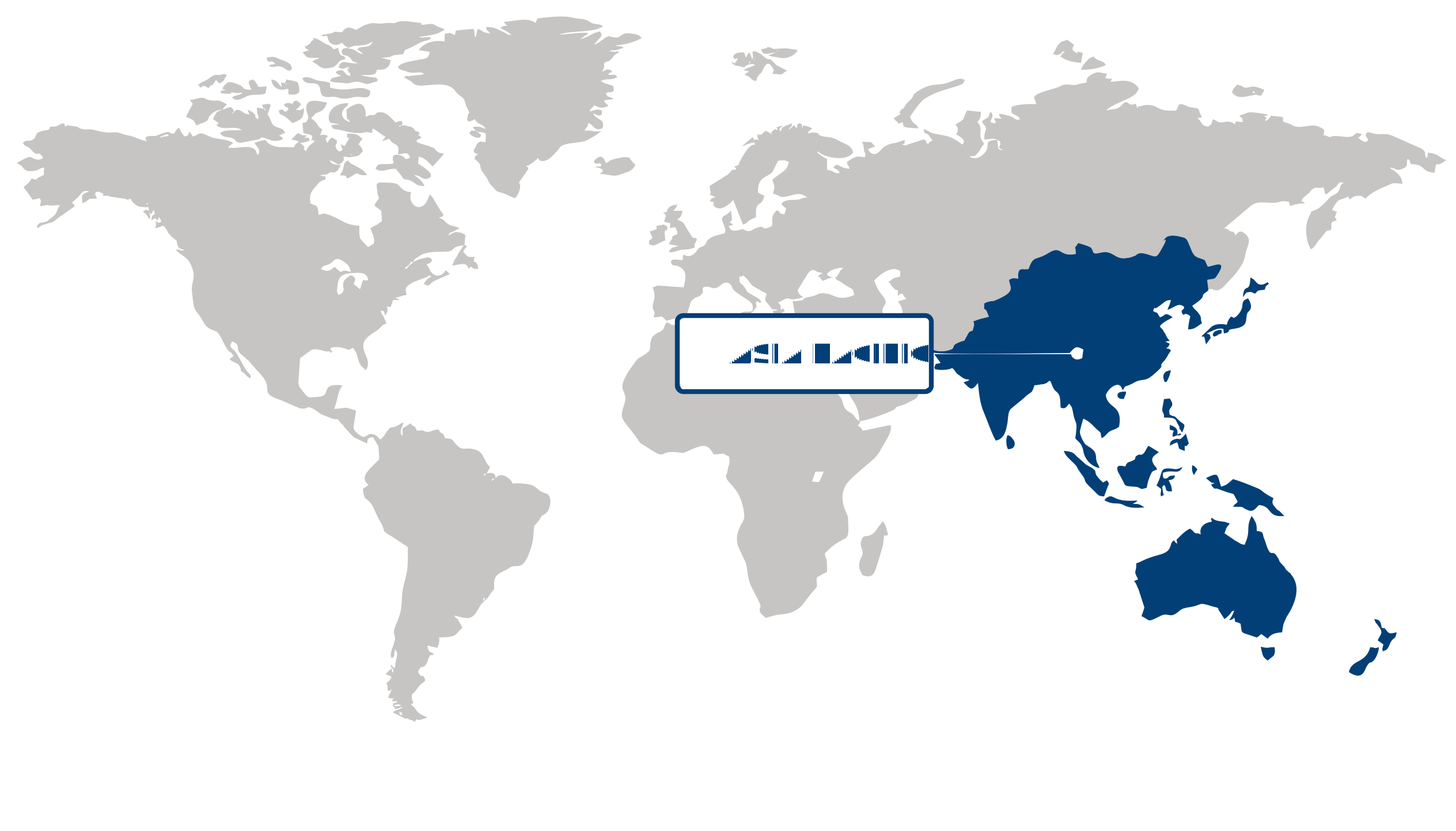
Asia Pacific (Largest Region)
Asia Pacific accounted for 51.94% of the autonomous mining trucks market in 2026, reflecting the region's extensive mining activity, large-scale mineral extraction operations, and growing emphasis on automation in challenging work environments. Mining operators are increasingly adopting autonomous haulage technologies to improve productivity, enhance worker safety, and maintain consistent vehicle performance in demanding conditions. Strong mining infrastructure and ongoing investment in digitalized mine operations are creating a favorable environment for the deployment of autonomous trucks, particularly as operators seek to reduce operational risks and optimize resource utilization.
North America (Fastest-Growing Region)
North America is expected to witness the fastest growth, supported by increasing automation across mining operations and greater emphasis on improving safety, efficiency, and fleet utilization. Mining companies are progressively integrating autonomous technologies with advanced monitoring, fleet management, and data analytics systems to optimize haulage activities and reduce dependence on manual operations. The region's mature mining sector, technological capabilities, and focus on modernizing heavy equipment are expected to encourage wider adoption of autonomous trucks.
| Parameter | North America | Asia Pacific | Europe | Latin America | MEA |
|---|---|---|---|---|---|
| Innovation Hub i Scale Nascent Developing Advanced | |||||
| Cost-Sensitive Region i Scale Low Medium High | |||||
| Regulatory Environment i Scale Restrictive Neutral Supportive | |||||
| Demand Drivers i Scale Weak Moderate Strong | |||||
| Development Stage i Scale Emerging Developing Developed | |||||
| Adoption Rate i Scale Low Medium High | |||||
| New Entrants / Startups i Scale Sparse Moderate Dense | |||||
| Macro Indicators i Scale Weak Stable Strong |
Key Country Insights
United States 🇺🇸
Productivity Driven AutomationThe U.S. autonomous mining trucks market is focused on improving operational efficiency and reducing workforce constraints at large mining sites. Mining companies are increasingly deploying autonomous haulage technologies integrated with fleet management and predictive maintenance systems.
Germany 🇩🇪
Mining Technology IntegrationGermany's role in the autonomous mining trucks market is centered on supplying advanced automation technologies, sensors, and industrial software for autonomous operations. German equipment providers are supporting the development of highly connected and digitally managed mining fleets.
Japan 🇯🇵
Precision Haulage SystemsJapan is advancing autonomous mining trucks through expertise in robotics and intelligent vehicle technologies. Japanese manufacturers are concentrating on safety-focused automation solutions and efficient fleet control systems for demanding mining environments.
South Korea 🇰🇷
Intelligent Equipment DevelopmentSouth Korea is increasing investment in autonomous mining technologies through developments in industrial automation and heavy equipment manufacturing. The country is prioritizing remote operation capabilities and digital control systems that enhance productivity and worker safety.
France 🇫🇷
Automated Resource OperationsFrance is supporting autonomous mining truck adoption through technology development aimed at improving operational sustainability and site efficiency. French companies are showing interest in integrating autonomous haulage with broader digital mining management platforms.
Italy 🇮🇹
Engineering Support EcosystemItaly participates in the autonomous mining trucks market through specialized engineering, component manufacturing, and automation expertise. Italian suppliers are focusing on technologies that improve vehicle control, connectivity, and maintenance efficiency in mining operations.
Segment Leadership and Growth Trends
Autonomous Mining Trucks Market Share (%), by Engine Type, 2026
Go beyond the chart, access full insights & data tables
Request Free Sample ReportEngine Type Segment Analysis: Diesel (Largest Segment) vs Hybrid Electric (Fastest-Growing Segment)
The diesel segment accounted for the largest share of the autonomous mining trucks market, representing 80.36% in 2026, supported by the established use of diesel-powered heavy-duty mining equipment and its suitability for demanding off-highway operations. Diesel engines provide the high power output and operational endurance required for hauling heavy loads across challenging mining environments, while existing mining infrastructure and maintenance capabilities are already well aligned with diesel-powered equipment. The familiarity of mining operators with diesel technology also supports its continued deployment in autonomous truck fleets.
The hybrid electric segment is gaining momentum as mining operators increasingly focus on improving energy efficiency, reducing fuel consumption, and lowering the environmental impact of heavy-duty operations. Hybrid powertrains can combine conventional engine performance with electric propulsion capabilities, supporting more efficient energy management during demanding hauling cycles. The integration of electrification with autonomous operation also aligns with broader mining industry efforts to modernize equipment and improve operational sustainability, positioning hybrid electric systems as the fastest-growing engine type.
Trucks Segment Analysis: Rigid Dump Trucks (Largest Segment) vs Articulated Dump Trucks (Fastest-Growing Segment)
Rigid dump trucks held the largest share of the autonomous mining trucks market in 2026, reflecting their extensive suitability for high-capacity material transportation across large-scale mining operations. Their rigid chassis and robust construction provide stability and durability under demanding hauling conditions, while their ability to transport substantial loads makes them well suited to repetitive mine-site transportation routes. The structured operating environments of large mines also facilitate the deployment of autonomous technologies on rigid platforms, supporting their continued market leadership.
Articulated dump trucks are emerging as the fastest-growing truck type as their articulated configuration provides greater maneuverability across uneven, variable, and challenging terrain. This flexibility makes them particularly useful in mining environments where operating conditions can change across haul routes and work areas. The combination of autonomous driving capabilities with improved maneuverability can enhance vehicle utilization and support safer material movement in complex environments. Increasing adoption of automation across diverse mining operations is therefore creating stronger opportunities for articulated dump trucks.
Automation Level Segment Analysis: Semi-autonomous (Largest Segment) vs Fully Autonomous (Fastest-Growing Segment)
The semi-autonomous segment maintained the largest share of the autonomous mining trucks market in 2026, supported by its ability to combine automated vehicle functions with human supervision. This approach allows mining operators to benefit from automated navigation, hauling, and operational assistance while retaining human oversight for complex situations and critical decisions. Semi-autonomous systems can also provide a more gradual transition toward automation by allowing existing mining operations to incorporate autonomous capabilities without fully removing operator involvement. Their operational flexibility and compatibility with evolving automation strategies support continued adoption.
Fully autonomous mining trucks are positioned as the fastest-growing automation level as mining operators increasingly pursue safer, more productive, and highly automated material-handling operations. Fully autonomous systems can perform repetitive hauling activities with limited direct human intervention, reducing exposure of personnel to hazardous mine environments while enabling more consistent vehicle operation. Advances in perception, navigation, artificial intelligence, and fleet coordination are strengthening the technical foundation for autonomous mining. As mining companies increasingly prioritize automation and operational efficiency, fully autonomous trucks are gaining traction as a key pathway toward more advanced mine-site operations.
| Segment | Sub-Segment | Largest Segment | Fastest Growing |
|---|---|---|---|
| Engine Type | Diesel, Hybrid Electric, Others | Diesel | Hybrid Electric |
| Trucks | Rigid Dump Trucks, Articulated Dump Trucks, Haul Trucks, Others | Rigid Dump Trucks | Articulated Dump Trucks |
| Automation Level | Semi-autonomous, Fully Autonomous | Semi-autonomous | Fully Autonomous |
| Load Capacity | Less Than 100 Tons, 100-300 Tons, More Than 300 Tons | Less Than 100 Tons | More Than 300 Tons |
Competitive Landscape and Market Positioning
Key companies in the autonomous mining trucks market:
- Caterpillar, Inc. (USA)
- Komatsu Ltd. (Japan)
- Hitachi Construction Machinery Co., Ltd. (Japan)
- Volvo Group (Sweden)
- Liebherr Group (Germany)
- Sandvik AB (Sweden)
- Epiroc AB (Sweden)
- Rio Tinto Group (United Kingdom)
- Daimler Truck AG (Germany)
- PACCAR Inc (USA)
The autonomous mining trucks market is increasingly defined by the transition from standalone vehicle offerings to integrated autonomous mining ecosystems that combine fleet management, real-time analytics, and operational optimization. Equipment providers are strengthening their competitive position by delivering solutions that seamlessly connect with mine planning, dispatch, and monitoring systems, enabling customers to maximize productivity across entire operations. At the same time, suppliers with expertise in autonomous software, safety validation, and lifecycle support are creating higher barriers to entry, shifting competition toward long-term technology capabilities and implementation expertise rather than vehicle specifications alone.
| Company | Market Share | Company Revenue | Revenue CAGR (%) | Product Portfolio | Geographic Presence | Innovation / R&D Focus | Strategic Developments |
|---|---|---|---|---|---|---|---|
| Caterpillar Inc. (USA) | |||||||
| Komatsu Ltd. (Japan) | |||||||
| Hitachi Construction Machinery Co. Ltd. (Japan) | |||||||
| Volvo Group (Sweden) | |||||||
| Liebherr Group (Germany) | |||||||
| Sandvik AB (Sweden) | |||||||
| Epiroc AB (Sweden) | |||||||
| Rio Tinto Group (United Kingdom) | |||||||
| Daimler Truck AG (Germany) | |||||||
| PACCAR Inc (USA) |
Industry Development/News
| Company Name | Date | Key Development |
|---|---|---|
| EACON Group Co., Ltd. | Jun-26 | EACON launched its Hong Kong H-share initial public offering to raise expansion capital, leveraging its dominant 55.5% share of the Chinese autonomous mining haulage system market. The funding drives localized scaling and broader global commercialization. |
| MicroVision | Jun-26 | MicroVision secured a long-term supply agreement with a leading mining equipment manufacturer to deliver specialized lidar sensors. This OEM partnership hardwires proprietary perception capabilities directly into high-tonnage heavy vehicle platforms. |
| MMD | Apr-26 | MMD entered an operational partnership with CiDi to embed driverless technologies into its proprietary TraxIQ transport platform. The technical integration shifts focus toward global field validation across diverse open-pit and heavy-duty extraction sites. |
| Seyond | Apr-26 | Seyond partnered with autonomous systems specialist Boonray to speed up the commercialization of intelligent heavy transport. The joint engineering effort focuses on combining sensor systems to achieve higher operational reliability. |
| SANY Group | Mar-26 | SANY Group secured a CHF 100 million, five-year procurement framework agreement with Holcim. The deal schedules the delivery of electrified heavy machinery alongside 20 autonomous mining trucks to support intelligent, low-emission materials handling. |
| BYD | Jan-26 | BYD executed a CNY 100 million strategic investment in autonomous technology developer Boonray. The funding directly anchors a collaborative initiative to engineer autonomous electric mining trucks, accelerating commercial rollout across large-scale industrial sites. |
| Volvo Autonomous Solutions | Dec-25 | Volvo Autonomous Solutions initiated industrial-scale production of dedicated autonomous mining trucks at its Säffle facility. The factory integrates a suite of advanced lidar, radar, vision systems, and onboard computing directly into the specialized Volvo FH platform. |
| CATL | Oct-25 | CATL finalized a comprehensive strategic cooperation agreement with EACON focused on electric autonomous haulage. The ecosystem partnership combines capital, battery engineering, and vehicle technologies to deploy integrated zero-emission transport solutions. |
| Huawei | Jul-25 | Huawei completed the commercial deployment of a 100-vehicle fleet of autonomous electric mining trucks at an open-pit mine. The fleet utilizes advanced 5G-Advanced networks and cloud architecture for dispatch optimization. |
| Liebherr | Oct-24 | Liebherr formed a US$2.8 billion strategic partnership with Fortescue to co-develop and advance next-generation zero-emissions mining equipment. This massive capital commitment accelerates the development and commercial scale of autonomous, sustainable heavy transport solutions. |
Customize Your Report
Explore examples of how this report can be tailored to different research needs, including custom segments, additional topics or chapters, and related reports. Click a section of the wheel or its numbered marker to explore the available options.
Autonomous Mining Trucks Market — Custom Segments
| Segment | Sub-Segment |
|---|---|
| Mining Commodity | Coal, Iron Ore, Copper, Gold, Other Minerals |
| Fleet Size | Small Fleets, Medium Fleets, Large Fleets |
| Procurement Model | Direct OEM Procurement, Dealer/Distributor Procurement, System Integrator Procurement |
Autonomous Mining Trucks Market — Custom TOC
| Custom Chapter | Custom Details |
|---|---|
| Mine Automation Adoption Roadmap |
|
| Greenfield and Brownfield Deployment Assessment |
|
| Workforce Transition and Operational Change Assessment |
|
Need a different cut of the data?
Request Custom ResearchWhat is the market valuation of autonomous mining trucks?
How much is the autonomous mining trucks industry expected to grow by 2036?
How are safety and workforce challenges driving adoption of autonomous mining trucks?
Why is AI-enabled automation becoming a key investment area in autonomous mining operations?
Why does the diesel segment hold the largest share of the autonomous mining trucks market?
Which automation level is growing the fastest in the autonomous mining trucks market?
Why did Asia Pacific hold the largest share of the autonomous mining trucks market in 2026?
What is driving faster growth of autonomous mining trucks in North America?
Which companies dominate the autonomous mining trucks landscape?
Our Clients
"The team at Fundamental Business Insights & Consulting demonstrated a commitment to excellence, not only in the quality of the report but also in their client-centric approach."
FANUC
"The level of detail in the market segmentation provided were particularly noteworthy. The detailed country-level insights were also very helpful."
B&R Industrial Automation GmbH
"The consultant took the time to understand our specific business objectives, ensuring that the reports were tailored to address our unique challenges and opportunities."
KUKA SE & Co. KGaA
Our Research Team & Methodology
Every Fundamental Business Insights report is built by a dedicated vertical research team, validated through a structured primary-and-secondary methodology, and reviewed for accuracy before it reaches you.
Research Team Overview
Prepared by the Industrial Automation & Equipment Research Team
Delivery
Published
Demand
Available
Support
Trust & Compliance
Research Domains
10 coverage areasResearch Intelligence
| Source | Reference |
|---|---|
| International Society of Automation (ISA) | www.isa.org |
| International Organization for Standardization (ISO) | www.iso.org |
| National Institute of Standards and Technology (NIST) | www.nist.gov |
| IEEE | www.ieee.org |
| VDMA (German Mechanical Engineering Industry Association) | www.vdma.org |
| Association for Advancing Automation (A3) | www.automate.org |
| International Federation of Robotics (IFR) | ifr.org |
| ASME (American Society of Mechanical Engineers) | www.asme.org |
| ASHRAE | www.ashrae.org |
| American Society of Heating, Refrigerating and Air-Conditioning Engineers (ASHRAE) | www.ashrae.org |
| Material Handling Industry (MHI) | www.mhi.org |
| OSHA (Occupational Safety and Health Administration) | www.osha.gov |
| National Fire Protection Association (NFPA) | www.nfpa.org |
| ASTM International | www.astm.org |
| International Electrotechnical Commission (IEC) | www.iec.ch |
| Open Process Automation Forum (The Open Group) | www.opengroup.org/open-process-automation-forum |
| AGMA (American Gear Manufacturers Association) | www.agma.org |
| Association of Equipment Manufacturers (AEM) | www.aem.org |
| Food and Agriculture Organization (FAO) | www.fao.org |
| International Labour Organization (ILO) | www.ilo.org |
Research Workflow & Quality Assurance
Data Collection
Verified information gathered through primary and secondary research.
Data Triangulation
Cross-validation using multiple independent data sources.
Forecast Modelling
Market estimates developed using historical trends and analytical models.
Analyst Validation
Findings reviewed by domain experts for accuracy and consistency.
Editorial & Quality Review
Final editorial, quality, and compliance checks before publication.
Final Publication
Released after successful completion of the internal review process.
Report Coverage
📊 Market Assessment
- Market Size & Forecast
- Market Segmentation
- Regional Analysis
- Growth Drivers & Challenges
- Market Dynamics
🏢 Competitive Intelligence
- Competitive Landscape
- Company Profiles
- Competitive Benchmarking
- Mergers & Acquisitions
- Market Share Analysis or Key Company Strategies
🔍 Strategic Analysis
- Value Chain Analysis
- Porter's Five Forces
- PESTLE Analysis
- Pricing Trends
- Supply-Demand Analysis
🚀 Future Outlook
- Technology Landscape
- Regulatory Landscape
- Investment & Funding Landscape
- Emerging Opportunities
- Future Market Outlook
Have a question about this report or need a custom scope?
Request Customization