Grain Processing Equipment Market Size & Growth Forecast 2027–2036, By Segments (Mode of Operation, Machine), Regional Demand Trends (North America, Asia Pacific, Europe), Key Country Insights (U.S., Japan, South Korea, Germany, France, Italy), and Competitive Landscape
Market Size and Growth Outlook
Grain Processing Equipment Market size was more than USD 6.2 billion in 2026 and is set to grow at a 7.41% CAGR between 2027 and 2036, surpassing USD 12.67 billion by 2036. The industry revenue for 2027 is estimated at USD 6.59 billion.
Get more details on this report
Request Free Sample ReportGrain Processing Equipment Market Intelligence Snapshot
Regional Market Dynamics
- Asia Pacific held a 46.53% market share in 2026, supported by extensive grain production, large-scale processing operations, and ongoing investments in capacity expansion and productivity upgrades.
- North America is projected to grow at a 4.33% CAGR as processors modernize grain handling infrastructure with automated, higher-throughput equipment to improve efficiency and address labor constraints.
Segment Momentum
- Automatic equipment held a 53.34% share in 2026 because it delivers consistent throughput, reliable process control, and reduced manual intervention, supporting efficient large-scale grain processing operations.
- Processing equipment is expanding fastest as operators invest in technologies that improve value conversion, production efficiency, product consistency, and output across food, feed, and industrial grain applications.
Market Expansion Drivers
- Rising processed and ready-to-eat food demand increasing investment in grain processing machinery.
- Automation and IoT integration enhancing operational efficiency across grain processing facilities.
- Government-supported agricultural modernization programs accelerating advanced equipment adoption.
Leading Market Participants
- Leading companies in the grain processing equipment market include Bühler Group (Switzerland), Alvan Blanch Development Company Limited (United Kingdom), Osaw Agro Industries Private Limited (India), WESTRUP A/S (Denmark), Golfetto Sangati S.r.l. (Italy), PETKUS Technologie GmbH (Germany), Satake USA, Inc. (United States), Forsberg Agritech (India) Pvt. Ltd. (India), Lianyungang Huantai Machinery Co., Ltd. (China).
Global Market Forecast Snapshot
Market Outlook
- 2026 Market Size: USD 6.2 billion
- 2027 Estimated Market Size: USD 6.59 billion.
- Projected Market Size: USD 12.67 billion by 2036
- Growth Forecast: 7.41% CAGR (2027-2036)
Regional and Segment Outlook
- Leading Regional Market: Asia Pacific
- High-Growth Regional Hub: North America
- Core Revenue Segment: Automatic (Mode of Operation) | Pre Processing (Machine)
- Emerging Opportunity Segment: Semi-Automatic (Mode of Operation) | Processing (Machine)
Market Growth Drivers and Industry Trends
Rising processed and ready-to-eat food demand increasing investment in grain processing machinery
Changing consumer lifestyles and the growing preference for convenient food products are supporting the grain processing equipment market as food manufacturers increase their need for efficient grain cleaning, milling, sorting, and processing capabilities. Processed and ready-to-eat products require consistent raw material quality and reliable processing operations, encouraging investments in modern machinery that can improve throughput and product uniformity. Expanding consumption of packaged grain-based foods is also increasing the need for processing facilities to handle diverse grain varieties and meet evolving product specifications.
Automation and IoT integration enhancing operational efficiency across grain processing facilities
Technological modernization is driving the grain processing equipment market as processors increasingly adopt automated machinery and connected monitoring systems to improve production control. Automation can reduce dependence on manual intervention across repetitive processing stages, while IoT-enabled equipment can provide operational data that helps monitor machine performance, identify process irregularities, and support maintenance planning. Greater visibility into equipment performance enables processing facilities to optimize resource utilization and maintain consistent output quality across cleaning, grading, milling, and related operations.
Government-supported agricultural modernization programs accelerating advanced equipment adoption
Public initiatives aimed at improving agricultural productivity and modernizing food-processing infrastructure are contributing to the expansion of the grain processing equipment market by encouraging investment in updated machinery. Government-backed modernization programs can improve access to advanced processing technologies while supporting the development of more efficient post-harvest handling and value-addition capabilities. Such initiatives are particularly relevant where aging processing infrastructure limits productivity, encouraging processors and agricultural enterprises to replace conventional equipment with more efficient systems.
| Growth Driver | Impact on CAGR | Regulatory Influence | Geographic Relevance | Adoption Rate | Impact Timeline |
|---|---|---|---|---|---|
| Rising processed and ready-to-eat food demand increasing investment in grain processing machinery | 1.80% | Moderate | Asia Pacific, North America | High | Near Term |
| Automation and IoT integration enhancing operational efficiency across grain processing facilities | 1.60% | Moderate | Europe, Asia Pacific | Medium | Mid Term |
| Government-supported agricultural modernization programs accelerating advanced equipment adoption | 1.40% | High | Asia Pacific, Latin America | Medium | Mid Term |
Unlock insights tailored to your business with our bespoke market research solutions.
Click to get your customized report now.
Regional Demand Dynamics
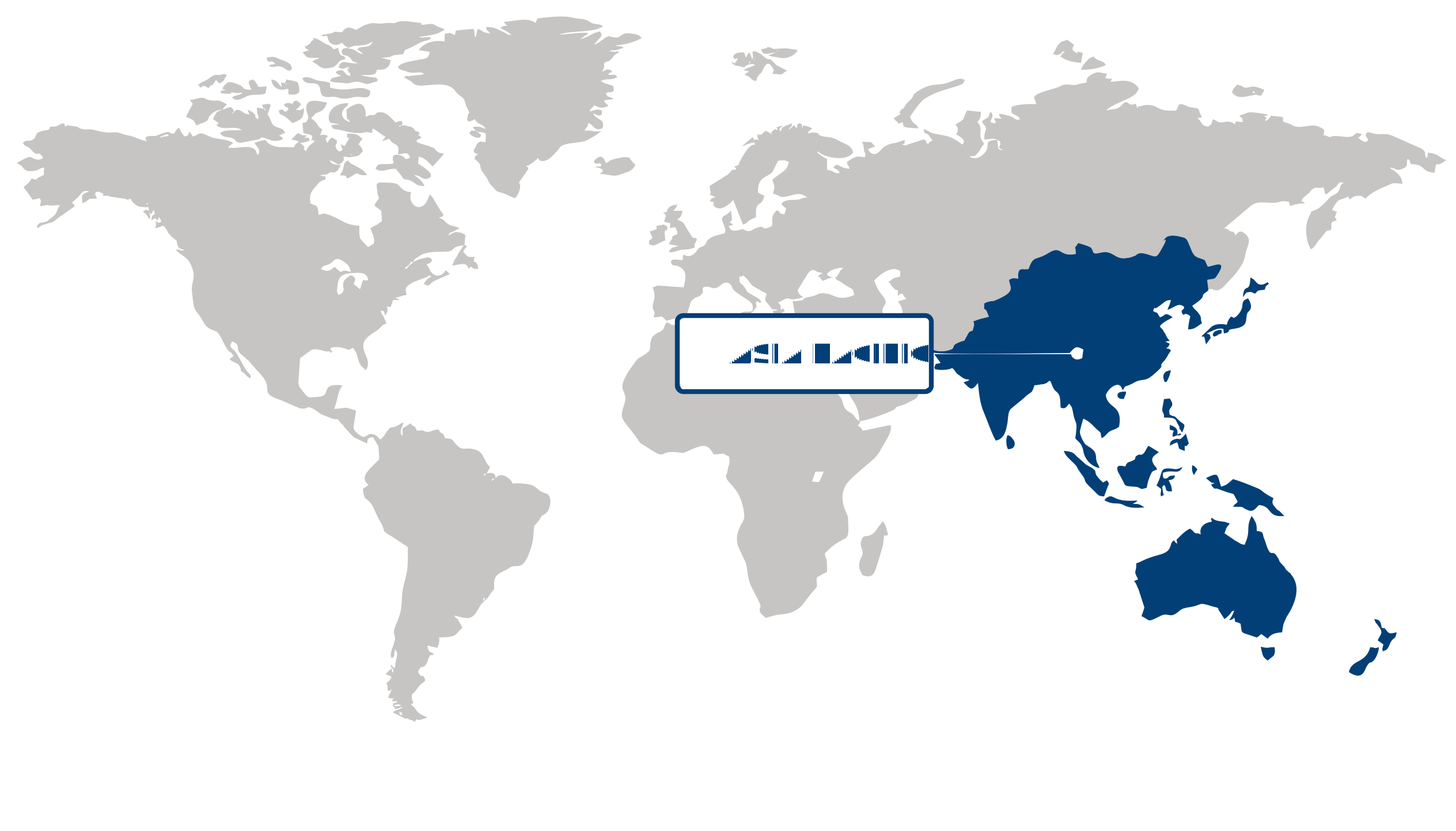
Asia Pacific (Largest Region)
In the grain processing equipment market, Asia Pacific held the largest share in 2026, supported by its extensive grain production and processing base and the importance of efficient food-processing infrastructure across the region. Rising demand for processed food, modernization of agricultural and milling operations, and increasing emphasis on processing efficiency are encouraging investment in advanced equipment. The region’s large agricultural sector and expanding food-processing capabilities further support equipment demand, while ongoing improvements in processing facilities are strengthening its established market position.
North America (Fastest-Growing Region)
North America represented the fastest-growing regional market, driven by increasing modernization of grain-processing facilities and greater adoption of automated and technologically advanced equipment. Demand for higher processing efficiency, consistent product quality, and improved operational productivity is encouraging processors to upgrade existing infrastructure. In addition, well-developed agricultural and food-processing systems, combined with continued investment in automation and equipment modernization, are creating favorable conditions for regional market expansion.
| Parameter | North America | Asia Pacific | Europe | Latin America | MEA |
|---|---|---|---|---|---|
| Innovation Hub i Scale Nascent Developing Advanced | |||||
| Cost-Sensitive Region i Scale Low Medium High | |||||
| Regulatory Environment i Scale Restrictive Neutral Supportive | |||||
| Demand Drivers i Scale Weak Moderate Strong | |||||
| Development Stage i Scale Emerging Developing Developed | |||||
| Adoption Rate i Scale Low Medium High | |||||
| New Entrants / Startups i Scale Sparse Moderate Dense | |||||
| Macro Indicators i Scale Weak Stable Strong |
Key Country Insights
Germany 🇩🇪
Engineering Efficiency SolutionsGermany prioritizes technologically advanced grain processing equipment that delivers precision milling, resource efficiency, and consistent product quality. German equipment adoption reflects demand for highly automated systems capable of supporting modern food processing standards and operational reliability.
France 🇫🇷
Premium Milling ApplicationsFrance emphasizes grain processing equipment that supports high-quality flour production and specialized food manufacturing. French processors invest in equipment designed to preserve product quality while improving operational efficiency and adapting to evolving consumer preferences.
Italy 🇮🇹
Specialty Grain ProcessingItaly utilizes grain processing equipment to strengthen production of premium flour, pasta, and bakery ingredients. Italian manufacturers focus on flexible processing technologies that maintain ingredient quality while supporting efficient production of traditional and specialty grain products.
Japan 🇯🇵
Value-Added Food ProductionJapan adopts grain processing equipment that supports premium food production, efficient processing, and strict quality requirements. Japanese processors increasingly seek compact, automated solutions capable of handling specialized grains while maintaining consistent product characteristics.
South Korea 🇰🇷
Automated Food ManufacturingSouth Korea expands the use of grain processing equipment to support modern food manufacturing and convenience food production. South Korean processors prioritize automated systems that improve throughput, reduce labor requirements, and maintain uniform processing performance across production lines.
United States 🇺🇸
Industrial Processing ModernizationThe U.S. continues upgrading grain processing equipment to improve productivity, product consistency, and operational efficiency across food manufacturing facilities. Equipment investments in the U.S. increasingly emphasize automation, energy optimization, and flexible processing for diverse grain-based products.
Segment Leadership and Growth Trends
Grain Processing Equipment Market Share (%), by Mode of Operation, 2026
Go beyond the chart, access full insights & data tables
Request Free Sample ReportMode of Operation Segment Analysis: Automatic (Largest Segment) vs Semi-Automatic (Fastest-Growing Segment)
Automatic equipment held the largest share of the grain processing equipment market at 53.34% in 2026, supported by the increasing need for consistent processing quality, higher operational efficiency, and reduced dependence on manual intervention. Automated systems can coordinate multiple processing stages with greater consistency, helping operators maintain controlled production conditions and reduce variability in grain handling and processing. They are particularly valuable for larger processing facilities where continuous throughput, process monitoring, and efficient resource utilization are important operational priorities. Growing adoption of modern food-processing infrastructure and the broader shift toward automated industrial operations are reinforcing the importance of automatic grain processing equipment.
Semi-automatic equipment is advancing at the fastest pace as smaller and mid-sized processors seek greater productivity while maintaining a degree of operational flexibility and human oversight. These systems can provide automation for selected processing activities without requiring the complete infrastructure associated with fully automated facilities, making them attractive to operators transitioning from conventional processes. Their balance between equipment functionality, operator involvement, and investment flexibility can support adoption across diverse processing environments. Increasing modernization of grain-processing operations and demand for more efficient workflows are therefore creating favorable conditions for the expansion of semi-automatic equipment.
Machine Segment Analysis: Pre Processing (Largest Segment) vs Processing (Fastest-Growing Segment)
Pre processing equipment accounted for the largest share of the grain processing equipment market at 55.86% in 2026, reflecting the fundamental importance of cleaning, sorting, grading, and preparing grains before subsequent processing stages. Effective pre-processing helps remove impurities and unwanted materials while improving the consistency and quality of grain entering downstream operations. These functions are essential for protecting processing machinery, maintaining product quality, and improving overall operational efficiency. Increasing attention to food safety, raw material quality, and process consistency is strengthening demand for reliable pre-processing machinery, supporting its leading position within the equipment landscape.
Processing equipment is growing at the fastest pace as grain processors increasingly invest in technologies that improve the efficiency, consistency, and value of converting prepared grains into finished or intermediate products. Modern processing systems can support more controlled operations while helping processors respond to changing product requirements and quality expectations. Growing demand for processed grain products and increasing emphasis on efficient utilization of agricultural raw materials are encouraging investment in advanced processing machinery. The broader modernization of food-processing facilities is further supporting adoption of equipment capable of improving process control and production efficiency, strengthening the growth prospects of the processing segment.
| Segment | Sub-Segment | Largest Segment | Fastest Growing |
|---|---|---|---|
| Mode of Operation | Automatic, Semi-Automatic | Automatic | Semi-Automatic |
| Machine | Pre Processing, Processing | Pre Processing | Processing |
Competitive Landscape and Market Positioning
Major players in the grain processing equipment market:
1. Bühler Group (Switzerland)
2. Alvan Blanch Development Company Limited (United Kingdom)
3. Osaw Agro Industries Private Limited (India)
4. WESTRUP A/S (Denmark)
5. Golfetto Sangati S.r.l. (Italy)
6. PETKUS Technologie GmbH (Germany)
7. Satake USA Inc. (United States)
8. Forsberg Agritech (India) Pvt. Ltd. (India)
9. Lianyungang Huantai Machinery Co. Ltd. (China)
Rising global food demand and modernization of agricultural processing facilities are supporting growth in the grain processing equipment market. Equipment manufacturers are increasingly integrating automation, digital monitoring systems, and energy-efficient technologies to improve productivity and reduce processing waste. Demand for advanced milling, sorting, and cleaning solutions is also encouraging continuous equipment upgrades across grain handling operations.
| Company | Market Share | Company Revenue | Revenue CAGR (%) | Product Portfolio | Geographic Presence | Innovation / R&D Focus | Strategic Developments |
|---|---|---|---|---|---|---|---|
| Bühler Group (Switzerland) | |||||||
| Alvan Blanch Development Company Limited (United Kingdom) | |||||||
| Osaw Agro Industries Private Limited (India) | |||||||
| WESTRUP A/S (Denmark) | |||||||
| Golfetto Sangati S.r.l. (Italy) | |||||||
| PETKUS Technologie GmbH (Germany) | |||||||
| Satake USA Inc. (United States) | |||||||
| Forsberg Agritech (India) Pvt. Ltd. (India) | |||||||
| Lianyungang Huantai Machinery Co. Ltd. (China). |
Industry Development/News
| Company Name | Date | Key Development |
|---|---|---|
| AGCO | Jan-25 | The company announced a $95 million investment in a new 84,000-square-meter parts distribution center in Amnéville, France. Scheduled for completion by late 2026, the facility will serve as a sustainable, automated master depot for the GSI and Cimbria grain brands, supporting markets across Europe, the Middle East, the Americas, and Asia-Pacific. |
| CPM | Dec-24 | The company acquired Jacobs Global, a specialist in hammermill components, screens, and pellet mill dies. This strategic integration enhances CPM’s manufacturing capacity and expands its comprehensive processing solutions portfolio for the global feed market. |
| Bühler Group | Oct-24 | The company inaugurated its new Grain Innovation Center (GIC) in Uzwil, Switzerland, a 2,000 m² facility equipped with over 70 systems for cleaning, sorting, and processing. Designed to support production-scale trials up to 5 t/h, the hub fosters collaborative development of sustainable technologies for grain and animal feed processing. |
| AGI | Aug-24 | The company partnered with Boa Safra Ag LLC to provide farmers with integrated digital management solutions. The collaboration offers educational resources, cost incentives, and specialized tools to improve operational efficiency, grain safety, and farm profitability. |
Customize Your Report
Explore examples of how this report can be tailored to different research needs, including custom segments, additional topics or chapters, and related reports. Click a section of the wheel or its numbered marker to explore the available options.
Grain Processing Equipment Market — Custom Segments
| Segment | Sub-Segment |
|---|---|
| Grain Type | Wheat, Rice, Corn, Barley, Other Grains |
| Processing Capacity | Small-Scale, Medium-Scale, Large-Scale |
| Application | Flour Milling, Rice Milling, Grain Cleaning, Grain Sorting & Grading, Other Applications |
Grain Processing Equipment Market — Custom TOC
| Custom Chapter | Custom Details |
|---|---|
| Farm-to-Processing Supply Chain Modernization |
|
| Automation Adoption Across Processing Facilities |
|
| High-Growth Crop Processing Opportunity Mapping |
|
Need a different cut of the data?
Request Custom ResearchHow much is the grain processing equipment market worth?
How is the grain processing equipment industry expected to grow over the next 10 years?
How is automation transforming investment priorities in grain processing facilities?
Why are modernization programs accelerating adoption of advanced grain processing equipment?
Why is automatic equipment the preferred choice in the grain processing equipment market?
Why is processing equipment the fastest-growing machine segment?
Why is Asia Pacific the leading region in the grain processing equipment market?
What is fueling growth in North America's grain processing equipment market?
What are the key competitors in the grain processing equipment landscape?
Our Clients
"The report provided a thorough look at market trends, technological advancements, and the competitive landscape. The depth of insights was really valuable."
ITC Limited
"We would highly recommend Fundamental Business Insights & Consulting to anyone looking for reliable, detailed, and comprehensive market research in the Food industry."
Tyson Foods
"The clarity and presentation of the information were commendable. The report was delivered timely, which made the overall experience smooth and convenient."
Mondelēz International
Our Research Team & Methodology
Every Fundamental Business Insights report is built by a dedicated vertical research team, validated through a structured primary-and-secondary methodology, and reviewed for accuracy before it reaches you.
Research Team Overview
Prepared by the Food & Beverage Research Team
Delivery
Published
Demand
Available
Support
Trust & Compliance
Research Domains
10 coverage areasResearch Intelligence
| Source | Reference |
|---|---|
| Food and Agriculture Organization (FAO) | www.fao.org |
| World Health Organization (WHO) | www.who.int |
| U.S. Food & Drug Administration (FDA) | www.fda.gov |
| European Food Safety Authority (EFSA) | www.efsa.europa.eu |
| U.S. Department of Agriculture (USDA) | www.usda.gov |
| Codex Alimentarius Commission | www.fao.org/fao-who-codexalimentarius |
| International Organization for Standardization (ISO) | www.iso.org |
| AOAC INTERNATIONAL | www.aoac.org |
| Institute of Food Technologists (IFT) | www.ift.org |
| International Dairy Foods Association (IDFA) | www.idfa.org |
| International Sweeteners Association (ISA) | www.sweeteners.org |
| International Probiotics Association (IPA) | internationalprobiotics.org |
| Good Food Institute (GFI) | gfi.org |
| American Feed Industry Association (AFIA) | www.afia.org |
| International Feed Industry Federation (IFIF) | ifif.org |
| Specialty Food Association (SFA) | www.specialtyfood.com |
| Brewers Association | www.brewersassociation.org |
| International Bottled Water Association (IBWA) | bottledwater.org |
| International Alliance for Dietary/Food Supplement Associations (IADSA) | www.iadsa.org |
| OECD Agriculture & Food | www.oecd.org/agriculture |
Research Workflow & Quality Assurance
Data Collection
Verified information gathered through primary and secondary research.
Data Triangulation
Cross-validation using multiple independent data sources.
Forecast Modelling
Market estimates developed using historical trends and analytical models.
Analyst Validation
Findings reviewed by domain experts for accuracy and consistency.
Editorial & Quality Review
Final editorial, quality, and compliance checks before publication.
Final Publication
Released after successful completion of the internal review process.
Report Coverage
📊 Market Assessment
- Market Size & Forecast
- Market Segmentation
- Regional Analysis
- Growth Drivers & Challenges
- Market Dynamics
🏢 Competitive Intelligence
- Competitive Landscape
- Company Profiles
- Competitive Benchmarking
- Mergers & Acquisitions
- Market Share Analysis or Key Company Strategies
🔍 Strategic Analysis
- Value Chain Analysis
- Porter's Five Forces
- PESTLE Analysis
- Pricing Trends
- Supply-Demand Analysis
🚀 Future Outlook
- Technology Landscape
- Regulatory Landscape
- Investment & Funding Landscape
- Emerging Opportunities
- Future Market Outlook
Have a question about this report or need a custom scope?
Request Customization