Diesel Fuel Market Size & Growth Forecast 2027–2036, By Segments (Application, End-user), Regional Demand Trends (North America, Asia Pacific, Europe), Key Country Insights (U.S., Japan, South Korea, Germany, France, Italy), and Competitive Landscape
Market Size and Growth Outlook
Diesel Fuel Market size was worth USD 1.14 trillion in 2026 and is expected to grow at a 2.57% CAGR between 2027 and 2036, reaching USD 1.47 trillion by 2036. The industry revenue for 2027 is estimated at USD 1.16 trillion.
Get more details on this report
Request Free Sample ReportDiesel Fuel Market Intelligence Snapshot
Regional Market Dynamics
- Asia Pacific leads the market through extensive freight transportation, industrial operations, construction activity, mining, and power generation supported by broad diesel distribution networks.
- North America is projected to grow at a 4.67% CAGR, supported by sustained demand from long-haul transportation, agriculture, industrial machinery, and energy-related operations.
Segment Momentum
- Commercial Vehicles held a 59.46% share in 2026 because freight trucks, buses, and commercial fleets require dependable diesel fuel for long operating hours, heavy loads, and high-mileage transportation.
- The Transportation Industry is both the largest and fastest-growing end-user segment, accounting for 47.44% in 2026 due to its continuous reliance on diesel across logistics, freight, and passenger transport operations.
Market Expansion Drivers
- Expanding freight transportation and infrastructure development increasing diesel consumption across industrial sectors.
- Rising off-grid and backup power generation demand supporting diesel usage in remote operations.
- Growing adoption of ultra-low sulfur diesel improving compliance with tightening emission standards.
Leading Market Participants
- Major companies in the diesel fuel market include Saudi Arabian Oil Company (Saudi Arabia), Exxon Mobil Corporation (United States), Shell plc (United Kingdom), Chevron Corporation (United States), BP p.l.c. (United Kingdom), PetroChina Company Limited (China), China Petroleum & Chemical Corporation (China), Reliance Industries Limited (India), TotalEnergies SE (France), Indian Oil Corporation Limited (India).
Global Market Forecast Snapshot
Market Outlook
- 2026 Market Size: USD 1.14 trillion
- 2027 Estimated Market Size: USD 1.16 trillion.
- Projected Market Size: USD 1.47 trillion by 2036
- Growth Forecast: 2.57% CAGR (2027-2036)
Regional and Segment Outlook
- Leading Regional Market: Asia Pacific
- High-Growth Regional Hub: North America
- Core Revenue Segment: Commercial Vehicles (Application) | Transportation Industry (End-user)
- Emerging Opportunity Segment: Passenger Vehicles (Application) | Transportation Industry (End-user)
Market Growth Drivers and Industry Trends
Expanding freight transportation and infrastructure development increasing diesel consumption across industrial sectors
Expansion in freight movement and infrastructure activity will drive the diesel fuel market growth by increasing fuel requirements for heavy-duty transportation, construction equipment, logistics operations, and other industrial activities. Trucks and other commercial vehicles remain important for transporting raw materials, manufactured goods, construction inputs, and essential commodities across road-based supply networks, creating sustained demand for diesel-powered mobility. At the same time, infrastructure development requires extensive use of heavy machinery, generators, excavating equipment, and material-handling vehicles, many of which rely on diesel for operational power. Growth in industrial construction, road development, and logistics networks therefore contributes to broader diesel consumption as businesses require dependable energy for high-load transportation and equipment-intensive operations.
Rising off-grid and backup power generation demand supporting diesel usage in remote operations
The increasing need for reliable electricity outside fully developed power networks will support diesel fuel market growth, particularly across remote facilities, construction sites, telecommunications infrastructure, and other locations where grid access may be limited or unreliable. Diesel generators provide dispatchable power and can be deployed relatively quickly to support essential operations, making them suitable for temporary and backup electricity requirements. Remote industrial activities also depend on dependable energy sources for machinery, lighting, communications, and operational infrastructure, creating recurring fuel requirements. In areas exposed to power interruptions or where permanent grid infrastructure is difficult to establish, diesel-based generation continues to provide operational flexibility for maintaining essential services and industrial activities.
Growing adoption of ultra-low sulfur diesel improving compliance with tightening emission standards
Increasing adoption of cleaner fuel formulations will boost the diesel fuel market demand as transportation and industrial users respond to progressively stringent requirements for reducing harmful emissions. Ultra-low sulfur diesel contains substantially less sulfur than conventional diesel, enabling modern engines and after-treatment systems to operate more effectively while helping reduce sulfur-related emissions. Its compatibility with advanced emission-control technologies is particularly important as regulators and fuel suppliers pursue cleaner combustion standards across road transportation and other diesel-dependent applications. Refiners and fuel distributors are therefore adapting product offerings and fuel quality specifications to meet evolving environmental requirements, while fleet operators increasingly require compliant diesel for vehicles and equipment operating under tighter emissions frameworks.
| Growth Driver | Impact on CAGR | Regulatory Influence | Geographic Relevance | Adoption Rate | Impact Timeline |
|---|---|---|---|---|---|
| Steady demand in transportation & logistics sectors | 1.50% | Short term (≤ 2 yrs) | Asia Pacific, North America (spillover: Europe) | Medium | Fast |
| Growth in developing economies’ fuel consumption | 1.40% | Medium term (2–5 yrs) | Asia Pacific, Africa (spillover: Latin America) | Low | Moderate |
| Expansion of diesel blending regulations (biofuels) | 1.20% | Long term (5+ yrs) | Europe, North America (spillover: Asia Pacific) | High | Slow |
| Expanding freight transportation and infrastructure development increasing diesel consumption across industrial sectors | 2.00% | Moderate | Asia Pacific, North America | High | Near Term |
| Rising off-grid and backup power generation demand supporting diesel usage in remote operations | 1.70% | Moderate | Middle East, Africa | High | Mid Term |
| Growing adoption of ultra-low sulfur diesel improving compliance with tightening emission standards | 1.40% | High | Europe, North America | Medium | Mid Term |
Unlock insights tailored to your business with our bespoke market research solutions.
Click to get your customized report now.
Regional Demand Dynamics
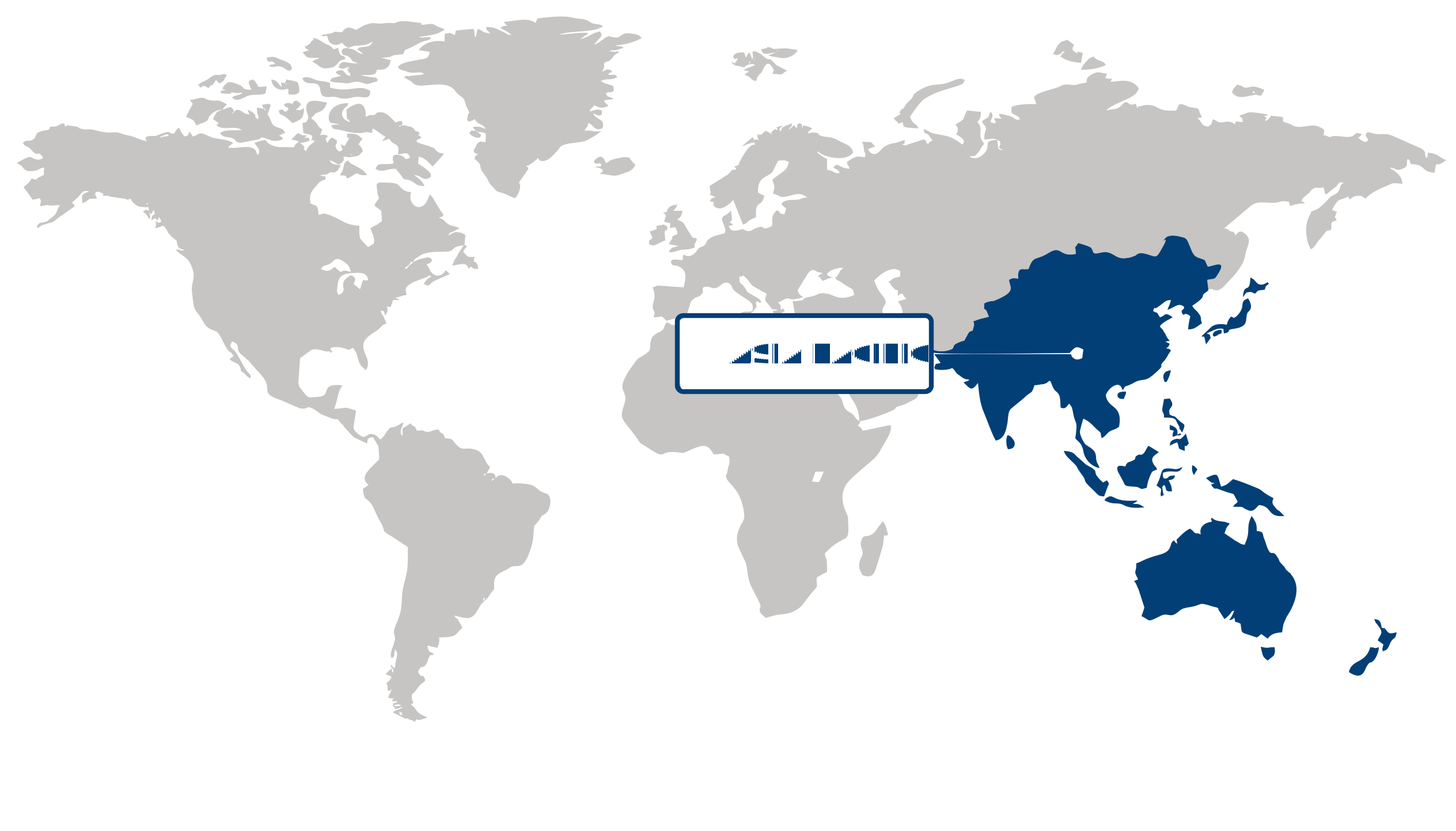
Asia Pacific (Largest Region)
Asia Pacific dominated the diesel fuel market in 2026, reflecting the region’s extensive industrial base, transportation activity, and continued reliance on diesel-powered vehicles and equipment. Strong demand from freight movement, commercial transportation, construction, agriculture, and manufacturing supports widespread diesel consumption across both developed and emerging economies. Rapid urbanization and infrastructure development are sustaining fuel requirements for heavy-duty mobility and construction machinery, while established refining and distribution networks provide broad access to diesel products. The region’s large manufacturing and logistics ecosystem further reinforces its position as the leading market.
North America (Fastest-Growing Region)
North America represents the fastest-growing region, supported by robust freight transportation, expanding logistics activity, and continued use of diesel-powered heavy-duty vehicles and industrial equipment. Demand is reinforced by the region’s extensive road-based distribution networks and the importance of diesel in commercial trucking, construction, agriculture, and other high-load applications. At the same time, refiners and fuel distributors are adapting to evolving emissions requirements and changing fuel-quality expectations, encouraging improvements in fuel efficiency and supply infrastructure. Ongoing industrial activity and transportation demand are supporting the region’s growth trajectory.
| Parameter | North America | Asia Pacific | Europe | Latin America | MEA |
|---|---|---|---|---|---|
| Innovation Hub i Scale Nascent Developing Advanced | |||||
| Cost-Sensitive Region i Scale Low Medium High | |||||
| Regulatory Environment i Scale Restrictive Neutral Supportive | |||||
| Demand Drivers i Scale Weak Moderate Strong | |||||
| Development Stage i Scale Emerging Developing Developed | |||||
| Adoption Rate i Scale Low Medium High | |||||
| New Entrants / Startups i Scale Sparse Moderate Dense | |||||
| Macro Indicators i Scale Weak Stable Strong |
Key Country Insights
Germany 🇩🇪
Industrial Mobility SupportGermany relies on diesel fuel across manufacturing logistics, commercial transport, and construction activities. German market participants emphasize cleaner fuel standards and operational efficiency while adapting infrastructure to evolving energy transition requirements.
France 🇫🇷
Low-Emission TransitionFrance is balancing diesel fuel demand with stricter emissions policies and growing alternative fuel adoption. French fuel suppliers increasingly invest in cleaner diesel solutions and distribution strategies that support commercial mobility during the energy transition.
Italy 🇮🇹
Regional Distribution NetworkItaly sustains diesel fuel consumption through road freight, agriculture, and industrial applications. Italian distributors focus on reliable regional supply and compliance with evolving fuel quality regulations while serving diverse commercial users.
Japan 🇯🇵
Logistics Efficiency FocusJapan maintains steady diesel fuel demand through commercial transportation, marine activities, and industrial operations. Japanese companies focus on fuel quality improvements and efficient distribution networks that support dependable logistics performance.
South Korea 🇰🇷
Commercial Transport BackboneSouth Korea depends on diesel fuel for freight movement, industrial machinery, and port operations. South Korean refiners continue strengthening fuel quality and supply flexibility to meet commercial transportation and industrial sector requirements.
United States 🇺🇸
Freight Energy SupplyThe U.S. diesel fuel market is shaped by freight transportation, agriculture, and industrial equipment demand. U.S. suppliers prioritize supply resilience, renewable diesel integration, and distribution efficiency to support commercial fleets and heavy-duty operations.
Segment Leadership and Growth Trends
Diesel Fuel Market Share (%), by Application, 2026
Go beyond the chart, access full insights & data tables
Request Free Sample ReportApplication Segment Analysis: Commercial Vehicles (Largest Segment) vs Passenger Vehicles (Fastest-Growing Segment)
Commercial vehicles dominated the diesel fuel market, holding a 59.46% share in 2026. Their substantial fuel requirements are closely tied to the operation of freight transport, logistics, construction, and other activities that depend on sustained vehicle utilization and long-distance mobility. Diesel remains particularly relevant for commercial applications because of its established suitability for heavy-duty operations and demanding transport cycles. Passenger vehicles are the fastest-growing application segment as diesel-powered vehicles continue to serve consumers seeking fuel efficiency and practical performance for longer-distance driving. Demand is also supported by established diesel vehicle fleets and continued use across markets where diesel remains an important option for passenger transportation.
End-user Segment Analysis: Transportation Industry (Largest & Fastest-Growing Segment)
The transportation industry led the diesel fuel market with a 47.44% share in 2026 and is also the fastest-growing end-user segment. The sector's strong fuel consumption is driven by the essential role of road transportation in moving passengers and goods, with diesel continuing to support commercial fleets and other high-utilization vehicles. Expansion of logistics activity, freight movement, and mobility requirements reinforces the industry's dependence on reliable transportation fuels. At the same time, the continued importance of road-based distribution and established diesel infrastructure supports sustained demand from transportation operators, particularly in applications where vehicle range, operating efficiency, and dependable fuel availability remain critical.
| Segment | Sub-Segment | Largest Segment | Fastest Growing |
|---|---|---|---|
| Application | Passenger Vehicles, Commercial Vehicles | Commercial Vehicles | Passenger Vehicles |
| End-user | Transportation Industry, Marine Industry, Others | Transportation Industry | Transportation Industry |
Competitive Landscape and Market Positioning
Top players in the diesel fuel market:
1. Saudi Arabian Oil Company (Saudi Arabia)
2. Exxon Mobil Corporation (United States)
3. Shell plc (United Kingdom)
4. Chevron Corporation (United States)
5. BP p.l.c. (United Kingdom)
6. PetroChina Company Limited (China)
7. China Petroleum & Chemical Corporation (China)
8. Reliance Industries Limited (India)
9. TotalEnergies SE (France)
10. Indian Oil Corporation Limited (India)
The diesel fuel market is undergoing gradual transformation influenced by evolving energy policies and efficiency improvements. Shifts in consumption patterns are shaping refining and distribution strategies. Environmental considerations are also influencing operational adjustments. The diesel fuel market continues to adapt within a changing global energy landscape.
| Company | Market Share | Company Revenue | Revenue CAGR (%) | Product Portfolio | Geographic Presence | Innovation / R&D Focus | Strategic Developments |
|---|---|---|---|---|---|---|---|
| Saudi Arabian Oil Company (Saudi Arabia) | |||||||
| Exxon Mobil Corporation (United States) | |||||||
| Shell plc (United Kingdom) | |||||||
| Chevron Corporation (United States) | |||||||
| BP p.l.c. (United Kingdom) | |||||||
| PetroChina Company Limited (China) | |||||||
| China Petroleum & Chemical Corporation (China) | |||||||
| Reliance Industries Limited (India) | |||||||
| TotalEnergies SE (France) | |||||||
| Indian Oil Corporation Limited (India). |
Industry Development/News
| Company Name | Date | Key Development |
|---|---|---|
| U.S. Bank | May-26 | U.S. Bank acquired TransCard’s heavy truck fuel card network, integrating a new commercial fuel payment solution specifically for Class 7 and 8 fleets. This acquisition expands the bank’s operational footprint in the heavy-duty trucking segment, enhancing its service portfolio for large-scale commercial transport operators by streamlining diesel procurement and transaction management processes. |
| Campbell Oil Co. | May-26 | Campbell Oil Co. completed the acquisition of John’s Fuel Service assets, incorporating its tank wagon operations and jobber network into the company’s dealer division. This consolidation strengthens Campbell Oil’s regional diesel supply infrastructure and downstream distribution capacity, increasing its physical footprint and reach within the local fuel retail and logistics value chain. |
| CountryMark | Jul-25 | CountryMark finalized a $100 million expansion at its Mount Vernon refinery to scale the production of renewable diesel derived from feedstocks like soybean oil. This investment increases the company's low-carbon fuel production capacity, utilizing existing refining infrastructure to meet growing market demand for renewable alternatives and supporting strategic decarbonization efforts within the transportation sector. |
| Mitsui & Co. | Apr-25 | Mitsui & Co. entered a partnership with Galp to initiate the production of hydrotreated vegetable oil (HVO) and sustainable aviation fuel in Europe. The initiative leverages existing diesel infrastructure to manufacture next-generation, low-emission fuels, representing a strategic pivot toward integrating renewable feedstocks into established supply chains to accelerate decarbonization across transportation fuel markets. |
| Reliance Industries Limited | Mar-25 | Reliance Industries completed major upgrades at its Jamnagar refining complex to optimize diesel output and quality. By enhancing hydrocracking and desulfurization unit performance, the company has increased its capability to produce ultra-low sulfur diesel (ULSD). This development aligns production standards with stricter global environmental regulations for the transportation, industrial, and export markets. |
Customize Your Report
Explore examples of how this report can be tailored to different research needs, including custom segments, additional topics or chapters, and related reports. Click a section of the wheel or its numbered marker to explore the available options.
Diesel Fuel Market — Custom Segments
| Segment | Sub-Segment |
|---|---|
| Fuel Grade | Automotive Diesel, Marine Diesel, Off-Road Diesel, Heating & Industrial Diesel |
| Distribution Channel | Retail Fuel Stations, Commercial Fuel Supply, Direct Industrial Supply, Marine Bunkering |
| Blend Type | Conventional Diesel, Biodiesel Blends, Renewable Diesel, Synthetic Diesel |
Diesel Fuel Market — Custom TOC
| Custom Chapter | Custom Details |
|---|---|
| Fuel Transition Impact Assessment |
|
| Commercial Fleet Fuel Optimization |
|
| Regional Energy Security Assessment |
|
Need a different cut of the data?
Request Custom ResearchWhat is the market valuation of diesel fuel?
What is the projected value of the diesel fuel industry by 2036?
How is freight and infrastructure expansion influencing diesel fuel consumption patterns?
What role is ultra-low sulfur diesel playing in reshaping procurement behavior in the diesel fuel market?
Why do commercial vehicles account for the largest share of the diesel fuel market?
Which end-user segment is growing the fastest in the diesel fuel market?
Why does Asia Pacific dominate the diesel fuel market?
What is driving diesel fuel market growth in North America?
Which companies dominate the diesel fuel landscape?
Our Clients
"The information presented in the report was genuinely insightful. The data was clear and easy to understand, which made it much easier to interpret the findings."
Amara Raja Group
"The responsiveness and professionalism exhibited by the team were exemplary. They were readily available to address queries, provide clarifications, and offer additional insights."
ONGC
"The reports offered a comprehensive analysis of various segments within the market. The detailed insights into market trends, and regulatory landscapes were excellent."
TotalEnergies
Our Research Team & Methodology
Every Fundamental Business Insights report is built by a dedicated vertical research team, validated through a structured primary-and-secondary methodology, and reviewed for accuracy before it reaches you.
Research Team Overview
Prepared by the Energy & Power Research Team
Delivery
Published
Demand
Available
Support
Trust & Compliance
Research Domains
10 coverage areasResearch Intelligence
| Source | Reference |
|---|---|
| International Energy Agency (IEA) | www.iea.org |
| U.S. Energy Information Administration (EIA) | www.eia.gov |
| International Renewable Energy Agency (IRENA) | www.irena.org |
| International Electrotechnical Commission (IEC) | www.iec.ch |
| International Organization for Standardization (ISO) | www.iso.org |
| IEEE | www.ieee.org |
| CIGRE (International Council on Large Electric Systems) | www.cigre.org |
| World Energy Council (WEC) | www.worldenergy.org |
| U.S. Department of Energy (DOE) | www.energy.gov |
| International Atomic Energy Agency (IAEA) | www.iaea.org |
| American Petroleum Institute (API) | www.api.org |
| Society of Petroleum Engineers (SPE) | www.spe.org |
| Hydrogen Council | hydrogencouncil.com |
| Battery Council International (BCI) | batterycouncil.org |
| Global Wind Energy Council (GWEC) | gwec.net |
| SolarPower Europe | www.solarpowereurope.org |
| World Bioenergy Association (WBA) | worldbioenergy.org |
| International Hydropower Association (IHA) | www.hydropower.org |
| Edison Electric Institute (EEI) | www.eei.org |
| National Renewable Energy Laboratory (NREL) | www.nrel.gov |
Research Workflow & Quality Assurance
Data Collection
Verified information gathered through primary and secondary research.
Data Triangulation
Cross-validation using multiple independent data sources.
Forecast Modelling
Market estimates developed using historical trends and analytical models.
Analyst Validation
Findings reviewed by domain experts for accuracy and consistency.
Editorial & Quality Review
Final editorial, quality, and compliance checks before publication.
Final Publication
Released after successful completion of the internal review process.
Report Coverage
📊 Market Assessment
- Market Size & Forecast
- Market Segmentation
- Regional Analysis
- Growth Drivers & Challenges
- Market Dynamics
🏢 Competitive Intelligence
- Competitive Landscape
- Company Profiles
- Competitive Benchmarking
- Mergers & Acquisitions
- Market Share Analysis or Key Company Strategies
🔍 Strategic Analysis
- Value Chain Analysis
- Porter's Five Forces
- PESTLE Analysis
- Pricing Trends
- Supply-Demand Analysis
🚀 Future Outlook
- Technology Landscape
- Regulatory Landscape
- Investment & Funding Landscape
- Emerging Opportunities
- Future Market Outlook
Have a question about this report or need a custom scope?
Request Customization