Automotive Lubricants Market Size & Growth Forecast 2027–2036, By Segments (Product), Regional Demand Trends (North America, Asia Pacific, Europe), Key Country Insights (U.S., Japan, South Korea, Germany, France, Italy), and Competitive Landscape
Market Size and Growth Outlook
Automotive Lubricants Market size was more than USD 81.01 billion in 2026 and is set to grow at a 3.33% CAGR between 2027 and 2036, attaining USD 112.41 billion by 2036. The industry revenue for 2027 is calculated at USD 83.28 billion.
Get more details on this report
Request Free Sample ReportAutomotive Lubricants Market Intelligence Snapshot
Regional Market Dynamics
- Asia Pacific accounted for 60.06% of the market in 2026, supported by its large vehicle parc, strong lubricant replacement demand, and extensive service networks across passenger and commercial vehicles.
- Asia Pacific is forecast to grow at a 4.1% CAGR as rising vehicle ownership, expanding freight activity, and continued internal combustion engine usage sustain lubricant consumption and replacement demand.
Segment Momentum
- Engine Oil captured a 57.54% share in 2026 because routine replacement across passenger and commercial vehicles creates consistent demand through OEM and aftermarket service channels.
- Brake Fluids are growing fastest as greater attention to braking performance, vehicle safety, and preventive maintenance encourages more timely fluid replacement across newer and aging vehicle fleets.
Market Expansion Drivers
- Rising lightweight vehicle production driving fuel-efficient lubricant demand in emerging economies.
- Shift toward sustainable lubricants reducing emissions and enhancing environmental compliance.
- Growing electric and hybrid vehicle adoption reshaping advanced fluid formulation requirements.
Leading Market Participants
- Prominent companies in the automotive lubricants market include Exxon Mobil Corporation (United States), Shell plc (United Kingdom), BP p.l.c. (United Kingdom), Chevron Corporation (United States), TotalEnergies SE (France), LUKOIL PJSC (Russia), Repsol S.A. (Spain), Valvoline Inc. (United States), FUCHS SE (Germany), Petronas Lubricants International Sdn Bhd (Malaysia).
Global Market Forecast Snapshot
Market Outlook
- 2026 Market Size: USD 81.01 billion
- 2027 Estimated Market Size: USD 83.28 billion.
- Projected Market Size: USD 112.41 billion by 2036
- Growth Forecast: 3.33% CAGR (2027-2036)
Regional and Segment Outlook
- Leading Regional Market: Asia Pacific
- High-Growth Regional Hub: Asia Pacific
- Core Revenue Segment: Engine Oil (Product)
- Emerging Opportunity Segment: Brake Fluids (Product)
Market Growth Drivers and Industry Trends
Rising lightweight vehicle production driving fuel-efficient lubricant demand in emerging economies
Increasing production of lightweight vehicles is supporting the automotive lubricants market as manufacturers and vehicle users place greater emphasis on fuel efficiency and optimized engine performance. Lightweight vehicle designs require lubricants that can support efficient operation while managing friction and wear, encouraging demand for formulations suited to evolving vehicle architectures in emerging economies.
Shift toward sustainable lubricants reducing emissions and enhancing environmental compliance
The automotive lubricants market is gaining momentum from the shift toward more sustainable lubricant solutions, as manufacturers and users seek products that can help reduce environmental impact. Greater attention to emissions and environmental compliance is encouraging the adoption of lubricant formulations designed around sustainability considerations, while supporting changes in product development and purchasing preferences across automotive applications.
Growing electric and hybrid vehicle adoption reshaping advanced fluid formulation requirements
Growing adoption of electric and hybrid vehicles is changing the automotive lubricants market by creating demand for fluid technologies tailored to newer powertrain configurations. These vehicles require specialized thermal management and lubrication solutions for components operating under different performance conditions, prompting lubricant developers to adapt formulations and address the changing technical requirements of electrified mobility.
| Growth Driver | Impact on CAGR | Regulatory Influence | Geographic Relevance | Adoption Rate | Impact Timeline |
|---|---|---|---|---|---|
| Rising lightweight vehicle production driving fuel-efficient lubricant demand in emerging economies | 2.00% | Moderate | Asia Pacific | High | Near Term |
| Shift toward sustainable lubricants reducing emissions and enhancing environmental compliance | 1.50% | High | Europe, North America | Medium | Mid Term |
| Growing electric and hybrid vehicle adoption reshaping advanced fluid formulation requirements | 1.00% | Moderate | Global | Emerging | Long Term |
Unlock insights tailored to your business with our bespoke market research solutions.
Click to get your customized report now.
Regional Demand Dynamics
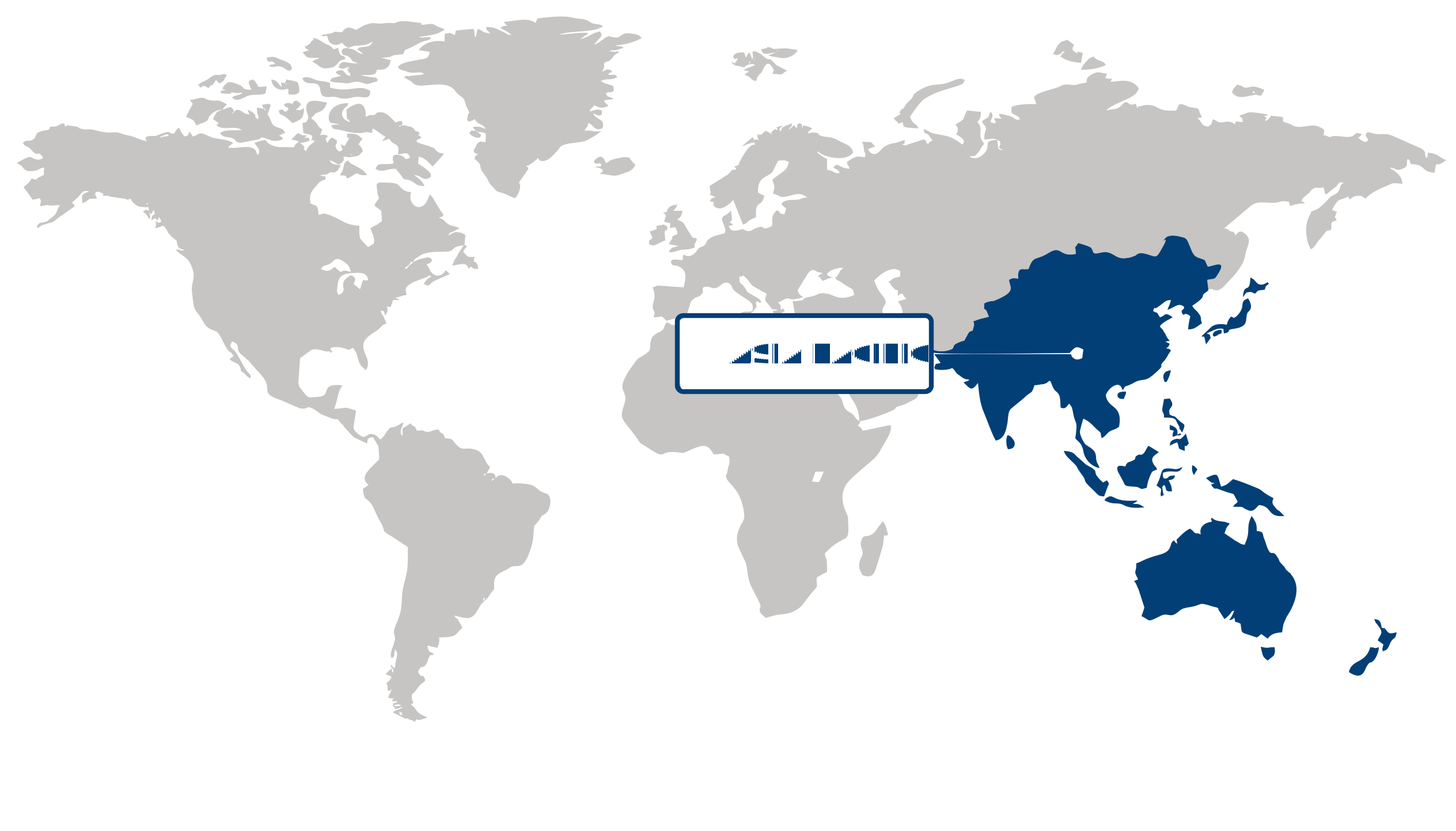
Asia Pacific (Largest & Fastest-Growing Region)
The automotive lubricants market in Asia Pacific held the largest share of 60.06% in 2026, while the region also represents the fastest-growing market, supported by its extensive automotive manufacturing base, expanding vehicle fleets, and continued industrialization. High demand for passenger vehicles, commercial transportation, and industrial mobility applications creates substantial consumption of engine oils, transmission fluids, gear oils, and other specialized lubricants. The region's diverse manufacturing ecosystem and increasing production of vehicles and automotive components further strengthen lubricant demand, while greater emphasis on engine efficiency, component protection, and maintenance is encouraging the use of higher-performance formulations. Rapid urbanization and expanding logistics and transportation activity are also sustaining aftermarket requirements, while evolving vehicle technologies are creating opportunities for increasingly specialized lubricant products.
| Parameter | North America | Asia Pacific | Europe | Latin America | MEA |
|---|---|---|---|---|---|
| Innovation Hub i Scale Nascent Developing Advanced | |||||
| Cost-Sensitive Region i Scale Low Medium High | |||||
| Regulatory Environment i Scale Restrictive Neutral Supportive | |||||
| Demand Drivers i Scale Weak Moderate Strong | |||||
| Development Stage i Scale Emerging Developing Developed | |||||
| Adoption Rate i Scale Low Medium High | |||||
| New Entrants / Startups i Scale Sparse Moderate Dense | |||||
| Macro Indicators i Scale Weak Stable Strong |
Key Country Insights
Germany 🇩🇪
Premium OEM AlignmentGermany emphasizes automotive lubricants designed to meet demanding OEM specifications for passenger and commercial vehicles. Manufacturers prioritize advanced formulations that enhance engine protection while supporting efficiency and evolving emission requirements.
France 🇫🇷
Low-Emission CompatibilityFrance prioritizes automotive lubricants compatible with modern engines and increasingly stringent environmental requirements. Suppliers focus on products that reduce engine wear, improve efficiency, and support diverse vehicle fleets across passenger and commercial segments.
Italy 🇮🇹
Aftermarket Service DemandItaly maintains steady demand for automotive lubricants through a well-established vehicle maintenance and aftermarket network. Lubricant suppliers emphasize premium formulations, product availability, and technical support to address varied vehicle operating conditions.
Japan 🇯🇵
Efficiency-Centered LubricationJapan focuses on automotive lubricants optimized for fuel-efficient engines and hybrid vehicle platforms. Domestic lubricant producers continue refining low-viscosity formulations that support durability while meeting strict vehicle manufacturer standards.
South Korea 🇰🇷
Advanced Vehicle SupportSouth Korea aligns automotive lubricant development with its expanding portfolio of advanced passenger and commercial vehicles. Companies invest in high-performance synthetic products that complement modern engine technologies and evolving maintenance needs.
United States 🇺🇸
Fleet Performance FocusThe U.S. automotive lubricants market is shaped by extensive passenger vehicle and commercial fleet maintenance requirements. Suppliers are expanding synthetic lubricant offerings and service-oriented solutions to improve engine efficiency and support longer maintenance intervals.
Segment Leadership and Growth Trends
Automotive Lubricants Market Share (%), by Product, 2026
Go beyond the chart, access full insights & data tables
Request Free Sample ReportProduct Segment Analysis: Engine Oil (Largest Segment) vs Brake Fluids (Fastest-Growing Segment)
Engine oil dominated the automotive lubricants market with a 57.54% share in 2026, reflecting its essential role in reducing friction, controlling wear, dissipating heat, and protecting engine components during vehicle operation. Continued use of internal combustion and hybrid powertrains maintains demand for engine lubrication, while modern engines increasingly require formulations capable of supporting fuel efficiency and component durability. Rising vehicle ownership, ongoing fleet operation, and greater attention to preventive maintenance further reinforce the segment's established position.
Brake fluids are growing at a faster pace as vehicle safety requirements and advances in braking systems increase the importance of reliable hydraulic performance. Brake fluids must maintain stable performance under demanding temperature and pressure conditions while supporting consistent braking response. The expansion of vehicle fleets, increasing maintenance requirements, and continued development of advanced braking technologies are contributing to stronger demand for specialized brake fluid formulations.
| Segment | Sub-Segment | Largest Segment | Fastest Growing |
|---|---|---|---|
| Product | Engine Oil, Gear Oil, Transmission Fluids, Brake Fluids, Coolants, Greases | Engine Oil | Brake Fluids |
Competitive Landscape and Market Positioning
Prominent players in the automotive lubricants market:
1. Exxon Mobil Corporation (United States)
2. Shell plc (United Kingdom)
3. BP p.l.c. (United Kingdom)
4. Chevron Corporation (United States)
5. TotalEnergies SE (France)
6. LUKOIL PJSC (Russia)
7. Repsol S.A. (Spain)
8. Valvoline Inc. (United States)
9. FUCHS SE (Germany)
10. Petronas Lubricants International Sdn Bhd (Malaysia)
Shifting mobility patterns and efficiency expectations are pushing the automotive lubricants market toward advanced formulations designed for longer service life and improved thermal stability. A noticeable transition toward high-performance synthetic variants reflects changing demand conditions influenced by modern engine architectures and regulatory pressure. At the same time, ongoing product enhancements are emphasizing friction reduction and fuel efficiency gains, supported by continuous material science improvements. Broader technology integration across formulation processes is further accelerating performance optimization, creating a more innovation-driven competitive environment.
| Company | Market Share | Company Revenue | Revenue CAGR (%) | Product Portfolio | Geographic Presence | Innovation / R&D Focus | Strategic Developments |
|---|---|---|---|---|---|---|---|
| Exxon Mobil Corporation (United States) | |||||||
| Shell plc (United Kingdom) | |||||||
| BP p.l.c. (United Kingdom) | |||||||
| Chevron Corporation (United States) | |||||||
| TotalEnergies SE (France) | |||||||
| LUKOIL PJSC (Russia) | |||||||
| Repsol S.A. (Spain) | |||||||
| Valvoline Inc. (United States) | |||||||
| FUCHS SE (Germany) | |||||||
| Petronas Lubricants International Sdn Bhd (Malaysia). |
Industry Development/News
| Company Name | Date | Key Development |
|---|---|---|
| HPCL | Jul-24 | HPCL has partnered with Tata Motors to establish a scalable circular economy model for used automotive lubricants in India. The initiative creates a structured system for the collection, traceability, and recycling of used oils into re-refined base oils, aiming to minimize hazardous waste leakage and foster sustainable supply chain practices throughout the automotive aftermarket. |
| Vollenhoven Oil Technology | Jul-24 | Vollenhoven Oil Technology and ABC Energies have established a joint venture, Vona, to consolidate their fuel and specialty lubricant wholesale operations. This strategic integration is designed to enhance market coverage across the automotive, transport, and industrial sectors, creating a more robust and efficient distribution platform to support broader product offerings. |
| Sunoco | Jul-24 | Sunoco Automotive Lubricants has officially entered the Philippine market, marking a significant expansion of its geographic footprint in Asia. By leveraging local distribution channels, the company is positioning its performance-oriented lubricant portfolio to compete in the regional vehicle maintenance sector and satisfy growing demand for high-performance engine lubrication solutions. |
| AMSOIL | Jul-24 | AMSOIL has collaborated with Fleece Performance to develop the "Freedom Series" lubricant line, specifically engineered for high-load diesel and racing applications. Scheduled for launch in Spring 2026, the product line represents a focused effort to address advanced lubrication requirements in high-performance automotive and motorsport environments through collaborative technical development. |
| Infineum | Jun-24 | Infineum has expanded its manufacturing footprint in India by developing a new, advanced lubricant blending facility. This investment significantly enhances local production capacity for high-performance lubricant additives, enabling the company to provide customized, market-specific formulations that improve engine efficiency and meet increasingly stringent environmental compliance standards. |
| Valvoline Cummins | Jun-24 | Valvoline Cummins has entered a strategic collaboration with Mahindra to integrate its lubricant offerings across Mahindra’s vehicle portfolio. The partnership focuses on optimizing aftermarket lubricant performance, improving serviceability for the end-user, and advancing sustainability initiatives, including the adoption of eco-friendly PCR packaging within the Indian automotive lubricant segment. |
| Daewoo Lubricants | Jun-24 | Daewoo Lubricants has formally entered the Indian market through a licensing agreement with Mangali Industries. This partnership facilitates the local manufacturing and distribution of the company’s premium lubricant range, enabling expansion across passenger, commercial, and agricultural vehicle segments while strengthening Daewoo’s international market penetration strategy. |
| ADNOC Distribution | Jun-24 | ADNOC Distribution has secured a strategic agreement with AD Ports Group to optimize the supply of marine lubricants. The partnership aims to enhance global maritime logistics by streamlining the distribution of high-quality lubricants, further solidifying ADNOC’s position in integrated fuel and lubricant logistics for international shipping routes. |
| EnerG Lubricants | Jun-24 | EnerG Lubricants, in partnership with GAT GmbH, has launched a new high-performance automotive lubricant and additive range in India. The rollout includes Mercedes-Benz-approved engine oil formulations, allowing the company to compete more effectively in premium market segments by offering globally certified lubrication technologies to local consumers. |
| Duckhams Oils | Jun-24 | Duckhams Oils has expanded its distribution network through a partnership with D2P Autoparts, enabling availability on major e-commerce platforms like eBay and Autodoc. This digital transformation initiative strengthens aftermarket accessibility and supports the company’s broader strategy of scaling sales through online consumer and workshop channels. |
Customize Your Report
Explore examples of how this report can be tailored to different research needs, including custom segments, additional topics or chapters, and related reports. Click a section of the wheel or its numbered marker to explore the available options.
Automotive Lubricants Market — Custom Segments
| Segment | Sub-Segment |
|---|---|
| Vehicle Type | Passenger Cars, Light Commercial Vehicles, Heavy Commercial Vehicles, Two-Wheelers |
| Engine Technology | Internal Combustion Engines, Hybrid Electric Vehicles, Plug-in Hybrid Electric Vehicles, Battery Electric Vehicles |
| Sales Channel | OEM & Authorized Service Centers, Independent Workshops, Automotive Retailers, E-commerce |
Automotive Lubricants Market — Custom TOC
| Custom Chapter | Custom Details |
|---|---|
| Electric Vehicle Transition Impact Assessment |
|
| OEM Factory Fill and Aftermarket Strategy Analysis |
|
| Used Oil Collection and Re-refining Opportunity Assessment |
|
Need a different cut of the data?
Request Custom ResearchHow much is the automotive lubricants market worth?
How is the automotive lubricants industry expected to grow over the next 10 years?
How is vehicle efficiency-focused design influencing lubricant formulation and purchasing behavior?
What impact is the transition toward electric and hybrid vehicles having on automotive lubricant demand patterns?
Why is engine oil the largest product segment in the automotive lubricants market?
Why are brake fluids the fastest-growing product segment in the automotive lubricants market?
Why is Asia Pacific the leading region in the automotive lubricants market?
What is supporting continued growth in the Asia Pacific automotive lubricants market?
What are the key competitors in the automotive lubricants landscape?
Our Clients
"The team surpassed our expectations with the report depth. The actionable insights provided proved crucial in navigating market challenges."
Tata Motors
"We found the report to be very informative. The expertise and attention to market nuances significantly influenced our business direction."
DENSO Corporation
"The consumer survey findings were quite good. We now have a clearer picture of the customer churning and retention strategy."
HL Mando
Our Research Team & Methodology
Every Fundamental Business Insights report is built by a dedicated vertical research team, validated through a structured primary-and-secondary methodology, and reviewed for accuracy before it reaches you.
Research Team Overview
Prepared by the Automotive & Transportation Research Team
Delivery
Published
Demand
Available
Support
Trust & Compliance
Research Domains
10 coverage areasResearch Intelligence
| Source | Reference |
|---|---|
| International Organization of Motor Vehicle Manufacturers (OICA) | www.oica.net |
| SAE International | www.sae.org |
| International Energy Agency (IEA) | www.iea.org |
| International Transport Forum (ITF) | www.itf-oecd.org |
| International Road Federation (IRF) | www.irf.global |
| International Organization for Standardization (ISO) | www.iso.org |
| United Nations Economic Commission for Europe (UNECE) | unece.org |
| National Highway Traffic Safety Administration (NHTSA) | www.nhtsa.gov |
| U.S. Department of Transportation (USDOT) | www.transportation.gov |
| European Automobile Manufacturers' Association (ACEA) | www.acea.auto |
| Society of Indian Automobile Manufacturers (SIAM) | www.siam.in |
| International Air Transport Association (IATA) | www.iata.org |
| International Civil Aviation Organization (ICAO) | www.icao.int |
| International Maritime Organization (IMO) | www.imo.org |
| International Union of Railways (UIC) | uic.org |
| American Public Transportation Association (APTA) | www.apta.com |
| International Federation of Robotics (IFR) | ifr.org |
| CharIN | www.charin.global |
| World Shipping Council | www.worldshipping.org |
| International Federation of Freight Forwarders Associations (FIATA) | fiata.org |
Research Workflow & Quality Assurance
Data Collection
Verified information gathered through primary and secondary research.
Data Triangulation
Cross-validation using multiple independent data sources.
Forecast Modelling
Market estimates developed using historical trends and analytical models.
Analyst Validation
Findings reviewed by domain experts for accuracy and consistency.
Editorial & Quality Review
Final editorial, quality, and compliance checks before publication.
Final Publication
Released after successful completion of the internal review process.
Report Coverage
📊 Market Assessment
- Market Size & Forecast
- Market Segmentation
- Regional Analysis
- Growth Drivers & Challenges
- Market Dynamics
🏢 Competitive Intelligence
- Competitive Landscape
- Company Profiles
- Competitive Benchmarking
- Mergers & Acquisitions
- Market Share Analysis or Key Company Strategies
🔍 Strategic Analysis
- Value Chain Analysis
- Porter's Five Forces
- PESTLE Analysis
- Pricing Trends
- Supply-Demand Analysis
🚀 Future Outlook
- Technology Landscape
- Regulatory Landscape
- Investment & Funding Landscape
- Emerging Opportunities
- Future Market Outlook
Have a question about this report or need a custom scope?
Request Customization