Automotive Bumper Market Size & Growth Forecast 2027–2036, By Segments (Material, Bumper, Position, Vehicle, End Use, Manufacturing Process), Regional Demand Trends (North America, Asia Pacific, Europe), Key Country Insights (U.S., Japan, South Korea, Germany, France, Italy), and Competitive Landscape
Market Size and Growth Outlook
Automotive Bumper Market size was over USD 18.02 Billion in 2026 and is likely to grow at 4.54% CAGR between 2027 and 2036, exceeding USD 28.09 Billion by 2036. The industry revenue for 2027 is estimated at USD 18.7 Billion.
Get more details on this report
Request Free Sample ReportAutomotive Bumper Market Intelligence Snapshot
Regional Market Dynamics
- Strong vehicle production, expanding automotive manufacturing capabilities, extensive supply chains, and rising passenger and commercial vehicle demand support regional leadership.
- Increasing vehicle manufacturing investment and demand for safer, aesthetically refined vehicles are encouraging adoption of lightweight, durable, and advanced bumper designs.
Segment Momentum
- Plastic accounted for 44.2% of the market in 2026, supported by its lightweight design, impact resistance, corrosion protection, cost efficiency, and flexibility for complex vehicle styling and aerodynamic integration.
- Rear bumpers are gaining momentum as automakers integrate parking sensors, cameras, and other assistance technologies while enhancing rear-end safety and vehicle styling to meet evolving consumer and design requirements.
Market Expansion Drivers
- Rising automotive production increasing global bumper demand
- Lightweight material adoption improving fuel efficiency and EV range
- EV platform redesign driving integrated aerodynamic bumper systems
Leading Market Participants
- Prominent players in the automotive bumper market include Magna International Inc. (Canada), Hyundai Mobis Co., Ltd. (South Korea), Toyota Boshoku Corporation (Japan), Samvardhana Motherson International Ltd. (India), Gestamp Automoción S.A. (Spain), Valeo SE (France), Lear Corporation (United States), OPmobility SE (France)
Global Market Forecast Snapshot
Market Outlook
- 2026 Market Size: USD 18.02 Billion
- 2027 Estimated Market Size: USD 18.7 Billion
- Projected Market Size: USD 28.09 Billion by 2036
- Growth Forecast: 4.54% CAGR (2027-2036)
Regional and Segment Outlook
- Leading Regional Market: Asia Pacific
- High-Growth Regional Hub: Asia Pacific
- Core Revenue Segment: Plastic (Material) | Standard Bumper (Bumper) | Front Bumper (Position) | Passenger Vehicles (Vehicle) | OEMs (End Use) | Injection Molding (Manufacturing Process)
- Emerging Opportunity Segment: Carbon Fiber (Material) | Tube Bumper (Bumper) | Rear Bumper (Position) | Commercial Vehicles (Vehicle) | Aftermarket (End Use) | Compression Molding (Manufacturing Process)
Market Growth Drivers and Industry Trends
Rising automotive production increasing global bumper demand
Growing vehicle manufacturing across passenger and commercial segments is creating consistent demand for essential exterior components that are installed on every new vehicle. The automotive bumper market will drive growth as higher production volumes translate directly into increased procurement of front and rear bumper assemblies across original equipment manufacturers. Expanding manufacturing capacity, broader model portfolios, and rising consumer demand for personal mobility are encouraging suppliers to increase production while introducing designs that accommodate different vehicle categories and regional safety requirements. Replacement demand generated by collision repairs and aftermarket servicing further supports steady consumption of bumper systems across mature and developing automotive markets.
Lightweight material adoption improving fuel efficiency and EV range
Automakers are increasingly replacing conventional materials with advanced polymers, composites, and lightweight alloys to reduce vehicle mass without compromising structural performance or impact protection. This material transition will propel the automotive bumper market growth as manufacturers seek bumper systems that contribute to improved fuel economy in internal combustion vehicles while extending driving range in electric models. Lightweight bumper designs also simplify vehicle assembly, support weight distribution objectives, and enhance compatibility with modern manufacturing processes. Material innovation is encouraging suppliers to develop components that combine durability, energy absorption, corrosion resistance, and design flexibility for evolving vehicle architectures.
EV platform redesign driving integrated aerodynamic bumper systems
The shift toward dedicated electric vehicle platforms is transforming the functional role of bumpers beyond conventional impact protection. In the automotive bumper market, redesigned vehicle architectures are increasing demand for integrated bumper systems that incorporate aerodynamic contours, sensor housings, cooling management features, and advanced driver assistance technologies within a single assembly. Electric vehicles require optimized airflow to improve energy efficiency while accommodating cameras, radar modules, and other electronic components without affecting vehicle styling. These evolving design requirements are encouraging closer collaboration between vehicle manufacturers and component suppliers to develop multifunctional bumper solutions that align with modern platform engineering.
| Growth Driver | Impact on CAGR | Regulatory Influence | Geographic Relevance | Adoption Rate | Impact Timeline |
|---|---|---|---|---|---|
| Rising automotive production increasing global bumper demand | 1.8% | Moderate | Asia Pacific, North America | High | Near Term |
| Lightweight material adoption improving fuel efficiency and EV range | 2% | High | Europe, Asia Pacific | High | Mid Term |
| EV platform redesign driving integrated aerodynamic bumper systems | 1.6% | Moderate | North America, Europe | Medium | Mid Term |
Unlock insights tailored to your business with our bespoke market research solutions.
Click to get your customized report now.
Regional Demand Dynamics
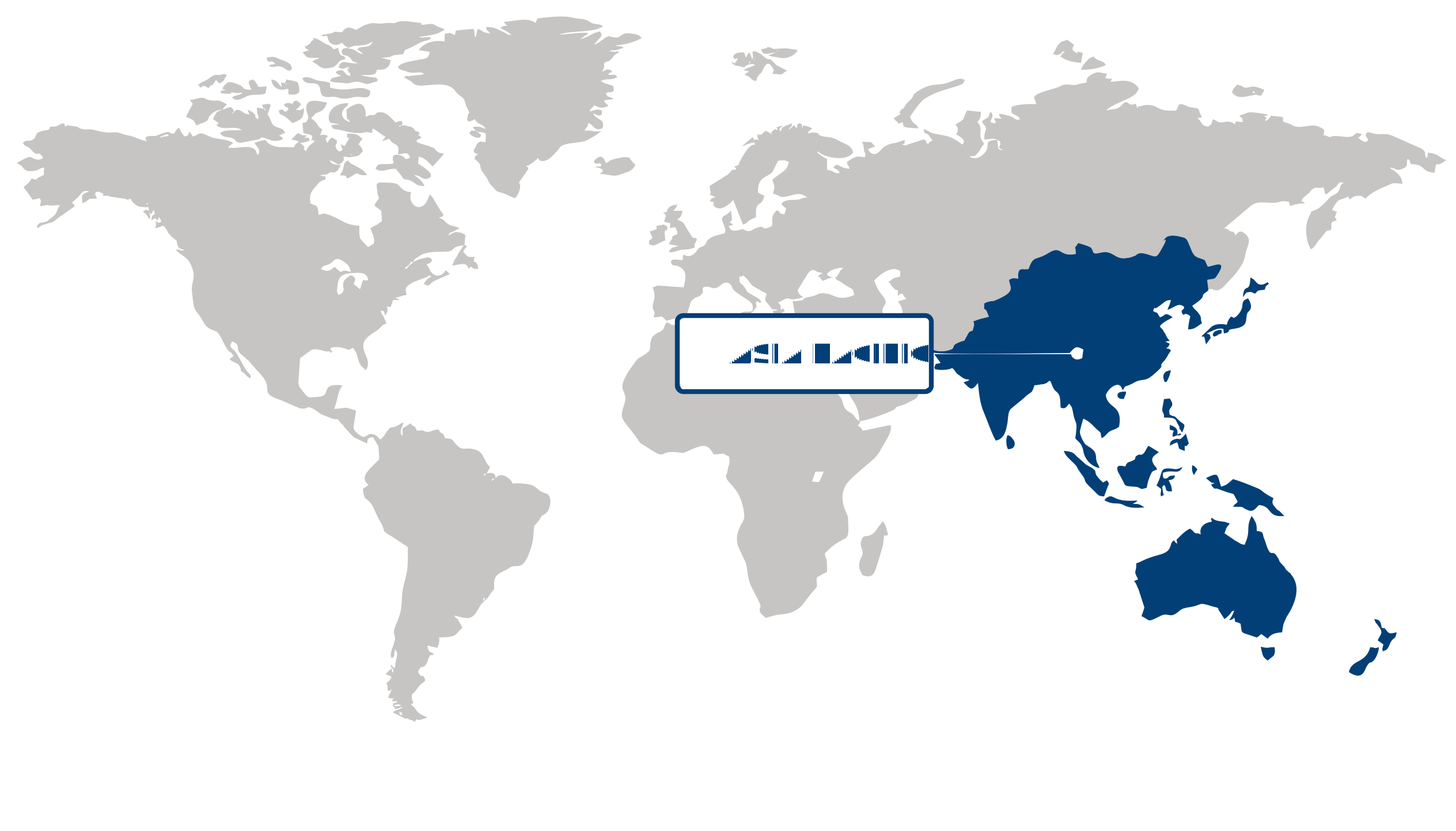
Asia Pacific (Largest & Fastest-Growing Region)
The Asia Pacific region accounted for the largest share of the automotive bumper market in 2026 and is also positioned for the fastest growth, supported by strong vehicle production, expanding automotive manufacturing capabilities, and rising demand for passenger and commercial vehicles. The presence of extensive automotive supply chains and increasing investments in vehicle manufacturing are creating steady requirements for bumper systems and related components. In addition, growing consumer demand for safer and more aesthetically refined vehicles is encouraging the integration of lightweight, durable, and technologically advanced bumper designs, strengthening regional market opportunities.
| Parameter | North America | Asia Pacific | Europe | Latin America | MEA |
|---|---|---|---|---|---|
| Innovation Hub i Scale Nascent Developing Advanced | |||||
| Cost-Sensitive Region i Scale Low Medium High | |||||
| Regulatory Environment i Scale Restrictive Neutral Supportive | |||||
| Demand Drivers i Scale Weak Moderate Strong | |||||
| Development Stage i Scale Emerging Developing Developed | |||||
| Adoption Rate i Scale Low Medium High | |||||
| New Entrants / Startups i Scale Sparse Moderate Dense | |||||
| Macro Indicators i Scale Weak Stable Strong |
Key Country Insights
United States 🇺🇸
Utility Vehicle IntegrationThe U.S. automotive bumper market is influenced by strong production of SUVs, pickup trucks, and passenger vehicles. Manufacturers increasingly incorporate lightweight materials, integrated sensors, and impact-resistant designs that support evolving vehicle architectures.
Germany 🇩🇪
Premium Vehicle EngineeringGermany's automotive bumper market is shaped by premium vehicle manufacturing with emphasis on safety, aerodynamics, and design integration. Suppliers continue developing lightweight bumper systems compatible with advanced driver assistance technologies.
Japan 🇯🇵
Lightweight Component DesignJapan prioritizes automotive bumper solutions that reduce vehicle weight while maintaining structural performance and repair efficiency. Demand increasingly favors innovative materials and streamlined manufacturing processes for both conventional and electrified vehicles.
South Korea 🇰🇷
Smart Exterior SystemsSouth Korea integrates automotive bumpers with advanced sensing technologies used in modern passenger vehicles. Suppliers focus on modular assemblies, lightweight plastics, and efficient production methods supporting domestic and export vehicle programs.
France 🇫🇷
Design-Oriented ManufacturingFrance supports automotive bumper development through passenger vehicle production emphasizing styling, pedestrian safety, and lightweight construction. Manufacturers increasingly adopt recyclable materials and integrated component designs that simplify vehicle assembly.
Italy 🇮🇹
Specialty Vehicle ComponentsItaly's automotive bumper market benefits from passenger vehicle manufacturing and specialized automotive suppliers. Product development emphasizes design flexibility, durable composite materials, and compatibility with increasingly sophisticated exterior vehicle systems.
Segment Leadership and Growth Trends
Automotive Bumper Market Share (%), by Material, 2026
Go beyond the chart, access full insights & data tables
Request Free Sample ReportMaterial Segment Analysis: Plastic (Largest Segment) vs Carbon Fiber (Fastest-Growing Segment)
The plastic segment dominated the automotive bumper market, accounting for 44.2% of the market share in 2026. Its leading position is supported by the material's favorable combination of low weight, impact absorption, corrosion resistance, and cost efficiency, making it suitable for high-volume vehicle production. Plastic bumpers can also be molded into complex shapes, enabling manufacturers to achieve greater design flexibility while integrating aerodynamic and styling requirements into vehicle exteriors. Their relatively straightforward manufacturing and finishing processes further support widespread adoption across passenger and commercial vehicles. As automakers continue to pursue lighter vehicle structures without compromising safety and appearance, plastic remains a practical material choice for bumper systems and maintains strong demand across the automotive industry.
Carbon fiber is expected to be the fastest-growing material segment, driven by increasing interest in lightweight, high-strength materials for advanced vehicle design. Carbon fiber offers an attractive strength-to-weight profile, enabling manufacturers to reduce component mass while maintaining structural performance. This characteristic is particularly valuable as the automotive industry places greater emphasis on improving vehicle efficiency, performance, and handling. The material's premium appearance and suitability for performance-oriented vehicle applications also contribute to its expanding use. In addition, the broader shift toward lightweight construction is encouraging greater exploration of advanced composites, creating favorable conditions for carbon fiber bumper applications and supporting its rapid segment growth.
Bumper Segment Analysis: Standard Bumper (Largest Segment) vs Tube Bumper (Fastest-Growing Segment)
The standard bumper segment held the largest share of the automotive bumper market in 2026, reflecting its broad applicability across conventional vehicle designs and its established role in providing basic impact protection. Standard bumpers are widely incorporated into vehicle architectures because they offer a practical balance between protection, styling, manufacturability, and cost. Their compatibility with mass-market vehicle platforms and established production processes supports consistent demand from vehicle manufacturers and replacement markets. The continued focus on vehicle safety and exterior component durability further reinforces the need for dependable bumper systems, allowing standard bumpers to maintain their leading position across a wide range of automotive applications.
The tube bumper segment is anticipated to experience the fastest growth, supported by rising interest in specialized vehicle applications that require enhanced durability and off-road protection. Tube bumpers typically provide a robust structural configuration suited to demanding driving environments where vehicles may encounter rough terrain, obstacles, and higher impact exposure. Their functional characteristics make them attractive for recreational, utility, and off-road-oriented vehicles, where protection and ruggedness are prioritized alongside vehicle customization. Growing consumer interest in vehicle personalization and specialized exterior accessories is also creating additional opportunities for tube bumper adoption, supporting faster expansion within the bumper product landscape.
Position Segment Analysis: Front Bumper (Largest Segment) vs Rear Bumper (Fastest-Growing Segment)
The front bumper segment accounted for the largest share of the automotive bumper market in 2026, reflecting its critical role in protecting the front section of a vehicle and supporting overall occupant and vehicle safety. Front bumpers are designed to absorb and manage impact forces while also accommodating increasingly integrated vehicle components such as sensors, cameras, grilles, and lighting systems. The growing incorporation of advanced driver assistance technologies is encouraging more sophisticated bumper designs that can accommodate electronic sensing equipment without compromising structural performance or aesthetics. As vehicle manufacturers continue to prioritize front-end safety, aerodynamic design, and technology integration, demand for front bumpers remains substantial across the automotive sector.
The rear bumper segment is expected to grow at the fastest pace, driven by increasing attention to rear-end safety, vehicle styling, and the integration of electronic sensing technologies. Modern rear bumper designs increasingly need to accommodate parking sensors, cameras, and other assistance features, creating demand for components that combine protection with precise technology integration. The expansion of advanced driver assistance functions is also increasing the importance of rear vehicle areas in overall safety and maneuvering systems. At the same time, consumer preferences for distinctive exterior designs are encouraging greater innovation in rear bumper construction and styling, supporting stronger growth in this segment.
| Segment | Sub-Segment | Largest Segment | Fastest Growing |
|---|---|---|---|
| Material | Plastic, Metal, Carbon Fiber, Composite, Others | Plastic | Carbon Fiber |
| Bumper | Standard Bumper, Step Bumper, Roll Pan Bumper, Deep Drop Bumper, Tube Bumper | Standard Bumper | Tube Bumper |
| Position | Front Bumper, Rear Bumper | Front Bumper | Rear Bumper |
| Vehicle | Passenger Vehicles, Commercial Vehicles | Passenger Vehicles | Commercial Vehicles |
| End Use | OEMs, Aftermarket | OEMs | Aftermarket |
| Manufacturing Process | Injection Molding, Reaction Injection Molding (RIM), Blow Molding, Compression Molding | Injection Molding | Compression Molding |
Competitive Landscape and Market Positioning
Major players in the automotive bumper market:
- Magna International, Inc. (Canada)
- Hyundai Mobis Co., Ltd. (South Korea)
- Toyota Boshoku Corporation (Japan)
- Samvardhana Motherson International Ltd. (India)
- Gestamp Automoción S.A. (Spain)
- Valeo SE (France)
- Lear Corporation (United States)
- OPmobility SE (France)
Advances in vehicle design and safety expectations are reshaping competitive priorities, with manufacturers balancing lightweight construction against increasingly demanding impact performance and styling requirements. Material innovation has become a central area of differentiation as suppliers refine polymer formulations, composite structures, and manufacturing techniques that improve energy absorption while supporting vehicle efficiency objectives. Growing design complexity is also encouraging closer alignment between engineering, production, and finishing capabilities, particularly as automakers seek exterior components that integrate seamlessly with sensors and advanced driver assistance technologies. Competitive strength is therefore becoming more closely linked to technical development capabilities and manufacturing precision than to component production alone.
| Company | Market Share | Company Revenue | Revenue CAGR (%) | Product Portfolio | Geographic Presence | Innovation / R&D Focus | Strategic Developments |
|---|---|---|---|---|---|---|---|
| Magna International Inc. (Canada) | |||||||
| Hyundai Mobis Co. Ltd. (South Korea) | |||||||
| Toyota Boshoku Corporation (Japan) | |||||||
| Samvardhana Motherson International Ltd. (India) | |||||||
| Gestamp Automoción S.A. (Spain) | |||||||
| Valeo SE (France) | |||||||
| Lear Corporation (United States) | |||||||
| OPmobility SE (France) |
Industry Development/News
| Company Name | Date | Key Development |
|---|---|---|
| Motherson | Jul-26 | Motherson and PureCycle successfully produced a Class-A surface automotive bumper prototype incorporating 30% PureFive recycled polypropylene. The prototype, manufactured in Tuscaloosa, Alabama, undergoes rigorous performance and climate testing to align with upcoming EU End-of-Life Vehicle regulations requiring higher recycled plastic content in automotive exterior components. |
| MBA Polymers UK | Feb-24 | MBA Polymers UK launched a dedicated recycling initiative to transform end-of-life vehicle (ELV) bumpers into high-quality, reusable polymers. By establishing specialized processing lines, the company enables automotive manufacturers to integrate circular materials into their supply chains, helping the sector meet sustainability targets and reduce reliance on virgin plastic production. |
Customize Your Report
Explore examples of how this report can be tailored to different research needs, including custom segments, additional topics or chapters, and related reports. Click a section of the wheel or its numbered marker to explore the available options.
Automotive Bumper Market — Custom Segments
| Segment | Sub-Segment |
|---|---|
| Vehicle Powertrain | Internal Combustion Engine, Hybrid Electric Vehicle, Battery Electric Vehicle |
| Vehicle Architecture | Unibody, Body-on-Frame |
| ADAS Integration Level | Non-ADAS Bumpers, Basic Sensor-Integrated Bumpers, Advanced ADAS-Integrated Bumpers |
Automotive Bumper Market — Custom TOC
| Custom Chapter | Custom Details |
|---|---|
| Lightweighting Adoption Roadmap |
|
| EV Bumper Design Priorities |
|
| Circular Materials Strategy |
|
Need a different cut of the data?
Request Custom ResearchWhat is the market valuation of automotive bumper?
What is the projected value of the automotive bumper industry by 2036?
How is the transition to electric vehicles reshaping automotive bumper design?
Why are lightweight materials becoming a strategic priority in automotive bumper development?
Why are plastic bumpers the largest material segment in the automotive bumper market?
Why is the rear bumper segment expected to grow the fastest in the automotive bumper market?
Why does Asia Pacific lead the automotive bumper market?
What is supporting Asia Pacific's fastest growth in automotive bumpers?
Which companies dominate the automotive bumper landscape?
Our Clients
"The team surpassed our expectations with the report depth. The actionable insights provided proved crucial in navigating market challenges."
Tata Motors
"We found the report to be very informative. The expertise and attention to market nuances significantly influenced our business direction."
DENSO Corporation
"The consumer survey findings were quite good. We now have a clearer picture of the customer churning and retention strategy."
HL Mando
Our Research Team & Methodology
Every Fundamental Business Insights report is built by a dedicated vertical research team, validated through a structured primary-and-secondary methodology, and reviewed for accuracy before it reaches you.
Research Team Overview
Prepared by the Automotive & Transportation Research Team
Delivery
Published
Demand
Available
Support
Trust & Compliance
Research Domains
10 coverage areasResearch Intelligence
| Source | Reference |
|---|---|
| International Organization of Motor Vehicle Manufacturers (OICA) | www.oica.net |
| SAE International | www.sae.org |
| International Energy Agency (IEA) | www.iea.org |
| International Transport Forum (ITF) | www.itf-oecd.org |
| International Road Federation (IRF) | www.irf.global |
| International Organization for Standardization (ISO) | www.iso.org |
| United Nations Economic Commission for Europe (UNECE) | unece.org |
| National Highway Traffic Safety Administration (NHTSA) | www.nhtsa.gov |
| U.S. Department of Transportation (USDOT) | www.transportation.gov |
| European Automobile Manufacturers' Association (ACEA) | www.acea.auto |
| Society of Indian Automobile Manufacturers (SIAM) | www.siam.in |
| International Air Transport Association (IATA) | www.iata.org |
| International Civil Aviation Organization (ICAO) | www.icao.int |
| International Maritime Organization (IMO) | www.imo.org |
| International Union of Railways (UIC) | uic.org |
| American Public Transportation Association (APTA) | www.apta.com |
| International Federation of Robotics (IFR) | ifr.org |
| CharIN | www.charin.global |
| World Shipping Council | www.worldshipping.org |
| International Federation of Freight Forwarders Associations (FIATA) | fiata.org |
Research Workflow & Quality Assurance
Data Collection
Verified information gathered through primary and secondary research.
Data Triangulation
Cross-validation using multiple independent data sources.
Forecast Modelling
Market estimates developed using historical trends and analytical models.
Analyst Validation
Findings reviewed by domain experts for accuracy and consistency.
Editorial & Quality Review
Final editorial, quality, and compliance checks before publication.
Final Publication
Released after successful completion of the internal review process.
Report Coverage
📊 Market Assessment
- Market Size & Forecast
- Market Segmentation
- Regional Analysis
- Growth Drivers & Challenges
- Market Dynamics
🏢 Competitive Intelligence
- Competitive Landscape
- Company Profiles
- Competitive Benchmarking
- Mergers & Acquisitions
- Market Share Analysis or Key Company Strategies
🔍 Strategic Analysis
- Value Chain Analysis
- Porter's Five Forces
- PESTLE Analysis
- Pricing Trends
- Supply-Demand Analysis
🚀 Future Outlook
- Technology Landscape
- Regulatory Landscape
- Investment & Funding Landscape
- Emerging Opportunities
- Future Market Outlook
Have a question about this report or need a custom scope?
Request Customization