Automotive Crash Impact Simulator Market Size & Growth Forecast 2027–2036, By Segments (Propulsion, Simulation, Vehicle, Application), Regional Demand Trends (North America, Asia Pacific, Europe), Key Country Insights (U.S., Japan, South Korea, Germany, France, Italy), and Competitive Landscape
Market Size and Growth Outlook
Automotive Crash Impact Simulator Market size stood at USD 1 Billion in 2026 and is predicted to grow at 8.9% CAGR from 2027 to 2036, reaching USD 2.35 Billion by 2036. The industry revenue for 2027 is assessed at USD 1.08 Billion.
Get more details on this report
Request Free Sample ReportAutomotive Crash Impact Simulator Market Intelligence Snapshot
Regional Market Dynamics
- Europe led in 2026 due to its mature automotive ecosystem, stringent safety requirements, advanced engineering capabilities, and investment in virtual crash simulation technologies.
- North America is growing fastest through automotive R&D investment, advanced safety technology adoption, and rising simulation needs for electric and increasingly automated vehicles.
Segment Momentum
- Passenger vehicles are the largest and fastest-growing segment, driven by rising demand for occupant safety, stricter vehicle safety regulations, and greater use of virtual crash validation to shorten development cycles.
- Software simulation is the fastest-growing simulation segment because it enables efficient virtual crash analysis, reduces reliance on physical prototypes, and accelerates vehicle design optimization.
Market Expansion Drivers
- Rising global road accident rates increasing demand for advanced crash simulation and testing systems
- Shift toward EV and autonomous vehicles driving need for enhanced virtual safety validation tools
- Cost-efficient simulation software adoption reducing physical prototyping in automotive safety testing workflows
Leading Market Participants
- Leading companies in the automotive crash impact simulator market include Altair Engineering Inc. (United States), Ansys Inc. (United States), Dassault Systèmes SE (France), Siemens AG (Germany), Hexagon AB (Sweden), ESI Group (France), MathWorks Inc. (United States), AVSimulation (France), Humanetics Group (United States), VI-grade GmbH (Italy)
Global Market Forecast Snapshot
Market Outlook
- 2026 Market Size: USD 1 Billion
- 2027 Estimated Market Size: USD 1.08 Billion
- Projected Market Size: USD 2.35 Billion by 2036
- Growth Forecast: 8.9% CAGR (2027-2036)
Regional and Segment Outlook
- Leading Regional Market: Europe
- High-Growth Regional Hub: North America
- Core Revenue Segment: ICE (Propulsion) | Hardware-in-the-loop Simulation (Simulation) | Passenger Vehicles (Vehicle) | Vehicle Design & Development (Application)
- Emerging Opportunity Segment: Electric Vehicles (Propulsion) | Software Simulation (Simulation) | Passenger Vehicles (Vehicle) | Vehicle Design & Development (Application)
Market Growth Drivers and Industry Trends
Rising global road accident rates increasing demand for advanced crash simulation and testing systems
Growing concerns surrounding road safety and the continued occurrence of traffic collisions are encouraging automotive manufacturers to strengthen vehicle safety development processes before commercial deployment. The automotive crash impact simulator market growth is driven by increasing demand for sophisticated simulation platforms capable of evaluating vehicle behavior under diverse crash scenarios. Engineers are relying on advanced modeling tools to analyze structural integrity, occupant protection, and energy absorption characteristics while improving overall vehicle design efficiency. These technologies enable manufacturers to examine multiple impact conditions during product development, supporting more comprehensive safety validation across a wide range of vehicle platforms.
Shift toward EV and autonomous vehicles driving need for enhanced virtual safety validation tools
The transition toward electric mobility and autonomous driving technologies is introducing increasingly complex vehicle architectures that require more advanced safety assessment methods. As these technologies evolve, the automotive crash impact simulator market will propel demand for virtual validation tools capable of evaluating battery systems, sensor integration, electronic control systems, and novel structural designs under crash conditions. Digital simulation environments enable manufacturers to assess interactions between mechanical and electronic components while addressing safety challenges associated with next-generation vehicle platforms. The growing complexity of connected and electrified vehicles has made simulation-based engineering an essential part of modern automotive safety development.
Cost-efficient simulation software adoption reducing physical prototyping in automotive safety testing workflows
Automotive manufacturers are increasingly adopting digital engineering solutions that streamline product development while lowering overall testing expenses and reducing development timelines. Cost-efficient simulation platforms will drive the automotive crash impact simulator market growth by enabling engineers to perform extensive crash analyses before constructing physical prototypes. Virtual testing allows rapid design modifications, improves collaboration between engineering teams, and supports the evaluation of numerous design alternatives within a single development cycle. This approach enhances resource utilization by reducing dependence on repeated physical crash tests while maintaining comprehensive safety assessment throughout automotive development workflows.
| Growth Driver | Impact on CAGR | Regulatory Influence | Geographic Relevance | Adoption Rate | Impact Timeline |
|---|---|---|---|---|---|
| Rising global road accident rates increasing demand for advanced crash simulation and testing systems | 2% | High | North America, Europe | High | Near Term |
| Shift toward EV and autonomous vehicles driving need for enhanced virtual safety validation tools | 1.8% | High | Asia Pacific, North America | High | Mid Term |
| Cost-efficient simulation software adoption reducing physical prototyping in automotive safety testing workflows | 1.5% | Moderate | Europe, Asia Pacific | Medium | Mid Term |
Unlock insights tailored to your business with our bespoke market research solutions.
Click to get your customized report now.
Regional Demand Dynamics
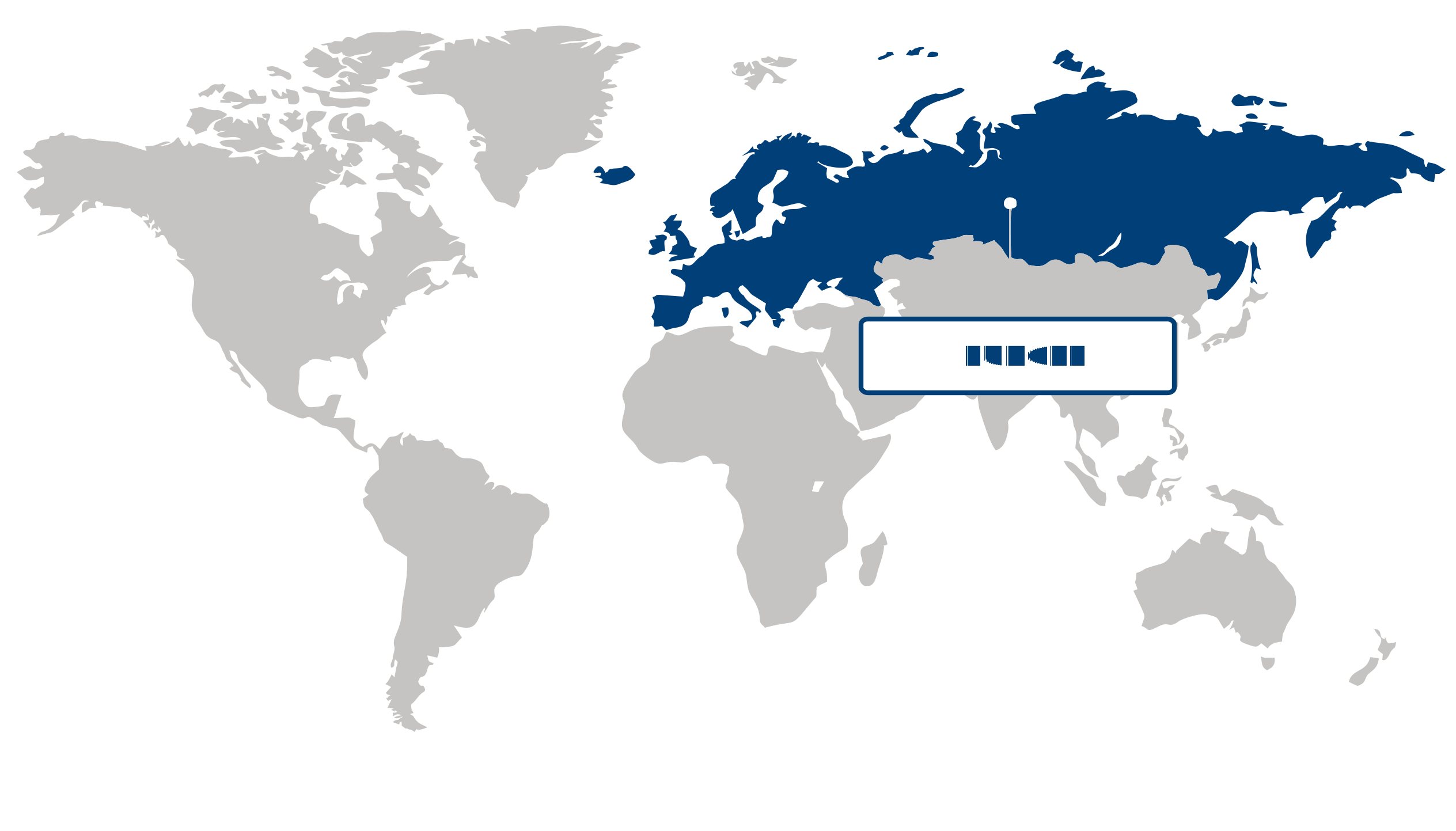
Europe (Largest Region)
Europe held the largest share of the automotive crash impact simulator market in 2026, supported by its mature automotive manufacturing ecosystem, strong emphasis on vehicle safety, and stringent regulatory requirements for crash testing and occupant protection. Advanced automotive engineering capabilities and continued investment in virtual simulation technologies are encouraging manufacturers and testing organizations to adopt sophisticated crash impact simulators to improve development efficiency, validate vehicle safety performance, and reduce reliance on physical testing.
North America (Fastest-Growing Region)
North America is emerging as the fastest-growing regional market, driven by sustained investments in automotive research and development, increasing adoption of advanced vehicle safety technologies, and growing demand for efficient simulation-based testing. The region's expanding focus on electric and increasingly automated vehicles is also creating greater requirements for sophisticated crash analysis, enabling simulation technologies to support complex vehicle architectures and accelerate safety validation.
| Parameter | North America | Asia Pacific | Europe | Latin America | MEA |
|---|---|---|---|---|---|
| Innovation Hub i Scale Nascent Developing Advanced | |||||
| Cost-Sensitive Region i Scale Low Medium High | |||||
| Regulatory Environment i Scale Restrictive Neutral Supportive | |||||
| Demand Drivers i Scale Weak Moderate Strong | |||||
| Development Stage i Scale Emerging Developing Developed | |||||
| Adoption Rate i Scale Low Medium High | |||||
| New Entrants / Startups i Scale Sparse Moderate Dense | |||||
| Macro Indicators i Scale Weak Stable Strong |
Key Country Insights
United States 🇺🇸
Advanced Validation PlatformsThe U.S. utilizes automotive crash impact simulators to accelerate vehicle safety validation and engineering development. Manufacturers increasingly invest in high-fidelity simulation tools that shorten development cycles while supporting regulatory and consumer safety expectations.
Germany 🇩🇪
Digital Safety EngineeringGermany prioritizes automotive crash impact simulators integrated with digital engineering workflows for vehicle development. Automotive companies in Germany focus on simulation accuracy, virtual validation, and efficient design optimization before physical testing begins.
Japan 🇯🇵
Virtual Design RefinementJapan emphasizes automotive crash impact simulators that improve design precision and reduce dependence on repeated prototype testing. Engineering teams integrate simulation technologies with advanced vehicle development processes to enhance safety evaluation efficiency.
South Korea 🇰🇷
Software-Driven ValidationSouth Korea expands automotive crash impact simulator adoption to strengthen software-enabled vehicle safety development. Domestic manufacturers combine simulation platforms with connected engineering environments to improve collaboration and accelerate validation activities.
France 🇫🇷
Regulatory Testing SupportFrance applies automotive crash impact simulators to strengthen compliance-focused vehicle safety assessment and engineering analysis. Research organizations and manufacturers in France increasingly use virtual testing to complement conventional crash evaluation methods.
Italy 🇮🇹
Engineering Collaboration HubItaly supports automotive crash impact simulator adoption through collaboration between vehicle manufacturers, engineering firms, and technology providers. Italian development teams focus on flexible simulation environments that improve product refinement across multiple vehicle platforms.
Segment Leadership and Growth Trends
Automotive Crash Impact Simulator Market Share (%), by Propulsion, 2026
Go beyond the chart, access full insights & data tables
Request Free Sample ReportPropulsion Segment Analysis: ICE (Largest Segment) vs Electric Vehicles (Fastest-Growing Segment)
The internal combustion engine (ICE) vehicle segment accounted for the largest market share of 72% in 2026. ICE vehicles continue to dominate crash impact simulation activities because they represent a substantial portion of the global vehicle fleet and production landscape. Manufacturers, testing facilities, and regulatory organizations continue to invest heavily in validating occupant protection, structural integrity, and safety performance for conventional vehicles, sustaining demand for advanced crash simulation platforms.
The automotive crash impact simulator market is witnessing the fastest growth in the electric vehicles segment. As electric vehicle production expands, manufacturers are placing greater emphasis on evaluating battery safety, structural crashworthiness, and the protection of high-voltage electrical systems under collision scenarios. The increasing complexity of electric vehicle architectures is driving demand for sophisticated simulation technologies that accelerate product development while supporting evolving safety standards.
Simulation Segment Analysis: Hardware-in-the-loop Simulation (Largest Segment) vs Software Simulation (Fastest-Growing Segment)
Hardware-in-the-loop simulation held the largest market share of 56.29% in 2026. This approach enables manufacturers to evaluate the interaction between physical hardware components and simulated operating environments, delivering highly reliable testing outcomes before full-scale vehicle deployment. Its ability to validate safety-critical systems under realistic conditions has made it an essential part of automotive development and certification processes.
The automotive crash impact simulator market is experiencing the fastest growth in software simulation. Software-based simulation solutions enable engineers to conduct virtual crash analyses more efficiently, reduce dependence on physical prototypes, and accelerate design optimization during product development. Continuous advancements in computational modeling and digital engineering are further increasing the adoption of software-driven crash simulation across the automotive industry.
Vehicle Segment Analysis: Passenger Vehicles (Largest & Fastest-Growing Segment)
Holding the largest share of the automotive crash impact simulator market, the passenger vehicles segment dominated the market in 2026 while also representing the fastest-growing category. Strong demand for enhanced occupant safety, continuous introduction of new passenger vehicle models, and increasingly stringent vehicle safety regulations have encouraged manufacturers to expand the use of advanced crash impact simulation technologies. The growing integration of sophisticated safety systems and the industry's focus on reducing development time through virtual validation continue to strengthen the segment's leadership.
| Segment | Sub-Segment | Largest Segment | Fastest Growing |
|---|---|---|---|
| Propulsion | ICE, Electric Vehicles | ICE | Electric Vehicles |
| Simulation | Hardware-in-the-loop Simulation, Software Simulation, Full-scale Crash Testing | Hardware-in-the-loop Simulation | Software Simulation |
| Vehicle | Passenger Vehicles, Commercial Vehicles | Passenger Vehicles | Passenger Vehicles |
| Application | Vehicle Design & Development, Crash Safety Assessment, Driver & Passenger Safety Studies, Others | Vehicle Design & Development | Vehicle Design & Development |
Competitive Landscape and Market Positioning
Key companies in the automotive crash impact simulator market:
- Altair Engineering, Inc. (United States)
- Ansys, Inc. (United States)
- Dassault Systèmes SE (France)
- Siemens AG (Germany)
- Hexagon AB (Sweden)
- ESI Group (France)
- MathWorks, Inc. (United States)
- AVSimulation (France)
- Humanetics Group (United States)
- VI-grade GmbH (Italy)
Advances in vehicle design are reshaping competition in the automotive crash impact simulator market, where development priorities increasingly revolve around replicating complex real-world collision scenarios with greater precision. Suppliers are enhancing simulation platforms to accommodate evolving vehicle architectures, advanced safety systems, and more sophisticated validation workflows, creating differentiation through modeling accuracy and engineering flexibility. The ability to integrate physical testing with digital development environments is becoming a stronger competitive lever as manufacturers seek faster design refinement without compromising confidence in safety assessments.
| Company | Market Share | Company Revenue | Revenue CAGR (%) | Product Portfolio | Geographic Presence | Innovation / R&D Focus | Strategic Developments |
|---|---|---|---|---|---|---|---|
| Altair Engineering Inc. (United States) | |||||||
| Ansys Inc. (United States) | |||||||
| Dassault Systèmes SE (France) | |||||||
| Siemens AG (Germany) | |||||||
| Hexagon AB (Sweden) | |||||||
| ESI Group (France) | |||||||
| MathWorks Inc. (United States) | |||||||
| AVSimulation (France) | |||||||
| Humanetics Group (United States) | |||||||
| VI-grade GmbH (Italy) |
Industry Development/News
| Company Name | Date | Key Development |
|---|---|---|
| Altair HyperWorks | Sep-24 | Altair HyperWorks integrated Oasys Primer software to enhance automotive safety simulation workflows. By combining this with AI-augmented 3D modeling, the platform improves the efficiency of data preparation, visualization, and building, enabling engineers to manage more complex crash modeling scenarios and streamline the integration of multi-platform simulation data within the automotive safety design cycle. |
| Siemens | Sep-24 | Siemens upgraded its Simcenter Testlab, enabling manufacturers to perform complex impact testing on combined structural and electronic systems with 50% greater efficiency. The update supports the reuse of CAD data for instrumentation and adds multi-hammer testing capabilities, specifically enhancing the evaluation of vehicle chassis and battery characteristics for electric vehicles while significantly reducing development timelines. |
| SimScale | Jun-24 | SimScale incorporated AI-based physics prediction features into its simulation platform. This development improves the speed and accuracy of predictive modeling for automotive safety, allowing engineers to accelerate the evaluation of complex structural impact scenarios and reducing the reliance on physical testing through more advanced, automated computational analysis. |
Customize Your Report
Explore examples of how this report can be tailored to different research needs, including custom segments, additional topics or chapters, and related reports. Click a section of the wheel or its numbered marker to explore the available options.
Automotive Crash Impact Simulator Market — Custom Segments
| Segment | Sub-Segment |
|---|---|
| End User | Automotive OEMs, Tier 1 Suppliers, Testing & Certification Organizations, Research Institutions |
| Vehicle Component Tested | Body & Structure, Restraint Systems, Interior Systems, Safety Electronics, Chassis & Powertrain Components |
| Deployment Model | In-House Testing Facilities, Third-Party Testing Services |
Automotive Crash Impact Simulator Market — Custom TOC
| Custom Chapter | Custom Details |
|---|---|
| OEM Simulation Adoption Roadmap |
|
| Virtual Testing Investment Priorities |
|
| Crash Safety Regulatory Readiness |
|
Need a different cut of the data?
Request Custom ResearchWhat is the market valuation of automotive crash impact simulator?
What is the projected value of the automotive crash impact simulator industry by 2036?
How is the transition to EVs and autonomous vehicles driving demand for crash impact simulators?
Why are automotive manufacturers increasing investment in virtual crash simulation platforms?
Why do passenger vehicles dominate the automotive crash impact simulator market?
How is software simulation transforming crash impact testing?
Why does Europe lead the automotive crash impact simulator market?
What is driving the fastest growth of automotive crash impact simulators in North America?
Which companies dominate the automotive crash impact simulator landscape?
Our Clients
"The team surpassed our expectations with the report depth. The actionable insights provided proved crucial in navigating market challenges."
Tata Motors
"We found the report to be very informative. The expertise and attention to market nuances significantly influenced our business direction."
DENSO Corporation
"The consumer survey findings were quite good. We now have a clearer picture of the customer churning and retention strategy."
HL Mando
Our Research Team & Methodology
Every Fundamental Business Insights report is built by a dedicated vertical research team, validated through a structured primary-and-secondary methodology, and reviewed for accuracy before it reaches you.
Research Team Overview
Prepared by the Automotive & Transportation Research Team
Delivery
Published
Demand
Available
Support
Trust & Compliance
Research Domains
10 coverage areasResearch Intelligence
| Source | Reference |
|---|---|
| International Organization of Motor Vehicle Manufacturers (OICA) | www.oica.net |
| SAE International | www.sae.org |
| International Energy Agency (IEA) | www.iea.org |
| International Transport Forum (ITF) | www.itf-oecd.org |
| International Road Federation (IRF) | www.irf.global |
| International Organization for Standardization (ISO) | www.iso.org |
| United Nations Economic Commission for Europe (UNECE) | unece.org |
| National Highway Traffic Safety Administration (NHTSA) | www.nhtsa.gov |
| U.S. Department of Transportation (USDOT) | www.transportation.gov |
| European Automobile Manufacturers' Association (ACEA) | www.acea.auto |
| Society of Indian Automobile Manufacturers (SIAM) | www.siam.in |
| International Air Transport Association (IATA) | www.iata.org |
| International Civil Aviation Organization (ICAO) | www.icao.int |
| International Maritime Organization (IMO) | www.imo.org |
| International Union of Railways (UIC) | uic.org |
| American Public Transportation Association (APTA) | www.apta.com |
| International Federation of Robotics (IFR) | ifr.org |
| CharIN | www.charin.global |
| World Shipping Council | www.worldshipping.org |
| International Federation of Freight Forwarders Associations (FIATA) | fiata.org |
Research Workflow & Quality Assurance
Data Collection
Verified information gathered through primary and secondary research.
Data Triangulation
Cross-validation using multiple independent data sources.
Forecast Modelling
Market estimates developed using historical trends and analytical models.
Analyst Validation
Findings reviewed by domain experts for accuracy and consistency.
Editorial & Quality Review
Final editorial, quality, and compliance checks before publication.
Final Publication
Released after successful completion of the internal review process.
Report Coverage
📊 Market Assessment
- Market Size & Forecast
- Market Segmentation
- Regional Analysis
- Growth Drivers & Challenges
- Market Dynamics
🏢 Competitive Intelligence
- Competitive Landscape
- Company Profiles
- Competitive Benchmarking
- Mergers & Acquisitions
- Market Share Analysis or Key Company Strategies
🔍 Strategic Analysis
- Value Chain Analysis
- Porter's Five Forces
- PESTLE Analysis
- Pricing Trends
- Supply-Demand Analysis
🚀 Future Outlook
- Technology Landscape
- Regulatory Landscape
- Investment & Funding Landscape
- Emerging Opportunities
- Future Market Outlook
Have a question about this report or need a custom scope?
Request Customization