Artificial Intelligence in Robotics Market Size & Growth Forecast 2027–2036, By Segments (Offering, Technology, Deployment, Robots Type, End-use), Regional Demand Trends (North America, Asia Pacific, Europe), Key Country Insights (U.S., Japan, South Korea, Germany, France, Italy), and Competitive Landscape
Market Size and Growth Outlook
Artificial Intelligence in Robotics Market size stood at USD 26.1 billion in 2026 and is predicted to grow at a 30.4% CAGR from 2027 to 2036, surpassing USD 371.04 billion by 2036. The industry revenue for 2027 is assessed at USD 32.78 billion.
Get more details on this report
Request Free Sample ReportArtificial Intelligence in Robotics Market Intelligence Snapshot
Regional Market Dynamics
- Asia Pacific accounted for 47.28% of the market in 2026, driven by extensive AI-enabled robotics deployment across manufacturing industries seeking greater precision, productivity, and operational efficiency.
- Asia Pacific is forecast to grow at a 40.59% CAGR as manufacturers increasingly deploy intelligent robotics for vision-based inspection, predictive maintenance, and real-time factory automation.
Segment Momentum
- Hardware accounted for 58.3% of the market in 2026 because processors, sensors, controllers, and other physical components remain essential for delivering AI functionality, reliability, and operational performance in robotic systems.
- Edge Computing is the fastest-growing technology segment as robotics applications increasingly require low-latency processing, real-time decision-making, and local data handling to support more autonomous and continuously operating environments.
Market Expansion Drivers
- Rising industrial automation demand across manufacturing and logistics operations.
- Adoption of AI-powered cobots and autonomous mobile robots in smart factories.
- Industry 4.0 integration with digital twins and predictive maintenance systems.
Leading Market Participants
- Top players in the artificial intelligence in robotics market include NVIDIA Corporation (United States), Intel Corporation (United States), Boston Dynamics, Inc. (United States), SoftBank Robotics Group Corp (Japan), Yaskawa Electric Corporation (Japan), Universal Robots A/S (Denmark), Advanced Micro Devices, Inc. (United States), Hanwha Robotics Co., Ltd. (South Korea), Diligent Robotics Inc. (United States), Franka Robotics GmbH (Germany).
Global Market Forecast Snapshot
Market Outlook
- 2026 Market Size: USD 26.1 billion
- 2027 Estimated Market Size: USD 32.78 billion.
- Projected Market Size: USD 371.04 billion by 2036
- Growth Forecast: 30.4% CAGR (2027-2036)
Regional and Segment Outlook
- Leading Regional Market: Asia Pacific
- High-Growth Regional Hub: Asia Pacific
- Core Revenue Segment: Hardware (Offering) | Machine Learning (Technology) | Cloud (Deployment) | Industrial Robots (Robots Type) | Manufacturing (End-use)
- Emerging Opportunity Segment: Software (Offering) | Edge Computing (Technology) | Cloud (Deployment) | Industrial Robots (Robots Type) | Healthcare (End-use)
Market Growth Drivers and Industry Trends
Rising industrial automation demand across manufacturing and logistics operations
Labor requirements, productivity objectives, and the need for greater operational consistency are encouraging manufacturers and logistics operators to automate repetitive and physically demanding activities, which will drive the artificial intelligence in robotics market growth. AI-enabled robotic systems can process operational information, adapt to changing conditions, and perform tasks such as material handling, sorting, assembly, inspection, and movement with reduced dependence on continuous human intervention. In manufacturing environments, intelligent robots can support production consistency and flexible task execution, while logistics facilities can use them to coordinate material flows and warehouse activities. The growing complexity of industrial operations is increasing interest in robotic systems capable of responding to real-time environments rather than performing only fixed, pre-programmed sequences.
Adoption of AI-powered cobots and autonomous mobile robots in smart factories
Smart manufacturing environments are increasingly incorporating collaborative robots and autonomous mobile robots to support flexible production workflows, strengthening artificial intelligence in robotics market demand. AI-powered cobots can work alongside human operators in applications requiring repetitive handling, assembly, inspection, or machine tending, while autonomous mobile robots can navigate facilities and transport materials between workstations with greater operational flexibility. Their ability to interpret surroundings, respond to changing task requirements, and coordinate movement can improve the adaptability of automated production environments. As factories move toward more connected and responsive operating models, these robotic platforms are being integrated into workflows where conventional fixed automation may provide less flexibility.
Industry 4.0 integration with digital twins and predictive maintenance systems
The convergence of robotics with industry 4.0 technologies is expanding the functional scope of intelligent automation, supporting artificial intelligence in robotics market growth through more connected and data-driven industrial operations. Digital twins can provide virtual representations of robotic equipment and production environments, allowing operators to analyze processes, simulate changes, and identify potential operational issues before physical implementation. Predictive maintenance systems can further use equipment data to identify patterns associated with wear or performance degradation, enabling maintenance activities to be better coordinated with production requirements. Connecting robotic systems with these digital technologies is improving visibility across automated operations while supporting more informed equipment management and process optimization.
| Growth Driver | Impact on CAGR | Regulatory Influence | Geographic Relevance | Adoption Rate | Impact Timeline |
|---|---|---|---|---|---|
| Rising industrial automation demand across manufacturing and logistics operations | 2.10% | Moderate | Asia Pacific, North America | High | Near Term |
| Adoption of AI-powered cobots and autonomous mobile robots in smart factories | 2.00% | Moderate | Europe, Asia Pacific | High | Mid Term |
| Industry 4.0 integration with digital twins and predictive maintenance systems | 1.80% | Moderate | North America, Europe | High | Mid Term |
Unlock insights tailored to your business with our bespoke market research solutions.
Click to get your customized report now.
Regional Demand Dynamics
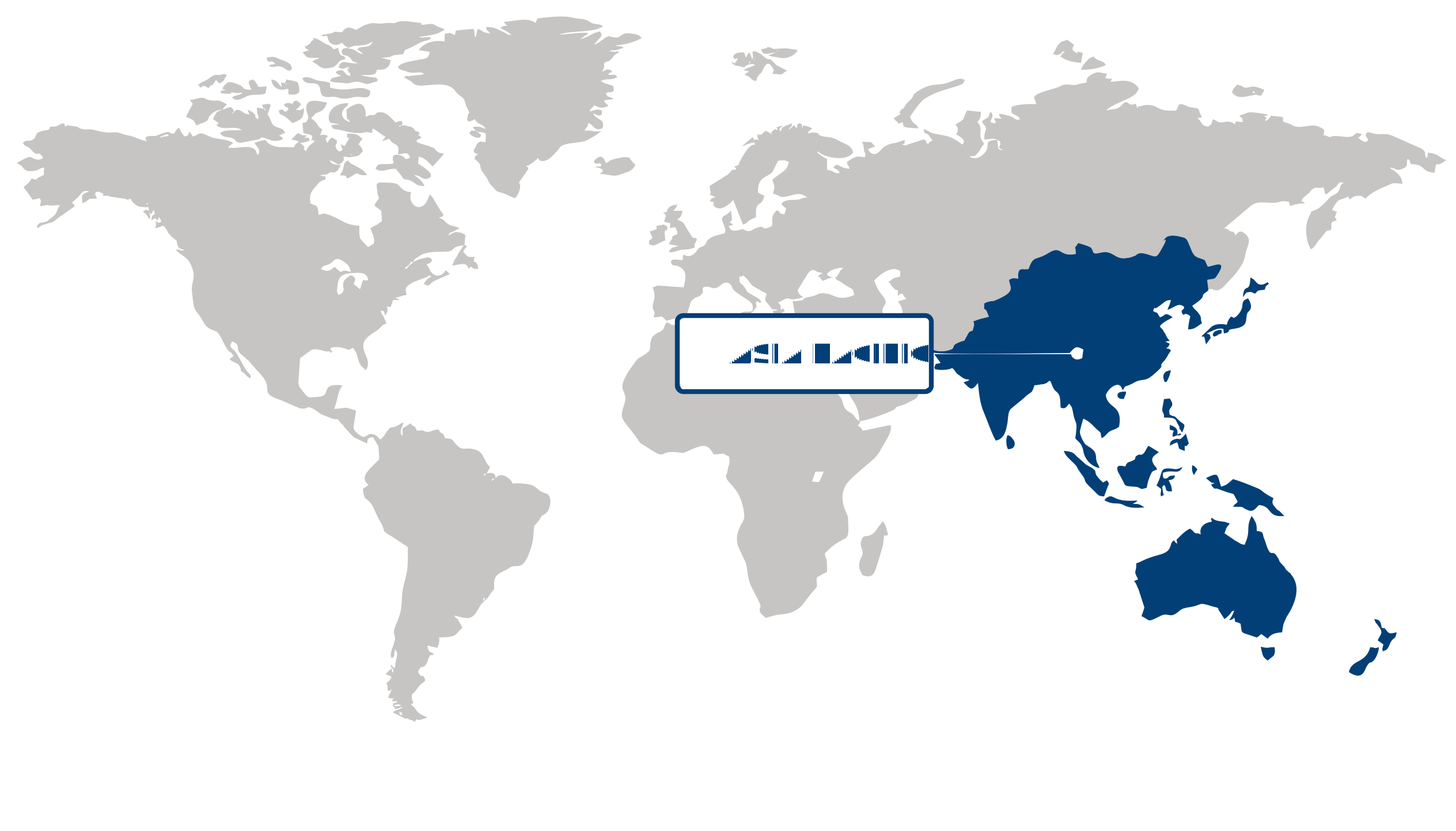
Asia Pacific (Largest & Fastest-Growing Region)
Asia Pacific dominated the artificial intelligence in robotics market and accounted for a 47.28% share in 2026, while also representing the fastest-growing regional market. Its strong position is supported by extensive manufacturing activity, rapid industrial automation, and increasing integration of artificial intelligence into robotic systems for production, logistics, inspection, and service applications. Manufacturers are increasingly seeking intelligent machines capable of adapting to changing environments, optimizing workflows, and supporting labor-intensive operations. Strong investment in smart manufacturing infrastructure, robotics development, and digital transformation is further accelerating the deployment of AI-enabled robotic solutions. The region's broad industrial base and growing focus on productivity, automation, and intelligent operations provide a strong foundation for continued market development.
| Parameter | North America | Asia Pacific | Europe | Latin America | MEA |
|---|---|---|---|---|---|
| Innovation Hub i Scale Nascent Developing Advanced | |||||
| Cost-Sensitive Region i Scale Low Medium High | |||||
| Regulatory Environment i Scale Restrictive Neutral Supportive | |||||
| Demand Drivers i Scale Weak Moderate Strong | |||||
| Development Stage i Scale Emerging Developing Developed | |||||
| Adoption Rate i Scale Low Medium High | |||||
| New Entrants / Startups i Scale Sparse Moderate Dense | |||||
| Macro Indicators i Scale Weak Stable Strong |
Key Country Insights
Germany 🇩🇪
Smart Factory IntegrationGermany prioritizes AI-powered robotics within advanced manufacturing environments where precision and production optimization are critical. Companies are integrating intelligent robots with digital factory systems to improve operational coordination and equipment performance.
France 🇫🇷
Applied AI InnovationFrance encourages artificial intelligence in robotics through research partnerships and industrial digitalization initiatives. French organizations are developing intelligent robotic solutions for manufacturing, healthcare, and public infrastructure with a strong focus on operational efficiency.
Italy 🇮🇹
SME Automation AdoptionItaly is adopting AI-powered robotics to improve productivity across manufacturing sectors dominated by small and medium-sized enterprises. Businesses prioritize flexible robotic systems capable of supporting customized production while reducing manual operational constraints.
Japan 🇯🇵
Human-Robot CollaborationJapan focuses on AI-driven robotics that enhance collaboration between humans and machines in manufacturing, healthcare, and service industries. Investment remains centered on reliable automation, adaptive learning, and safe robotic interaction.
South Korea 🇰🇷
AI Robotics CommercializationSouth Korea is accelerating commercialization of AI-enabled robotics across electronics manufacturing, logistics, and smart facilities. Companies are emphasizing machine vision, autonomous operation, and intelligent process optimization to strengthen industrial competitiveness.
United States 🇺🇸
Intelligent Automation DeploymentThe U.S. is advancing artificial intelligence in robotics through industrial automation, logistics, healthcare, and defense applications. Organizations are integrating AI-enabled robotics to improve decision-making, operational flexibility, and productivity across complex environments.
Segment Leadership and Growth Trends
Artificial Intelligence in Robotics Market Share (%), by Offering, 2026
Go beyond the chart, access full insights & data tables
Request Free Sample ReportOffering Segment Analysis: Hardware (Largest Segment) vs Software (Fastest-Growing Segment)
The hardware segment held the largest position in the artificial intelligence in robotics market, accounting for 58.3% share in 2026, supported by the essential role of physical robotic systems in enabling AI-driven automation. Sensors, processors, actuators, control components, and robotic platforms provide the underlying infrastructure required for robots to perceive environments, process information, and perform increasingly complex tasks. Growing adoption of intelligent automation across industrial and service applications, combined with demand for more capable robotic systems, continues to sustain hardware requirements.
Software is the fastest-growing offering segment as artificial intelligence increasingly becomes central to robotic autonomy, adaptability, and decision-making. AI software enables robots to interpret sensor inputs, recognize objects, learn from operational data, optimize movements, and respond to changing environments with greater independence. The growing emphasis on autonomous operations and intelligent human-machine interaction is encouraging greater investment in sophisticated software capabilities, while improvements in machine learning and AI algorithms are expanding the range of tasks that robots can perform.
Technology Segment Analysis: Machine Learning (Largest Segment) vs Edge Computing (Fastest-Growing Segment)
Machine learning accounted for 58.3% share of the artificial intelligence in robotics market in 2026, reflecting its importance in enabling robots to learn from data and improve performance without relying solely on predefined instructions. Machine learning supports capabilities such as pattern recognition, predictive decision-making, object identification, and adaptive control, which are increasingly important across autonomous and collaborative robotic applications. Its broad applicability to robotic perception and decision processes continues to make it a foundational technology for AI-enabled automation.
Edge computing represents the fastest-growing technology segment, driven by the need to process robotic data closer to where it is generated. Localized processing can support faster responses, reduce reliance on remote computing infrastructure, and enable robots to make time-sensitive decisions with greater efficiency. As robotic systems become more autonomous and generate increasingly complex streams of sensor and operational data, the ability to perform real-time analytics at or near the point of operation is strengthening demand for edge-based computing architectures.
| Segment | Sub-Segment | Largest Segment | Fastest Growing |
|---|---|---|---|
| Offering | Hardware, Software | Hardware | Software |
| Technology | Machine Learning, Computer Vision, Natural Language Processing, Context Aware Computing, Edge Computing, Others | Machine Learning | Edge Computing |
| Deployment | On-Premise, Cloud | Cloud | Cloud |
| Robots Type | Industrial Robots, Service Robots | Industrial Robots | Industrial Robots |
| End-use | Automotive, Manufacturing, Transportation and Logistics, Healthcare, Retail, Aerospace, Military and Defense, Agriculture, Others | Manufacturing | Healthcare |
Competitive Landscape and Market Positioning
Major players in the artificial intelligence in robotics market:
1. NVIDIA Corporation (United States)
2. Intel Corporation (United States)
3. Boston Dynamics Inc. (United States)
4. SoftBank Robotics Group Corp (Japan)
5. Yaskawa Electric Corporation (Japan)
6. Universal Robots A/S (Denmark)
7. Advanced Micro Devices Inc. (United States)
8. Hanwha Robotics Co. Ltd. (South Korea)
9. Diligent Robotics Inc. (United States)
10. Franka Robotics GmbH (Germany)
Integration of intelligent systems is driving rapid evolution in the artificial intelligence in robotics market. The artificial intelligence in robotics market is advancing through enhanced learning algorithms and adaptive automation capabilities. Continuous innovation is improving decision-making and operational autonomy in robotic systems.
| Company | Market Share | Company Revenue | Revenue CAGR (%) | Product Portfolio | Geographic Presence | Innovation / R&D Focus | Strategic Developments |
|---|---|---|---|---|---|---|---|
| NVIDIA Corporation (United States) | |||||||
| Intel Corporation (United States) | |||||||
| Boston Dynamics Inc. (United States) | |||||||
| SoftBank Robotics Group Corp (Japan) | |||||||
| Yaskawa Electric Corporation (Japan) | |||||||
| Universal Robots A/S (Denmark) | |||||||
| Advanced Micro Devices Inc. (United States) | |||||||
| Hanwha Robotics Co. Ltd. (South Korea) | |||||||
| Diligent Robotics Inc. (United States) | |||||||
| Franka Robotics GmbH (Germany). |
Industry Development/News
| Company Name | Date | Key Development |
|---|---|---|
| Google DeepMind | Jan-26 | Google DeepMind partnered with Boston Dynamics to integrate Gemini Robotics foundation models into Atlas humanoid robots. This strategic collaboration focuses on enhancing cognitive reasoning capabilities, signaling a significant shift toward deploying advanced AI models to improve real-time decision-making and autonomy in industrial robotics applications. |
| NVIDIA | Jan-26 | NVIDIA unveiled the GR00T N1.6 and expanded its Isaac model ecosystem, partnering with industry leaders including Boston Dynamics and Franka Robotics. By integrating Jetson Thor hardware for humanoid robotics, NVIDIA is solidifying its position as a critical infrastructure provider, accelerating the commercialization and deployment of AI-driven robotic platforms across diverse industrial sectors. |
| Intel | Oct-25 | Intel launched the Robotics AI Suite, combining AI-optimized hardware, Core Ultra processors, and OpenVINO tools. The platform provides a comprehensive environment for motion planning and imitation learning, designed to streamline the transition of industrial robotics from pilot testing to full-scale production environments by reducing complexity in edge-based AI deployment. |
| Skild AI | Jul-25 | Skild AI introduced the Skild Brain foundation model, a platform designed to provide general-purpose intelligence for autonomous systems. By leveraging continuous learning from real-world robotic data, the system enhances capabilities in complex physical navigation and manipulation, facilitating broader industry adoption of versatile, multi-purpose autonomous platforms in high-variability environments. |
| Boston Dynamics | Nov-24 | Boston Dynamics initiated operational trials for its electric Atlas platform, focusing on complex warehouse picking and parts handling tasks. These trials demonstrate measurable advancements in precision manipulation and autonomous task execution, marking a strategic move toward transitioning humanoid robots from research platforms to functional assets within logistics and manufacturing value chains. |
| NVIDIA | Apr-24 | NVIDIA launched the Nova Carter autonomous mobile robot platform to accelerate the development of scalable AI-driven robotic systems. By integrating advanced perception and navigation technologies, the platform provides developers with an essential framework for improving spatial awareness and autonomy, directly supporting the industrial scaling of mobile robotics in logistics and manufacturing operations. |
| Arm | Apr-24 | Arm introduced the Ethos-U85 NPU and Corstone-320 platform, specifically architected to improve compute efficiency for edge AI and robotics. The new hardware provides the necessary processing power to support on-device AI tasks, enabling more intelligent and responsive robotics systems capable of real-time decision-making within the constrained power budgets typical of industrial edge environments. |
Customize Your Report
Explore examples of how this report can be tailored to different research needs, including custom segments, additional topics or chapters, and related reports. Click a section of the wheel or its numbered marker to explore the available options.
Artificial Intelligence in Robotics Market — Custom Segments
| Segment | Sub-Segment |
|---|---|
| Autonomy Level | Assisted Robots, Semi-Autonomous Robots, Fully Autonomous Robots |
| Robot Mobility Type | Stationary Robots, Wheeled Mobile Robots, Legged Robots, Aerial Robots, Hybrid Mobile Robots |
| Integration Type | Standalone AI Systems, Robot-Embedded AI, AI-Enabled Robot Fleet Platforms, AI Integrated with Enterprise Systems |
Artificial Intelligence in Robotics Market — Custom TOC
| Custom Chapter | Custom Details |
|---|---|
| AI Robotics Adoption Readiness Assessment |
|
| Industry Use Case Opportunity Mapping |
|
| Workforce Impact and Automation Strategy |
|
Need a different cut of the data?
Request Custom ResearchWhat is the current size of the artificial intelligence in robotics market?
What are the growth projections for the artificial intelligence in robotics industry?
How is industrial automation demand influencing deployment strategies in the artificial intelligence in robotics market?
Why is edge computing becoming critical for real-time robotic decision-making in the artificial intelligence in robotics market?
Why does hardware dominate the artificial intelligence in robotics market?
How is edge computing driving growth in the artificial intelligence in robotics market?
Why is Asia Pacific the leading region for the artificial intelligence in robotics market?
What is driving the rapid expansion of the artificial intelligence in robotics market in Asia Pacific?
Who are the leading players in the artificial intelligence in robotics landscape?
Our Clients
"The team at Fundamental Business Insights & Consulting demonstrated a commitment to excellence, not only in the quality of the report but also in their client-centric approach."
FANUC
"The level of detail in the market segmentation provided were particularly noteworthy. The detailed country-level insights were also very helpful."
B&R Industrial Automation GmbH
"The consultant took the time to understand our specific business objectives, ensuring that the reports were tailored to address our unique challenges and opportunities."
KUKA SE & Co. KGaA
Our Research Team & Methodology
Every Fundamental Business Insights report is built by a dedicated vertical research team, validated through a structured primary-and-secondary methodology, and reviewed for accuracy before it reaches you.
Research Team Overview
Prepared by the Industrial Automation & Equipment Research Team
Delivery
Published
Demand
Available
Support
Trust & Compliance
Research Domains
10 coverage areasResearch Intelligence
| Source | Reference |
|---|---|
| International Society of Automation (ISA) | www.isa.org |
| International Organization for Standardization (ISO) | www.iso.org |
| National Institute of Standards and Technology (NIST) | www.nist.gov |
| IEEE | www.ieee.org |
| VDMA (German Mechanical Engineering Industry Association) | www.vdma.org |
| Association for Advancing Automation (A3) | www.automate.org |
| International Federation of Robotics (IFR) | ifr.org |
| ASME (American Society of Mechanical Engineers) | www.asme.org |
| ASHRAE | www.ashrae.org |
| American Society of Heating, Refrigerating and Air-Conditioning Engineers (ASHRAE) | www.ashrae.org |
| Material Handling Industry (MHI) | www.mhi.org |
| OSHA (Occupational Safety and Health Administration) | www.osha.gov |
| National Fire Protection Association (NFPA) | www.nfpa.org |
| ASTM International | www.astm.org |
| International Electrotechnical Commission (IEC) | www.iec.ch |
| Open Process Automation Forum (The Open Group) | www.opengroup.org/open-process-automation-forum |
| AGMA (American Gear Manufacturers Association) | www.agma.org |
| Association of Equipment Manufacturers (AEM) | www.aem.org |
| Food and Agriculture Organization (FAO) | www.fao.org |
| International Labour Organization (ILO) | www.ilo.org |
Research Workflow & Quality Assurance
Data Collection
Verified information gathered through primary and secondary research.
Data Triangulation
Cross-validation using multiple independent data sources.
Forecast Modelling
Market estimates developed using historical trends and analytical models.
Analyst Validation
Findings reviewed by domain experts for accuracy and consistency.
Editorial & Quality Review
Final editorial, quality, and compliance checks before publication.
Final Publication
Released after successful completion of the internal review process.
Report Coverage
📊 Market Assessment
- Market Size & Forecast
- Market Segmentation
- Regional Analysis
- Growth Drivers & Challenges
- Market Dynamics
🏢 Competitive Intelligence
- Competitive Landscape
- Company Profiles
- Competitive Benchmarking
- Mergers & Acquisitions
- Market Share Analysis or Key Company Strategies
🔍 Strategic Analysis
- Value Chain Analysis
- Porter's Five Forces
- PESTLE Analysis
- Pricing Trends
- Supply-Demand Analysis
🚀 Future Outlook
- Technology Landscape
- Regulatory Landscape
- Investment & Funding Landscape
- Emerging Opportunities
- Future Market Outlook
Have a question about this report or need a custom scope?
Request Customization