Zero-Touch Provisioning Market Size & Growth Forecast 2027–2036, By Segments (Component, Enterprise Size, Network Complexity, Industry, Device Type), Regional Demand Trends (North America, Asia Pacific, Europe), Key Country Insights (U.S., Japan, South Korea, Germany, France, Italy), and Competitive Landscape
Market Size and Growth Outlook
Zero-Touch Provisioning Market size was more than USD 3.82 billion in 2026 and is set to grow at a 9.79% CAGR between 2027 and 2036, attaining USD 9.72 billion by 2036. The industry revenue for 2027 is assessed at USD 4.13 billion.
Get more details on this report
Request Free Sample ReportZero-Touch Provisioning Market Intelligence Snapshot
Regional Market Dynamics
- Asia Pacific held a 36.04% market share in 2026, driven by extensive network expansion and high-volume deployments requiring faster device onboarding, lower manual effort, and consistent provisioning across distributed infrastructure.
- North America is expected to grow at an 11.42% CAGR as enterprises expand automation, modernize device management, and streamline provisioning across cloud-connected and hybrid network environments.
Segment Momentum
- Platforms lead with a 68.16% share due to their core role in automating device onboarding, configuration, and policy enforcement across large-scale enterprise network environments.
- Services are growing fastest as enterprises require integration, customization, and deployment support to operationalize zero-touch provisioning across complex hybrid IT environments.
Market Expansion Drivers
- Expanding IoT device ecosystems accelerating automated network provisioning demand.
- 5G rollout and network slicing increasing complexity of automated network orchestration.
- Enterprise migration to cloud-based SD-WAN driving automated network configuration adoption.
Leading Market Participants
- Prominent companies in the zero-touch provisioning market include Cisco Systems, Inc. (United States), Huawei Technologies Co., Ltd. (China), Telefonaktiebolaget LM Ericsson (Sweden), Nokia Corporation (Finland), Hewlett Packard Enterprise Company (United States), Juniper Networks, Inc. (United States), Arista Networks, Inc. (United States), ZTE Corporation (China), VMware, Inc. (United States), Extreme Networks, Inc. (United States).
Global Market Forecast Snapshot
Market Outlook
- 2026 Market Size: USD 3.82 billion
- 2027 Estimated Market Size: USD 4.13 billion.
- Projected Market Size: USD 9.72 billion by 2036
- Growth Forecast: 9.79% CAGR (2027-2036)
Regional and Segment Outlook
- Leading Regional Market: Asia Pacific
- High-Growth Regional Hub: North America
- Core Revenue Segment: Platform (Component) | Large Enterprises (Enterprise Size) | Complex Network Architecture (Network Complexity) | IT & Telecommunications (Industry) | Switches (Device Type)
- Emerging Opportunity Segment: Services (Component) | Small & Medium Enterprises (Enterprise Size) | Dynamic Network Environment (Network Complexity) | Healthcare (Industry) | IoT Devices (Device Type)
Market Growth Drivers and Industry Trends
Expanding IoT device ecosystems accelerating automated network provisioning demand
The rapid proliferation of connected devices is increasing the operational burden associated with deploying and managing network endpoints, which will drive the zero-touch provisioning market growth. IoT environments can involve large numbers of sensors, machines, gateways, and connected devices that require secure configuration before becoming operational. Automated provisioning reduces manual intervention by enabling devices to receive required network settings, credentials, policies, and software configurations with limited human involvement. This capability is particularly valuable for distributed IoT deployments where individually configuring devices would increase deployment time and create greater opportunities for configuration errors.
5G rollout and network slicing increasing complexity of automated network orchestration
The expansion of 5G infrastructure and adoption of network slicing are creating more sophisticated network environments, strengthening demand for automated provisioning and orchestration capabilities. In the zero-touch provisioning market, automation enables network resources and device configurations to be deployed consistently across increasingly dynamic 5G environments. Network slicing can require different configurations and service policies according to application requirements, making manual provisioning less practical as the number of network services and endpoints increases. Automated systems can coordinate device onboarding, configuration changes, policy application, and service activation while supporting the operational flexibility required by segmented network architectures.
Enterprise migration to cloud-based SD-WAN driving automated network configuration adoption
The transition toward cloud-based networking architectures is increasing the need for simplified and repeatable deployment processes, supporting zero-touch provisioning market adoption among enterprises. SD-WAN environments often connect geographically distributed offices, remote locations, and cloud resources, creating configuration requirements across numerous network endpoints. Automated provisioning allows equipment to be shipped to locations and configured remotely with minimal on-site technical intervention, reducing deployment complexity and supporting faster network activation. As enterprises increasingly manage networking functions through centralized cloud platforms, automated configuration becomes valuable for maintaining consistent policies and connectivity across distributed infrastructure.
| Growth Driver | Impact on CAGR | Regulatory Influence | Geographic Relevance | Adoption Rate | Impact Timeline |
|---|---|---|---|---|---|
| Expanding IoT device ecosystems accelerating automated network provisioning demand | 2.90% | Moderate | North America, Asia Pacific, Europe | High | Near Term |
| 5G rollout and network slicing increasing complexity of automated network orchestration | 2.40% | High | North America, Asia Pacific, Europe | High | Near Term |
| Enterprise migration to cloud-based SD-WAN driving automated network configuration adoption | 1.70% | Moderate | North America, Europe | High | Mid Term |
Unlock insights tailored to your business with our bespoke market research solutions.
Click to get your customized report now.
Regional Demand Dynamics
Asia Pacific (Largest Region)
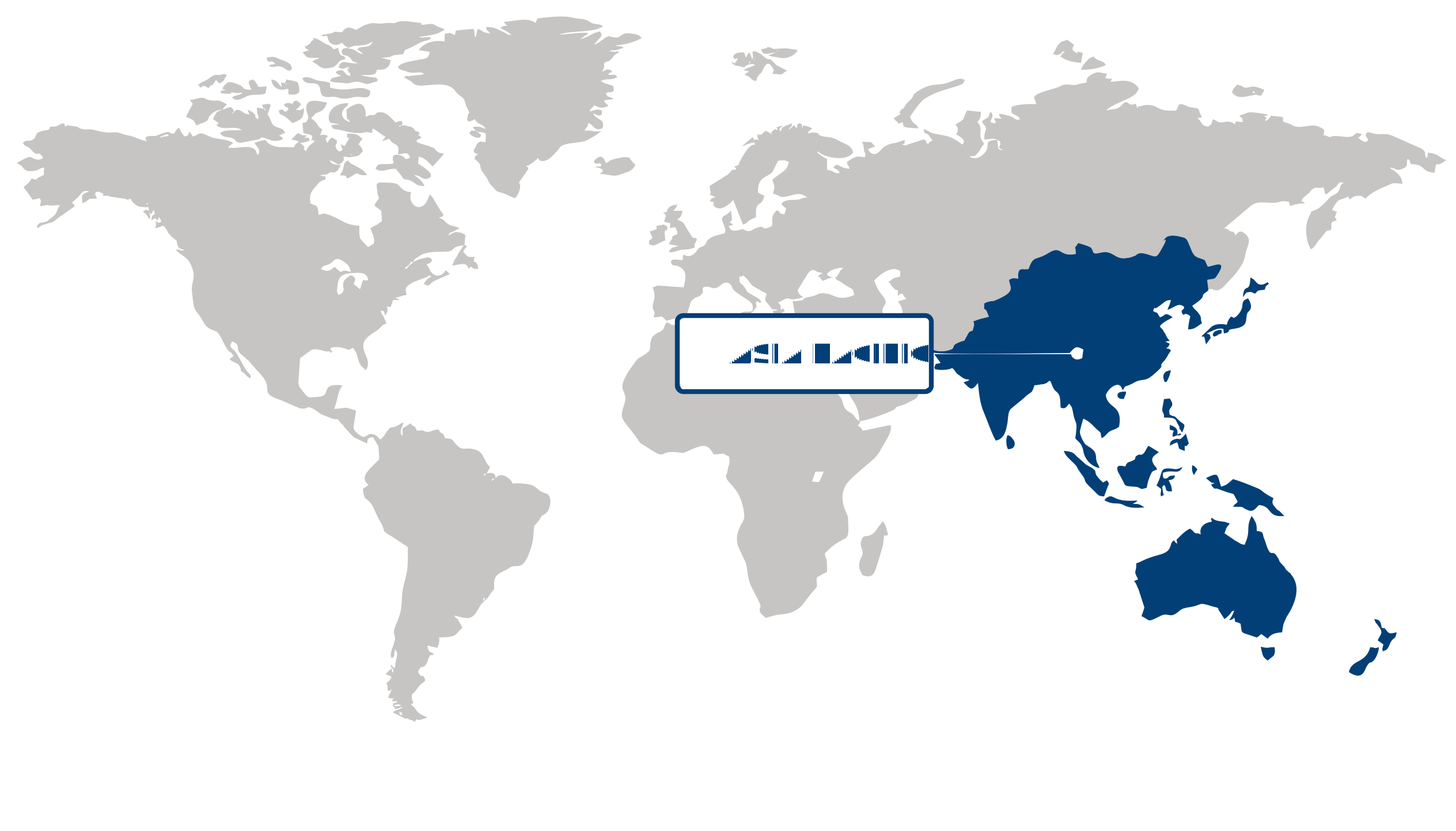
In the zero-touch provisioning market, Asia Pacific accounted for a 36.04% share in 2026, reflecting the region's expanding telecommunications infrastructure, rapid enterprise digitization, and growing deployment of connected devices. The proliferation of cloud-based services, distributed networks, and mobile connectivity is increasing the need for automated device deployment and configuration with minimal manual intervention. Enterprises and service providers are increasingly prioritizing operational efficiency, consistent network configuration, and faster deployment of devices across geographically dispersed environments. Strong investments in digital transformation and the expansion of network infrastructure further support adoption, particularly as organizations seek scalable approaches to managing increasingly complex technology environments.
North America (Fastest-Growing Region)
North America is the fastest-growing region, supported by strong enterprise adoption of cloud-native infrastructure, network automation, and software-defined technologies. Organizations across sectors are increasingly seeking to streamline IT operations, reduce configuration complexity, and accelerate deployment across distributed workforces and connected environments. The region's mature digital ecosystem and strong focus on cybersecurity and infrastructure modernization also encourage adoption of automated provisioning capabilities. As enterprises increasingly manage hybrid environments and large device fleets, zero-touch provisioning is becoming an important component of efficient lifecycle management and scalable network operations.
| Parameter | North America | Asia Pacific | Europe | Latin America | MEA |
|---|---|---|---|---|---|
| Innovation Hub i Scale Nascent Developing Advanced | |||||
| Cost-Sensitive Region i Scale Low Medium High | |||||
| Regulatory Environment i Scale Restrictive Neutral Supportive | |||||
| Demand Drivers i Scale Weak Moderate Strong | |||||
| Development Stage i Scale Emerging Developing Developed | |||||
| Adoption Rate i Scale Low Medium High | |||||
| New Entrants / Startups i Scale Sparse Moderate Dense | |||||
| Macro Indicators i Scale Weak Stable Strong |
Key Country Insights
Germany 🇩🇪
Industrial Deployment EfficiencyGermany integrates zero-touch provisioning into industrial networking and enterprise infrastructure modernization. Businesses emphasize secure device enrollment, standardized configuration, and scalable deployment processes that support connected manufacturing and operational efficiency.
France 🇫🇷
Secure Network RolloutFrance increasingly adopts zero-touch provisioning to simplify enterprise networking and distributed device deployment. Companies prioritize secure authentication, policy-based configuration, and centralized visibility as connected infrastructure expands across multiple business locations.
Italy 🇮🇹
Simplified Device ManagementItaly's zero-touch provisioning market supports organizations seeking efficient deployment of enterprise networking equipment and IoT devices. Demand is centered on reducing installation time, maintaining configuration consistency, and improving operational scalability across remote sites.
Japan 🇯🇵
Connected Infrastructure IntegrationJapan advances zero-touch provisioning through expanding enterprise networks, telecommunications infrastructure, and IoT deployments. Organizations focus on minimizing manual configuration while improving deployment consistency, cybersecurity, and lifecycle management of connected devices.
South Korea 🇰🇷
Telecom Automation StrategySouth Korea's zero-touch provisioning market benefits from advanced telecommunications infrastructure and widespread enterprise digital transformation. Service providers and businesses invest in automated provisioning to accelerate device activation and improve network management efficiency.
United States 🇺🇸
Enterprise Network AutomationThe U.S. zero-touch provisioning market is driven by enterprise IT modernization and large-scale deployment of connected devices. Organizations prioritize automated device onboarding, centralized management, and secure configuration to reduce operational complexity across distributed networks.
Segment Leadership and Growth Trends
Zero-Touch Provisioning Market Share (%), by Component, 2026
Go beyond the chart, access full insights & data tables
Request Free Sample ReportComponent Segment Analysis: Platform (Largest Segment) vs Services (Fastest-Growing Segment)
The platform segment led the zero-touch provisioning market with a 68.16% share in 2026, supported by the increasing need for centralized automation of device deployment, configuration, and lifecycle management. Zero-touch provisioning platforms enable organizations to reduce manual intervention, accelerate device onboarding, and maintain consistent configuration policies across distributed environments. Their ability to integrate provisioning workflows with broader network and IT management systems is particularly valuable as enterprises manage increasingly complex device estates. Growing adoption of cloud-based infrastructure and remote IT operations is further reinforcing demand for platforms that simplify large-scale deployment and improve operational efficiency.
Services are emerging as the fastest-growing component as organizations increasingly seek specialized support for implementing, integrating, and optimizing zero-touch provisioning environments. Service providers can help enterprises address deployment complexity, system integration, configuration requirements, and ongoing management while reducing the internal resources required for automation initiatives. The expansion of distributed workforces and increasingly heterogeneous IT environments is also creating demand for managed and professional services that ensure provisioning workflows remain reliable and aligned with organizational policies.
Enterprise Size Segment Analysis: Large Enterprises (Largest Segment) vs Small & Medium Enterprises (Fastest-Growing Segment)
Large enterprises accounted for a 63.05% share of the zero-touch provisioning market in 2026, reflecting their greater need to automate device deployment across extensive and geographically dispersed IT environments. These organizations often manage diverse fleets of endpoints and network devices, making centralized provisioning valuable for reducing configuration effort and maintaining standardized security and operational policies. Zero-touch deployment also supports faster onboarding and replacement of devices, which can improve IT productivity and simplify lifecycle management. Continued enterprise modernization and the expansion of distributed infrastructure are supporting sustained adoption among large organizations.
Small and medium enterprises are adopting zero-touch provisioning more rapidly as cloud-based technologies and automated IT management tools become more accessible. For smaller organizations with limited IT resources, automated provisioning can reduce the administrative burden associated with configuring and deploying devices while enabling employees to become operational more quickly. Growing reliance on remote and hybrid work environments is further increasing the need for streamlined device management without requiring extensive in-house technical expertise. The availability of scalable solutions and service-based deployment models is helping make zero-touch provisioning increasingly practical for smaller businesses.
| Segment | Sub-Segment | Largest Segment | Fastest Growing |
|---|---|---|---|
| Component | Platform, Services | Platform | Services |
| Enterprise Size | Large Enterprises, Small & Medium Enterprises | Large Enterprises | Small & Medium Enterprises |
| Network Complexity | Multi-Vendor Environment, Complex Network Architecture, Dynamic Network Environment | Complex Network Architecture | Dynamic Network Environment |
| Industry | IT & Telecommunications, Manufacturing, Healthcare, Retail, Others | IT & Telecommunications | Healthcare |
| Device Type | Routers, Switches, Access Points, Firewalls, IoT Devices, Others | Switches | IoT Devices |
Competitive Landscape and Market Positioning
Prominent players in the zero-touch provisioning market:
1. Cisco Systems Inc. (United States)
2. Huawei Technologies Co. Ltd. (China)
3. Telefonaktiebolaget LM Ericsson (Sweden)
4. Nokia Corporation (Finland)
5. Hewlett Packard Enterprise Company (United States)
6. Juniper Networks Inc. (United States)
7. Arista Networks Inc. (United States)
8. ZTE Corporation (China)
9. VMware Inc. (United States)
10. Extreme Networks Inc. (United States)
Enterprise network automation is driving growth in the zero-touch provisioning market, with intelligent deployment platforms enabling faster device configuration, simplified infrastructure management, and improved operational efficiency. Automation technologies continue to reduce manual intervention and deployment complexity.
| Company | Market Share | Company Revenue | Revenue CAGR (%) | Product Portfolio | Geographic Presence | Innovation / R&D Focus | Strategic Developments |
|---|---|---|---|---|---|---|---|
| Cisco Systems Inc. (United States) | |||||||
| Huawei Technologies Co. Ltd. (China) | |||||||
| Telefonaktiebolaget LM Ericsson (Sweden) | |||||||
| Nokia Corporation (Finland) | |||||||
| Hewlett Packard Enterprise Company (United States) | |||||||
| Juniper Networks Inc. (United States) | |||||||
| Arista Networks Inc. (United States) | |||||||
| ZTE Corporation (China) | |||||||
| VMware Inc. (United States) | |||||||
| Extreme Networks Inc. (United States). |
Industry Development/News
| Company Name | Date | Key Development |
|---|---|---|
| BLiNQ Networks | Jun-26 | Launched a private 5G small cell portfolio featuring simplified deployment capabilities, supporting faster network rollouts and streamlined remote provisioning for industrial and enterprise connectivity environments. |
| Extreme Networks | May-26 | Expanded Platform ONE and introduced Agent One AI, integrating zero-touch provisioning and unified fabric visibility to enable autonomous network operations and improve efficiency in large-scale multi-vendor environments. |
| Siemens & OnLogic | Apr-26 | Partnered to advance industrial edge computing solutions, focusing on ruggedized systems that facilitate remote deployment and streamlined provisioning to reduce manual configuration in energy and mining sectors. |
| Motive | Mar-26 | Expanded HDM broadband deployments in Italy and Kazakhstan, enhancing global remote device management and scalable provisioning capabilities to streamline network onboarding for telecom operators. |
| Amino & Xibo | Jan-26 | Partnered to integrate media player hardware with content management software, enhancing large-scale device deployment and remote configuration capabilities for distributed enterprise digital signage networks. |
| Inseego | Oct-25 | Launched the FX4200 5G fixed wireless access router and updated Inseego Connect, providing enhanced remote management and provisioning features to accelerate secure broadband rollout in business environments. |
| Palo Alto Networks | Mar-25 | Introduced Prisma SASE 5G, integrating zero-trust security with automated network provisioning to enable organizations to deploy and manage distributed 5G networks with simplified connectivity at scale. |
| TP-Link Systems | Sep-24 | Launched Omada Cloud Essentials, expanding its cloud-managed portfolio with centralized management and zero-touch provisioning to enable streamlined infrastructure deployment for enterprise and SMB networks. |
| AT&T & Cisco Systems | May-24 | Introduced a simplified deployment framework for 5G fixed wireless access, targeting enterprise customers with streamlined device onboarding for Cisco Meraki gateways to reduce network setup complexity. |
| Zscaler | Jan-24 | Introduced an SD-WAN solution for the SASE market, strengthening its networking portfolio by enabling simplified enterprise network provisioning and centralized policy control across distributed environments. |
Customize Your Report
Explore examples of how this report can be tailored to different research needs, including custom segments, additional topics or chapters, and related reports. Click a section of the wheel or its numbered marker to explore the available options.
Zero-Touch Provisioning Market — Custom Segments
| Segment | Sub-Segment |
|---|---|
| Deployment Model | Cloud-Based, On-Premises, Hybrid |
| Network Deployment Location | Data Centers, Enterprise Campuses, Branch Offices, Remote & Distributed Sites, Service Provider Networks |
| Management Model | Centralized Network Management, Distributed Network Management, Managed Service Provider Management, Co-Managed Network Management |
Zero-Touch Provisioning Market — Custom TOC
| Custom Chapter | Custom Details |
|---|---|
| Enterprise Network Automation Maturity Benchmarking |
|
| Multi-Vendor Ecosystem Interoperability Analysis |
|
| Customer Adoption Barriers and Procurement Decision Analysis |
|
Need a different cut of the data?
Request Custom ResearchWhat is the market valuation of zero-touch provisioning?
How is the zero-touch provisioning industry size expected to evolve during the forecast period?
Which technology trends are accelerating enterprise adoption of zero-touch provisioning?
Why are professional services gaining strategic importance in the zero-touch provisioning market?
Why does the platform segment dominate the zero-touch provisioning market?
How are services driving growth in the zero-touch provisioning market?
Why is Asia Pacific the leading region in the zero-touch provisioning market?
How is North America accelerating growth in the zero-touch provisioning market?
Which companies dominate the zero-touch provisioning landscape?
Our Clients
"The team demonstrated a great understanding of our business needs, and the reports were tailored to address our specific concerns and objectives."
Infosys
"The report was up-to-date with the latest industry trends and technological advancements. The detailed competitive landscape analysis was quite helpful."
Zebra Technologies
"The data presented in the report was accurate and well-researched. I also found the market dynamics section particularly useful."
Arlo Technologies
Our Research Team & Methodology
Every Fundamental Business Insights report is built by a dedicated vertical research team, validated through a structured primary-and-secondary methodology, and reviewed for accuracy before it reaches you.
Research Team Overview
Prepared by the Smart Technologies Research Team
Delivery
Published
Demand
Available
Support
Trust & Compliance
Research Domains
10 coverage areasResearch Intelligence
| Source | Reference |
|---|---|
| National Institute of Standards and Technology (NIST) | www.nist.gov |
| International Organization for Standardization (ISO) | www.iso.org |
| Institute of Electrical and Electronics Engineers (IEEE) | www.ieee.org |
| Internet Engineering Task Force (IETF) | www.ietf.org |
| World Wide Web Consortium (W3C) | www.w3.org |
| Cloud Security Alliance (CSA) | cloudsecurityalliance.org |
| Open Source Initiative (OSI) | opensource.org |
| Linux Foundation | www.linuxfoundation.org |
| FinOps Foundation | www.finops.org |
| PCI Security Standards Council | www.pcisecuritystandards.org |
| SWIFT | www.swift.com |
| Financial Stability Board (FSB) | www.fsb.org |
| GSMA | www.gsma.com |
| International Telecommunication Union (ITU) | www.itu.int |
| OWASP Foundation | owasp.org |
| MITRE | www.mitre.org |
| World Economic Forum (WEF) | www.weforum.org |
| OECD Digital Economy | www.oecd.org/digital |
| World Bank Data | data.worldbank.org |
| U.S. Census Bureau | www.census.gov |
Research Workflow & Quality Assurance
Data Collection
Verified information gathered through primary and secondary research.
Data Triangulation
Cross-validation using multiple independent data sources.
Forecast Modelling
Market estimates developed using historical trends and analytical models.
Analyst Validation
Findings reviewed by domain experts for accuracy and consistency.
Editorial & Quality Review
Final editorial, quality, and compliance checks before publication.
Final Publication
Released after successful completion of the internal review process.
Report Coverage
📊 Market Assessment
- Market Size & Forecast
- Market Segmentation
- Regional Analysis
- Growth Drivers & Challenges
- Market Dynamics
🏢 Competitive Intelligence
- Competitive Landscape
- Company Profiles
- Competitive Benchmarking
- Mergers & Acquisitions
- Market Share Analysis or Key Company Strategies
🔍 Strategic Analysis
- Value Chain Analysis
- Porter's Five Forces
- PESTLE Analysis
- Pricing Trends
- Supply-Demand Analysis
🚀 Future Outlook
- Technology Landscape
- Regulatory Landscape
- Investment & Funding Landscape
- Emerging Opportunities
- Future Market Outlook
Have a question about this report or need a custom scope?
Request Customization