Wireless Charger Market Size & Growth Forecast 2027–2036, By Segments (Component, Technology, Application), Regional Demand Trends (North America, Asia Pacific, Europe), Key Country Insights (U.S., Japan, South Korea, Germany, France, Italy), and Competitive Landscape
Market Size and Growth Outlook
Wireless Charger Market size was estimated at USD 8.5 billion in 2026 and is projected to grow at a 21.76% CAGR from 2027 to 2036, attaining USD 60.88 billion by 2036. The industry revenue for 2027 is calculated at USD 10.06 billion.
Get more details on this report
Request Free Sample ReportWireless Charger Market Intelligence Snapshot
Regional Market Dynamics
- Asia Pacific leads the market through its strong consumer electronics manufacturing base, high smartphone penetration, and efficient supply chains that accelerate wireless charging adoption across devices.
- Europe is projected to grow at a 25.08% CAGR as premium mobile device adoption, in-car wireless charging, and demand for cable-free charging solutions continue to rise.
Segment Momentum
- The transmitter segment captured a 64.02% share in 2026 because every wireless charging system requires a transmitting unit, supporting widespread deployment across consumer electronics, vehicles, and public charging infrastructure.
- Radio Frequency technology is growing fastest because it offers greater charging flexibility with less dependence on precise device placement, supporting evolving expectations for seamless wireless charging experiences.
Market Expansion Drivers
- Expanding electric vehicle adoption accelerating integration of wireless automotive charging systems.
- Increasing penetration of Qi-enabled consumer electronics driving wireless charger demand globally.
- Advancements in over-the-air charging technologies enabling next-generation cable-free power ecosystems.
Leading Market Participants
- Major players in the wireless charger market include Samsung Electronics Co., Ltd. (South Korea), Apple Inc. (United States), Sony Group Corporation (Japan), Anker Innovations Technology Co., Ltd. (China), Belkin International, Inc. (United States), WiTricity Corporation (United States), Energous Corporation (United States), Powermat Technologies Ltd. (Israel), Renesas Electronics Corporation (Japan), Tesla, Inc. (United States).
Global Market Forecast Snapshot
Market Outlook
- 2026 Market Size: USD 8.5 billion
- 2027 Estimated Market Size: USD 10.06 billion.
- Projected Market Size: USD 60.88 billion by 2036
- Growth Forecast: 21.76% CAGR (2027-2036)
Regional and Segment Outlook
- Leading Regional Market: Asia Pacific
- High-Growth Regional Hub: Europe
- Core Revenue Segment: Transmitter (Component) | Inductive (Technology) | Consumer Electronics (Application)
- Emerging Opportunity Segment: Receiver (Component) | Radio Frequency (Technology) | Automotive (Application)
Market Growth Drivers and Industry Trends
Expanding electric vehicle adoption accelerating integration of wireless automotive charging systems
The wireless charger market is gaining momentum from the expanding adoption of electric vehicles, as automakers and charging infrastructure providers increasingly explore cable-free power delivery for greater convenience and ease of use. Wireless automotive charging systems can simplify vehicle charging by allowing energy transfer through charging pads without requiring drivers to manually connect charging cables, making them particularly attractive for residential parking, commercial facilities, and public charging locations. Integration with automated parking and vehicle positioning technologies can further improve charging convenience, while the development of standardized systems supports broader compatibility across electric vehicle platforms and charging infrastructure.
Increasing penetration of Qi-enabled consumer electronics driving wireless charger demand globally
Growing adoption of qi-enabled smartphones, earbuds, smartwatches, and other connected devices is broadening the addressable consumer base for wireless charging solutions. As more electronic products incorporate compatible wireless charging capabilities, the wireless charger market benefits from rising demand for charging pads, stands, multi-device stations, and integrated charging surfaces used in homes, offices, vehicles, and hospitality environments. Consumers are increasingly attracted to charging solutions that reduce cable clutter and allow compatible devices to be powered simply by placing them on a designated surface, while manufacturers are incorporating wireless charging into increasingly diverse categories of portable electronics.
Advancements in over-the-air charging technologies enabling next-generation cable-free power ecosystems
Technological development in over-the-air power transfer is expanding the possibilities for cable-free energy delivery beyond conventional contact-based charging pads. The wireless charger market is being supported by innovations aimed at transmitting power across greater distances, improving charging efficiency, and enabling multiple devices to receive energy within a connected environment. Such capabilities could facilitate charging for sensors, wearables, smart home devices, and other low-power electronics without requiring precise physical placement on a charging surface. Improvements in power management, device detection, and energy-transfer control are also helping address practical requirements associated with creating more flexible wireless charging ecosystems.
| Growth Driver | Impact on CAGR | Regulatory Influence | Geographic Relevance | Adoption Rate | Impact Timeline |
|---|---|---|---|---|---|
| Expanding electric vehicle adoption accelerating integration of wireless automotive charging systems | 2.00% | High | Asia Pacific, North America, Europe | High | Mid Term |
| Increasing penetration of Qi-enabled consumer electronics driving wireless charger demand globally | 1.90% | Moderate | Asia Pacific, North America | High | Near Term |
| Advancements in over-the-air charging technologies enabling next-generation cable-free power ecosystems | 1.60% | High | North America, Europe, Asia Pacific | Emerging | Long Term |
Unlock insights tailored to your business with our bespoke market research solutions.
Click to get your customized report now.
Regional Demand Dynamics
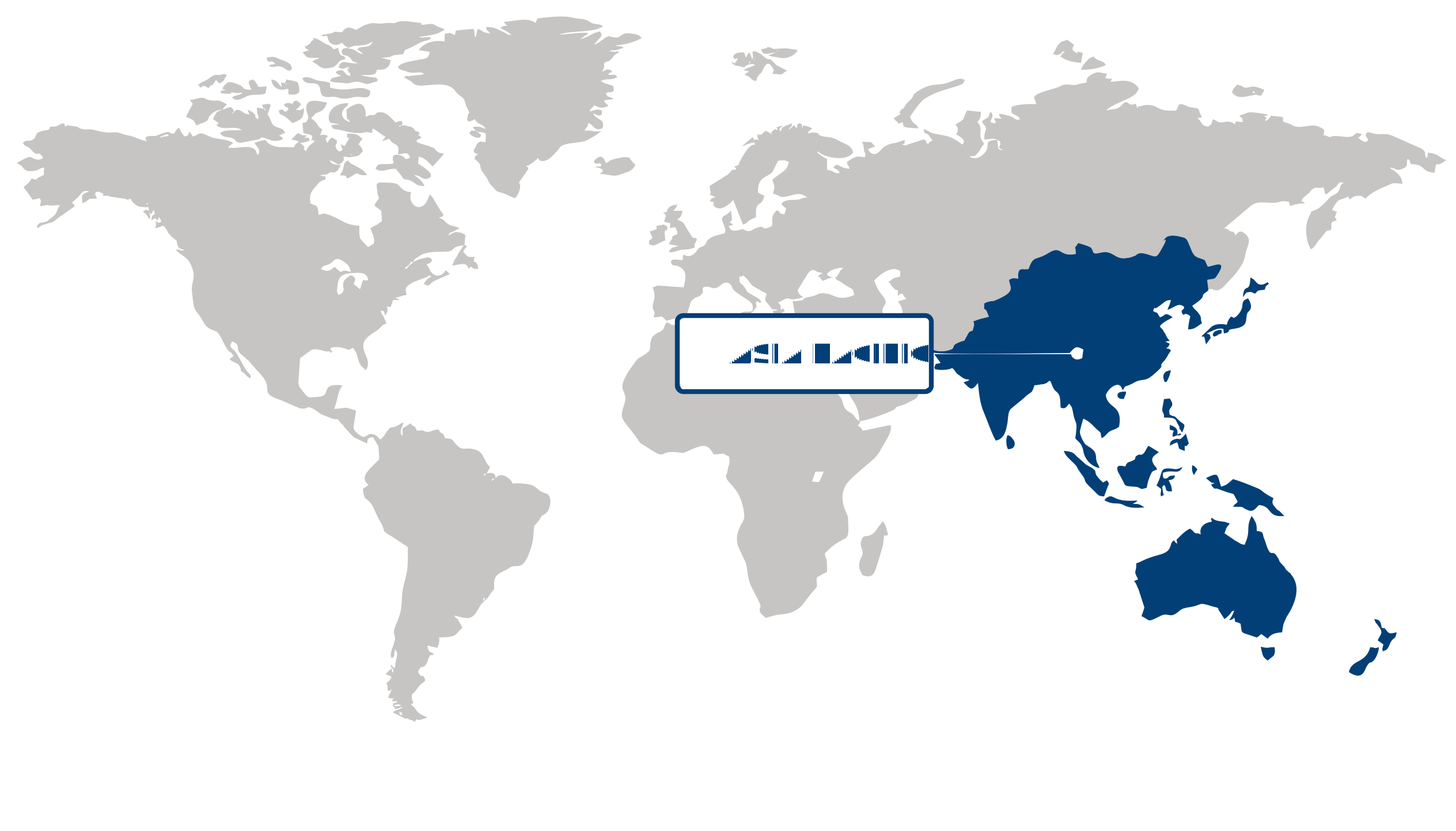
Asia Pacific (Largest Region)
Asia Pacific held the largest share of the wireless charger market in 2026, supported by its extensive consumer electronics manufacturing base, high smartphone penetration, and rapid adoption of connected consumer devices. Growing demand for convenient charging solutions is encouraging integration of wireless charging capabilities across smartphones, wearable devices, accessories, and other personal electronics. The region's strong technology ecosystem and established electronics supply chains facilitate innovation in charging efficiency, compatibility, and device integration. Increasing consumer preference for cable-free experiences and continued expansion of smart-device usage are further strengthening demand for wireless charging solutions.
Europe (Fastest-Growing Region)
Europe is the fastest-growing region, driven by rising adoption of premium consumer electronics, increasing interest in convenient charging technologies, and growing integration of wireless charging into mobility and connected-device applications. Consumers are increasingly seeking streamlined device ecosystems that reduce dependence on physical connectors, supporting demand for compatible charging accessories and embedded solutions. The region's emphasis on energy efficiency and sustainable technology design is also encouraging innovation in charging systems. Expanding use of connected devices across residential, commercial, and automotive environments provides additional opportunities for wireless charging adoption.
| Parameter | North America | Asia Pacific | Europe | Latin America | MEA |
|---|---|---|---|---|---|
| Innovation Hub i Scale Nascent Developing Advanced | |||||
| Cost-Sensitive Region i Scale Low Medium High | |||||
| Regulatory Environment i Scale Restrictive Neutral Supportive | |||||
| Demand Drivers i Scale Weak Moderate Strong | |||||
| Development Stage i Scale Emerging Developing Developed | |||||
| Adoption Rate i Scale Low Medium High | |||||
| New Entrants / Startups i Scale Sparse Moderate Dense | |||||
| Macro Indicators i Scale Weak Stable Strong |
Key Country Insights
Germany 🇩🇪
Automotive Charging IntegrationGermany increasingly integrates wireless charging solutions into passenger vehicles, office environments, and premium consumer electronics. The market in Germany supports technologies that deliver efficient charging performance while maintaining high product quality standards.
France 🇫🇷
Connected Device AdoptionFrance is seeing increasing adoption of wireless chargers across households, workplaces, and public environments as connected devices become more prevalent. Companies in France continue expanding accessory portfolios that emphasize convenience, safety, and universal compatibility.
Italy 🇮🇹
Retail Accessory ExpansionItaly's wireless charger market benefits from growing consumer demand for practical charging accessories compatible with multiple devices. Retailers and manufacturers in Italy continue expanding product availability while emphasizing design, portability, and reliable charging performance.
Japan 🇯🇵
Consumer Electronics InnovationJapan continues advancing wireless charger development through innovation in compact design, charging efficiency, and device interoperability. Electronics companies in Japan focus on seamless charging experiences across smartphones, wearables, and portable consumer devices.
South Korea 🇰🇷
Fast Charging DevelopmentSouth Korea remains focused on high-speed wireless charging technologies aligned with advanced mobile device innovation. Manufacturers in South Korea continue improving charging efficiency and expanding compatibility across premium consumer electronics portfolios.
United States 🇺🇸
Ecosystem CompatibilityThe U.S. wireless charger market is shaped by broad adoption of smartphones, wearables, and multi-device charging accessories. Manufacturers in the U.S. continue prioritizing fast charging performance and compatibility across expanding consumer electronics ecosystems.
Segment Leadership and Growth Trends
Wireless Charger Market Share (%), by Component, 2026
Go beyond the chart, access full insights & data tables
Request Free Sample ReportComponent Segment Analysis: Transmitter (Largest Segment) vs Receiver (Fastest-Growing Segment)
The transmitter segment dominated the wireless charger market, accounting for 64.02% in 2026. Its strong position reflects the essential role of transmitters in initiating and delivering wireless power to compatible devices. Growing adoption of wireless charging across consumer electronics is increasing the need for reliable transmission components capable of supporting convenient cable-free charging. As wireless charging becomes more integrated into everyday device usage, demand for transmitter components remains closely linked to the expansion of the broader charging ecosystem.
Receiver components are projected to be the fastest-growing segment during the forecast period as more compatible devices incorporate wireless power reception capabilities. Receivers enable electronic devices to capture transmitted energy, making them critical to the practical operation of wireless charging systems. Continued expansion of wireless charging functionality across devices, together with consumer preference for greater charging convenience and reduced reliance on physical cables, is expected to strengthen demand for these components.
Technology Segment Analysis: Inductive (Largest Segment) vs Radio Frequency (Fastest-Growing Segment)
Inductive technology held the largest share of the wireless charger market in 2026, reflecting its established application in wireless power transfer and broad suitability for compatible charging devices. Its ability to provide convenient charging without a physical cable connection supports continued adoption across consumer electronics. The established presence of inductive charging solutions, combined with their practical integration into everyday charging environments, continues to underpin the technology's leading market position.
Radio frequency technology is anticipated to grow at the fastest pace during the forecast period as demand increases for more flexible approaches to wireless power delivery. RF-based charging can support power transmission without requiring the same degree of close physical contact associated with conventional charging approaches, creating opportunities for greater user convenience. Growing interest in charging technologies that provide more freedom in device positioning is expected to contribute to the segment's expansion.
| Segment | Sub-Segment | Largest Segment | Fastest Growing |
|---|---|---|---|
| Component | Transmitter, Receiver | Transmitter | Receiver |
| Technology | Inductive, Resonant, Radio Frequency, Others | Inductive | Radio Frequency |
| Application | Consumer Electronics, Automotive, Healthcare, Others | Consumer Electronics | Automotive |
Competitive Landscape and Market Positioning
Prominent players in the wireless charger market:
1. Samsung Electronics Co. Ltd. (South Korea)
2. Apple Inc. (United States)
3. Sony Group Corporation (Japan)
4. Anker Innovations Technology Co. Ltd. (China)
5. Belkin International Inc. (United States)
6. WiTricity Corporation (United States)
7. Energous Corporation (United States)
8. Powermat Technologies Ltd. (Israel)
9. Renesas Electronics Corporation (Japan)
10. Tesla Inc. (United States)
The wireless charger market is expanding with increasing adoption of fast and universal charging standards. Device compatibility improvements are enhancing user convenience. Compact and efficient designs are shaping consumer preferences. The wireless charger market continues to grow alongside rising mobile device dependency.
| Company | Market Share | Company Revenue | Revenue CAGR (%) | Product Portfolio | Geographic Presence | Innovation / R&D Focus | Strategic Developments |
|---|---|---|---|---|---|---|---|
| Samsung Electronics Co. Ltd. (South Korea) | |||||||
| Apple Inc. (United States) | |||||||
| Sony Group Corporation (Japan) | |||||||
| Anker Innovations Technology Co. Ltd. (China) | |||||||
| Belkin International Inc. (United States) | |||||||
| WiTricity Corporation (United States) | |||||||
| Energous Corporation (United States) | |||||||
| Powermat Technologies Ltd. (Israel) | |||||||
| Renesas Electronics Corporation (Japan) | |||||||
| Tesla Inc. (United States). |
Industry Development/News
| Company Name | Date | Key Development |
|---|---|---|
| Anker | May-26 | Anker expanded its portable power solutions with the launch of the Qi2-certified Nano 5K power bank. Integrating 15W wireless charging capabilities within an ultra-thin form factor, the product strengthens the company's competitive standing in the premium magnetic accessory segment, specifically targeting users requiring high-speed, interoperable charging in mobile applications. |
| WiTricity | Feb-26 | WiTricity introduced a 600W inductive charging system specifically for golf cart fleets. The solution targets community mobility and small-format electric vehicle segments, providing a lower-cost, maintenance-free alternative to traditional plug-in charging by automating the power transfer process for commercial and residential utility vehicle operators. |
| Wireless Power Consortium | Jul-25 | The Wireless Power Consortium officially launched the Qi2 25W wireless charging standard. This release enables higher-speed, interoperable wireless charging across smartphones and peripherals, setting a new technical benchmark for the industry and accelerating the adoption of magnetic alignment and power delivery protocols among leading device manufacturers. |
| Powercast Corporation | Feb-25 | Powercast Corporation entered a strategic partnership with B&Plus to introduce RF-based wireless power solutions to the Japanese market. By integrating battery-free power technology into industrial designs, the collaboration aims to provide a sustainable, long-term alternative to traditional battery use, aligning with national emissions-reduction objectives and supporting broader commercial adoption of energy-efficient power harvesting. |
| Samsung | Jan-25 | Samsung launched the S2MIW06 power management integrated chip (PMIC), designed to support wireless charging speeds up to 50W. The chip aligns with the Qi 2.2 standard, supporting both Baseline and Extended Power Profiles, as well as Magnetic Power Profile (MPP) for precise alignment, heat reduction, and improved energy transfer efficiency. |
| OnePlus | Jan-25 | OnePlus introduced a 50W magnetic wireless charger featuring advanced cooling technology to manage thermal output during high-speed energy transfer. With cross-brand compatibility, including support for iPhone and other Qi-enabled smartphones, the charger represents an effort to capture broader market share in the high-performance wireless accessory category. |
| Quaze Technologies | Oct-24 | Quaze Technologies partnered with L3Harris Technologies to commercialize tubular wireless charging products. This collaboration focuses on deploying specialized inductive power solutions for defense-related applications, demonstrating the scalability of wireless power technology in mission-critical environments where durability, alignment-free operation, and sealed charging interfaces are required. |
| Tesla | Sep-24 | Tesla filed patents for inductive wireless charging mats integrated into its Robotaxi platform. The filings signal a strategic commitment to autonomous vehicle infrastructure, aiming to eliminate human intervention in the charging process and establish a foundation for scalable, automated fleet electrification and operational energy management within its autonomous mobility ecosystem. |
| WiBotic | Apr-24 | WiBotic expanded its industrial wireless charging portfolio with a 1kW solution tailored for high-capacity battery systems. This development targets the robotics and industrial automation sectors, offering a scalable, reliable power delivery system that minimizes mechanical wear and improves operational uptime in demanding warehouse and factory environments. |
| WAVE | Jan-24 | WAVE demonstrated a 500kW high-power inductive charging system designed for heavy-duty electric trucks in extreme cold-weather conditions. The advancement highlights significant progress in deploying wireless infrastructure for commercial fleet logistics, proving the viability of high-speed energy transfer for large vehicles in harsh operational climates where traditional plug-in connections may face reliability challenges. |
Customize Your Report
Explore examples of how this report can be tailored to different research needs, including custom segments, additional topics or chapters, and related reports. Click a section of the wheel or its numbered marker to explore the available options.
Wireless Charger Market — Custom Segments
| Segment | Sub-Segment |
|---|---|
| Power Output Class | Up to 5W, Above 5W to 15W, Above 15W to 30W, Above 30W |
| Installation Type | Portable, Desktop, In-Vehicle, Built-In Furniture & Infrastructure, Wall-Mounted |
| Sales Channel | Online Retail, Consumer Electronics Stores, Specialty Stores, Automotive & OEM Channels, Institutional & Commercial Sales |
Wireless Charger Market — Custom TOC
| Custom Chapter | Custom Details |
|---|---|
| Charging Ecosystem Evolution Analysis |
|
| Automotive Wireless Charging Opportunity |
|
| Consumer Adoption Barrier Assessment |
|
Need a different cut of the data?
Request Custom ResearchHow much revenue does the wireless charger market generate?
How much is the wireless charger industry expected to grow by 2036?
How is expanding electric vehicle adoption reshaping investment priorities in wireless charging infrastructure?
What role is Qi-enabled device proliferation playing in accelerating wireless charger market expansion?
Why is the transmitter segment the largest component in the wireless charger market?
Why is Radio Frequency technology the fastest-growing segment in the wireless charger market?
Why is Asia Pacific the leading region in the wireless charger market?
What is driving wireless charger market growth in Europe?
What are the prominent companies operating in the wireless charger landscape?
Our Clients
"Working with FBI has been a good experience. The market report provided a holistic view, covering everything from emerging trends to potential risks."
Semtech Corporation
"The experience was highly positive. The team showcased remarkable flexibility in adapting to our specific needs and delivered report that perfectly aligned with all our requirements."
TSMC
"What really stood out to me was how clearly and promptly the Fundamental Business Insights team communicated throughout. It made the collaboration feel effortless."
NXP Semiconductors
Our Research Team & Methodology
Every Fundamental Business Insights report is built by a dedicated vertical research team, validated through a structured primary-and-secondary methodology, and reviewed for accuracy before it reaches you.
Research Team Overview
Prepared by the Electronics & Semiconductors Research Team
Delivery
Published
Demand
Available
Support
Trust & Compliance
Research Domains
10 coverage areasResearch Intelligence
| Source | Reference |
|---|---|
| Semiconductor Industry Association (SIA) | www.semiconductors.org |
| SEMI | www.semi.org |
| JEDEC Solid State Technology Association | www.jedec.org |
| IEEE | www.ieee.org |
| IPC – Association Connecting Electronics Industries | www.ipc.org |
| International Electrotechnical Commission (IEC) | www.iec.ch |
| International Organization for Standardization (ISO) | www.iso.org |
| U.S. Bureau of Industry and Security (BIS) | www.bis.gov |
| U.S. Patent and Trademark Office (USPTO) | www.uspto.gov |
| European Patent Office (EPO) | www.epo.org |
| Taiwan Semiconductor Industry Association (TSIA) | www.tsia.org.tw |
| World Semiconductor Trade Statistics (WSTS) | www.wsts.org |
| International Energy Agency (IEA) | www.iea.org |
| GSMA | www.gsma.com |
| 3GPP | www.3gpp.org |
| ITU (International Telecommunication Union) | www.itu.int |
| Omdia (public insights) | omdia.tech.informa.com |
| Display Supply Chain Consultants (DSCC) | www.displaysupplychain.com |
| U.S. Department of Energy (DOE) | www.energy.gov |
| NIST (National Institute of Standards and Technology) | www.nist.gov |
Research Workflow & Quality Assurance
Data Collection
Verified information gathered through primary and secondary research.
Data Triangulation
Cross-validation using multiple independent data sources.
Forecast Modelling
Market estimates developed using historical trends and analytical models.
Analyst Validation
Findings reviewed by domain experts for accuracy and consistency.
Editorial & Quality Review
Final editorial, quality, and compliance checks before publication.
Final Publication
Released after successful completion of the internal review process.
Report Coverage
📊 Market Assessment
- Market Size & Forecast
- Market Segmentation
- Regional Analysis
- Growth Drivers & Challenges
- Market Dynamics
🏢 Competitive Intelligence
- Competitive Landscape
- Company Profiles
- Competitive Benchmarking
- Mergers & Acquisitions
- Market Share Analysis or Key Company Strategies
🔍 Strategic Analysis
- Value Chain Analysis
- Porter's Five Forces
- PESTLE Analysis
- Pricing Trends
- Supply-Demand Analysis
🚀 Future Outlook
- Technology Landscape
- Regulatory Landscape
- Investment & Funding Landscape
- Emerging Opportunities
- Future Market Outlook
Have a question about this report or need a custom scope?
Request Customization