Wind Turbine Forging Market Size & Growth Forecast 2027–2036, By Segments (Application, Type, Distribution Channel, Material, Component), Regional Demand Trends (North America, Asia Pacific, Europe), Key Country Insights (U.S., Japan, South Korea, Germany, France, Italy), and Competitive Landscape
Market Size and Growth Outlook
Wind Turbine Forging Market size was valued at USD 10.83 Billion in 2026 and is projected to grow at 7.74% CAGR from 2027 to 2036, exceeding USD 22.82 Billion by 2036. The industry revenue for 2027 is estimated at USD 11.54 Billion.
Get more details on this report
Request Free Sample ReportWind Turbine Forging Market Intelligence Snapshot
Regional Market Dynamics
- Europe held the largest share in 2026, supported by renewable energy investment, wind capacity expansion, advanced manufacturing, and established industrial supply chains.
- Asia Pacific is accelerating through renewable energy deployment, rising electricity demand, government initiatives, large-scale wind projects, and expanding domestic manufacturing capabilities.
Segment Momentum
- The onshore installation segment led with a 64.61% share in 2026, supported by widespread wind farm deployment, lower installation costs, and established grid connectivity requiring large volumes of forged components.
- Offshore installation is the fastest-growing segment as demand rises for specialized forged components capable of supporting larger turbines and operating reliably in harsh marine conditions.
Market Expansion Drivers
- Surge in global wind power installations increasing demand for high-strength forged turbine components
- Government net-zero commitments and incentives accelerating renewable energy infrastructure development
- Growth in offshore wind farms requiring large-scale forged components for high-load environments
Leading Market Participants
- Key players in the wind turbine forging market include Bharat Forge Ltd. (India), Thyssenkrupp AG (Germany), China First Heavy Industries Group Co., Ltd. (China), Forgital Group (Italy), Scot Forge Company (United States), Ellwood Group Inc. (United States), Larsen & Toubro Limited (India), Samuel, Son & Co. (Canada), VDM Metals GmbH (Germany), Jiangsu Pacific Precision Forging Co., Ltd. (China)
Global Market Forecast Snapshot
Market Outlook
- 2026 Market Size: USD 10.83 Billion
- 2027 Estimated Market Size: USD 11.54 Billion
- Projected Market Size: USD 22.82 Billion by 2036
- Growth Forecast: 7.74% CAGR (2027-2036)
Regional and Segment Outlook
- Leading Regional Market: Europe
- High-Growth Regional Hub: Asia Pacific
- Core Revenue Segment: Onshore Installation (Application) | Open Die Forging (Type) | Direct Channel (Distribution Channel) | Steel Alloys (Material) | Shafts (Component)
- Emerging Opportunity Segment: Offshore Installation (Application) | Seamless Rolled Ring (Type) | Indirect Channel (Distribution Channel) | Composite Materials (Material) | Bearings (Component)
Market Growth Drivers and Industry Trends
Surge in global wind power installations increasing demand for high-strength forged turbine components
The rapid expansion of wind energy projects worldwide is creating substantial demand for durable forged components, and this trend will drive the wind turbine forging market growth. Wind turbines require high-strength forged shafts, flanges, rings, and bearing components capable of withstanding continuous mechanical stress and varying environmental conditions throughout long operational lifecycles. As larger turbines are deployed to maximize energy generation, manufacturers are increasingly investing in precision forging technologies that deliver superior structural integrity and consistent performance.
Government net-zero commitments and incentives accelerating renewable energy infrastructure development
National decarbonization strategies and supportive policy frameworks are encouraging greater investment in renewable energy infrastructure, and the wind turbine forging market is expanding alongside this transition. Financial incentives, renewable energy targets, and infrastructure development programs are accelerating the construction of new wind power facilities while supporting modernization of existing installations. These initiatives increase procurement of forged turbine components that are essential for reliable turbine assembly, operational efficiency, and long-term asset durability across utility-scale projects.
Growth in offshore wind farms requiring large-scale forged components for high-load environments
Increasing deployment of offshore wind farms will boost the wind turbine forging market demand as marine installations require specialized forged components engineered for challenging operating conditions. Offshore turbines are exposed to higher mechanical loads, strong winds, and corrosive marine environments, necessitating large-scale forged structures with exceptional strength and fatigue resistance. Manufacturers are therefore focusing on advanced forging capabilities that produce high-performance components capable of supporting larger turbine capacities and extended service life in offshore applications.
| Growth Driver | Impact on CAGR | Regulatory Influence | Geographic Relevance | Adoption Rate | Impact Timeline |
|---|---|---|---|---|---|
| Surge in global wind power installations increasing demand for high-strength forged turbine components | 2.4% | High | Asia Pacific, Europe, North America | High | Near Term |
| Government net-zero commitments and incentives accelerating renewable energy infrastructure development | 2.2% | High | Europe, Asia Pacific, North America | High | Near Term |
| Growth in offshore wind farms requiring large-scale forged components for high-load environments | 1.9% | High | Europe, Asia Pacific | High | Mid Term |
Unlock insights tailored to your business with our bespoke market research solutions.
Click to get your customized report now.
Regional Demand Dynamics
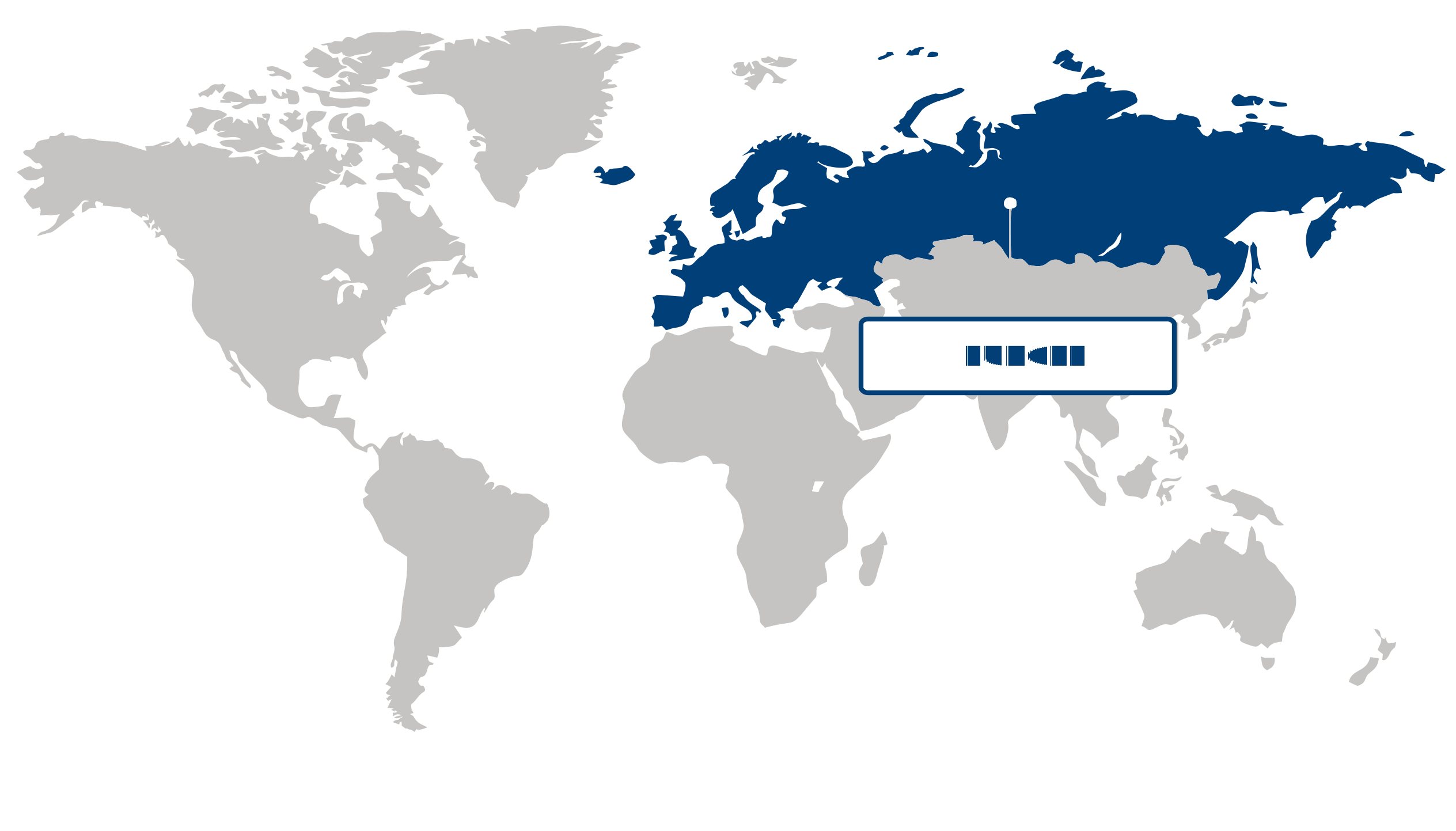
Europe (Largest Region)
Europe accounted for the largest share of the wind turbine forging market in 2026, underpinned by its established renewable energy ecosystem and continued emphasis on expanding wind power capacity. Strong policy support for decarbonization, offshore wind development, and energy security is encouraging investment in wind infrastructure, creating sustained requirements for forged components used in turbines. The region's advanced manufacturing capabilities, engineering expertise, and established industrial supply chains also support the production of high-performance forged parts capable of meeting demanding wind turbine operating conditions.
Asia Pacific (Fastest-Growing Region)
Asia Pacific is anticipated to be the fastest-growing regional market as countries across the region accelerate renewable energy deployment and expand wind power infrastructure. Rising electricity demand, efforts to diversify energy sources, and government initiatives supporting low-carbon generation are encouraging new turbine installations and related manufacturing activity. Expanding domestic industrial capabilities and investments in large-scale wind projects are strengthening the regional supply chain for forged components, while increasing demand for reliable and efficient turbines is creating additional opportunities for specialized forging technologies.
| Parameter | North America | Asia Pacific | Europe | Latin America | MEA |
|---|---|---|---|---|---|
| Innovation Hub i Scale Nascent Developing Advanced | |||||
| Cost-Sensitive Region i Scale Low Medium High | |||||
| Regulatory Environment i Scale Restrictive Neutral Supportive | |||||
| Demand Drivers i Scale Weak Moderate Strong | |||||
| Development Stage i Scale Emerging Developing Developed | |||||
| Adoption Rate i Scale Low Medium High | |||||
| New Entrants / Startups i Scale Sparse Moderate Dense | |||||
| Macro Indicators i Scale Weak Stable Strong |
Key Country Insights
United States 🇺🇸
Utility-Scale Component SupplyThe U.S. wind turbine forging market is driven by demand for large forged components used in utility-scale wind projects. Manufacturers focus on expanding domestic production capacity, improving material performance, and strengthening resilient supply chains for renewable energy infrastructure.
Germany 🇩🇪
Engineering Quality FocusGermany emphasizes precision-forged wind turbine components that support high-performance turbine assemblies and long operating lifecycles. The market values advanced metallurgical capabilities, consistent quality standards, and collaboration with turbine manufacturers across Europe.
Japan 🇯🇵
High-Reliability ForgingsJapan prioritizes forged wind turbine components designed for durability and operational reliability under demanding environmental conditions. Producers invest in advanced forging technologies and stringent quality control to meet specialized renewable energy requirements.
South Korea 🇰🇷
Export-Oriented ManufacturingSouth Korea supports the wind turbine forging market through competitive heavy industrial manufacturing and export capabilities. Companies strengthen production efficiency and develop large-scale forged components suited for offshore and international wind energy projects.
France 🇫🇷
Offshore Infrastructure SupportFrance is expanding demand for wind turbine forgings alongside offshore wind development and related infrastructure investments. Buyers seek forged components with high structural integrity and dependable performance for long-term renewable energy installations.
Italy 🇮🇹
Specialized Forging ExpertiseItaly leverages its established forging industry to supply precision-engineered wind turbine components for domestic and export markets. Manufacturers prioritize flexible production capabilities and high-quality metallurgy for diverse turbine applications.
Segment Leadership and Growth Trends
Wind Turbine Forging Market Share (%), by Application, 2026
Go beyond the chart, access full insights & data tables
Request Free Sample ReportApplication Segment Analysis: Onshore Installation (Largest Segment) vs Offshore Installation (Fastest-Growing Segment)
The onshore installation segment dominated the wind turbine forging market with a 64.61% share in 2026. Its leadership is primarily driven by the widespread deployment of land-based wind farms, which benefit from comparatively lower installation costs, easier accessibility, and established grid connectivity. Onshore wind projects require a substantial volume of forged components, including shafts, rings, and structural elements that must withstand demanding operational conditions. Continued investments in renewable energy infrastructure and the expansion of utility-scale wind projects have reinforced the segment’s dominant position.
The offshore installation segment is expected to witness the fastest growth as countries increasingly focus on harnessing stronger and more consistent wind resources available in offshore environments. Offshore wind turbines require larger and more specialized forged components capable of supporting higher power capacities and operating in harsh marine conditions. Advancements in offshore wind technology, coupled with growing government support for clean energy generation, are accelerating demand for high-performance forging solutions within this segment.
Type Segment Analysis: Open Die Forging (Largest Segment) vs Seamless Rolled Ring (Fastest-Growing Segment)
The open die forging segment accounted for the largest share of 46.64% in 2026. Open die forging is widely utilized for manufacturing large and heavy-duty wind turbine components that require exceptional mechanical strength and structural integrity. The process enables the production of customized forged parts with superior grain structure and durability, making it particularly suitable for critical wind energy applications. Growing demand for reliable and long-lasting turbine components continues to support the segment’s market leadership.
In the wind turbine forging market, the seamless rolled ring segment is emerging as the fastest-growing type category. These forgings are increasingly preferred for applications that require high strength, dimensional accuracy, and resistance to fatigue under continuous operating loads. As turbine sizes increase and performance requirements become more demanding, manufacturers are adopting seamless rolled ring components to enhance reliability and operational efficiency. The ongoing evolution of advanced wind turbine designs is further driving growth in this segment.
Distribution Channel Segment Analysis: Direct Channel (Largest Segment) vs Indirect Channel (Fastest-Growing Segment)
The direct channel segment held the largest share of the market in 2026. Direct relationships between forging manufacturers and wind turbine producers facilitate customized product development, streamlined communication, and better quality control throughout the supply chain. Given the technical complexity and stringent performance requirements of wind turbine components, direct procurement models are often preferred to ensure consistency, reliability, and timely project execution. These advantages have contributed significantly to the segment’s dominant position.
The indirect channel segment is projected to experience the fastest growth due to the increasing globalization of supply chains and the expanding presence of specialized distributors and intermediaries. These channels help manufacturers access broader customer bases and improve market penetration across diverse geographic regions. As wind energy deployment expands into emerging markets, the role of indirect distribution networks is becoming increasingly important in supporting efficient product availability and market reach.
| Segment | Sub-Segment | Largest Segment | Fastest Growing |
|---|---|---|---|
| Application | Onshore Installation, Offshore Installation | Onshore Installation | Offshore Installation |
| Type | Open Die Forging, Seamless Rolled Ring, Closed Die Forging | Open Die Forging | Seamless Rolled Ring |
| Distribution Channel | Direct Channel, Indirect Channel | Direct Channel | Indirect Channel |
| Material | Steel Alloys, Aluminium Alloys, Composite Materials, Others | Steel Alloys | Composite Materials |
| Component | Flanges, Gears, Shafts, Blades, Bearings, Others | Shafts | Bearings |
Competitive Landscape and Market Positioning
Key companies in the wind turbine forging market:
- Bharat Forge Ltd. (India)
- Thyssenkrupp AG (Germany)
- China First Heavy Industries Group Co., Ltd. (China)
- Forgital Group (Italy)
- Scot Forge Company (United States)
- Ellwood Group, Inc. (United States)
- Larsen & Toubro Limited (India)
- Samuel Son & Co. (Canada)
- VDM Metals GmbH (Germany)
- Jiangsu Pacific Precision Forging Co., Ltd. (China)
Wind turbine forging manufacturers are facing a competitive environment shaped by the need for higher-performance components, manufacturing efficiency, and supply chain resilience. Producers are investing in advanced forging capabilities and process optimization to meet the requirements of increasingly demanding turbine designs, where component reliability directly affects operational performance. Larger manufacturers are leveraging production scale and engineering expertise, while specialized suppliers are competing through customized solutions and faster adaptation to turbine technology changes. The shift toward larger renewable energy installations is encouraging forging companies to strengthen technical capabilities and secure closer integration with turbine manufacturers.
| Company | Market Share | Company Revenue | Revenue CAGR (%) | Product Portfolio | Geographic Presence | Innovation / R&D Focus | Strategic Developments |
|---|---|---|---|---|---|---|---|
| Bharat Forge Ltd. (India) | |||||||
| Thyssenkrupp AG (Germany) | |||||||
| China First Heavy Industries Group Co. Ltd. (China) | |||||||
| Forgital Group (Italy) | |||||||
| Scot Forge Company (United States) | |||||||
| Ellwood Group Inc. (United States) | |||||||
| Larsen & Toubro Limited (India) | |||||||
| Samuel Son & Co. (Canada) | |||||||
| VDM Metals GmbH (Germany) | |||||||
| Jiangsu Pacific Precision Forging Co. Ltd. (China) |
Industry Development/News
| Company Name | Date | Key Development |
|---|---|---|
| Venterra Group | Feb-25 | Venterra Group formed a strategic alliance with Tonkin + Taylor through a Memorandum of Understanding to collaborate on offshore wind projects across Australia and New Zealand, combining full lifecycle engineering expertise with regional capabilities. |
| US Forged Rings | Feb-24 | US Forged Rings announced a USD 700 million investment to construct a dedicated offshore wind turbine tower fabrication facility and a major steel forging plant on the U.S. East Coast to support domestic component manufacturing. |
| Bharat Forge | Dec-22 | Bharat Forge initiated the commercial supply of industrial forgings manufactured utilizing green steel sourced from Saarloha Advanced Materials Private Limited, advancing sustainable manufacturing practices. |
Customize Your Report
Explore examples of how this report can be tailored to different research needs, including custom segments, additional topics or chapters, and related reports. Click a section of the wheel or its numbered marker to explore the available options.
Wind Turbine Forging Market — Custom Segments
| Segment | Sub-Segment |
|---|---|
| Wind Turbine Capacity | Small-Scale Turbines, Medium-Scale Turbines, Large-Scale Turbines |
| Turbine Manufacturer | Integrated OEMs, Independent Turbine OEMs, Specialized Turbine Manufacturers |
| Replacement Demand | Scheduled Component Replacement, Failure-Driven Replacement, Repowering & Life-Extension Replacement |
Wind Turbine Forging Market — Custom TOC
| Custom Chapter | Custom Details |
|---|---|
| Offshore Wind Localization Opportunity Assessment |
|
| Forged Component Supply Risk Analysis |
|
| Low-Carbon Forging Transition Assessment |
|
Need a different cut of the data?
Request Custom ResearchWhat is the market valuation of wind turbine forging?
How is the wind turbine forging industry size expected to evolve during the forecast period?
How are expanding wind power installations influencing investment priorities in the wind turbine forging market?
Why is offshore wind development becoming a major growth driver for the wind turbine forging market?
Why does onshore installation dominate the wind turbine forging market?
How is offshore installation driving future growth in wind turbine forgings?
What supports Europe's leadership in the wind turbine forging market?
Why is Asia Pacific expected to grow fastest in wind turbine forging?
Which companies dominate the wind turbine forging landscape?
Our Clients
"The information presented in the report was genuinely insightful. The data was clear and easy to understand, which made it much easier to interpret the findings."
Amara Raja Group
"The responsiveness and professionalism exhibited by the team were exemplary. They were readily available to address queries, provide clarifications, and offer additional insights."
ONGC
"The reports offered a comprehensive analysis of various segments within the market. The detailed insights into market trends, and regulatory landscapes were excellent."
TotalEnergies
Our Research Team & Methodology
Every Fundamental Business Insights report is built by a dedicated vertical research team, validated through a structured primary-and-secondary methodology, and reviewed for accuracy before it reaches you.
Research Team Overview
Prepared by the Energy & Power Research Team
Delivery
Published
Demand
Available
Support
Trust & Compliance
Research Domains
10 coverage areasResearch Intelligence
| Source | Reference |
|---|---|
| International Energy Agency (IEA) | www.iea.org |
| U.S. Energy Information Administration (EIA) | www.eia.gov |
| International Renewable Energy Agency (IRENA) | www.irena.org |
| International Electrotechnical Commission (IEC) | www.iec.ch |
| International Organization for Standardization (ISO) | www.iso.org |
| IEEE | www.ieee.org |
| CIGRE (International Council on Large Electric Systems) | www.cigre.org |
| World Energy Council (WEC) | www.worldenergy.org |
| U.S. Department of Energy (DOE) | www.energy.gov |
| International Atomic Energy Agency (IAEA) | www.iaea.org |
| American Petroleum Institute (API) | www.api.org |
| Society of Petroleum Engineers (SPE) | www.spe.org |
| Hydrogen Council | hydrogencouncil.com |
| Battery Council International (BCI) | batterycouncil.org |
| Global Wind Energy Council (GWEC) | gwec.net |
| SolarPower Europe | www.solarpowereurope.org |
| World Bioenergy Association (WBA) | worldbioenergy.org |
| International Hydropower Association (IHA) | www.hydropower.org |
| Edison Electric Institute (EEI) | www.eei.org |
| National Renewable Energy Laboratory (NREL) | www.nrel.gov |
Research Workflow & Quality Assurance
Data Collection
Verified information gathered through primary and secondary research.
Data Triangulation
Cross-validation using multiple independent data sources.
Forecast Modelling
Market estimates developed using historical trends and analytical models.
Analyst Validation
Findings reviewed by domain experts for accuracy and consistency.
Editorial & Quality Review
Final editorial, quality, and compliance checks before publication.
Final Publication
Released after successful completion of the internal review process.
Report Coverage
📊 Market Assessment
- Market Size & Forecast
- Market Segmentation
- Regional Analysis
- Growth Drivers & Challenges
- Market Dynamics
🏢 Competitive Intelligence
- Competitive Landscape
- Company Profiles
- Competitive Benchmarking
- Mergers & Acquisitions
- Market Share Analysis or Key Company Strategies
🔍 Strategic Analysis
- Value Chain Analysis
- Porter's Five Forces
- PESTLE Analysis
- Pricing Trends
- Supply-Demand Analysis
🚀 Future Outlook
- Technology Landscape
- Regulatory Landscape
- Investment & Funding Landscape
- Emerging Opportunities
- Future Market Outlook
Have a question about this report or need a custom scope?
Request Customization