Wind Turbine Control System Market Size & Growth Forecast 2027–2036, By Segments (Component, Function), Regional Demand Trends (North America, Asia Pacific, Europe), Key Country Insights (U.S., Japan, South Korea, Germany, France, Italy), and Competitive Landscape
Market Size and Growth Outlook
Wind Turbine Control System Market size was worth USD 5.35 Billion in 2026 and is expected to grow at 6.89% CAGR between 2027 and 2036, crossing USD 10.42 Billion by 2036. The industry revenue for 2027 is estimated at USD 5.66 Billion.
Get more details on this report
Request Free Sample ReportWind Turbine Control System Market Intelligence Snapshot
Regional Market Dynamics
- Asia Pacific held the largest position in 2026, driven by extensive renewable deployment, expanding wind capacity, utility-scale projects, and modernization of existing wind farms.
- North America is expected to grow fastest, supported by renewable infrastructure investment, grid modernization, clean electricity demand, and adoption of advanced turbine controls.
Segment Momentum
- Software is the largest component because it enables real-time monitoring, automated decision-making, performance optimization, and predictive maintenance, supporting more efficient and reliable turbine operations.
- Load control is the fastest-growing function as operators increasingly focus on managing mechanical stress, improving structural stability, and optimizing turbine performance under changing wind conditions.
Market Expansion Drivers
- Rapid renewable energy integration increasing demand for advanced turbine control systems
- Aging power infrastructure driving modernization of wind energy control technologies
- Efficiency optimization technologies improving wind farm performance and operational stability
Leading Market Participants
- Key players in the wind turbine control system market include Siemens Energy AG (Germany), General Electric Company (United States), Schneider Electric SE (France), Vestas Wind Systems A/S (Denmark), ABB Ltd. (Switzerland), Mitsubishi Electric Corporation (Japan), Honeywell International Inc. (United States), Rockwell Automation, Inc. (United States), Danfoss A/S (Denmark), Yokogawa Electric Corporation (Japan)
Global Market Forecast Snapshot
Market Outlook
- 2026 Market Size: USD 5.35 Billion
- 2027 Estimated Market Size: USD 5.66 Billion
- Projected Market Size: USD 10.42 Billion by 2036
- Growth Forecast: 6.89% CAGR (2027-2036)
Regional and Segment Outlook
- Leading Regional Market: Asia Pacific
- High-Growth Regional Hub: North America
- Core Revenue Segment: Software (Component) | Temperature Control (Function)
- Emerging Opportunity Segment: Software (Component) | Load Control (Function)
Market Growth Drivers and Industry Trends
Rapid renewable energy integration increasing demand for advanced turbine control systems
The accelerating deployment of renewable energy projects is increasing the need for intelligent control platforms capable of maintaining efficient and reliable wind turbine operations under varying environmental conditions. This transition will drive the wind turbine control system market growth as project developers prioritize advanced control technologies that optimize power generation, regulate turbine performance, and support seamless integration with modern electricity networks. Sophisticated monitoring and automation capabilities also enable operators to respond quickly to changing wind conditions while maintaining grid stability and improving overall asset utilization.
Aging power infrastructure driving modernization of wind energy control technologies
Many existing energy systems require modernization to accommodate growing renewable energy capacity, creating demand for upgraded wind control technologies that enhance compatibility with evolving grid infrastructure. The wind turbine control system market benefits from replacement and retrofit initiatives focused on improving operational reliability, communication capabilities, and system responsiveness across both existing and newly integrated wind assets. Modern control architectures also enable enhanced diagnostics, remote management, and improved coordination between turbines and grid operators, supporting more resilient energy networks.
Efficiency optimization technologies improving wind farm performance and operational stability
Wind farm operators are increasingly investing in digital technologies that maximize energy production while minimizing equipment wear and operational interruptions. Continuous innovation in predictive analytics, adaptive control algorithms, and condition monitoring will propel the wind turbine control system market growth by enabling more precise turbine adjustments based on real-time operating conditions. These technologies help optimize rotor performance, reduce maintenance requirements, and improve coordination across multiple turbines, allowing wind farms to achieve greater operational consistency and resource efficiency.
| Growth Driver | Impact on CAGR | Regulatory Influence | Geographic Relevance | Adoption Rate | Impact Timeline |
|---|---|---|---|---|---|
| Rapid renewable energy integration increasing demand for advanced turbine control systems | 2% | High | Europe, Asia Pacific | High | Near Term |
| Aging power infrastructure driving modernization of wind energy control technologies | 1.7% | Moderate | North America, Europe | High | Mid Term |
| Efficiency optimization technologies improving wind farm performance and operational stability | 1.4% | Low | Asia Pacific, North America | Medium | Mid Term |
Unlock insights tailored to your business with our bespoke market research solutions.
Click to get your customized report now.
Regional Demand Dynamics
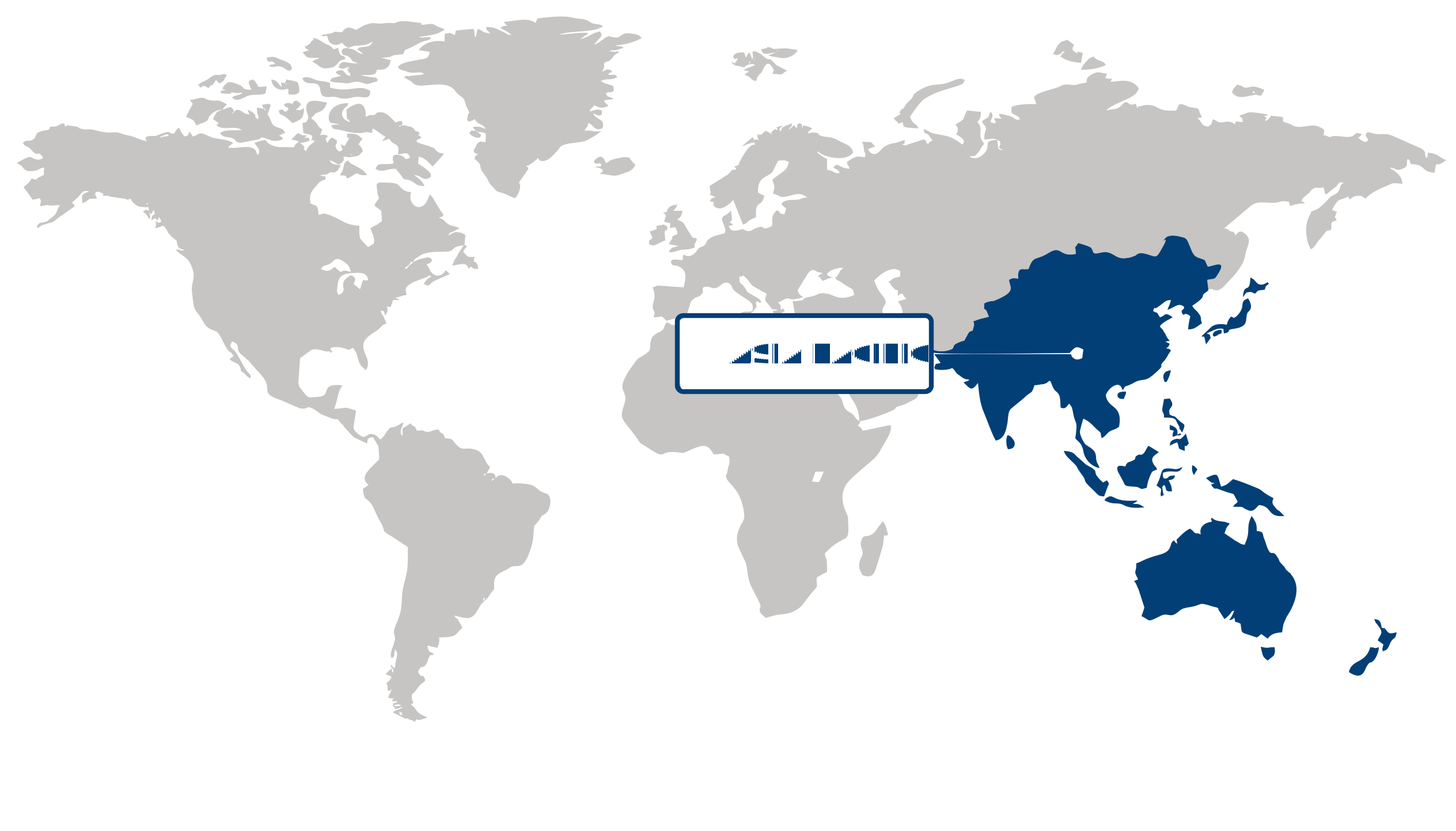
Asia Pacific (Largest Region)
Asia Pacific accounted for the largest position in the wind turbine control system market in 2026, supported by extensive renewable energy deployment, expanding wind power capacity, and continued development of utility-scale wind projects. Governments and power producers across the region are emphasizing renewable generation to strengthen energy security and reduce dependence on conventional power sources, increasing the need for sophisticated control systems that optimize turbine performance and grid integration. Ongoing modernization of wind farms and greater adoption of digital monitoring and automated control technologies are further reinforcing regional demand.
North America (Fastest-Growing Region)
North America is expected to register the fastest growth, supported by continued investment in renewable power infrastructure and efforts to improve the operational efficiency of existing and newly developed wind assets. Wind farm operators are increasingly focusing on advanced turbine control capabilities to optimize energy capture, manage variable operating conditions, and improve asset reliability. Grid modernization, rising interest in clean electricity, and the integration of digital technologies into renewable energy operations are creating additional opportunities for sophisticated control systems across the region.
| Parameter | North America | Asia Pacific | Europe | Latin America | MEA |
|---|---|---|---|---|---|
| Innovation Hub i Scale Nascent Developing Advanced | |||||
| Cost-Sensitive Region i Scale Low Medium High | |||||
| Regulatory Environment i Scale Restrictive Neutral Supportive | |||||
| Demand Drivers i Scale Weak Moderate Strong | |||||
| Development Stage i Scale Emerging Developing Developed | |||||
| Adoption Rate i Scale Low Medium High | |||||
| New Entrants / Startups i Scale Sparse Moderate Dense | |||||
| Macro Indicators i Scale Weak Stable Strong |
Key Country Insights
United States 🇺🇸
Grid Optimization FocusThe U.S. emphasizes advanced wind turbine control systems that improve operational efficiency, predictive maintenance, and grid compatibility. Developers across the U.S. continue investing in digital monitoring platforms and software upgrades to support increasingly complex wind energy installations.
Germany 🇩🇪
Smart Automation IntegrationGermany prioritizes intelligent control technologies that enhance turbine reliability and energy optimization. Manufacturers in Germany integrate automation, advanced sensors, and condition monitoring solutions to improve operational performance throughout wind farm lifecycles.
Japan 🇯🇵
Resilient Control SolutionsJapan focuses on wind turbine control systems capable of maintaining stable operation under demanding environmental conditions. Companies in Japan invest in precision control technologies and remote monitoring capabilities to improve equipment availability and maintenance planning.
South Korea 🇰🇷
Digital Wind ManagementSouth Korea advances wind turbine control systems through digitalization and industrial automation expertise. South Korean developers increasingly deploy AI-enabled diagnostics and centralized control platforms to improve wind farm efficiency and operational visibility.
France 🇫🇷
Offshore System IntegrationFrance emphasizes wind turbine control systems optimized for offshore renewable energy projects. Companies in France increasingly adopt advanced supervisory controls, remote asset management, and cybersecurity measures to support reliable offshore wind operations.
Italy 🇮🇹
Renewable Asset EfficiencyItaly prioritizes control system upgrades that improve wind asset productivity and maintenance efficiency. Operators across Italy increasingly implement digital control platforms and performance analytics to optimize energy output from both new and existing wind installations.
Segment Leadership and Growth Trends
Wind Turbine Control System Market Share (%), by Component, 2026
Go beyond the chart, access full insights & data tables
Request Free Sample ReportComponent Segment Analysis: Software (Largest & Fastest-Growing Segment)
The software segment dominated the wind turbine control system market in 2026 and also represented the fastest-growing component segment. Software serves as the intelligence layer of wind turbine control systems, enabling real-time monitoring, automated decision-making, performance optimization, and coordinated management of turbine operations. As wind farms become more technologically advanced and operators seek to improve energy generation efficiency, system reliability, and predictive maintenance capabilities, the importance of software-based control solutions continues to increase. The growing integration of digital monitoring, automation, and data-driven operational management is further strengthening demand for the software component segment.
Function Segment Analysis: Temperature Control (Largest Segment) vs Load Control (Fastest-Growing Segment)
Temperature control held the largest share of the wind turbine control system market in 2026. Maintaining appropriate operating temperatures across critical turbine components is essential for protecting equipment, supporting reliable operation, and minimizing the risk of performance degradation caused by excessive heat. Temperature control functions help monitor and regulate thermal conditions in systems exposed to continuous mechanical and electrical activity. The increasing focus on equipment reliability, operational continuity, and preventive maintenance is supporting the leading position of the temperature control function segment.
Load control is expected to be the fastest-growing function segment as wind turbine operators increasingly seek to manage mechanical stress and optimize turbine performance under changing operating conditions. Load control systems can help regulate the forces exerted on turbine components, supporting improved structural stability and reducing excessive stress during variable wind conditions. As wind turbines become more advanced and operators place greater emphasis on extending equipment performance and improving operational efficiency, demand for the load control function segment is increasing.
| Segment | Sub-Segment | Largest Segment | Fastest Growing |
|---|---|---|---|
| Component | Software, Controller, Sensors, HMI, Others | Software | Software |
| Function | Speed Control, Temperature Control, Load Control, Pressure Control, Others | Temperature Control | Load Control |
Competitive Landscape and Market Positioning
Prominent players in the wind turbine control system market:
- Siemens Energy AG (Germany)
- General Electric Company (United States)
- Schneider Electric SE (France)
- Vestas Wind Systems A/S (Denmark)
- ABB Ltd. (Switzerland)
- Mitsubishi Electric Corporation (Japan)
- Honeywell International, Inc. (United States)
- Rockwell Automation, Inc. (United States)
- Danfoss A/S (Denmark)
- Yokogawa Electric Corporation (Japan)
The competitive focus within the wind turbine control system market is moving toward intelligent control capabilities that maximize turbine efficiency under increasingly complex operating conditions. Market participants are investing in advanced software architectures, predictive monitoring functions, and grid-responsive control technologies that enhance operational reliability while supporting evolving energy infrastructure requirements. Competition is further shaped by the ability to deliver scalable solutions that can be integrated across both new installations and existing wind assets, encouraging continuous innovation in digital control platforms, cybersecurity, and remote operational management.
| Company | Market Share | Company Revenue | Revenue CAGR (%) | Product Portfolio | Geographic Presence | Innovation / R&D Focus | Strategic Developments |
|---|---|---|---|---|---|---|---|
| Siemens Energy AG (Germany) | |||||||
| General Electric Company (United States) | |||||||
| Schneider Electric SE (France) | |||||||
| Vestas Wind Systems A/S (Denmark) | |||||||
| ABB Ltd. (Switzerland) | |||||||
| Mitsubishi Electric Corporation (Japan) | |||||||
| Honeywell International Inc. (United States) | |||||||
| Rockwell Automation Inc. (United States) | |||||||
| Danfoss A/S (Denmark) | |||||||
| Yokogawa Electric Corporation (Japan) |
Industry Development/News
| Company Name | Date | Key Development |
|---|---|---|
| AEG Power Solutions | May-24 | AEG Power Solutions was selected to provide AC and DC UPS redundant systems for a green hydrogen production and energy storage platform at the Hollandse offshore wind farm in the Netherlands. The project, developed by a Shell-Eneco joint venture, utilizes AEG’s power systems to ensure reliable operations for infrastructure aimed at converting excess wind energy into green hydrogen. |
| Amazon Web Services (AWS) | Mar-24 | Amazon Web Services (AWS) demonstrated the integration of the OpenFAST simulation tool within a digital twin framework to optimize wind turbine performance. By leveraging cloud-based physics modeling and advanced simulation, the initiative enhances analytical capabilities for wind energy assets, providing a technical foundation for the development of more efficient and responsive wind turbine control systems. |
| Siemens Energy | Jan-23 | Siemens Energy, in collaboration with Dragados Offshore, secured a contract to construct converter systems for two 2-gigawatt offshore grid connections for transmission operator Amprion. This project represents a significant scale in offshore grid connectivity, designed to transport 4 GW of wind energy from the North Sea, facilitating the integration of large-scale renewable electricity into the mainland grid. |
Customize Your Report
Explore examples of how this report can be tailored to different research needs, including custom segments, additional topics or chapters, and related reports. Click a section of the wheel or its numbered marker to explore the available options.
Wind Turbine Control System Market — Custom Segments
| Segment | Sub-Segment |
|---|---|
| Turbine Capacity | Up to 2 MW, 2–5 MW, 5–10 MW, Above 10 MW |
| Turbine Technology | Fixed-Speed Turbines, Variable-Speed Turbines, Direct-Drive Turbines, Geared Turbines |
| Deployment Stage | New Turbine Installations, Control System Upgrades, Retrofit & Modernization, Maintenance & Replacement |
Wind Turbine Control System Market — Custom TOC
| Custom Chapter | Custom Details |
|---|---|
| Turbine Retrofit & Modernization Opportunity |
|
| Grid Integration & Curtailment Management |
|
| Wind Farm Digitalization Roadmap |
|
Need a different cut of the data?
Request Custom ResearchHow much revenue does the wind turbine control system market generate?
What are the growth projections for the wind turbine control system industry?
How is renewable energy expansion influencing investment in wind turbine control systems?
Why are modernization initiatives creating demand for advanced wind turbine control technologies?
Why is software the leading component in the wind turbine control system market?
Which function segment is growing fastest in the wind turbine control system market?
Why does Asia Pacific lead the wind turbine control system market?
How is North America shaping future demand for wind turbine control systems?
What are the prominent companies operating in the wind turbine control system landscape?
Our Clients
"The information presented in the report was genuinely insightful. The data was clear and easy to understand, which made it much easier to interpret the findings."
Amara Raja Group
"The responsiveness and professionalism exhibited by the team were exemplary. They were readily available to address queries, provide clarifications, and offer additional insights."
ONGC
"The reports offered a comprehensive analysis of various segments within the market. The detailed insights into market trends, and regulatory landscapes were excellent."
TotalEnergies
Our Research Team & Methodology
Every Fundamental Business Insights report is built by a dedicated vertical research team, validated through a structured primary-and-secondary methodology, and reviewed for accuracy before it reaches you.
Research Team Overview
Prepared by the Energy & Power Research Team
Delivery
Published
Demand
Available
Support
Trust & Compliance
Research Domains
10 coverage areasResearch Intelligence
| Source | Reference |
|---|---|
| International Energy Agency (IEA) | www.iea.org |
| U.S. Energy Information Administration (EIA) | www.eia.gov |
| International Renewable Energy Agency (IRENA) | www.irena.org |
| International Electrotechnical Commission (IEC) | www.iec.ch |
| International Organization for Standardization (ISO) | www.iso.org |
| IEEE | www.ieee.org |
| CIGRE (International Council on Large Electric Systems) | www.cigre.org |
| World Energy Council (WEC) | www.worldenergy.org |
| U.S. Department of Energy (DOE) | www.energy.gov |
| International Atomic Energy Agency (IAEA) | www.iaea.org |
| American Petroleum Institute (API) | www.api.org |
| Society of Petroleum Engineers (SPE) | www.spe.org |
| Hydrogen Council | hydrogencouncil.com |
| Battery Council International (BCI) | batterycouncil.org |
| Global Wind Energy Council (GWEC) | gwec.net |
| SolarPower Europe | www.solarpowereurope.org |
| World Bioenergy Association (WBA) | worldbioenergy.org |
| International Hydropower Association (IHA) | www.hydropower.org |
| Edison Electric Institute (EEI) | www.eei.org |
| National Renewable Energy Laboratory (NREL) | www.nrel.gov |
Research Workflow & Quality Assurance
Data Collection
Verified information gathered through primary and secondary research.
Data Triangulation
Cross-validation using multiple independent data sources.
Forecast Modelling
Market estimates developed using historical trends and analytical models.
Analyst Validation
Findings reviewed by domain experts for accuracy and consistency.
Editorial & Quality Review
Final editorial, quality, and compliance checks before publication.
Final Publication
Released after successful completion of the internal review process.
Report Coverage
📊 Market Assessment
- Market Size & Forecast
- Market Segmentation
- Regional Analysis
- Growth Drivers & Challenges
- Market Dynamics
🏢 Competitive Intelligence
- Competitive Landscape
- Company Profiles
- Competitive Benchmarking
- Mergers & Acquisitions
- Market Share Analysis or Key Company Strategies
🔍 Strategic Analysis
- Value Chain Analysis
- Porter's Five Forces
- PESTLE Analysis
- Pricing Trends
- Supply-Demand Analysis
🚀 Future Outlook
- Technology Landscape
- Regulatory Landscape
- Investment & Funding Landscape
- Emerging Opportunities
- Future Market Outlook
Have a question about this report or need a custom scope?
Request Customization