Wavelength Division Multiplexer Market Size & Forecasts 2026-2035, By Segments (Multiplexer Type, Verticals), Growth Opportunities, Innovation Landscape, Regulatory Shifts, Strategic Regional Insights (U.S., Japan, China, South Korea, UK, Germany, France), and Competitive Dynamics (Fujitsu, Ciena, Lumentum, NeoPhotonics, II‐VI Incorporated)
Market Size and Growth Outlook
Wavelength Division Multiplexer Market size is projected to grow steadily from USD 7.08 billion in 2025 to USD 18.7 billion by 2035, demonstrating a CAGR exceeding 10.2% through the forecast period (2026-2035). The 2026 revenue is estimated at USD 7.72 billion.
Get more details on this report
Request Free Sample ReportWavelength Division Multiplexer Market Intelligence Snapshot
Regional Market Dynamics
Segment Momentum
Market Expansion Drivers
Leading Market Participants
Global Market Forecast Snapshot
Market Outlook
Regional and Segment Outlook
Market Growth Drivers and Industry Trends
The increasing reliance on high-speed data transmission within optical communication networks and data centers is a key growth driver for the wavelength division multiplexer market. Organizations such as the U.S. National Institute of Standards and Technology (NIST) highlight that escalating internet traffic and cloud computing demands intensify the need for efficient optical multiplexing solutions to enhance bandwidth without disproportionate infrastructure investments. This trend supports both established manufacturers in scaling high-capacity solutions and new entrants designing customizable WDM modules tailored to hyperscale data center needs. Moving forward, the wavelength division multiplexer market will benefit from ongoing data traffic surges, especially as enterprises and telecom operators advance network upgrade plans emphasizing low-latency, high-throughput connectivity.
Technological Advancements in WDM Modules and Integration
Continuous innovation in WDM technology, including higher channel counts and improved integration with photonic integrated circuits (PICs), significantly shapes the wavelength division multiplexer market’s trajectory. Companies like Lumentum and Acacia Communications report breakthroughs in miniaturized, energy-efficient multiplexers that reduce operational costs and enhance network scalability. These advancements lower barriers for new entrants who can leverage modular and integrated designs to address niche client demands, while incumbents can diversify product portfolios. The strategic opportunity lies in accelerating adoption within emerging 5G and IoT infrastructures, where compact and cost-effective WDM solutions are critical. This evolving technological landscape ensures that the wavelength division multiplexer market remains aligned with broader digital transformation imperatives.
Expansion in Telecom, Enterprise, and Cable TV Networks
The growing deployment of fiber-optic networks across telecom, enterprise, and cable TV sectors is driving substantial demand in the wavelength division multiplexer market. Government-backed initiatives, such as China’s National Broadband Plan and the European Commission’s digital connectivity targets, encourage infrastructural expansion that relies heavily on WDM technology to optimize fiber utilization. Service providers like Verizon and Comcast have publicly announced network modernization projects incorporating WDM to meet consumer expectations for reliable, high-speed broadband. This growth environment offers strategic advantages for players capable of delivering scalable, interoperable solutions for diverse network architectures. As network densification and multi-service integration intensify, the wavelength division multiplexer market will continue to advance hand-in-hand with these large-scale connectivity expansions.
Industry Restraints:
High Capital Expenditure and Implementation Costs
The significant upfront investment in wavelength division multiplexer (WDM) technology installation and integration remains a critical barrier to market expansion. High costs associated with advanced optical components, intricate system design, and specialized labor deter many telecommunications providers from rapid deployment, especially in cost-sensitive regions. For example, Corning Incorporated’s annual reports highlight the complexity and expense of scaling WDM infrastructure in emerging markets, where budget constraints force prioritization of legacy systems. This financial hurdle pressures market participants to balance innovation against operational budgets, limiting smaller players’ ability to compete with incumbents who can absorb these expenses. Consequently, capital-intensive barriers maintain the dominance of established firms while slowing broader adoption. Looking forward, gradual cost reductions through component miniaturization and improved manufacturing processes, as noted by the Optical Society of America, suggest this restraint will ease but remain a decisive consideration for tactical deployment decisions over the near to medium term.
Regulatory and Standards Compliance Complexity
Navigating the evolving landscape of standards and regulatory requirements imposes substantial friction on WDM market growth, as manufacturers and service providers must ensure interoperability, security, and environmental compliance worldwide. Agencies like the International Telecommunication Union (ITU) and the Federal Communications Commission (FCC) frequently update mandates governing spectral efficiency and electromagnetic emissions. Compliance pressures increase certification timelines and elevate R&D costs, with companies such as Cisco Systems Inc. publicly reporting delays linked to standard harmonization across international jurisdictions. This complexity challenges newcomers lacking regulatory expertise and resources, while seasoned players invest heavily in compliance frameworks, thereby constraining agility. Over time, as global harmonization initiatives advance and clearer regulatory roadmaps emerge, market participants are expected to navigate these obstacles more effectively; nevertheless, regulatory compliance will continue to shape strategic planning and market entry barriers in the foreseeable future.
| Growth Driver | Impact on CAGR | Regulatory Influence | Geographic Relevance | Adoption Rate | Impact Timeline |
|---|---|---|---|---|---|
| Adoption in optical communication networks and data centers | 3.50% | Short term (≤ 2 yrs) | North America, Asia Pacific | Medium | Fast |
| Technological advancements in WDM modules and integration | 3.30% | Medium term (2–5 yrs) | Europe, North America | Medium | Moderate |
| Expansion in telecom, enterprise, and cable TV networks | 3.40% | Long term (5+ yrs) | Asia Pacific, Europe; Spillover: North America | Low | Slow |
Unlock insights tailored to your business with our bespoke market research solutions.
Click to get your customized report now.
Regional Demand Dynamics
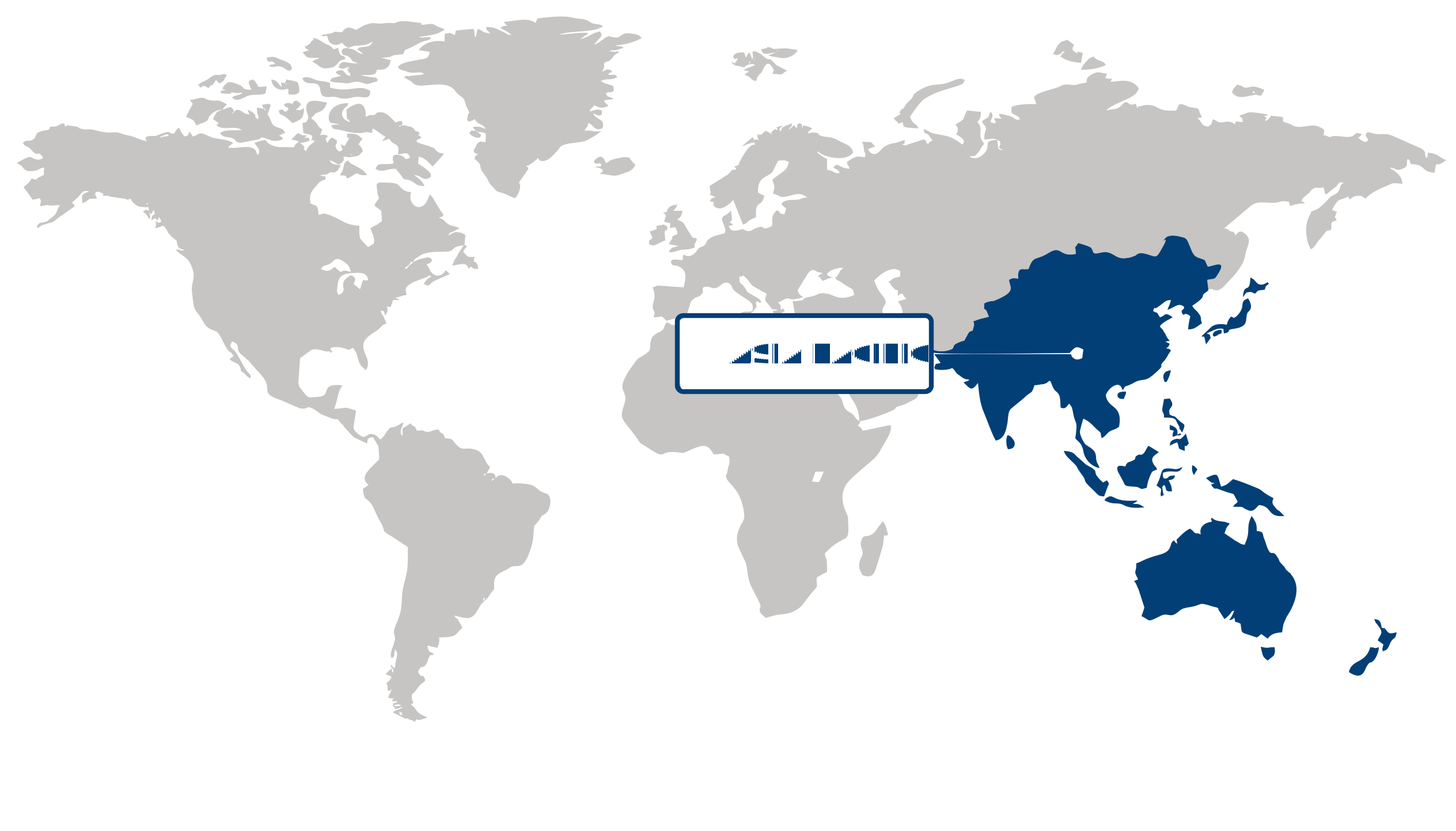
Asia Pacific dominated the wavelength division multiplexer market in 2025, capturing approximately 47% of the global share and exhibiting the fastest growth with a 12% CAGR. This region’s leadership stems primarily from rapid fiber optic network deployment and expansive cloud datacenter construction, driven by escalating digital consumption and enterprise digitization. For instance, China’s Ministry of Industry and Information Technology reported aggressive fiber-to-the-home (FTTH) expansion to enhance broadband quality nationwide. Concurrently, Amazon Web Services and Alibaba announced major datacenter investments in the region, underscoring intensifying demand for high-capacity, low-latency optical solutions. Such dynamics reflect substantial shifts in data traffic patterns and infrastructure investment strategies, reinforced by government initiatives promoting smart cities and 5G expansion. The convergence of robust infrastructure development, technological adoption, and favorable policy frameworks positions Asia Pacific as a fertile ground for sustained wavelength division multiplexer market growth, attracting diversified stakeholder interest.
Japan functions as a vital hub in the Asia Pacific wavelength division multiplexer market, characterized by its advanced telecommunication networks and stringent quality standards. The country’s focus on upgrading legacy infrastructure alongside government endorsement of 5G and IoT applications, as highlighted in the Ministry of Internal Affairs and Communications’ policy releases, accelerates demand for sophisticated multiplexing technology. Corporate players like Nippon Telegraph and Telephone (NTT) are actively innovating to meet soaring data throughput needs in urban and industrial sectors. This environment fosters competitive innovation while enhancing resilience in optical transmission capabilities. Japan’s integration of cutting-edge technology with strategic infrastructure renewal amplifies regional market prospects, underpinning Asia Pacific’s broader leadership in optical networking solutions.
China anchors the Asia Pacific wavelength division multiplexer market through extensive fiber optic expansion and cloud ecosystem development, both pivotal to regional growth. Regulatory incentives from the National Development and Reform Commission promote broad infrastructure upgrades, while major cloud providers including Tencent Cloud and Huawei Cloud scale datacenter megaplexes across key urban centers. These developments catalyze demand for wavelength division multiplexers to manage burgeoning data transmission volumes with efficiency. Additionally, the competitive landscape encourages local OEMs to invest in R&D for enhanced multiplexing performance aligned with continental connectivity ambitions. China’s prolific infrastructural advancement and technological push not only bolster its domestic market but also feed into Asia Pacific’s dominant position in global wavelength division multiplexer uptake.
North America Market Analysis:
North America held a commanding share in the wavelength division multiplexer market, driven by its established telecommunications infrastructure and continuous advancement in optical communication technologies. The region benefits from high investments in 5G rollout and fiber optic network expansions, supported by both private enterprise and government initiatives like the National Broadband Plan by the Federal Communications Commission (FCC). This has intensified demand for wavelength division multiplexers, optimizing bandwidth in existing fiber networks to meet rising data consumption and enterprise cloud services. Furthermore, North America’s focus on sustainability through energy-efficient network equipment aligns closely with market preferences, encouraging adoption of advanced multiplexing solutions. The presence of leading technology innovators such as Cisco Systems and Ciena Corporation fosters competitive product development and operational advancements, solidifying North America’s position. Going forward, the region’s digital transformation efforts and resilient economic environment continue to present lucrative opportunities for wavelength division multiplexer providers.
The U.S. plays a pivotal role in North America’s wavelength division multiplexer market, underpinned by aggressive 5G infrastructure deployment and federal funding to bridge connectivity gaps in rural areas. U.S. telecom operators, including Verizon and AT&T, are increasingly integrating wavelength division multiplexers to enhance network capacity and reduce latency amid surging mobile data traffic. Regulatory frameworks from the FCC encouraging spectrum allocation and infrastructure sharing further incentivize innovation and deployment efficiency. Additionally, U.S. companies lead in optical research and development, exemplified by Corning Incorporated’s recent advancements in fiber optic components, accelerating market growth. This strong domestic ecosystem amplifies North America’s overall market leadership, making the U.S. a strategic cornerstone for wavelength division multiplexer expansion.
Europe Market Trends:
Europe maintained a notable presence in the wavelength division multiplexer market, driven by its robust digital infrastructure and a growing commitment to advancing high-speed optical communication networks. The region’s steady digital transformation initiatives, supported by European Union policies promoting connectivity and sustainable technology, have bolstered demand for efficient bandwidth management solutions. Companies such as Nokia and ADVA Optical Networking, headquartered in Europe, are accelerating innovation in multiplexing technology, enhancing operational efficiencies and scalability for telecom providers. Meanwhile, stringent regulatory frameworks on data privacy and network security are influencing market dynamics, prioritizing solutions that offer reliable, secure optical transmission. This regulatory rigor, combined with a well-established supply chain ecosystem and skilled workforce, underscores Europe's capacity to adapt to evolving technological demands. Given these factors, Europe is positioned to capitalize on the increasing need for next-generation communication infrastructure, offering substantial growth opportunities in the wavelength division multiplexer market.
Germany holds a pivotal role in Europe’s wavelength division multiplexer market, propelled by its advanced industrial base and commitment to Industry 4.0 applications, which emphasize high-speed, reliable data transmission. German telecommunications providers, supported by federal initiatives like the Gigabit Strategy, are actively upgrading network capacities, driving demand for multi-channel optical solutions. Companies such as Deutsche Telekom are investing heavily in dense wavelength division multiplexing (DWDM) technologies to enhance network flexibility and performance, as evidenced by recent deployments cited in Deutsche Telekom’s corporate releases. Germany’s emphasis on innovation and precision engineering strengthens its market position by facilitating the integration of cutting-edge components that meet stringent quality demands. Strategically, Germany’s leadership in technological adoption enhances Europe's overall market potential, reinforcing the region’s appeal for investors targeting wavelength division multiplexer advancements.
France represents a key contributor within Europe’s wavelength division multiplexer market, with its aggressive rollout of fiber optic networks and increasing focus on 5G infrastructure catalyzing demand for advanced multiplexing technologies. Regulatory support from the French Autorité de régulation des communications électroniques et des postes (ARCEP) for expanding ultra-fast broadband access has created a conducive environment for suppliers to innovate. Major operators like Orange are deploying wavelength division multiplexers to optimize network traffic and improve service resilience, as highlighted in Orange’s recent strategic communications. Cultural emphasis on digital inclusivity drives consumer demand for enhanced connectivity, encouraging telecom firms to prioritize capacity and scalability. France’s dynamic market trajectory complements the broader European landscape by fostering competitive innovation and adoption, positioning the region as a robust growth frontier for wavelength division multiplexer solutions.
| Parameter | North America | Asia Pacific | Europe | Latin America | MEA |
|---|---|---|---|---|---|
| Innovation Hub i Scale Nascent Developing Advanced | |||||
| Cost-Sensitive Region i Scale Low Medium High | |||||
| Regulatory Environment i Scale Restrictive Neutral Supportive | |||||
| Demand Drivers i Scale Weak Moderate Strong | |||||
| Development Stage i Scale Emerging Developing Developed | |||||
| Adoption Rate i Scale Low Medium High | |||||
| New Entrants / Startups i Scale Sparse Moderate Dense | |||||
| Macro Indicators i Scale Weak Stable Strong |
Segment Leadership and Growth Trends
Wavelength Division Multiplexer Market Share (%), by Multiplexer Type, 2026
Go beyond the chart, access full insights & data tables
Request Free Sample ReportDense Wavelength Division Multiplexer (DWDM) held the largest share in the wavelength division multiplexer market in 2025, driven primarily by the rising demand for high-capacity, long-haul fiber-optic transmission systems. DWDM’s ability to efficiently multiplex numerous data streams over vast distances aligns with telecommunications providers’ push for robust and scalable infrastructure to support growing bandwidth needs. According to Ciena Corporation, advancements in DWDM technology have enabled greater channel density and enhanced signal integrity, addressing supply chain challenges related to raw materials while meeting stringent industry standards. This leadership position offers strategic advantages for both established vendors and emerging players focusing on next-generation network solutions. The segment's continued relevance is underpinned by ongoing digital transformation trends and global connectivity initiatives that necessitate reliable, high-throughput optical transmission capabilities.
Analysis by Verticals
The IT & Telecommunication segment represented the largest share in the wavelength division multiplexer market in 2025, bolstered by the exponential growth in global data traffic and the critical need for scalable backbone networks. Telecommunications operators and internet service providers have intensified investments in dense and metro networks to accommodate evolving customer demands for faster, more resilient connectivity, as highlighted by Verizon Communications’ recent network expansion announcements. This segment’s dominance reflects a preference for futuristic infrastructure capable of adapting to dynamic usage patterns and regulatory frameworks emphasizing data privacy and network security. Opportunities abound for incumbents and startups leveraging wavelength division multiplexing solutions to capture enterprise and consumer segments. Given sustained digital consumption growth and 5G rollout ambitions, the IT & Telecommunication segment is poised to maintain its market leadership in the near to medium term.
| Segment | Sub-Segment | Largest Segment | Fastest Growing |
|---|---|---|---|
| Multiplexer Type | Coarse Wavelength Division Multiplexer (CWDM), Dense Wavelength Division Multiplexer (DWDM) | ||
| Verticals | IT & Telecommunication, Healthcare, Manufacturing, Financial Services, Others |
Competitive Landscape and Market Positioning
The competitive dynamics in the wavelength division multiplexer market are marked by continuous refinement of product lines and alignment with evolving optical communication standards. Leading firms actively pursue synergies through selective business integrations and collaborative ventures, enhancing their technological breadth and market reach. Innovation is further driven by substantial investment in next-generation multiplexing techniques and photonic integration, allowing companies like ADVA Optical Networking and NeoPhotonics to reinforce their competitive edge. Simultaneously, the expansion of cloud infrastructure and 5G networks has prompted rapid adaptation of solutions aimed at improved bandwidth management, underscoring the sector’s emphasis on agility and continuous advancement.
Strategic / Actionable Recommendations for Regional Players
In North America, capitalizing on partnerships with hyperscale data center operators and integrating emerging silicon photonics could enhance value propositions. Emphasizing modular, scalable multiplexing solutions may address the diverse demands of telecom and enterprise customers seeking network densification.
Asia Pacific participants should deepen collaboration across supply chains while harnessing advances in AI-driven network management to unlock efficiencies. Targeting high-growth segments like metro and access networks through customized multiplexing technologies can solidify presence amid rising digital infrastructure investments.
European companies may benefit from intensifying innovation through cross-border alliances focused on sustainability and energy-efficient optical components. Prioritizing interoperability and compliance with stringent regional standards will support adoption in critical sectors such as finance and industry 4.0 networking applications.
| Company | Market Share | Company Revenue | Revenue CAGR (%) | Product Portfolio | Geographic Presence | Innovation / R&D Focus | Strategic Developments |
|---|---|---|---|---|---|---|---|
| No companies available. | |||||||
Industry Development/News
| Company Name | Date | Key Development |
|---|
Customize Your Report
Explore examples of how this report can be tailored to different research needs, including custom segments, additional topics or chapters, and related reports. Click a section of the wheel or its numbered marker to explore the available options.
Wavelength Division Multiplexer Market — Custom Segments
| Segment | Sub-Segment |
|---|---|
| No segment data available. | |
Wavelength Division Multiplexer Market — Custom TOC
| Custom Chapter | Custom Details | ||
|---|---|---|---|
| No custom TOC data available. | |||
Need a different cut of the data?
Request Custom ResearchHow is the wavelength division multiplexer industry expected to grow over the next 10 years?
In which region is the wavelength division multiplexer market share the greatest?
Which area is showing the greatest surge in wavelength division multiplexer sector?
Why is the dense wavelength division multiplexer (DWDM) segment leading in the wavelength division multiplexer industry?
Why does IT & telecommunication sub-segment dominate the verticals segment of wavelength division multiplexer sector?
Who holds a significant market share in the wavelength division multiplexer landscape?
Our Clients
"Working with FBI has been a good experience. The market report provided a holistic view, covering everything from emerging trends to potential risks."
Semtech Corporation
"The experience was highly positive. The team showcased remarkable flexibility in adapting to our specific needs and delivered report that perfectly aligned with all our requirements."
TSMC
"What really stood out to me was how clearly and promptly the Fundamental Business Insights team communicated throughout. It made the collaboration feel effortless."
NXP Semiconductors
Our Research Team & Methodology
Every Fundamental Business Insights report is built by a dedicated vertical research team, validated through a structured primary-and-secondary methodology, and reviewed for accuracy before it reaches you.
Research Team Overview
Prepared by the Electronics & Semiconductors Research Team
Delivery
Published
Demand
Available
Support
Trust & Compliance
Research Domains
10 coverage areasResearch Intelligence
| Source | Reference |
|---|---|
| Semiconductor Industry Association (SIA) | www.semiconductors.org |
| SEMI | www.semi.org |
| JEDEC Solid State Technology Association | www.jedec.org |
| IEEE | www.ieee.org |
| IPC – Association Connecting Electronics Industries | www.ipc.org |
| International Electrotechnical Commission (IEC) | www.iec.ch |
| International Organization for Standardization (ISO) | www.iso.org |
| U.S. Bureau of Industry and Security (BIS) | www.bis.gov |
| U.S. Patent and Trademark Office (USPTO) | www.uspto.gov |
| European Patent Office (EPO) | www.epo.org |
| Taiwan Semiconductor Industry Association (TSIA) | www.tsia.org.tw |
| World Semiconductor Trade Statistics (WSTS) | www.wsts.org |
| International Energy Agency (IEA) | www.iea.org |
| GSMA | www.gsma.com |
| 3GPP | www.3gpp.org |
| ITU (International Telecommunication Union) | www.itu.int |
| Omdia (public insights) | omdia.tech.informa.com |
| Display Supply Chain Consultants (DSCC) | www.displaysupplychain.com |
| U.S. Department of Energy (DOE) | www.energy.gov |
| NIST (National Institute of Standards and Technology) | www.nist.gov |
Research Workflow & Quality Assurance
Data Collection
Verified information gathered through primary and secondary research.
Data Triangulation
Cross-validation using multiple independent data sources.
Forecast Modelling
Market estimates developed using historical trends and analytical models.
Analyst Validation
Findings reviewed by domain experts for accuracy and consistency.
Editorial & Quality Review
Final editorial, quality, and compliance checks before publication.
Final Publication
Released after successful completion of the internal review process.
Report Coverage
📊 Market Assessment
- Market Size & Forecast
- Market Segmentation
- Regional Analysis
- Growth Drivers & Challenges
- Market Dynamics
🏢 Competitive Intelligence
- Competitive Landscape
- Company Profiles
- Competitive Benchmarking
- Mergers & Acquisitions
- Market Share Analysis or Key Company Strategies
🔍 Strategic Analysis
- Value Chain Analysis
- Porter's Five Forces
- PESTLE Analysis
- Pricing Trends
- Supply-Demand Analysis
🚀 Future Outlook
- Technology Landscape
- Regulatory Landscape
- Investment & Funding Landscape
- Emerging Opportunities
- Future Market Outlook
Have a question about this report or need a custom scope?
Request Customization