Water-Tube Food Processing Boiler Market Size & Growth Forecast 2027–2036, By Segments (Technology, Capacity, Fuel), Regional Demand Trends (North America, Asia Pacific, Europe), Key Country Insights (U.S., Japan, South Korea, Germany, France, Italy), and Competitive Landscape
Market Size and Growth Outlook
Water-Tube Food Processing Boiler Market size was around USD 899.3 Million in 2026 and is slated to grow at 4.1% CAGR from 2027 to 2036, exceeding USD 1.34 Billion by 2036. The industry revenue for 2027 is calculated at USD 930.06 Million.
Get more details on this report
Request Free Sample ReportWater-Tube Food Processing Boiler Market Intelligence Snapshot
Regional Market Dynamics
- Asia Pacific led in 2026, driven by expanding food and beverage manufacturing, processed food consumption, and development of large-scale food processing infrastructure.
- Urbanization, expanding production capabilities, and investments in energy-efficient, lower-emission boiler technologies are strengthening demand across emerging economies.
Segment Momentum
- The 175–250 MMBtu/hr segment led the market in 2026 because it supports continuous, high-volume steam generation for large-scale food processing operations, including sterilization, cooking, drying, and cleaning.
- The 10–25 MMBtu/hr segment is expanding rapidly as small and medium-sized food processors invest in efficient steam systems that improve operational flexibility, energy optimization, and regional production capacity.
Market Expansion Drivers
- Food safety compliance requirements driving adoption of advanced industrial boiler systems
- Expanding processed food consumption increasing demand for high-capacity food processing boilers
- Globalized food supply chains requiring standardized and efficient thermal processing systems
Leading Market Participants
- Top companies in the water-tube food processing boiler market include Alfa Laval AB (Sweden), Babcock & Wilcox Enterprises, Inc. (United States), Cleaver-Brooks, Inc. (United States), Thermax Limited (India), Bosch Thermotechnology (Germany), Viessmann Group (Germany), Fulton Companies (United States), Forbes Marshall Pvt. Ltd. (India), Miura Co., Ltd. (Japan), Babcock Wanson (France)
Global Market Forecast Snapshot
Market Outlook
- 2026 Market Size: USD 899.3 Million
- 2027 Estimated Market Size: USD 930.06 Million
- Projected Market Size: USD 1.34 Billion by 2036
- Growth Forecast: 4.1% CAGR (2027-2036)
Regional and Segment Outlook
- Leading Regional Market: Asia Pacific
- High-Growth Regional Hub: Asia Pacific
- Core Revenue Segment: Non-condensing (Technology) | 175 - 250 MMBtu/hr (Capacity) | Natural Gas (Fuel)
- Emerging Opportunity Segment: Condensing (Technology) | 10 - 25 MMBtu/hr (Capacity) | Natural Gas (Fuel)
Market Growth Drivers and Industry Trends
Food safety compliance requirements driving adoption of advanced industrial boiler systems
Stringent food safety regulations are encouraging manufacturers to modernize thermal processing infrastructure, and the water-tube food processing boiler market is benefiting from this shift as processors invest in equipment capable of delivering consistent steam quality and precise temperature control. Reliable boiler performance helps maintain hygienic production conditions across cooking, sterilization, cleaning, and pasteurization processes while reducing the risk of contamination associated with inconsistent heat delivery. Advanced industrial boiler systems also support better process monitoring, automated controls, and improved operational traceability, enabling food manufacturers to align production practices with evolving compliance requirements across domestic and international markets.
Expanding processed food consumption increasing demand for high-capacity food processing boilers
As consumer demand for packaged, ready-to-eat, frozen, and convenience foods continues to expand, manufacturers are increasing production capacity to handle larger processing volumes, which will drive the water-tube food processing boiler market growth. High-capacity boilers play a critical role in supplying uninterrupted steam for multiple production lines operating simultaneously, allowing facilities to maintain productivity while meeting strict quality standards. Water-tube configurations are particularly suitable for intensive food manufacturing environments because they can accommodate high-pressure operations, respond rapidly to changing production loads, and support continuous manufacturing schedules without compromising processing efficiency.
Globalized food supply chains requiring standardized and efficient thermal processing systems
Growing participation in international food trade has increased the need for standardized production processes that deliver consistent product quality across manufacturing locations, creating favorable conditions for the water-tube food processing boiler market. Food processors supplying multiple regions require dependable thermal systems capable of maintaining uniform processing parameters regardless of production scale or facility location. Efficient steam generation also supports standardized sanitation procedures, minimizes production variability, and enables manufacturers to satisfy diverse regulatory expectations while managing complex supply chains that depend on predictable and repeatable processing operations.
| Growth Driver | Impact on CAGR | Regulatory Influence | Geographic Relevance | Adoption Rate | Impact Timeline |
|---|---|---|---|---|---|
| Food safety compliance requirements driving adoption of advanced industrial boiler systems | 2% | High | Europe, North America | High | Near Term |
| Expanding processed food consumption increasing demand for high-capacity food processing boilers | 1.8% | Moderate | Asia Pacific, North America | High | Near Term |
| Globalized food supply chains requiring standardized and efficient thermal processing systems | 1.5% | Moderate | Europe, Asia Pacific | Medium | Mid Term |
Unlock insights tailored to your business with our bespoke market research solutions.
Click to get your customized report now.
Regional Demand Dynamics
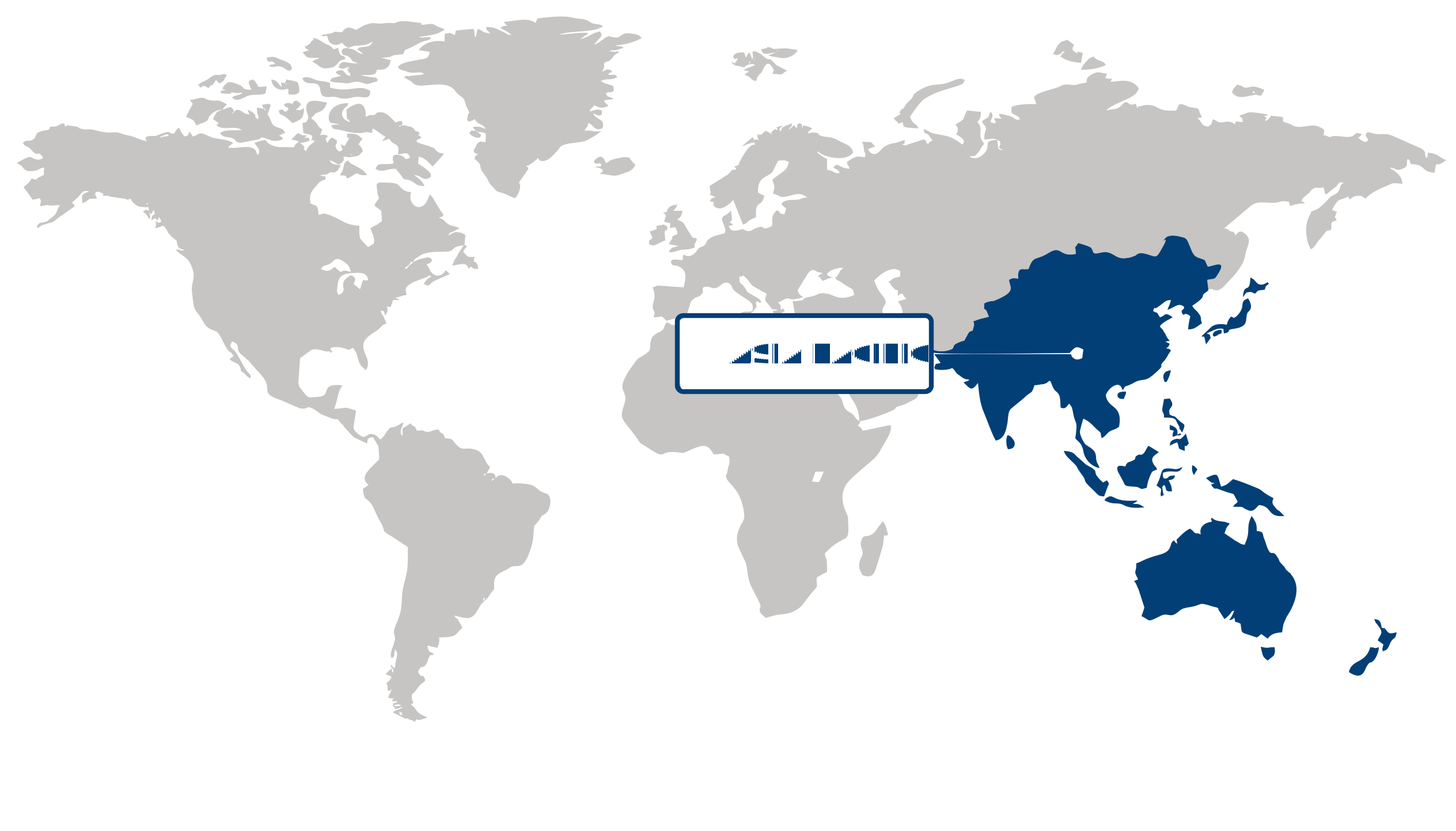
Asia Pacific (Largest & Fastest-Growing Region)
The Asia Pacific region accounted for the largest position in the water-tube food processing boiler market in 2026 and is anticipated to register the fastest growth during the forecast period. Expansion of food and beverage manufacturing, increasing consumption of processed foods, and rapid development of food processing infrastructure are driving demand for dependable steam-generation systems. Water-tube boilers are well suited to larger processing facilities that require consistent thermal energy for cooking, sterilization, drying, and other production activities. Rising urbanization and changing dietary preferences are encouraging food manufacturers to expand production capabilities, while growing attention to energy efficiency and emissions management is supporting investments in modern boiler technologies. Continued industrialization across emerging economies is expected to further strengthen regional demand.
| Parameter | North America | Asia Pacific | Europe | Latin America | MEA |
|---|---|---|---|---|---|
| Innovation Hub i Scale Nascent Developing Advanced | |||||
| Cost-Sensitive Region i Scale Low Medium High | |||||
| Regulatory Environment i Scale Restrictive Neutral Supportive | |||||
| Demand Drivers i Scale Weak Moderate Strong | |||||
| Development Stage i Scale Emerging Developing Developed | |||||
| Adoption Rate i Scale Low Medium High | |||||
| New Entrants / Startups i Scale Sparse Moderate Dense | |||||
| Macro Indicators i Scale Weak Stable Strong |
Key Country Insights
United States 🇺🇸
High-Capacity Steam SolutionsThe U.S. food industry increasingly adopts water-tube boilers for large-scale steam generation in processing facilities. Operators prioritize efficient fuel utilization, automated controls, and dependable performance that supports continuous production and food safety standards.
Germany 🇩🇪
Precision Thermal OperationsGermany favors water-tube food processing boilers that deliver consistent steam output for highly automated food manufacturing plants. Investment focuses on efficient combustion, digital monitoring, and compliance with demanding operational and environmental requirements.
Japan 🇯🇵
Compact Process EfficiencyJapan emphasizes compact water-tube food processing boilers that maximize thermal efficiency within space-constrained manufacturing facilities. Food processors value advanced control systems that ensure stable steam generation while reducing energy consumption and maintenance needs.
South Korea 🇰🇷
Automated Processing SupportSouth Korea integrates water-tube food processing boilers into modern food production facilities emphasizing automation and operational efficiency. Manufacturers increasingly seek equipment with intelligent monitoring capabilities and reliable steam delivery for high-throughput processing lines.
France 🇫🇷
Food Quality ReliabilityFrance prioritizes water-tube food processing boilers that maintain consistent steam quality across dairy, beverage, and packaged food production. Buyers focus on energy-efficient equipment that supports regulatory compliance and uninterrupted manufacturing operations.
Italy 🇮🇹
Flexible Food ManufacturingItaly adopts water-tube food processing boilers that accommodate diverse food production requirements while improving thermal efficiency. Processors favor adaptable boiler systems that simplify maintenance and enhance reliability across both established and modernized facilities.
Segment Leadership and Growth Trends
Water-Tube Food Processing Boiler Market Share (%), by Technology, 2026
Go beyond the chart, access full insights & data tables
Request Free Sample ReportTechnology Segment Analysis: Non-condensing (Largest Segment) vs Condensing (Fastest-Growing Segment)
The water-tube food processing boiler market was led by the non-condensing technology segment in 2026, supported by its widespread installation across existing food processing facilities and its proven operational reliability under demanding industrial conditions. These systems remain a preferred choice for many manufacturers because they are well suited for continuous steam generation, are compatible with established production infrastructure, and require relatively straightforward maintenance. Their broad acceptance across diverse food manufacturing processes has sustained their leading market position.
The condensing technology segment is expected to register the fastest growth as food processors increasingly prioritize energy efficiency, lower fuel consumption, and reduced emissions. The ability of condensing boilers to recover waste heat and improve overall thermal performance aligns with growing sustainability initiatives and the industry's focus on optimizing operating costs. Continued modernization of food processing facilities is expected to accelerate adoption of this technology.
Capacity Segment Analysis: 175 - 250 MMBtu/hr (Largest Segment) vs 10 - 25 MMBtu/hr (Fastest-Growing Segment)
The 175–250 MMBtu/hr capacity segment held the largest share in 2026, reflecting strong demand from large-scale food processing plants that require continuous, high-volume steam generation. These boilers support intensive production operations while maintaining process consistency across applications such as sterilization, cooking, drying, and cleaning. Their ability to meet substantial steam requirements efficiently makes them a preferred choice for high-capacity manufacturing facilities.
The 10–25 MMBtu/hr capacity segment is anticipated to witness the fastest growth as small and medium-sized food processing facilities increasingly invest in efficient steam generation systems that match their production requirements. Growing expansion of regional food manufacturing operations, combined with increasing emphasis on operational flexibility and energy optimization, is encouraging wider adoption of medium-capacity boiler installations.
Fuel Segment Analysis: Natural Gas (Largest & Fastest-Growing Segment)
The natural gas fuel segment dominated the water-tube food processing boiler market while also remaining the fastest-growing segment in 2026. Its strong position is driven by cleaner combustion characteristics, high thermal efficiency, and dependable fuel availability, making it well suited for food processing operations that require consistent steam production and strict environmental compliance. Food manufacturers are increasingly adopting natural gas-fired boilers to improve energy performance, reduce operational emissions, and support sustainability objectives while maintaining reliable production across a wide range of processing applications.
| Segment | Sub-Segment | Largest Segment | Fastest Growing |
|---|---|---|---|
| Technology | Condensing, Non-condensing | Non-condensing | Condensing |
| Capacity | < 10 MMBtu/hr, 10 - 25 MMBtu/hr, 25 - 50 MMBtu/hr, 50 - 75 MMBtu/hr, 75 - 100 MMBtu/hr, 100 - 175 MMBtu/hr, 175 - 250 MMBtu/hr, > 250 MMBtu/hr | 175 - 250 MMBtu/hr | 10 - 25 MMBtu/hr |
| Fuel | Natural Gas, Oil, Coal, Others | Natural Gas | Natural Gas |
Competitive Landscape and Market Positioning
Major players in the water-tube food processing boiler market:
- Alfa Laval AB (Sweden)
- Babcock & Wilcox Enterprises, Inc. (United States)
- Cleaver-Brooks, Inc. (United States)
- Thermax Limited (India)
- Bosch Thermotechnology (Germany)
- Viessmann Group (Germany)
- Fulton Companies (United States)
- Forbes Marshall Pvt. Ltd. (India)
- Miura Co., Ltd. (Japan)
- Babcock Wanson (France)
Evolving processing standards within the food industry are driving manufacturers of water-tube boilers to compete through operational efficiency, safety, and integration with modern production facilities. Rather than emphasizing equipment capacity alone, suppliers are developing systems that support improved thermal control, lower emissions, and easier maintenance while accommodating increasingly automated manufacturing environments. The ability to deliver reliable performance under continuous production schedules has become a significant differentiator, prompting ongoing refinement of boiler design, monitoring capabilities, and service support. As food processors seek greater resource efficiency and compliance with stringent operational standards, competition increasingly revolves around delivering dependable, application-specific heating solutions that align with changing manufacturing practices.
| Company | Market Share | Company Revenue | Revenue CAGR (%) | Product Portfolio | Geographic Presence | Innovation / R&D Focus | Strategic Developments |
|---|---|---|---|---|---|---|---|
| Alfa Laval AB (Sweden) | |||||||
| Babcock & Wilcox Enterprises Inc. (United States) | |||||||
| Cleaver-Brooks Inc. (United States) | |||||||
| Thermax Limited (India) | |||||||
| Bosch Thermotechnology (Germany) | |||||||
| Viessmann Group (Germany) | |||||||
| Fulton Companies (United States) | |||||||
| Forbes Marshall Pvt. Ltd. (India) | |||||||
| Miura Co. Ltd. (Japan) | |||||||
| Babcock Wanson (France) |
Industry Development/News
| Company Name | Date | Key Development |
|---|
Customize Your Report
Explore examples of how this report can be tailored to different research needs, including custom segments, additional topics or chapters, and related reports. Click a section of the wheel or its numbered marker to explore the available options.
Water-Tube Food Processing Boiler Market — Custom Segments
| Segment | Sub-Segment |
|---|---|
| Steam Application | Process Heating, Cooking & Blanching, Sterilization & Pasteurization, Drying & Evaporation, Cleaning & Sanitation |
| Installation Type | New-Build Installations, Replacement Installations, Retrofit Installations, Expansion Installations |
| Automation Level | Manual Systems, Semi-Automated Systems, Fully Automated Systems |
Water-Tube Food Processing Boiler Market — Custom TOC
| Custom Chapter | Custom Details |
|---|---|
| Food Industry Boiler Replacement & Modernization Roadmap |
|
| Process Steam Cost Optimization |
|
| Food Processing Heat Decarbonization Pathways |
|
Need a different cut of the data?
Request Custom ResearchHow large is the water-tube food processing boiler market?
What is the anticipated CAGR of the water-tube food processing boiler industry?
How are food safety compliance requirements influencing investment in water-tube food processing boilers?
Why is processed food production accelerating demand for high-capacity water-tube boilers?
Why does the 175–250 MMBtu/hr capacity segment lead the water-tube food processing boiler market?
Why is the 10–25 MMBtu/hr capacity segment growing the fastest?
Why does Asia Pacific hold the leading position in the water-tube food processing boiler market?
How is Asia Pacific supporting future growth of water-tube food processing boilers?
Who holds a significant market share in the water-tube food processing boiler landscape?
Our Clients
"The report provided a thorough look at market trends, technological advancements, and the competitive landscape. The depth of insights was really valuable."
ITC Limited
"We would highly recommend Fundamental Business Insights & Consulting to anyone looking for reliable, detailed, and comprehensive market research in the Food industry."
Tyson Foods
"The clarity and presentation of the information were commendable. The report was delivered timely, which made the overall experience smooth and convenient."
Mondelēz International
Our Research Team & Methodology
Every Fundamental Business Insights report is built by a dedicated vertical research team, validated through a structured primary-and-secondary methodology, and reviewed for accuracy before it reaches you.
Research Team Overview
Prepared by the Food & Beverage Research Team
Delivery
Published
Demand
Available
Support
Trust & Compliance
Research Domains
10 coverage areasResearch Intelligence
| Source | Reference |
|---|---|
| Food and Agriculture Organization (FAO) | www.fao.org |
| World Health Organization (WHO) | www.who.int |
| U.S. Food & Drug Administration (FDA) | www.fda.gov |
| European Food Safety Authority (EFSA) | www.efsa.europa.eu |
| U.S. Department of Agriculture (USDA) | www.usda.gov |
| Codex Alimentarius Commission | www.fao.org/fao-who-codexalimentarius |
| International Organization for Standardization (ISO) | www.iso.org |
| AOAC INTERNATIONAL | www.aoac.org |
| Institute of Food Technologists (IFT) | www.ift.org |
| International Dairy Foods Association (IDFA) | www.idfa.org |
| International Sweeteners Association (ISA) | www.sweeteners.org |
| International Probiotics Association (IPA) | internationalprobiotics.org |
| Good Food Institute (GFI) | gfi.org |
| American Feed Industry Association (AFIA) | www.afia.org |
| International Feed Industry Federation (IFIF) | ifif.org |
| Specialty Food Association (SFA) | www.specialtyfood.com |
| Brewers Association | www.brewersassociation.org |
| International Bottled Water Association (IBWA) | bottledwater.org |
| International Alliance for Dietary/Food Supplement Associations (IADSA) | www.iadsa.org |
| OECD Agriculture & Food | www.oecd.org/agriculture |
Research Workflow & Quality Assurance
Data Collection
Verified information gathered through primary and secondary research.
Data Triangulation
Cross-validation using multiple independent data sources.
Forecast Modelling
Market estimates developed using historical trends and analytical models.
Analyst Validation
Findings reviewed by domain experts for accuracy and consistency.
Editorial & Quality Review
Final editorial, quality, and compliance checks before publication.
Final Publication
Released after successful completion of the internal review process.
Report Coverage
📊 Market Assessment
- Market Size & Forecast
- Market Segmentation
- Regional Analysis
- Growth Drivers & Challenges
- Market Dynamics
🏢 Competitive Intelligence
- Competitive Landscape
- Company Profiles
- Competitive Benchmarking
- Mergers & Acquisitions
- Market Share Analysis or Key Company Strategies
🔍 Strategic Analysis
- Value Chain Analysis
- Porter's Five Forces
- PESTLE Analysis
- Pricing Trends
- Supply-Demand Analysis
🚀 Future Outlook
- Technology Landscape
- Regulatory Landscape
- Investment & Funding Landscape
- Emerging Opportunities
- Future Market Outlook
Have a question about this report or need a custom scope?
Request Customization