Warehouse Conveying Equipment Market Size & Growth Forecast 2027–2036, By Segments (Product, Application, End Use, Type), Regional Demand Trends (North America, Asia Pacific, Europe), Key Country Insights (U.S., Japan, South Korea, Germany, France, Italy), and Competitive Landscape
Market Size and Growth Outlook
Warehouse Conveying Equipment Market size was around USD 16.7 billion in 2026 and is slated to grow at a 4.28% CAGR from 2027 to 2036, surpassing USD 25.39 billion by 2036. The industry revenue for 2027 is assessed at USD 17.3 billion.
Get more details on this report
Request Free Sample ReportWarehouse Conveying Equipment Market Intelligence Snapshot
Regional Market Dynamics
- Asia Pacific leads due to its dense manufacturing base, expanding warehouse construction, and sustained demand for conveyor systems that improve throughput across large distribution networks.
- The region is projected to grow at a 5.24% CAGR as logistics operators expand capacity, modernize warehouse layouts, and deploy conveyor systems to support faster, more efficient order fulfillment.
Segment Momentum
- Sorting held a 48.22% market share in 2026 because warehouses prioritize accurate, high-speed item routing to improve throughput, reduce manual handling, and support increasingly complex fulfillment operations.
- Asia Pacific is projected to grow at a 5.24% CAGR as expanding warehouse construction, logistics modernization, and higher throughput requirements increase demand for advanced conveying equipment.
Market Expansion Drivers
- Rapid expansion of e-commerce logistics driving automation in warehouse material handling systems.
- Increasing adoption of automated sorting and conveyor systems improving fulfillment efficiency.
- Rising integration of robotics and smart warehousing technologies enhancing supply chain productivity.
Leading Market Participants
- Top players in the warehouse conveying equipment market include Daifuku Co., Ltd. (Japan), BEUMER Group GmbH & Co. KG (Germany), Siemens AG (Germany), KION GROUP AG (Germany), TGW Logistics Group GmbH (Austria), Murata Machinery, Ltd. (Japan), Jungheinrich AG (Germany), Kardex Holding AG (Switzerland), KUKA AG (Germany), Fives Group (France).
Global Market Forecast Snapshot
Market Outlook
- 2026 Market Size: USD 16.7 billion
- 2027 Estimated Market Size: USD 17.3 billion.
- Projected Market Size: USD 25.39 billion by 2036
- Growth Forecast: 4.28% CAGR (2027-2036)
Regional and Segment Outlook
- Leading Regional Market: Asia Pacific
- High-Growth Regional Hub: Asia Pacific
- Core Revenue Segment: Unit Handling (Product) | Sorting (Application) | Logistics (End Use) | Belt (Type)
- Emerging Opportunity Segment: Unit Handling (Product) | Sorting (Application) | E-commerce (End Use) | Roller (Type)
Market Growth Drivers and Industry Trends
Rapid expansion of e-commerce logistics driving automation in warehouse material handling systems
The continued expansion of online retail is increasing pressure on fulfillment centers to process larger and more varied order volumes efficiently, creating a strong requirement for automated material movement solutions. This trend will drive the warehouse conveying equipment market as warehouses adopt conveyor systems to move cartons, totes, parcels, and other goods between receiving, storage, picking, packing, and dispatch areas. E-commerce operations also require faster order processing and greater flexibility because products must be handled in smaller batches with frequent changes in order composition. Conveying equipment can reduce unnecessary manual movement and establish more organized product flows, making automation increasingly important in high-throughput distribution environments.
Increasing adoption of automated sorting and conveyor systems improving fulfillment efficiency
Warehouses are increasingly deploying integrated conveyor and sorting systems to improve the speed and accuracy of order fulfillment while reducing bottlenecks between operational stages. For the warehouse conveying equipment market, automated sortation enables packages and inventory units to be directed toward specific picking, packing, storage, or shipping destinations with limited manual intervention. Conveyor networks can also connect multiple warehouse zones and maintain a continuous movement of goods, helping operators coordinate processes more effectively. The ability to combine conveying with barcode scanning, sensors, and automated sortation technologies supports better inventory flow and helps fulfillment facilities respond to demanding delivery schedules.
Rising integration of robotics and smart warehousing technologies enhancing supply chain productivity
The convergence of robotics, connected sensors, warehouse software, and automated material-handling equipment is transforming how distribution facilities manage inventory and internal logistics. In the warehouse conveying equipment market, conveyors increasingly operate as part of broader smart warehouse ecosystems in which robotic systems, automated storage and retrieval equipment, and digital control platforms coordinate the movement of goods. Real-time monitoring can provide visibility into equipment status and material flows, while intelligent controls can adjust operating sequences according to warehouse activity. Integration with robotic picking and mobile automation can further reduce manual handling requirements and create coordinated workflows across receiving, storage, order fulfillment, and dispatch operations.
| Growth Driver | Impact on CAGR | Regulatory Influence | Geographic Relevance | Adoption Rate | Impact Timeline |
|---|---|---|---|---|---|
| Rapid expansion of e-commerce logistics driving automation in warehouse material handling systems | 2.20% | Moderate | Asia Pacific, North America | High | Near Term |
| Increasing adoption of automated sorting and conveyor systems improving fulfillment efficiency | 1.80% | Moderate | North America, Europe, Asia Pacific | High | Near Term |
| Rising integration of robotics and smart warehousing technologies enhancing supply chain productivity | 1.50% | Moderate | Asia Pacific, Europe | Medium | Mid Term |
Unlock insights tailored to your business with our bespoke market research solutions.
Click to get your customized report now.
Regional Demand Dynamics
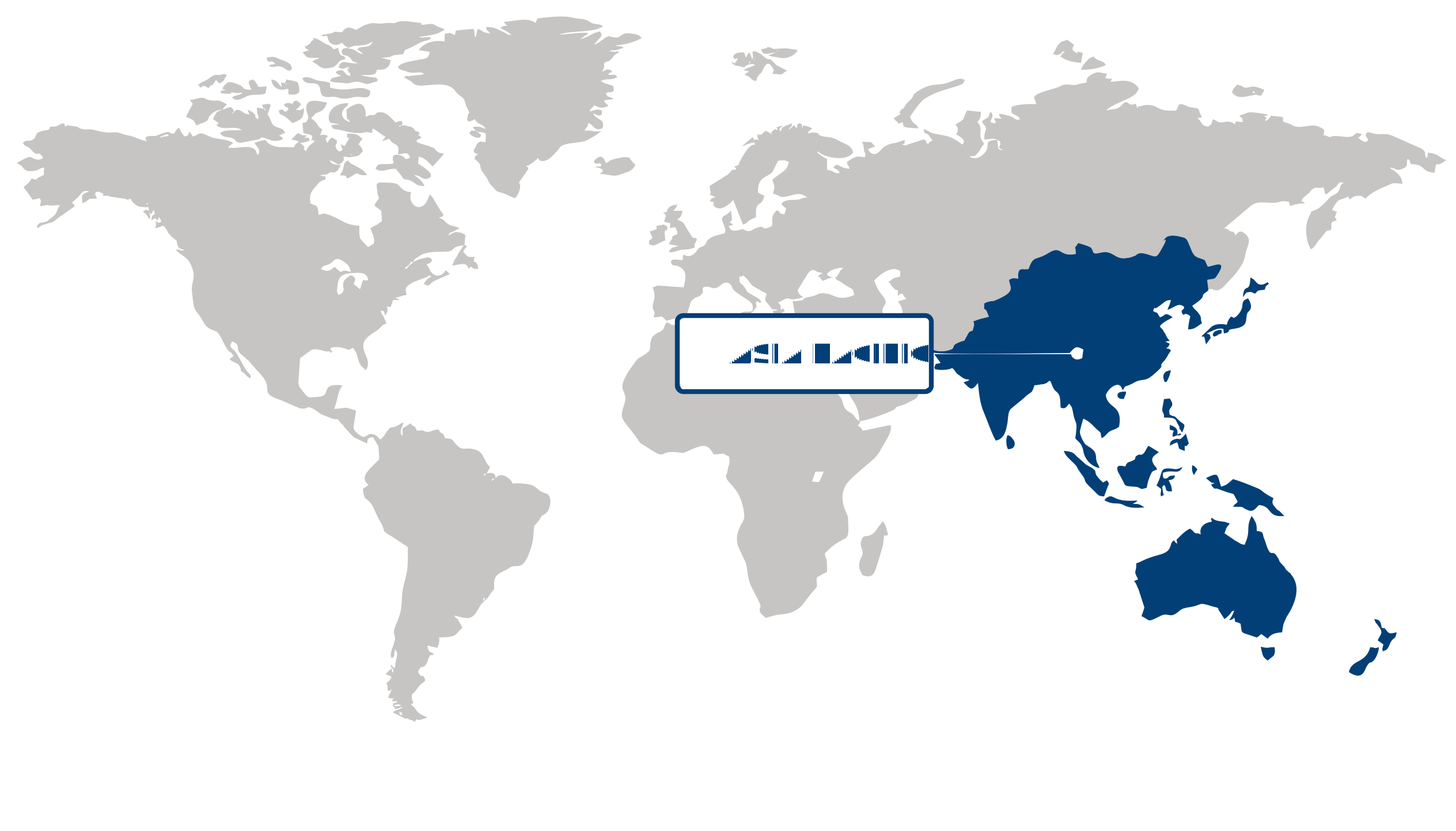
Asia Pacific (Largest & Fastest-Growing Region)
The Asia Pacific warehouse conveying equipment market held the largest share in 2026 and is also the fastest-growing regional market, reflecting rapid expansion of logistics infrastructure, manufacturing activity, and organized warehousing across the region. The growth of e-commerce and increasing requirements for faster order fulfillment are encouraging warehouses to adopt automated material-handling systems that improve throughput, space utilization, and operational efficiency. Rising investments in modern distribution facilities, together with the growing integration of automation and digital warehouse technologies, are strengthening demand for conveying equipment. Expanding industrial production and the modernization of supply-chain networks further support the region's leading position and growth momentum.
| Parameter | North America | Asia Pacific | Europe | Latin America | MEA |
|---|---|---|---|---|---|
| Innovation Hub i Scale Nascent Developing Advanced | |||||
| Cost-Sensitive Region i Scale Low Medium High | |||||
| Regulatory Environment i Scale Restrictive Neutral Supportive | |||||
| Demand Drivers i Scale Weak Moderate Strong | |||||
| Development Stage i Scale Emerging Developing Developed | |||||
| Adoption Rate i Scale Low Medium High | |||||
| New Entrants / Startups i Scale Sparse Moderate Dense | |||||
| Macro Indicators i Scale Weak Stable Strong |
Key Country Insights
Germany 🇩🇪
Precision Logistics SystemsGermany emphasizes highly engineered warehouse conveying equipment to support advanced manufacturing and distribution operations. German facilities increasingly integrate conveying solutions with robotics and digital monitoring to enhance operational efficiency and system reliability.
France 🇫🇷
Distribution Network ModernizationFrance is modernizing warehouse operations through greater adoption of automated conveying equipment across retail and third-party logistics. French operators prioritize adaptable systems capable of supporting evolving order fulfillment and inventory management processes.
Italy 🇮🇹
Flexible Material HandlingItaly emphasizes conveying equipment that supports diverse manufacturing and distribution activities across multiple industries. Companies in Italy favor modular warehouse systems that can be upgraded efficiently while improving handling accuracy and operational continuity.
Japan 🇯🇵
Space-Efficient AutomationJapan focuses on compact and highly automated warehouse conveying equipment suited to space-constrained logistics facilities. Businesses in Japan invest in flexible conveying technologies that improve productivity while accommodating diverse product handling requirements.
South Korea 🇰🇷
Smart Fulfillment ExpansionSouth Korea is expanding automated fulfillment infrastructure to meet growing e-commerce and industrial logistics needs. Warehouse operators in South Korea increasingly deploy intelligent conveying equipment with real-time monitoring and high-speed material handling capabilities.
United States 🇺🇸
Automation Upgrade PipelineThe U.S. warehouse conveying equipment market is shaped by automation investments across retail, logistics, and manufacturing distribution centers. Companies in the U.S. prioritize scalable conveyor systems that improve throughput while integrating with warehouse management technologies.
Segment Leadership and Growth Trends
Warehouse Conveying Equipment Market Share (%), by Product, 2026
Go beyond the chart, access full insights & data tables
Request Free Sample ReportProduct Segment Analysis: Unit Handling (Largest & Fastest-Growing Segment)
Unit handling dominated the warehouse conveying equipment market in 2026, accounting for a 45.89% share, while also emerging as the fastest-growing product segment. Its strong position is supported by the widespread need to move individual cartons, packages, totes, and other discrete loads efficiently across warehouse operations. Unit handling equipment enables reliable material movement between receiving, storage, picking, sorting, and dispatch areas, making it well suited to increasingly automated fulfillment environments. The expansion of e-commerce, higher expectations for order accuracy, and growing emphasis on streamlined warehouse workflows are strengthening demand for flexible conveying solutions. Integration with automated storage, picking, and material-handling systems further enhances the segment's relevance by enabling continuous and coordinated movement of goods throughout distribution facilities.
Application Segment Analysis: Sorting (Largest & Fastest-Growing Segment)
Sorting represented the largest share of the warehouse conveying equipment market in 2026 at 48.22% and is also the fastest-growing application segment. The segment benefits from the increasing complexity of warehouse fulfillment, where products must be rapidly directed to the appropriate storage, picking, packing, or dispatch locations. Automated sorting systems improve throughput, order accuracy, and operational consistency while reducing reliance on manual material handling. The continued expansion of e-commerce and omnichannel distribution is increasing the need to process diverse product flows efficiently, particularly in facilities handling frequent and time-sensitive orders. Greater adoption of warehouse automation, barcode and identification technologies, and integrated control systems is further positioning sorting as a critical application for modern distribution operations.
| Segment | Sub-Segment | Largest Segment | Fastest Growing |
|---|---|---|---|
| Product | Unit Handling, Bulk Handling, Parts & Attachments | Unit Handling | Unit Handling |
| Application | Sorting, Loading & Unloading, Distribution | Sorting | Sorting |
| End Use | E-commerce, Logistics, Industrial | Logistics | E-commerce |
| Type | Belt, Roller, Pallet, Overhead, Chain Conveyors, Others | Belt | Roller |
Competitive Landscape and Market Positioning
Major players in the warehouse conveying equipment market:
1. Daifuku Co. Ltd. (Japan)
2. BEUMER Group GmbH & Co. KG (Germany)
3. Siemens AG (Germany)
4. KION GROUP AG (Germany)
5. TGW Logistics Group GmbH (Austria)
6. Murata Machinery Ltd. (Japan)
7. Jungheinrich AG (Germany)
8. Kardex Holding AG (Switzerland)
9. KUKA AG (Germany)
10. Fives Group (France)
Rapid growth in automated logistics systems is transforming material handling infrastructure across warehouses. The warehouse conveying equipment market is evolving with smart conveyor systems that integrate real-time tracking and automation controls. Improved load management technologies are enhancing throughput efficiency. Increasing demand for scalable warehouse automation is also driving system modularity and flexibility.
| Company | Market Share | Company Revenue | Revenue CAGR (%) | Product Portfolio | Geographic Presence | Innovation / R&D Focus | Strategic Developments |
|---|---|---|---|---|---|---|---|
| Daifuku Co. Ltd. (Japan) | |||||||
| BEUMER Group GmbH & Co. KG (Germany) | |||||||
| Siemens AG (Germany) | |||||||
| KION GROUP AG (Germany) | |||||||
| TGW Logistics Group GmbH (Austria) | |||||||
| Murata Machinery Ltd. (Japan) | |||||||
| Jungheinrich AG (Germany) | |||||||
| Kardex Holding AG (Switzerland) | |||||||
| KUKA AG (Germany) | |||||||
| Fives Group (France). |
Industry Development/News
| Company Name | Date | Key Development |
|---|---|---|
| Jungheinrich AG | Jul-23 | In July 2023, Jungheinrich AG disclosed plans to construct a logistics warehouse in Freilassing for Hawle Armaturen GmbH, with completion targeted by October 2024. The project includes a fully integrated conveyor system, order-picking workstations, five stacker cranes with SPS control, and silo steel rack structures, strengthening automated intralogistics capabilities for industrial warehousing operations. |
| TGW Logistics Group | Jun-23 | In June 2023, TGW Logistics Group announced the development of a high-performance automated e-commerce fulfillment system for SKECHERS USA near Shanghai, China. The system, scheduled for activation in summer 2025, features a 13-kilometer KingDrive conveyor network connecting warehouse operations, enabling energy-efficient material flow, integrated system connectivity, and large-scale automation of footwear distribution processes. |
Customize Your Report
Explore examples of how this report can be tailored to different research needs, including custom segments, additional topics or chapters, and related reports. Click a section of the wheel or its numbered marker to explore the available options.
Warehouse Conveying Equipment Market — Custom Segments
| Segment | Sub-Segment |
|---|---|
| Automation Level | Manual & Semi-Automated, Automated, Highly Automated |
| Facility Size | Small Warehouses, Medium Warehouses, Large Warehouses, Mega Distribution Centers |
| Deployment Type | New Facility Installations, Existing Facility Upgrades, System Expansion & Replacement |
Warehouse Conveying Equipment Market — Custom TOC
| Custom Chapter | Custom Details |
|---|---|
| Warehouse Automation Investment Analysis |
|
| Smart Warehouse Technology Integration Roadmap |
|
| E-Commerce Fulfillment Transformation Study |
|
Need a different cut of the data?
Request Custom ResearchWhat is the current size of the warehouse conveying equipment market?
What is the projected value of the warehouse conveying equipment industry by 2036?
How is e-commerce expansion reshaping investment priorities in warehouse conveying equipment?
What is driving the growing adoption of integrated conveyor and sorting automation?
Why does Sorting dominate the warehouse conveying equipment market?
What is driving the rapid growth of Asia Pacific in the warehouse conveying equipment market?
Why is Asia Pacific leading the warehouse conveying equipment market?
What is fueling continued growth in Asia Pacific's warehouse conveying equipment market?
Who are the leading players in the warehouse conveying equipment landscape?
Our Clients
"The team at Fundamental Business Insights & Consulting demonstrated a commitment to excellence, not only in the quality of the report but also in their client-centric approach."
FANUC
"The level of detail in the market segmentation provided were particularly noteworthy. The detailed country-level insights were also very helpful."
B&R Industrial Automation GmbH
"The consultant took the time to understand our specific business objectives, ensuring that the reports were tailored to address our unique challenges and opportunities."
KUKA SE & Co. KGaA
Our Research Team & Methodology
Every Fundamental Business Insights report is built by a dedicated vertical research team, validated through a structured primary-and-secondary methodology, and reviewed for accuracy before it reaches you.
Research Team Overview
Prepared by the Industrial Automation & Equipment Research Team
Delivery
Published
Demand
Available
Support
Trust & Compliance
Research Domains
10 coverage areasResearch Intelligence
| Source | Reference |
|---|---|
| International Society of Automation (ISA) | www.isa.org |
| International Organization for Standardization (ISO) | www.iso.org |
| National Institute of Standards and Technology (NIST) | www.nist.gov |
| IEEE | www.ieee.org |
| VDMA (German Mechanical Engineering Industry Association) | www.vdma.org |
| Association for Advancing Automation (A3) | www.automate.org |
| International Federation of Robotics (IFR) | ifr.org |
| ASME (American Society of Mechanical Engineers) | www.asme.org |
| ASHRAE | www.ashrae.org |
| American Society of Heating, Refrigerating and Air-Conditioning Engineers (ASHRAE) | www.ashrae.org |
| Material Handling Industry (MHI) | www.mhi.org |
| OSHA (Occupational Safety and Health Administration) | www.osha.gov |
| National Fire Protection Association (NFPA) | www.nfpa.org |
| ASTM International | www.astm.org |
| International Electrotechnical Commission (IEC) | www.iec.ch |
| Open Process Automation Forum (The Open Group) | www.opengroup.org/open-process-automation-forum |
| AGMA (American Gear Manufacturers Association) | www.agma.org |
| Association of Equipment Manufacturers (AEM) | www.aem.org |
| Food and Agriculture Organization (FAO) | www.fao.org |
| International Labour Organization (ILO) | www.ilo.org |
Research Workflow & Quality Assurance
Data Collection
Verified information gathered through primary and secondary research.
Data Triangulation
Cross-validation using multiple independent data sources.
Forecast Modelling
Market estimates developed using historical trends and analytical models.
Analyst Validation
Findings reviewed by domain experts for accuracy and consistency.
Editorial & Quality Review
Final editorial, quality, and compliance checks before publication.
Final Publication
Released after successful completion of the internal review process.
Report Coverage
📊 Market Assessment
- Market Size & Forecast
- Market Segmentation
- Regional Analysis
- Growth Drivers & Challenges
- Market Dynamics
🏢 Competitive Intelligence
- Competitive Landscape
- Company Profiles
- Competitive Benchmarking
- Mergers & Acquisitions
- Market Share Analysis or Key Company Strategies
🔍 Strategic Analysis
- Value Chain Analysis
- Porter's Five Forces
- PESTLE Analysis
- Pricing Trends
- Supply-Demand Analysis
🚀 Future Outlook
- Technology Landscape
- Regulatory Landscape
- Investment & Funding Landscape
- Emerging Opportunities
- Future Market Outlook
Have a question about this report or need a custom scope?
Request Customization