Utility On Grid PV Inverter Market Size & Growth Forecast 2027–2036, By Segments (Nominal Output Voltage, Product), Regional Demand Trends (North America, Asia Pacific, Europe), Key Country Insights (U.S., Japan, South Korea, Germany, France, Italy), and Competitive Landscape
Market Size and Growth Outlook
Utility On Grid PV Inverter Market size was more than USD 21 Billion in 2026 and is set to grow at 8.16% CAGR between 2027 and 2036, attaining USD 46.01 Billion by 2036. The industry revenue for 2027 is estimated at USD 22.46 Billion.
Get more details on this report
Request Free Sample ReportUtility On Grid PV Inverter Market Intelligence Snapshot
Regional Market Dynamics
- Asia Pacific led in 2026 due to extensive solar deployment, utility-scale PV investment, expanding renewable infrastructure, and growing grid integration requirements.
- Europe is expected to grow fastest as utility-scale solar deployment, grid modernization, energy security, and renewable integration drive investment in advanced inverter systems.
Segment Momentum
- The < 1500 V segment leads because it is widely deployed in utility-scale solar projects, offering reliable performance, compatibility with established photovoltaic infrastructure, and proven operating characteristics that support large-scale grid-connected installations.
- The string inverter segment is expected to grow the fastest as developers prioritize modularity, operational flexibility, simplified maintenance, improved monitoring, and greater energy harvesting across utility-scale solar installations.
Market Expansion Drivers
- Rapid renewable energy expansion increasing utility-scale inverter deployment
- Corporate sustainability targets accelerating large-scale solar infrastructure adoption
- Government-led clean energy transition policies supporting grid-connected solar systems
Leading Market Participants
- Leading players in the utility on grid PV inverter market include Canadian Solar Inc. (Canada), SMA Solar Technology AG (Germany), SolarEdge Technologies Inc. (Israel), Enphase Energy Inc. (United States), Sungrow Power Supply Co., Ltd. (China), GoodWe Technologies Co., Ltd. (China), Delta Electronics, Inc. (Taiwan), FIMER S.p.A. (Italy), Schneider Electric SE (France), Huawei Technologies Co., Ltd. (China)
Global Market Forecast Snapshot
Market Outlook
- 2026 Market Size: USD 21 Billion
- 2027 Estimated Market Size: USD 22.46 Billion
- Projected Market Size: USD 46.01 Billion by 2036
- Growth Forecast: 8.16% CAGR (2027-2036)
Regional and Segment Outlook
- Leading Regional Market: Asia Pacific
- High-Growth Regional Hub: Europe
- Core Revenue Segment: < 1500 V (Nominal Output Voltage) | Central (Product)
- Emerging Opportunity Segment: ≥ 1500 V (Nominal Output Voltage) | String (Product)
Market Growth Drivers and Industry Trends
Rapid renewable energy expansion increasing utility-scale inverter deployment
Accelerating investments in large-scale renewable energy projects are creating sustained opportunities that will drive the utility on grid PV inverter market growth as solar power developers expand grid-connected generation capacity. Utility-scale photovoltaic installations require high-performance inverters to efficiently convert direct current into grid-compatible alternating current while maintaining stable system operation. As electricity providers continue integrating larger volumes of renewable energy into transmission networks, demand grows for advanced inverter solutions capable of supporting reliable and efficient power conversion.
Corporate sustainability targets accelerating large-scale solar infrastructure adoption
Increasing commitments by businesses to reduce operational emissions are strengthening the utility on grid PV inverter market through greater investment in utility-scale solar projects that support long-term clean energy procurement strategies. Organizations are entering renewable energy agreements and expanding solar generation capacity to meet sustainability objectives while improving energy cost management. These developments encourage broader deployment of grid-connected photovoltaic infrastructure equipped with advanced inverter technologies that optimize system performance and grid compatibility.
Government-led clean energy transition policies supporting grid-connected solar systems
Supportive policy frameworks promoting renewable electricity generation will boost the utility on grid PV inverter market demand by encouraging utilities and independent power producers to accelerate grid-connected solar installations. Government initiatives focused on energy diversification, carbon reduction, and power sector modernization create favorable investment conditions for large photovoltaic projects requiring dependable inverter systems. Grid-connected inverters play an essential role in maintaining power quality, voltage stability, and efficient energy delivery within increasingly renewable-focused electricity networks.
| Growth Driver | Impact on CAGR | Regulatory Influence | Geographic Relevance | Adoption Rate | Impact Timeline |
|---|---|---|---|---|---|
| Rapid renewable energy expansion increasing utility-scale inverter deployment | 2% | High | Asia Pacific, Europe | High | Near Term |
| Corporate sustainability targets accelerating large-scale solar infrastructure adoption | 1.6% | High | North America, Europe | High | Mid Term |
| Government-led clean energy transition policies supporting grid-connected solar systems | 1.4% | High | Asia Pacific, Europe | High | Mid Term |
Unlock insights tailored to your business with our bespoke market research solutions.
Click to get your customized report now.
Regional Demand Dynamics
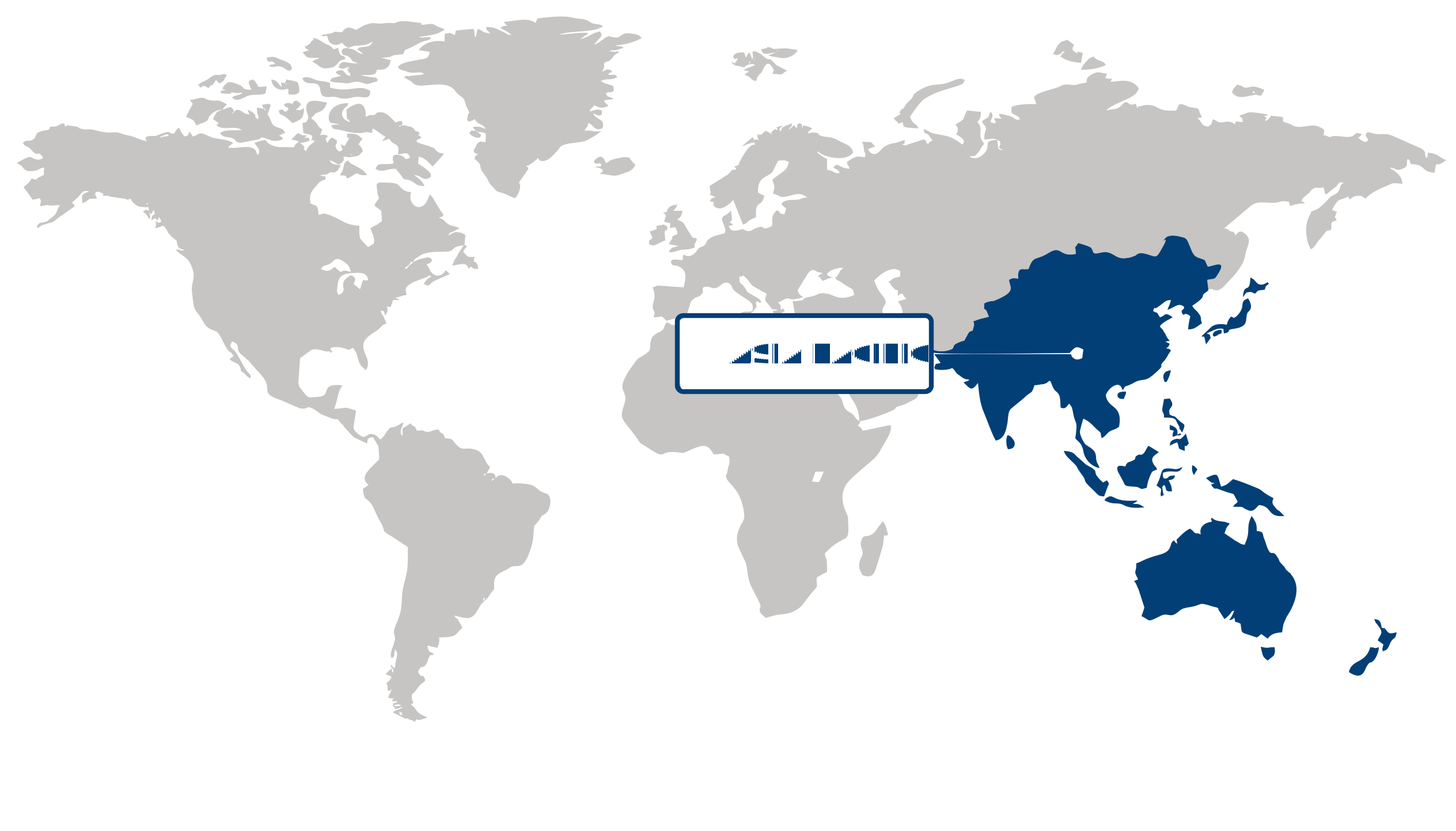
Asia Pacific (Largest Region)
The Asia Pacific region dominated the utility on grid PV inverter market in 2026, supported by extensive solar power deployment, expanding renewable energy infrastructure, and strong investment in utility-scale photovoltaic projects. Rising electricity demand and efforts to diversify energy systems are encouraging governments and utilities to increase solar generation capacity, creating sustained demand for grid-connected inverters. The region’s large-scale solar manufacturing ecosystem and expanding transmission and distribution infrastructure further support the deployment of PV inverter technologies. In addition, increasing efforts to integrate renewable generation into power networks are creating demand for advanced inverter solutions capable of supporting grid stability, efficient power conversion, and reliable electricity delivery.
Europe (Fastest-Growing Region)
Europe is expected to register the fastest growth in the utility on grid PV inverter market, driven by the region’s continued transition toward renewable energy and growing emphasis on reducing dependence on conventional power sources. Increasing deployment of utility-scale solar projects is creating opportunities for advanced inverters that can efficiently connect photovoltaic generation to electricity grids. The modernization of power infrastructure and increasing integration of intermittent renewable generation are also encouraging investment in grid-supportive inverter technologies. Furthermore, the region’s focus on energy security, decarbonization, and expansion of clean electricity generation is expected to accelerate demand for utility-scale PV inverter systems.
| Parameter | North America | Asia Pacific | Europe | Latin America | MEA |
|---|---|---|---|---|---|
| Innovation Hub i Scale Nascent Developing Advanced | |||||
| Cost-Sensitive Region i Scale Low Medium High | |||||
| Regulatory Environment i Scale Restrictive Neutral Supportive | |||||
| Demand Drivers i Scale Weak Moderate Strong | |||||
| Development Stage i Scale Emerging Developing Developed | |||||
| Adoption Rate i Scale Low Medium High | |||||
| New Entrants / Startups i Scale Sparse Moderate Dense | |||||
| Macro Indicators i Scale Weak Stable Strong |
Key Country Insights
United States 🇺🇸
Grid Modernization SupportThe U.S. is strengthening deployment of utility on grid PV inverters that improve grid stability as large-scale solar installations expand. Utilities prioritize advanced inverter functions that enable efficient power conversion, remote monitoring, and grid integration.
Germany 🇩🇪
Renewable Grid IntegrationGermany focuses on utility on grid PV inverters that support reliable integration of renewable electricity into established transmission networks. Demand centers on high-efficiency systems with intelligent grid management and compliance with evolving technical standards.
Japan 🇯🇵
Grid Stability SolutionsJapan emphasizes utility on grid PV inverters designed to maintain stable power delivery across a complex electricity network. Japanese project developers seek highly reliable inverter technologies with advanced monitoring and efficient energy conversion capabilities.
South Korea 🇰🇷
Smart Utility InfrastructureSouth Korea is expanding utility-scale solar projects supported by intelligent on grid PV inverter technologies. Domestic stakeholders prioritize digital control features and grid-responsive performance that enhance renewable energy integration into national infrastructure.
France 🇫🇷
Clean Energy OptimizationFrance promotes utility on grid PV inverter deployment that improves operational efficiency across expanding solar generation assets. Project operators increasingly favor inverter platforms offering reliable performance, remote diagnostics, and compatibility with evolving grid requirements.
Italy 🇮🇹
Solar Network ExpansionItaly continues to integrate utility on grid PV inverters into large-scale solar developments supporting national renewable energy objectives. Italian developers prioritize efficient inverter systems that maximize plant availability and simplify long-term operational management.
Segment Leadership and Growth Trends
Utility On Grid PV Inverter Market Share (%), by Nominal Output Voltage, 2026
Go beyond the chart, access full insights & data tables
Request Free Sample ReportNominal Output Voltage Segment Analysis: < 1500 V (Largest Segment) vs ≥ 1500 V (Fastest-Growing Segment)
< 1500 V segment dominated the utility on grid PV inverter market in 2026, supported by its widespread suitability for utility-scale solar power generation and established deployment across grid-connected photovoltaic projects. These inverters provide an effective balance between system performance, installation requirements, and compatibility with established solar power infrastructure. Their broad adoption is also supported by the continued expansion of utility-scale solar installations, where reliable conversion of generated electricity into grid-compatible power is essential. Established supply chains, proven operating characteristics, and compatibility with widely deployed photovoltaic system configurations further reinforce the position of the < 1500 V segment.
The ≥ 1500 V segment is expected to register the fastest growth as utility-scale solar developers increasingly seek solutions that can improve power transmission efficiency and support larger photovoltaic installations. Higher-voltage inverter architectures can help reduce electrical losses and optimize system design by enabling efficient handling of power across extensive solar generation sites. The growing scale of utility solar projects and continued efforts to improve energy yield and reduce balance-of-system complexity are creating favorable conditions for higher-voltage solutions. As grid-connected solar infrastructure becomes more sophisticated, the adoption of ≥ 1500 V systems is expected to accelerate.
Product Segment Analysis: Central (Largest Segment) vs String (Fastest-Growing Segment)
Central segment held the largest share of the utility on grid PV inverter market in 2026, reflecting its established role in large-scale solar power installations. Central inverters are well suited to utility-scale projects because they can efficiently manage high power outputs and consolidate power conversion across large photovoltaic arrays. Their established deployment model, centralized monitoring capabilities, and suitability for large solar farms have supported widespread adoption. In addition, the ability to integrate central inverter systems into utility-scale power infrastructure and established operations and maintenance frameworks continues to reinforce their market position.
String is anticipated to experience the fastest growth as utility-scale solar projects increasingly prioritize modularity, operational flexibility, and improved energy harvesting. String inverters allow photovoltaic arrays to be divided into smaller independently managed sections, which can improve system-level control and reduce the impact of localized shading or equipment issues. Their modular architecture can also simplify system expansion, maintenance, and performance monitoring. As solar developers seek greater design flexibility and improved operational resilience, the increasing adoption of distributed inverter configurations is expected to support strong growth for string inverters.
| Segment | Sub-Segment | Largest Segment | Fastest Growing |
|---|---|---|---|
| Nominal Output Voltage | < 1500 V, ≥ 1500 V | < 1500 V | ≥ 1500 V |
| Product | String, Central | Central | String |
Competitive Landscape and Market Positioning
Top players in the utility on grid PV inverter market:
- Canadian Solar, Inc. (Canada)
- SMA Solar Technology AG (Germany)
- SolarEdge Technologies, Inc. (Israel)
- Enphase Energy, Inc. (United States)
- Sungrow Power Supply Co., Ltd. (China)
- GoodWe Technologies Co., Ltd. (China)
- Delta Electronics, Inc. (Taiwan)
- FIMER S.p.A. (Italy)
- Schneider Electric SE (France)
- Huawei Technologies Co., Ltd. (China)
Grid modernization and the rapid expansion of utility-scale solar projects are encouraging inverter manufacturers to compete through higher conversion efficiency, intelligent grid support functions, and advanced digital control capabilities. Market participants are increasingly differentiating their offerings by integrating remote diagnostics, predictive maintenance, and flexible system architectures that simplify deployment across diverse power generation environments. Competitive emphasis is also shifting toward long-term operational reliability and seamless compatibility with energy storage and grid management platforms, reflecting the growing demand for integrated power infrastructure. As utilities prioritize resilient and adaptable renewable energy assets, suppliers with strong software capabilities and scalable engineering approaches are strengthening their competitive position.
| Company | Market Share | Company Revenue | Revenue CAGR (%) | Product Portfolio | Geographic Presence | Innovation / R&D Focus | Strategic Developments |
|---|---|---|---|---|---|---|---|
| Canadian Solar Inc. (Canada) | |||||||
| SMA Solar Technology AG (Germany) | |||||||
| SolarEdge Technologies Inc. (Israel) | |||||||
| Enphase Energy Inc. (United States) | |||||||
| Sungrow Power Supply Co. Ltd. (China) | |||||||
| GoodWe Technologies Co. Ltd. (China) | |||||||
| Delta Electronics Inc. (Taiwan) | |||||||
| FIMER S.p.A. (Italy) | |||||||
| Schneider Electric SE (France) | |||||||
| Huawei Technologies Co. Ltd. (China) |
Industry Development/News
| Company Name | Date | Key Development |
|---|---|---|
| Solis | Oct-24 | Solis expanded its product portfolio by unveiling a diverse lineup of high-capacity hybrid PV inverters tailored for residential and commercial energy storage applications. Additionally, the company introduced grid-tied inverters spanning output power ratings of 3 kW, 5 kW, 150 kW, and 350 kW to address residential, commercial, and utility-scale market demands. |
| SMA Solar Technology | Apr-21 | SMA Solar Technology supplied its Sunny Highpower PEAK1 inverters to GreenYellow for deployment in a floating photovoltaic plant in Thailand. The installation is projected to generate approximately 2.73 GWh of renewable energy annually, enabling the local facility to displace around 25 percent of its conventional energy consumption and reduce carbon dioxide emissions by 1,380 tons per year. |
Customize Your Report
Explore examples of how this report can be tailored to different research needs, including custom segments, additional topics or chapters, and related reports. Click a section of the wheel or its numbered marker to explore the available options.
Utility On Grid PV Inverter Market — Custom Segments
| Segment | Sub-Segment |
|---|---|
| Solar Plant Capacity | Small Utility-Scale Plants, Medium Utility-Scale Plants, Large Utility-Scale Plants |
| Grid Connection Type | Low-Voltage Grid Connection, Medium-Voltage Grid Connection, High-Voltage Grid Connection |
| Buyer Type | Independent Power Producers, Utilities, Commercial & Industrial Developers, Engineering Procurement & Construction Companies |
Utility On Grid PV Inverter Market — Custom TOC
| Custom Chapter | Custom Details |
|---|---|
| Grid Integration & Interconnection Priorities |
|
| Inverter Bankability Assessment |
|
| Grid Stability Service Monetization |
|
Need a different cut of the data?
Request Custom ResearchWhat is the current revenue of the utility on grid PV inverter market?
What is the forecasted size of the utility on grid PV inverter industry?
What factors are accelerating deployment in the utility on grid PV inverter market?
How are sustainability commitments influencing the utility on grid PV inverter market?
Why does the < 1500 V nominal output voltage segment lead the utility on grid PV inverter market?
Which product segment is expected to experience the fastest growth in the utility on grid PV inverter market?
Why does Asia Pacific dominate the utility on grid PV inverter market?
How is Europe positioned for faster growth in utility on grid PV inverters?
Which companies are driving growth in the utility on grid PV inverter landscape?
Our Clients
"The information presented in the report was genuinely insightful. The data was clear and easy to understand, which made it much easier to interpret the findings."
Amara Raja Group
"The responsiveness and professionalism exhibited by the team were exemplary. They were readily available to address queries, provide clarifications, and offer additional insights."
ONGC
"The reports offered a comprehensive analysis of various segments within the market. The detailed insights into market trends, and regulatory landscapes were excellent."
TotalEnergies
Our Research Team & Methodology
Every Fundamental Business Insights report is built by a dedicated vertical research team, validated through a structured primary-and-secondary methodology, and reviewed for accuracy before it reaches you.
Research Team Overview
Prepared by the Energy & Power Research Team
Delivery
Published
Demand
Available
Support
Trust & Compliance
Research Domains
10 coverage areasResearch Intelligence
| Source | Reference |
|---|---|
| International Energy Agency (IEA) | www.iea.org |
| U.S. Energy Information Administration (EIA) | www.eia.gov |
| International Renewable Energy Agency (IRENA) | www.irena.org |
| International Electrotechnical Commission (IEC) | www.iec.ch |
| International Organization for Standardization (ISO) | www.iso.org |
| IEEE | www.ieee.org |
| CIGRE (International Council on Large Electric Systems) | www.cigre.org |
| World Energy Council (WEC) | www.worldenergy.org |
| U.S. Department of Energy (DOE) | www.energy.gov |
| International Atomic Energy Agency (IAEA) | www.iaea.org |
| American Petroleum Institute (API) | www.api.org |
| Society of Petroleum Engineers (SPE) | www.spe.org |
| Hydrogen Council | hydrogencouncil.com |
| Battery Council International (BCI) | batterycouncil.org |
| Global Wind Energy Council (GWEC) | gwec.net |
| SolarPower Europe | www.solarpowereurope.org |
| World Bioenergy Association (WBA) | worldbioenergy.org |
| International Hydropower Association (IHA) | www.hydropower.org |
| Edison Electric Institute (EEI) | www.eei.org |
| National Renewable Energy Laboratory (NREL) | www.nrel.gov |
Research Workflow & Quality Assurance
Data Collection
Verified information gathered through primary and secondary research.
Data Triangulation
Cross-validation using multiple independent data sources.
Forecast Modelling
Market estimates developed using historical trends and analytical models.
Analyst Validation
Findings reviewed by domain experts for accuracy and consistency.
Editorial & Quality Review
Final editorial, quality, and compliance checks before publication.
Final Publication
Released after successful completion of the internal review process.
Report Coverage
📊 Market Assessment
- Market Size & Forecast
- Market Segmentation
- Regional Analysis
- Growth Drivers & Challenges
- Market Dynamics
🏢 Competitive Intelligence
- Competitive Landscape
- Company Profiles
- Competitive Benchmarking
- Mergers & Acquisitions
- Market Share Analysis or Key Company Strategies
🔍 Strategic Analysis
- Value Chain Analysis
- Porter's Five Forces
- PESTLE Analysis
- Pricing Trends
- Supply-Demand Analysis
🚀 Future Outlook
- Technology Landscape
- Regulatory Landscape
- Investment & Funding Landscape
- Emerging Opportunities
- Future Market Outlook
Have a question about this report or need a custom scope?
Request Customization