Underfloor Heating Market Size & Growth Forecast 2027–2036, By Segments (Product Type, System, Installation Type, Application), Regional Demand Trends (North America, Asia Pacific, Europe), Key Country Insights (U.S., Japan, South Korea, Germany, France, Italy), and Competitive Landscape
Market Size and Growth Outlook
Underfloor Heating Market size stood at USD 5.8 billion in 2026 and is predicted to grow at a 5.7% CAGR from 2027 to 2036, exceeding USD 10.1 billion by 2036. The industry revenue for 2027 is calculated at USD 6.08 billion.
Get more details on this report
Request Free Sample ReportUnderfloor Heating Market Intelligence Snapshot
Regional Market Dynamics
- Asia Pacific accounted for 37.65% of the market in 2026, supported by strong residential and commercial construction activity and growing adoption of energy-efficient heating solutions.
- Asia Pacific is projected to grow at a 7.35% CAGR, driven by urban housing expansion, rising demand for energy-efficient buildings, and wider deployment across residential and mixed-use developments.
Segment Momentum
- Hydronic systems held a 69.12% share in 2026 because they provide energy-efficient, cost-effective whole-building heating, integrate with central heating infrastructure, and deliver consistent heat distribution across larger spaces.
- Cooling systems are growing fastest as demand rises for integrated radiant solutions that provide flexible indoor climate control, supporting multifunctional building designs beyond traditional heating-only applications.
Market Expansion Drivers
- Rising demand for mineral processing and metal recovery solutions driving separator adoption.
- Expanding mining and recycling activities boosting industrial separation equipment utilization globally.
- Automation and sensor-based separation technologies enhancing operational efficiency and throughput.
Leading Market Participants
- Leading players in the underfloor heating market include Danfoss A/S (Denmark), Daikin Industries, Ltd. (Japan), Robert Bosch GmbH (Germany), Siemens AG (Germany), Schneider Electric SE (France), Uponor Corporation (Finland), Mitsubishi Electric Corporation (Japan), Honeywell International Inc. (United States), nVent Electric plc (United Kingdom), Warmup plc (United Kingdom).
Global Market Forecast Snapshot
Market Outlook
- 2026 Market Size: USD 5.8 billion
- 2027 Estimated Market Size: USD 6.08 billion.
- Projected Market Size: USD 10.1 billion by 2036
- Growth Forecast: 5.7% CAGR (2027-2036)
Regional and Segment Outlook
- Leading Regional Market: Asia Pacific
- High-Growth Regional Hub: Asia Pacific
- Core Revenue Segment: Hydronic (Product Type) | Heating Systems (System) | New Installation (Installation Type) | Residential (Application)
- Emerging Opportunity Segment: Electric (Product Type) | Cooling Systems (System) | Retrofit Installation (Installation Type) | Commercial (Application)
Market Growth Drivers and Industry Trends
Rising demand for mineral processing and metal recovery solutions driving separator adoption
Increasing demand for mineral processing and metal recovery is creating broader opportunities for advanced separation equipment across mining and resource-intensive industries, with the underfloor heating market benefiting from related industrial investment and equipment development. Mineral processing operations require effective separation of valuable minerals from unwanted materials to improve resource utilization and processing quality, while metal recovery activities increasingly depend on efficient technologies capable of handling complex material streams. As mining operations seek to improve recovery performance and reduce material losses, the deployment of separators across crushing, screening, sorting, and concentration processes becomes increasingly important. Growing attention to resource efficiency and the recovery of usable materials from increasingly complex feedstocks is also encouraging processors to adopt specialized separation solutions suited to varying particle sizes, compositions, and operating conditions.
Expanding mining and recycling activities boosting industrial separation equipment utilization globally
Expansion of mining and recycling activities across major industrial economies is strengthening equipment requirements for material classification, sorting, and recovery processes, which will support the underfloor heating market growth. Rising extraction activity requires separation systems that can process large volumes of mined material while maintaining consistent recovery and product quality. At the same time, the expansion of recycling operations is increasing the need to separate metals, minerals, and other recoverable materials from mixed waste streams before downstream processing. Recycling facilities are also handling increasingly diverse feedstocks, creating demand for equipment that can accommodate differences in material composition and physical characteristics. This combination of primary resource extraction and secondary material recovery is broadening the application base for industrial separation equipment across mining, recycling, and resource recovery facilities.
Automation and sensor-based separation technologies enhancing operational efficiency and throughput
Adoption of automation, intelligent controls, and sensor-based sorting technologies is improving the precision and productivity of industrial separation processes, creating another avenue through which the underfloor heating market demand can expand. Modern separation systems can incorporate sensors and automated controls to identify material characteristics and adjust operating parameters with limited manual intervention, supporting more consistent processing conditions. These technologies are particularly valuable in high-throughput environments where operators need to manage continuous material flows while maintaining separation accuracy and minimizing unnecessary energy and labor requirements. Integration with digital monitoring platforms can also provide greater visibility into equipment performance, material flows, and process conditions, enabling operators to identify inefficiencies and optimize production settings. The growing emphasis on automated processing is encouraging investment in technologically advanced separation equipment across industrial facilities.
| Growth Driver | Impact on CAGR | Regulatory Influence | Geographic Relevance | Adoption Rate | Impact Timeline |
|---|---|---|---|---|---|
| Rising demand for mineral processing and metal recovery solutions driving separator adoption | 2.00% | Moderate | Asia Pacific, Europe | Medium | Near Term |
| Expanding mining and recycling activities boosting industrial separation equipment utilization globally | 1.70% | Moderate | Asia Pacific, Latin America, Africa | Medium | Mid Term |
| Automation and sensor-based separation technologies enhancing operational efficiency and throughput | 1.40% | Moderate | North America, Europe, Asia Pacific | Emerging | Long Term |
Unlock insights tailored to your business with our bespoke market research solutions.
Click to get your customized report now.
Regional Demand Dynamics
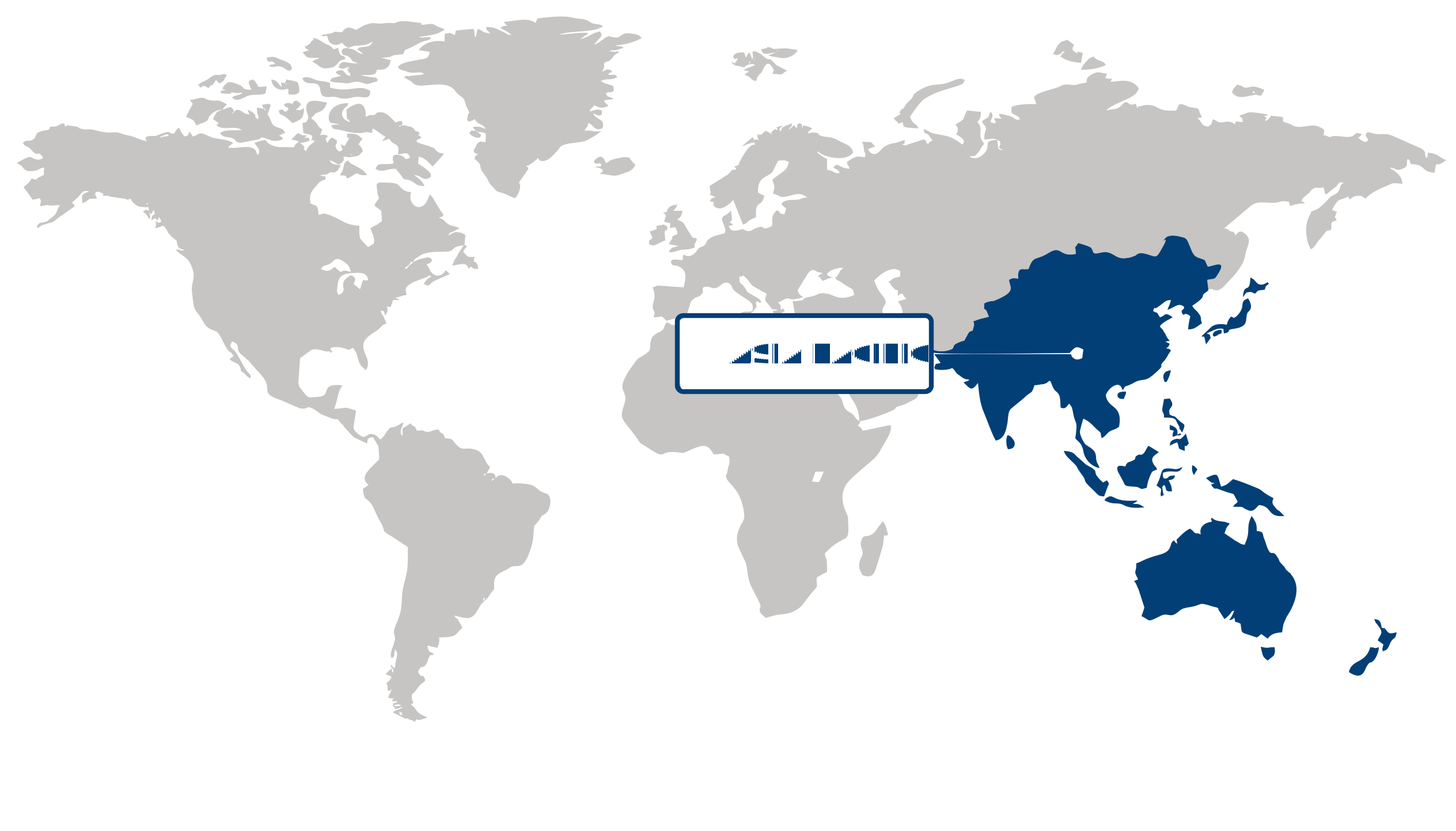
Asia Pacific (Largest & Fastest-Growing Region)
The underfloor heating market in Asia Pacific held the largest share and was also the fastest-growing region in 2026, supported by rapid urban development, expanding residential construction, and increasing attention to energy-efficient heating technologies. Rising demand for comfortable indoor environments is encouraging the adoption of concealed heating systems in modern homes, commercial properties, and hospitality facilities. The region’s expanding middle-class population and growing preference for technologically advanced building solutions are creating favorable conditions for underfloor heating installations, particularly in newly constructed properties where such systems can be integrated efficiently. Increasing awareness of energy conservation is also encouraging building owners and developers to consider heating solutions that can provide consistent temperature distribution while supporting efficient energy use. In addition, infrastructure modernization and the development of smart buildings are creating opportunities for automated heating controls and integrated thermal-management systems, reinforcing Asia Pacific’s strong market position.
| Parameter | North America | Asia Pacific | Europe | Latin America | MEA |
|---|---|---|---|---|---|
| Innovation Hub i Scale Nascent Developing Advanced | |||||
| Cost-Sensitive Region i Scale Low Medium High | |||||
| Regulatory Environment i Scale Restrictive Neutral Supportive | |||||
| Demand Drivers i Scale Weak Moderate Strong | |||||
| Development Stage i Scale Emerging Developing Developed | |||||
| Adoption Rate i Scale Low Medium High | |||||
| New Entrants / Startups i Scale Sparse Moderate Dense | |||||
| Macro Indicators i Scale Weak Stable Strong |
Key Country Insights
Germany 🇩🇪
Energy-Efficient BuildingsGermany is expanding underfloor heating installations as part of energy-efficient building modernization projects. Construction companies in Germany are combining low-temperature heating systems with heat pumps to improve building performance and energy utilization.
France 🇫🇷
Low-Carbon Heating SystemsFrance is encouraging underfloor heating as part of building efficiency improvements and low-carbon heating strategies. Construction professionals in France are integrating radiant heating with renewable energy systems to improve thermal performance in residential and commercial properties.
Italy 🇮🇹
Renovation-Led AdoptionItaly is expanding underfloor heating through residential renovations and modern building upgrades. Installers in Italy are focusing on compact, energy-efficient systems that enhance occupant comfort while fitting diverse architectural layouts.
Japan 🇯🇵
Space-Efficient HeatingJapan emphasizes underfloor heating in residential buildings where comfort and efficient use of interior space are important. Manufacturers in Japan are refining compact heating technologies that integrate smoothly with modern home construction and renovation projects.
South Korea 🇰🇷
Smart Heating IntegrationSouth Korea is combining underfloor heating with intelligent building management and connected home technologies. Developers in South Korea are modernizing heating installations that improve user comfort while supporting efficient residential energy management.
United States 🇺🇸
Residential Comfort SystemsThe U.S. underfloor heating market is gaining attention in premium residential developments and renovation projects. Installers in the U.S. are integrating energy-efficient heating systems with smart home technologies to improve indoor comfort and operational control.
Segment Leadership and Growth Trends
Underfloor Heating Market Share (%), by Product Type, 2026
Go beyond the chart, access full insights & data tables
Request Free Sample ReportProduct Type Segment Analysis: Hydronic (Largest Segment) vs Electric (Fastest-Growing Segment)
Hydronic systems led the underfloor heating market with a 69.12% share in 2026, owing to their ability to provide consistent heat distribution across large floor areas and operate efficiently in residential and commercial environments. These systems circulate heated water through embedded pipes, creating uniform indoor temperatures while supporting integration with energy-efficient heating technologies. Their suitability for larger buildings and compatibility with various heat sources continue to reinforce demand, particularly where long-term heating efficiency is a key consideration.
Electric underfloor heating is experiencing faster growth as installation flexibility and ease of deployment make it attractive for renovation projects and space-constrained applications. Electric systems can be installed without extensive plumbing infrastructure and provide responsive heating for individual rooms or targeted areas. Increasing demand for convenient heating solutions, building modernization, and energy-conscious indoor climate control is supporting wider adoption of electric systems.
System Segment Analysis: Heating Systems (Largest Segment) vs Cooling Systems (Fastest-Growing Segment)
Heating systems accounted for a 63.15% share of the underfloor heating market in 2026, reflecting the established use of radiant floor technology for maintaining comfortable indoor temperatures during colder conditions. Underfloor heating provides even heat distribution and can reduce reliance on conventional heat-emitting equipment, supporting both comfort and efficient space utilization. Increasing attention to building energy performance and the integration of heating systems with modern energy-efficient technologies continue to sustain demand.
Cooling systems are gaining momentum as building owners increasingly seek integrated solutions capable of managing indoor temperatures beyond the traditional heating season. Radiant cooling can provide comfortable indoor conditions while operating through concealed floor infrastructure, helping preserve interior aesthetics and usable wall space. Growing interest in year-round indoor climate management and energy-efficient building systems is creating opportunities for cooling applications within underfloor technologies.
| Segment | Sub-Segment | Largest Segment | Fastest Growing |
|---|---|---|---|
| Product Type | Hydronic, Electric | Hydronic | Electric |
| System | Heating Systems, Cooling Systems | Heating Systems | Cooling Systems |
| Installation Type | New Installation, Retrofit Installation | New Installation | Retrofit Installation |
| Application | Residential, Commercial, Industrial | Residential | Commercial |
Competitive Landscape and Market Positioning
Key companies in the underfloor heating market:
1. Danfoss A/S (Denmark)
2. Daikin Industries Ltd. (Japan)
3. Robert Bosch GmbH (Germany)
4. Siemens AG (Germany)
5. Schneider Electric SE (France)
6. Uponor Corporation (Finland)
7. Mitsubishi Electric Corporation (Japan)
8. Honeywell International Inc. (United States)
9. nVent Electric plc (United Kingdom)
10. Warmup plc (United Kingdom)
The underfloor heating market is expanding as energy-efficient heating solutions gain popularity in residential and commercial construction. Smart temperature control systems are improving comfort and energy optimization. The underfloor heating market is also evolving through advanced designs that integrate seamlessly with modern building infrastructures.
| Company | Market Share | Company Revenue | Revenue CAGR (%) | Product Portfolio | Geographic Presence | Innovation / R&D Focus | Strategic Developments |
|---|---|---|---|---|---|---|---|
| Danfoss A/S (Denmark) | |||||||
| Daikin Industries Ltd. (Japan) | |||||||
| Robert Bosch GmbH (Germany) | |||||||
| Siemens AG (Germany) | |||||||
| Schneider Electric SE (France) | |||||||
| Uponor Corporation (Finland) | |||||||
| Mitsubishi Electric Corporation (Japan) | |||||||
| Honeywell International Inc. (United States) | |||||||
| nVent Electric plc (United Kingdom) | |||||||
| Warmup plc (United Kingdom). |
Industry Development/News
| Company Name | Date | Key Development |
|---|---|---|
| Carrier Solutions UK | Jun-26 | Carrier Solutions UK launched the AQUASNAP® 30AWH-M monobloc air-to-water heat pump, expanding its portfolio of integrated low-carbon heating technologies. The product is specifically engineered for domestic hot water and space heating, supporting the growing market demand for heat pump systems that offer high-efficiency compatibility with modern residential and commercial underfloor heating infrastructure. |
| Haydale Graphene Industries | May-26 | Haydale Graphene Industries advanced trials of graphene-based functional inks for underfloor heating in collaboration with Staircraft. By integrating conductive ink into flooring systems to enable low-voltage, energy-efficient heat emission, the project marks a significant progression toward the commercialization of next-generation smart flooring materials and embedded, high-efficiency heating technologies for residential construction. |
| Jersey Energy Trust | May-26 | Jersey Energy Trust initiated a pilot program deploying graphene-based underfloor heating in social housing alongside Haydale. This initiative serves as a critical real-world trial for low-voltage, energy-efficient heating, evaluating the scalability of advanced material integration in public housing and its potential to significantly reduce residential energy consumption while meeting sustainability standards. |
| Wondrwall | May-26 | Wondrwall launched Energy Service Contracts (ESC) for the new-build housing sector, integrating renewable energy technologies within residential developments. This commercial model reinforces the company’s position in smart home energy management, facilitating the deployment of integrated, low-energy heating control systems that are essential for optimizing the infrastructure of underfloor heating in modern residential builds. |
| Daikin | Aug-25 | Daikin established a specialized heat pump R&D center in Belgium to accelerate the development of low-carbon heating technologies for the EMEA region. This facility, featuring advanced laboratories and dedicated engineering teams, reinforces the company’s strategic commitment to innovating energy-efficient heating systems, providing the core technological infrastructure necessary for modern underfloor heating compatibility. |
| Danfoss | May-25 | Danfoss entered a strategic partnership with E.ON One to develop intelligent, data-driven heating controls for buildings. By integrating digital management systems to optimize thermal efficiency, this collaboration facilitates the commercialization of advanced heating infrastructure, directly enhancing the operational performance and energy saving potential of both new and retrofitted underfloor heating systems. |
Customize Your Report
Explore examples of how this report can be tailored to different research needs, including custom segments, additional topics or chapters, and related reports. Click a section of the wheel or its numbered marker to explore the available options.
Underfloor Heating Market — Custom Segments
| Segment | Sub-Segment |
|---|---|
| Building Energy Efficiency Level | Standard-Efficiency Buildings, High-Efficiency Buildings, Near-Zero-Energy Buildings |
| Control Technology | Manual & Basic Controls, Programmable Controls, Smart & Connected Controls |
| Climate Zone | Cold Climates, Temperate Climates, Warm Climates, Hot & Arid Climates |
Underfloor Heating Market — Custom TOC
| Custom Chapter | Custom Details |
|---|---|
| Building Decarbonization Opportunity Assessment |
|
| Smart Home Integration Trends |
|
| Energy Efficiency Policy Impact Study |
|
Need a different cut of the data?
Request Custom ResearchHow large is the underfloor heating market?
How will the underfloor heating industry grow in terms of size and CAGR by 2036?
How is the shift toward energy-efficient building design influencing adoption of hydronic and electric underfloor heating systems?
Why are integrated cooling capabilities and urban construction trends reshaping investment decisions in the underfloor heating market?
Why are hydronic systems the leading product type in the underfloor heating market?
Why are cooling systems the fastest-growing system segment in the underfloor heating market?
Why is Asia Pacific leading the underfloor heating market?
What is driving underfloor heating market growth in Asia Pacific?
Who holds a significant market share in the underfloor heating landscape?
Our Clients
"Your insights on workforce structures were spot-on. The analysis on mid-to-senior level roles validated some of our hiring decisions and highlighted gaps."
Ateliers De France
"The report gave us insights on competitors in the market. It helped our team refine our bidding strategy for upcoming contracts."
Clark Construction
"The reports provided a deep dive into market trends, and competitive landscape. The strategic insights and recommendations have been very helpful."
Rudolph and Sletten
Our Research Team & Methodology
Every Fundamental Business Insights report is built by a dedicated vertical research team, validated through a structured primary-and-secondary methodology, and reviewed for accuracy before it reaches you.
Research Team Overview
Prepared by the Construction & Manufacturing Research Team
Delivery
Published
Demand
Available
Support
Trust & Compliance
Research Domains
10 coverage areasResearch Intelligence
| Source | Reference |
|---|---|
| International Organization for Standardization (ISO) | www.iso.org |
| ASTM International | www.astm.org |
| National Institute of Standards and Technology (NIST) | www.nist.gov |
| International Code Council (ICC) | www.iccsafe.org |
| American Concrete Institute (ACI) | www.concrete.org |
| American Institute of Steel Construction (AISC) | www.aisc.org |
| Construction Industry Institute (CII) | www.construction-institute.org |
| Associated General Contractors of America (AGC) | www.agc.org |
| Association of Equipment Manufacturers (AEM) | www.aem.org |
| Building Owners and Managers Association (BOMA) | www.boma.org |
| American Society of Civil Engineers (ASCE) | www.asce.org |
| National Ready Mixed Concrete Association (NRMCA) | www.nrmca.org |
| International Facility Management Association (IFMA) | www.ifma.org |
| World Green Building Council (WorldGBC) | worldgbc.org |
| International Federation of Consulting Engineers (FIDIC) | fidic.org |
| International Labour Organization (ILO) | www.ilo.org |
| American Society of Mechanical Engineers (ASME) | www.asme.org |
| Society of Manufacturing Engineers (SME) | www.sme.org |
| National Association of Home Builders (NAHB) | www.nahb.org |
| European Construction Industry Federation (FIEC) | www.fiec.eu |
Research Workflow & Quality Assurance
Data Collection
Verified information gathered through primary and secondary research.
Data Triangulation
Cross-validation using multiple independent data sources.
Forecast Modelling
Market estimates developed using historical trends and analytical models.
Analyst Validation
Findings reviewed by domain experts for accuracy and consistency.
Editorial & Quality Review
Final editorial, quality, and compliance checks before publication.
Final Publication
Released after successful completion of the internal review process.
Report Coverage
📊 Market Assessment
- Market Size & Forecast
- Market Segmentation
- Regional Analysis
- Growth Drivers & Challenges
- Market Dynamics
🏢 Competitive Intelligence
- Competitive Landscape
- Company Profiles
- Competitive Benchmarking
- Mergers & Acquisitions
- Market Share Analysis or Key Company Strategies
🔍 Strategic Analysis
- Value Chain Analysis
- Porter's Five Forces
- PESTLE Analysis
- Pricing Trends
- Supply-Demand Analysis
🚀 Future Outlook
- Technology Landscape
- Regulatory Landscape
- Investment & Funding Landscape
- Emerging Opportunities
- Future Market Outlook
Have a question about this report or need a custom scope?
Request Customization