Tunnel Boring Machine Market Size & Growth Forecast 2027–2036, By Segments (End-use, Product Type), Regional Demand Trends (North America, Asia Pacific, Europe), Key Country Insights (U.S., Japan, South Korea, Germany, France, Italy), and Competitive Landscape
Market Size and Growth Outlook
Tunnel Boring Machine Market size stood at USD 7.58 billion in 2026 and is predicted to grow at a 4.66% CAGR from 2027 to 2036, surpassing USD 11.95 billion by 2036. The industry revenue for 2027 is calculated at USD 7.88 billion.
Get more details on this report
Request Free Sample ReportTunnel Boring Machine Market Intelligence Snapshot
Regional Market Dynamics
- Asia Pacific leads due to extensive metro, railway, highway, and water infrastructure projects that maintain high equipment deployment across major civil engineering developments.
- The region is projected to grow at a 5.7% CAGR as expanding urban transport networks, underground utilities, and complex infrastructure projects increase demand for advanced tunneling systems.
Segment Momentum
- Transport captured a 34.24% share in 2026, driven by sustained metro, rail, and transport corridor construction where tunnel boring machines deliver precise excavation with reduced surface disruption in urban environments.
- Soft Ground TBM is the fastest-growing product type as expanding urban projects increasingly require stable excavation in loose soil and mixed ground conditions while minimizing settlement and construction disruption.
Market Expansion Drivers
- Expanding urban transportation infrastructure projects driving demand for advanced tunnel boring machines.
- Rising investments in high-speed rail and smart city developments accelerating tunnel construction activities.
- Integration of AI-enabled tunneling technologies improving operational efficiency across complex excavation projects.
Leading Market Participants
- Top players in the tunnel boring machine market include Herrenknecht AG (Germany), The Robbins Company (United States), CRCHI - China Railway Construction Heavy Industry Co., Ltd. (China), Mitsubishi Heavy Industries Ltd. (Japan), Kawasaki Heavy Industries Ltd. (Japan), Hitachi Zosen Corporation (Japan), Komatsu Ltd. (Japan), CREG - China Railway Engineering Equipment Group Co., Ltd. (China), TERRATEC Ltd. (United Kingdom).
Global Market Forecast Snapshot
Market Outlook
- 2026 Market Size: USD 7.58 billion
- 2027 Estimated Market Size: USD 7.88 billion.
- Projected Market Size: USD 11.95 billion by 2036
- Growth Forecast: 4.66% CAGR (2027-2036)
Regional and Segment Outlook
- Leading Regional Market: Asia Pacific
- High-Growth Regional Hub: Asia Pacific
- Core Revenue Segment: Transport (End-use) | Hard Rock TBM (Product Type)
- Emerging Opportunity Segment: Oil & Gas (End-use) | Soft Ground TBM (Product Type)
Market Growth Drivers and Industry Trends
Expanding urban transportation infrastructure projects driving demand for advanced tunnel boring machines
Rapid urbanization and rising pressure on existing transportation networks are encouraging governments and infrastructure developers to expand underground transit systems, particularly in densely populated cities where surface-level construction is constrained. The tunnel boring machine market will benefit from greater deployment of advanced excavation equipment for metro systems, road tunnels, underground rail corridors, and other urban mobility projects. Modern tunnel boring machines enable continuous excavation with controlled ground disturbance, making them suitable for projects passing beneath built-up areas, utilities, and existing transportation routes. Their ability to support different ground conditions and improve construction coordination also helps infrastructure contractors manage complex underground projects while reducing disruption to surrounding communities.
Rising investments in high-speed rail and smart city developments accelerating tunnel construction activities
Large-scale investments in high-speed rail networks and smart city infrastructure are creating additional requirements for underground construction capabilities. As the tunnel boring machine market expands, demand is supported by rail corridors that require tunnels through urban zones, mountainous terrain, and areas where conventional surface alignments are impractical. Smart city development is also increasing the need for integrated underground transportation and utility infrastructure, encouraging project developers to adopt mechanized excavation methods capable of handling long and technically demanding tunnel sections. The use of tunnel boring machines can provide controlled excavation and support consistent construction progress, particularly where projects require precise alignment and limited disturbance to populated areas.
Integration of AI-enabled tunneling technologies improving operational efficiency across complex excavation projects
The adoption of artificial intelligence, automation, and digital monitoring is changing how underground excavation projects are planned and executed. Within the tunnel boring machine market, AI-enabled systems can analyze equipment and geological information to support excavation parameter adjustments, identify abnormal operating conditions, and improve predictive maintenance practices. Real-time monitoring of machine performance, cutter conditions, ground behavior, and operational parameters can help contractors make more informed decisions during complex tunneling activities. Such technologies can also reduce avoidable equipment downtime and improve coordination between excavation, maintenance, and project management teams, which is particularly valuable in projects involving variable geological conditions and demanding construction schedules.
| Growth Driver | Impact on CAGR | Regulatory Influence | Geographic Relevance | Adoption Rate | Impact Timeline |
|---|---|---|---|---|---|
| Growing tunnel infrastructure projects globally | 1.70% | Short term (≤ 2 yrs) | North America, Europe | Medium | Fast |
| Technological improvements in boring machinery | 1.60% | Medium term (2–5 yrs) | North America, Asia Pacific | Low | Moderate |
| Expansion of construction and transport projects in emerging markets | 1.70% | Long term (5+ yrs) | Asia Pacific, Latin America | Low | Slow |
| Expanding urban transportation infrastructure projects driving demand for advanced tunnel boring machines | 2.00% | High | Asia Pacific, North America | High | Mid Term |
| Rising investments in high-speed rail and smart city developments accelerating tunnel construction activities | 1.80% | High | Europe, Asia Pacific | High | Near Term |
| Integration of AI-enabled tunneling technologies improving operational efficiency across complex excavation projects | 1.40% | Moderate | North America, Europe | Emerging | Long Term |
Unlock insights tailored to your business with our bespoke market research solutions.
Click to get your customized report now.
Regional Demand Dynamics
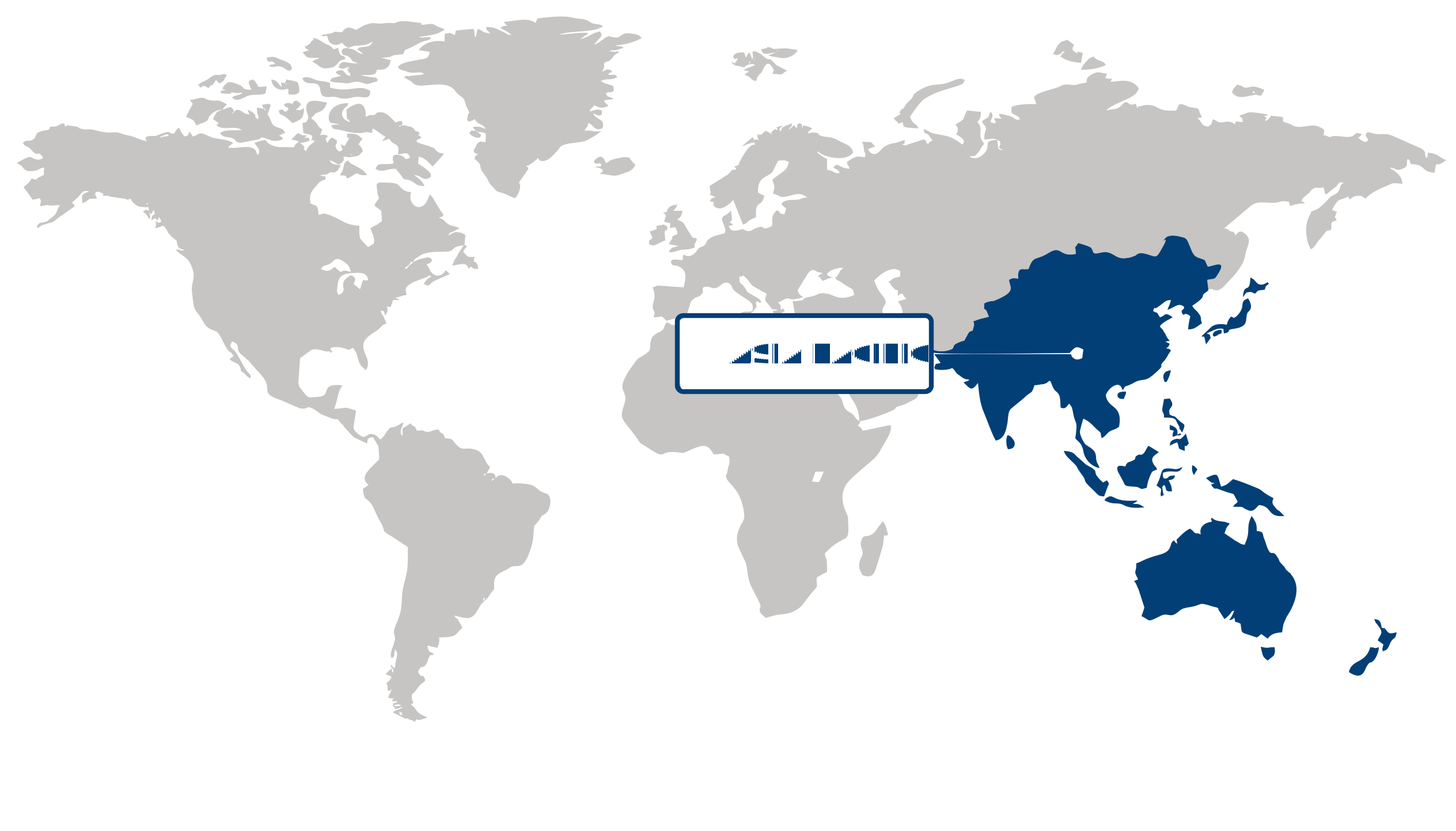
Asia Pacific (Largest & Fastest-Growing Region)
Asia Pacific led the tunnel boring machine market as both the largest and fastest-growing regional market in 2026, supported by extensive investment in urban infrastructure, transportation networks, and underground construction. Rapid urbanization and expanding metropolitan areas are increasing the need for efficient tunneling solutions for rail transit, road connectivity, water infrastructure, and utility networks, particularly where limited surface space makes underground development advantageous. Large infrastructure programs across emerging economies are also encouraging contractors and project developers to adopt advanced tunneling equipment that can improve excavation efficiency, construction safety, and project execution in challenging geological conditions. Continued development of high-speed rail, metro systems, and urban utility corridors, together with growing emphasis on mechanized construction and infrastructure modernization, is expected to reinforce the region's strong market position and accelerate demand for technologically advanced tunnel boring machines.
| Parameter | North America | Asia Pacific | Europe | Latin America | MEA |
|---|---|---|---|---|---|
| Innovation Hub i Scale Nascent Developing Advanced | |||||
| Cost-Sensitive Region i Scale Low Medium High | |||||
| Regulatory Environment i Scale Restrictive Neutral Supportive | |||||
| Demand Drivers i Scale Weak Moderate Strong | |||||
| Development Stage i Scale Emerging Developing Developed | |||||
| Adoption Rate i Scale Low Medium High | |||||
| New Entrants / Startups i Scale Sparse Moderate Dense | |||||
| Macro Indicators i Scale Weak Stable Strong |
Key Country Insights
Germany 🇩🇪
Precision Tunneling ExpertiseGermany is advancing tunnel boring machine deployment through technically demanding rail and underground infrastructure projects. The country values precision engineering, automation, and reliable equipment performance for complex excavation environments.
France 🇫🇷
Transit Infrastructure DevelopmentFrance is employing tunnel boring machines across urban rail extensions and underground utility projects requiring precise excavation. The country is supporting efficient construction practices while reducing environmental and community disruption during project delivery.
Italy 🇮🇹
Geology-Adaptive TunnelingItaly is deploying tunnel boring machines capable of addressing complex geological conditions across transportation and water infrastructure developments. Equipment demand reflects the importance of adaptable excavation technologies for challenging terrain and long tunnel alignments.
Japan 🇯🇵
Urban Underground ExpansionJapan is applying tunnel boring machines to expand underground transport and utility infrastructure within space-constrained urban areas. Project priorities include minimizing surface disruption while maintaining construction accuracy and operational safety.
South Korea 🇰🇷
Automated Excavation SolutionsSouth Korea is integrating advanced automation and monitoring technologies into tunnel boring machine operations for metropolitan infrastructure projects. Equipment selection increasingly reflects the need for productivity, safety, and efficient project execution.
United States 🇺🇸
Complex Infrastructure DeliveryThe U.S. is utilizing tunnel boring machines for major transportation, utility, and water infrastructure projects in densely populated regions. Demand emphasizes equipment capable of handling varied geological conditions while maintaining construction efficiency.
Segment Leadership and Growth Trends
Tunnel Boring Machine Market Share (%), by End-use, 2026
Go beyond the chart, access full insights & data tables
Request Free Sample ReportEnd-use Segment Analysis: Transport (Largest Segment) vs Oil & Gas (Fastest-Growing Segment)
The transport segment accounted for the largest position in the tunnel boring machine market in 2026, representing a 34.24% share, supported by extensive use of tunneling equipment in metro systems, rail networks, road tunnels, and other underground transportation infrastructure. Rapid urbanization and increasing traffic congestion are encouraging governments and infrastructure developers to expand underground transit capacity while minimizing disruption to densely populated surface areas. Tunnel boring machines provide controlled excavation, improved construction efficiency, and suitability for complex urban environments, making them particularly valuable for large-scale transportation projects where surface-level construction can create significant logistical and social challenges.
The oil & gas segment is anticipated to be the fastest-growing end-use category, driven by the increasing need for underground infrastructure supporting energy transportation, storage, and extraction activities. Tunnel boring technology can facilitate the construction of underground passages and utility corridors while reducing surface disturbance in environmentally or operationally sensitive areas. Growing investment in energy infrastructure modernization, expansion of pipeline and utility networks, and the need for safer and more efficient underground construction methods are supporting greater consideration of TBMs within oil and gas projects. Their ability to operate in challenging geological conditions is further enhancing their relevance across specialized energy infrastructure applications.
Product Type Segment Analysis: Hard Rock TBM (Largest Segment) vs Soft Ground TBM (Fastest-Growing Segment)
Hard rock TBMs represented the largest product type in the tunnel boring machine market in 2026, reflecting their critical role in projects involving strong and abrasive geological formations. These machines are engineered to withstand demanding excavation conditions while maintaining controlled cutting and material removal, making them essential for major transportation, mining, hydropower, and other underground infrastructure projects located in hard geological environments. Continued development of underground construction in regions with complex terrain and challenging rock formations sustains demand for robust tunneling equipment capable of delivering consistent performance and operational reliability.
Soft ground TBMs are expected to record the fastest growth as underground construction expands in densely populated urban areas and regions characterized by unconsolidated soil and mixed ground conditions. These machines are particularly suited to metro tunnels, utility corridors, and other projects where excavation must be carefully managed to limit ground movement and protect surrounding structures. Increasing urban infrastructure development, expansion of underground public transportation, and advances in ground-pressure control and excavation technologies are broadening the application potential of soft ground systems. Their suitability for complex urban tunneling environments is expected to support continued adoption as cities increasingly shift infrastructure development below ground.
| Segment | Sub-Segment | Largest Segment | Fastest Growing |
|---|---|---|---|
| End-use | Mining, Oil & Gas, Transport, Utility, Others | Transport | Oil & Gas |
| Product Type | Hard Rock TBM, Soft Ground TBM, Heterogeneous Ground TBM | Hard Rock TBM | Soft Ground TBM |
Competitive Landscape and Market Positioning
Major players in the tunnel boring machine market:
1. Herrenknecht AG (Germany)
2. The Robbins Company (United States)
3. CRCHI - China Railway Construction Heavy Industry Co. Ltd. (China)
4. Mitsubishi Heavy Industries Ltd. (Japan)
5. Kawasaki Heavy Industries Ltd. (Japan)
6. Hitachi Zosen Corporation (Japan)
7. Komatsu Ltd. (Japan)
8. CREG - China Railway Engineering Equipment Group Co. Ltd. (China)
9. TERRATEC Ltd. (United Kingdom)
The tunnel boring machine market is advancing through automation-led construction improvements and precision engineering upgrades. Focus on reducing excavation impact and improving speed is shaping innovation priorities. Advanced mechanical systems are being refined for complex underground environments. The tunnel boring machine market reflects a steady shift toward safer and more efficient tunneling operations.
| Company | Market Share | Company Revenue | Revenue CAGR (%) | Product Portfolio | Geographic Presence | Innovation / R&D Focus | Strategic Developments |
|---|---|---|---|---|---|---|---|
| Herrenknecht AG (Germany) | |||||||
| The Robbins Company (United States) | |||||||
| CRCHI - China Railway Construction Heavy Industry Co. Ltd. (China) | |||||||
| Mitsubishi Heavy Industries Ltd. (Japan) | |||||||
| Kawasaki Heavy Industries Ltd. (Japan) | |||||||
| Hitachi Zosen Corporation (Japan) | |||||||
| Komatsu Ltd. (Japan) | |||||||
| CREG - China Railway Engineering Equipment Group Co. Ltd. (China) | |||||||
| TERRATEC Ltd. (United Kingdom). |
Industry Development/News
| Company Name | Date | Key Development |
|---|---|---|
| Ivanhoe Electric | May-26 | Ivanhoe Electric commissioned a specialized Crossover XRE tunnel boring machine from The Robbins Company for its Santa Cruz Copper Project in Arizona. The investment in advanced underground excavation technology will accelerate decline development, demonstrating the strategic adoption of high-performance tunneling solutions to improve operational efficiency and access in mining environments. |
| The Robbins Company | May-26 | The Robbins Company secured a supply contract for a Crossover XRE tunnel boring machine and integrated material handling system for the Santa Cruz Copper Project. The deployment highlights the firm’s continued expansion into mining-specific underground infrastructure, providing the precision engineering required for efficient hard-rock excavation in resource development projects. |
| Herrenknecht | May-26 | Herrenknecht’s tunneling technology is currently being deployed for the National Grid’s Thames Crossing project, supporting critical underground energy infrastructure. The project underscores the manufacturer's leadership in engineering complex boring systems for energy transmission expansion, emphasizing the role of precision tunneling in meeting rising regional electricity demands. |
| ARC | May-26 | ARC successfully completed the logistics operation for the delivery of a Herrenknecht tunnel boring machine for the Hudson Tunnel Project in the United States. This infrastructure-enabling activity highlights the crucial role of specialized supply chain and transport services in the successful deployment of large-scale, capital-intensive tunneling equipment. |
| The Boring Company | Mar-26 | The Boring Company introduced its Prufrock-3 machine, featuring a “Monster” system that enables direct surface drilling without the need for traditional launch pits. This innovation represents a significant technological shift in tunneling, potentially reducing setup times, lowering capital infrastructure costs, and increasing the scalability of underground urban transit and utility projects. |
| TERRATEC | Apr-23 | TERRATEC introduced a reconditioned 6.61-meter Earth Pressure Balance (EPB) tunnel boring machine for the Surat Metro Rail Project in India. The deployment of this adapted machinery, designed to handle specific sand, clay, and silt geology, illustrates the industry's strategy of utilizing reconditioned, high-specification equipment to optimize project costs and timelines in urban rail development. |
Customize Your Report
Explore examples of how this report can be tailored to different research needs, including custom segments, additional topics or chapters, and related reports. Click a section of the wheel or its numbered marker to explore the available options.
Tunnel Boring Machine Market — Custom Segments
| Segment | Sub-Segment |
|---|---|
| Procurement Model | Direct Purchase, Equipment Leasing or Rental, Manufacturer-Supplied Contracting |
| Automation Level | Conventional or Manually Operated TBMs, Semi-Automated TBMs, Fully Automated TBMs |
| Project Ownership | Government-Owned Projects, Private-Sector Projects, Public-Private Partnership Projects |
Tunnel Boring Machine Market — Custom TOC
| Custom Chapter | Custom Details |
|---|---|
| Infrastructure Project Pipeline Assessment |
|
| Contractor and EPC Procurement Trends |
|
| Sustainable Tunneling Strategy Analysis |
|
Need a different cut of the data?
Request Custom ResearchHow big is the tunnel boring machine market?
How will the tunnel boring machine industry grow in terms of size and CAGR by 2036?
How is urban transportation infrastructure expansion influencing adoption of advanced tunnel boring machines?
Why are high-speed rail investments, smart city programs, and AI-enabled tunneling technologies accelerating TBM market development?
Why is transport the largest end-use segment in the tunnel boring machine market?
Which product type is experiencing the fastest growth in the tunnel boring machine market?
Why is Asia Pacific the leading market for tunnel boring machines?
What is supporting the rapid growth of the tunnel boring machine market in Asia Pacific?
Who are the major participants shaping the tunnel boring machine landscape?
Our Clients
"Your insights on workforce structures were spot-on. The analysis on mid-to-senior level roles validated some of our hiring decisions and highlighted gaps."
Ateliers De France
"The report gave us insights on competitors in the market. It helped our team refine our bidding strategy for upcoming contracts."
Clark Construction
"The reports provided a deep dive into market trends, and competitive landscape. The strategic insights and recommendations have been very helpful."
Rudolph and Sletten
Our Research Team & Methodology
Every Fundamental Business Insights report is built by a dedicated vertical research team, validated through a structured primary-and-secondary methodology, and reviewed for accuracy before it reaches you.
Research Team Overview
Prepared by the Construction & Manufacturing Research Team
Delivery
Published
Demand
Available
Support
Trust & Compliance
Research Domains
10 coverage areasResearch Intelligence
| Source | Reference |
|---|---|
| International Organization for Standardization (ISO) | www.iso.org |
| ASTM International | www.astm.org |
| National Institute of Standards and Technology (NIST) | www.nist.gov |
| International Code Council (ICC) | www.iccsafe.org |
| American Concrete Institute (ACI) | www.concrete.org |
| American Institute of Steel Construction (AISC) | www.aisc.org |
| Construction Industry Institute (CII) | www.construction-institute.org |
| Associated General Contractors of America (AGC) | www.agc.org |
| Association of Equipment Manufacturers (AEM) | www.aem.org |
| Building Owners and Managers Association (BOMA) | www.boma.org |
| American Society of Civil Engineers (ASCE) | www.asce.org |
| National Ready Mixed Concrete Association (NRMCA) | www.nrmca.org |
| International Facility Management Association (IFMA) | www.ifma.org |
| World Green Building Council (WorldGBC) | worldgbc.org |
| International Federation of Consulting Engineers (FIDIC) | fidic.org |
| International Labour Organization (ILO) | www.ilo.org |
| American Society of Mechanical Engineers (ASME) | www.asme.org |
| Society of Manufacturing Engineers (SME) | www.sme.org |
| National Association of Home Builders (NAHB) | www.nahb.org |
| European Construction Industry Federation (FIEC) | www.fiec.eu |
Research Workflow & Quality Assurance
Data Collection
Verified information gathered through primary and secondary research.
Data Triangulation
Cross-validation using multiple independent data sources.
Forecast Modelling
Market estimates developed using historical trends and analytical models.
Analyst Validation
Findings reviewed by domain experts for accuracy and consistency.
Editorial & Quality Review
Final editorial, quality, and compliance checks before publication.
Final Publication
Released after successful completion of the internal review process.
Report Coverage
📊 Market Assessment
- Market Size & Forecast
- Market Segmentation
- Regional Analysis
- Growth Drivers & Challenges
- Market Dynamics
🏢 Competitive Intelligence
- Competitive Landscape
- Company Profiles
- Competitive Benchmarking
- Mergers & Acquisitions
- Market Share Analysis or Key Company Strategies
🔍 Strategic Analysis
- Value Chain Analysis
- Porter's Five Forces
- PESTLE Analysis
- Pricing Trends
- Supply-Demand Analysis
🚀 Future Outlook
- Technology Landscape
- Regulatory Landscape
- Investment & Funding Landscape
- Emerging Opportunities
- Future Market Outlook
Have a question about this report or need a custom scope?
Request Customization