Train Loaders Market Size & Growth Forecast 2027–2036, By Segments (Loading Method, Capacity, Type, Application, End-Use Industry), Regional Demand Trends (North America, Asia Pacific, Europe), Key Country Insights (U.S., Japan, South Korea, Germany, France, Italy), and Competitive Landscape
Market Size and Growth Outlook
Train Loaders Market size was valued at USD 1.56 Billion in 2026 and is anticipated to grow at 4.64% CAGR from 2027 to 2036, reaching USD 2.46 Billion by 2036. The industry revenue for 2027 is calculated at USD 1.62 Billion.
Get more details on this report
Request Free Sample ReportTrain Loaders Market Intelligence Snapshot
Regional Market Dynamics
- Asia Pacific accounted for 43.46% in 2026, supported by rail infrastructure investment, mining activity, freight expansion, and demand for efficient bulk material handling.
- Continued industrialization, expanding freight networks, and adoption of automated loading solutions are strengthening demand for efficient high-volume rail transportation.
Segment Momentum
- Automatic loading held 60.42% of the market in 2026 by improving loading speed, precision, operational efficiency, and workplace safety while reducing material loss and manual intervention across bulk handling operations.
- High-capacity loaders are expected to grow the fastest as operators require equipment that handles larger bulk volumes, reduces downtime, improves train turnaround, and increases terminal productivity.
Market Expansion Drivers
- Rising bulk material transportation demand boosting train loader utilization efficiency
- Advancements in automation and digital systems improving train loader operational efficiency
- Integration of predictive maintenance and remote monitoring optimizing loader uptime performance
Leading Market Participants
- Leading companies in the train loaders market include Caterpillar Inc. (United States), Komatsu Ltd. (Japan), Sandvik AB (Sweden), FLSmidth & Co. A/S (Denmark), Metso Outotec Corporation (Finland), ThyssenKrupp AG (Germany), TAKRAF GmbH (Germany), Terex Corporation (United States), Hitachi Construction Machinery Co., Ltd. (Japan), Beumer Group GmbH & Co. KG (Germany)
Global Market Forecast Snapshot
Market Outlook
- 2026 Market Size: USD 1.56 Billion
- 2027 Estimated Market Size: USD 1.62 Billion
- Projected Market Size: USD 2.46 Billion by 2036
- Growth Forecast: 4.64% CAGR (2027-2036)
Regional and Segment Outlook
- Leading Regional Market: Asia Pacific
- High-Growth Regional Hub: Asia Pacific
- Core Revenue Segment: Automatic (Loading Method) | High-capacity Loaders (Capacity) | Gravimetric Train Loaders (Type) | Open Wagon (Application) | Mining (End-Use Industry)
- Emerging Opportunity Segment: Automatic (Loading Method) | High-capacity Loaders (Capacity) | Gravimetric Train Loaders (Type) | Hopper Wagon (Application) | Energy & Power (End-Use Industry)
Market Growth Drivers and Industry Trends
Rising bulk material transportation demand boosting train loader utilization efficiency
Growing movement of commodities such as coal, minerals, agricultural products, and industrial raw materials is creating stronger requirements for rapid and efficient rail loading operations, which will drive the train loaders market growth across mining, ports, and bulk logistics facilities. As freight operators seek to reduce turnaround times while handling larger shipment volumes, train loaders provide accurate and continuous material loading that minimizes product spillage and improves wagon utilization. Their ability to support high-capacity loading operations also helps streamline logistics planning, reduce manual intervention, and maintain consistent material flow across supply chains where uninterrupted transportation is essential.
Advancements in automation and digital systems improving train loader operational efficiency
The adoption of advanced automation technologies is reshaping bulk handling operations, and the train loaders market is benefiting from increasing deployment of intelligent control systems that enhance loading precision and operational consistency. Digital interfaces, programmable controls, and sensor-based positioning enable operators to optimize loading sequences while reducing human error and unnecessary equipment movement. Integration with terminal management platforms further allows real-time coordination between loading assets and rail schedules, improving resource utilization and supporting safer operations in demanding industrial environments where continuous performance is required.
Integration of predictive maintenance and remote monitoring optimizing loader uptime performance
Maintenance strategies are evolving from reactive servicing toward data-driven asset management, a shift that will propel the train loaders market growth as operators prioritize higher equipment availability and lower lifecycle costs. Remote monitoring systems continuously assess equipment health by tracking operating conditions and identifying potential component degradation before failures occur. Predictive maintenance enables maintenance teams to schedule repairs during planned shutdowns, reducing unexpected interruptions and improving maintenance efficiency. These capabilities are particularly valuable in high-throughput loading terminals where uninterrupted equipment performance is essential for maintaining consistent material handling operations.
| Growth Driver | Impact on CAGR | Regulatory Influence | Geographic Relevance | Adoption Rate | Impact Timeline |
|---|---|---|---|---|---|
| Rising bulk material transportation demand boosting train loader utilization efficiency | 1.8% | Moderate | Asia Pacific, North America, Europe | High | Mid Term |
| Advancements in automation and digital systems improving train loader operational efficiency | 1.6% | Moderate | Europe, Asia Pacific | High | Near Term |
| Integration of predictive maintenance and remote monitoring optimizing loader uptime performance | 1.2% | Low | North America, Europe | Emerging | Long Term |
Unlock insights tailored to your business with our bespoke market research solutions.
Click to get your customized report now.
Regional Demand Dynamics
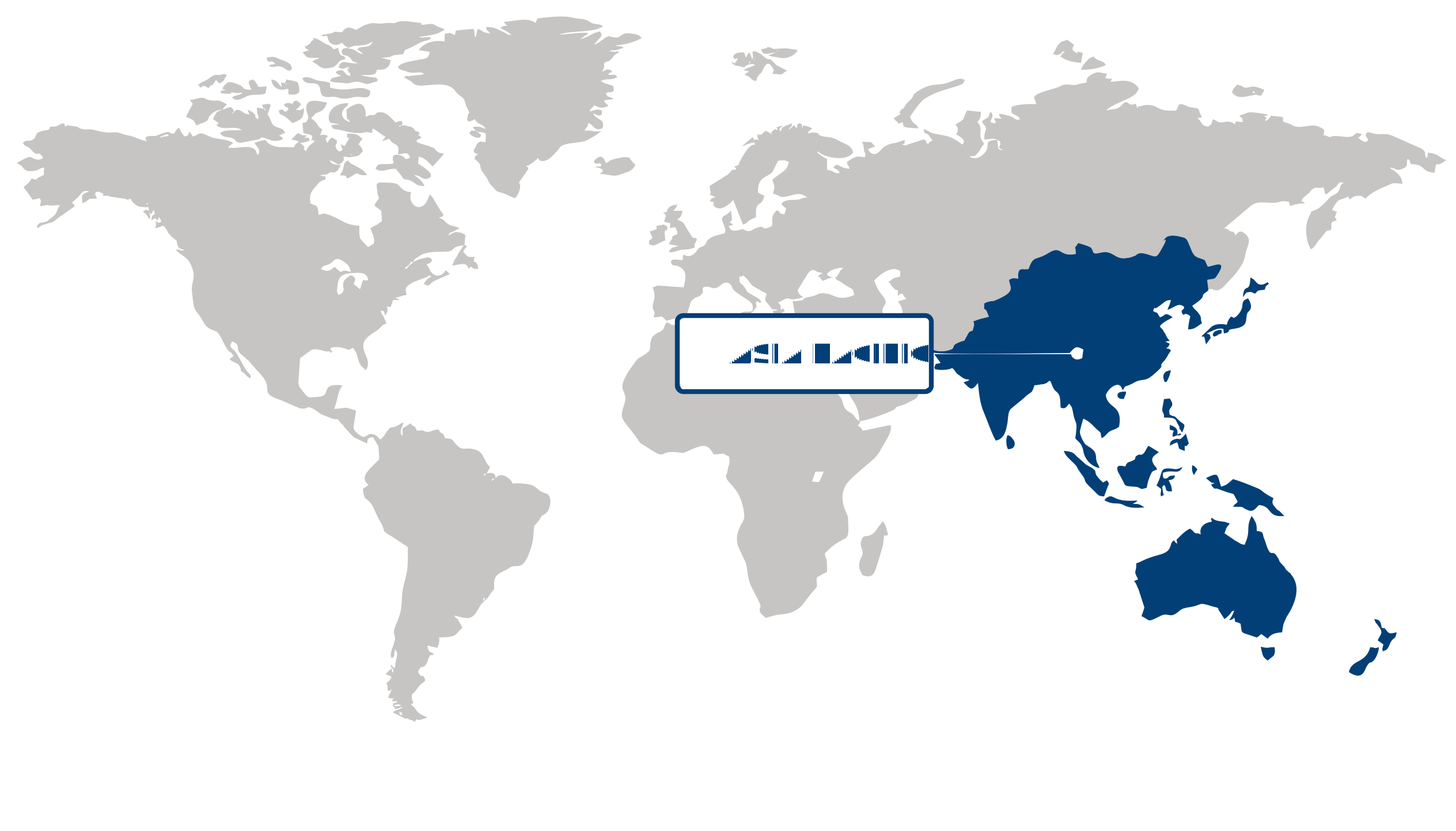
Asia Pacific (Largest & Fastest-Growing Region)
The Asia Pacific train loaders market accounted for 43.46% in 2026, reflecting the region's strong position in rail infrastructure development and bulk material transportation. Extensive mining, industrial processing, and logistics activities are generating demand for efficient loading systems capable of supporting high-volume rail transportation. Investments in railway infrastructure, expansion of freight networks, and efforts to improve material handling efficiency are further supporting the adoption of automated and technologically advanced train loading solutions. Continued industrialization is expected to reinforce the region's role in both current demand and future market expansion.
| Parameter | North America | Asia Pacific | Europe | Latin America | MEA |
|---|---|---|---|---|---|
| Innovation Hub i Scale Nascent Developing Advanced | |||||
| Cost-Sensitive Region i Scale Low Medium High | |||||
| Regulatory Environment i Scale Restrictive Neutral Supportive | |||||
| Demand Drivers i Scale Weak Moderate Strong | |||||
| Development Stage i Scale Emerging Developing Developed | |||||
| Adoption Rate i Scale Low Medium High | |||||
| New Entrants / Startups i Scale Sparse Moderate Dense | |||||
| Macro Indicators i Scale Weak Stable Strong |
Key Country Insights
United States 🇺🇸
Bulk Logistics EfficiencyThe U.S. train loaders market is supported by extensive bulk commodity transportation across mining, agriculture, and industrial sectors. Operators increasingly invest in automated loading systems that improve loading accuracy, reduce cycle times, and optimize rail terminal productivity.
Germany 🇩🇪
Industrial Material HandlingGermany emphasizes train loaders that support efficient movement of industrial raw materials and manufactured goods. Equipment suppliers focus on precision loading technologies, automation, and integration with advanced rail logistics and terminal management systems.
Japan 🇯🇵
Space-Efficient OperationsJapan prioritizes train loaders designed for efficient operation within space-constrained logistics facilities. Demand favors automated equipment that delivers precise loading performance while minimizing operational downtime and supporting high-frequency freight movement.
South Korea 🇰🇷
Port Logistics IntegrationSouth Korea expands train loader deployment through integrated port, industrial, and rail logistics infrastructure. Operators prioritize automated loading solutions that improve cargo handling efficiency and facilitate seamless movement between maritime and inland transportation networks.
France 🇫🇷
Rail Freight ModernizationFrance continues investing in train loaders that strengthen rail freight efficiency across industrial and agricultural supply chains. Equipment selection increasingly emphasizes automation, dust control, and operational flexibility for diverse bulk material handling applications.
Italy 🇮🇹
Flexible Bulk HandlingItaly maintains demand for train loaders supporting cement, aggregates, agricultural products, and industrial materials. Companies seek adaptable loading equipment that improves throughput while accommodating varying freight volumes and terminal configurations.
Segment Leadership and Growth Trends
Train Loaders Market Share (%), by Loading Method, 2026
Go beyond the chart, access full insights & data tables
Request Free Sample ReportLoading Method Segment Analysis: Automatic (Largest & Fastest-Growing Segment)
The automatic loading method dominated the train loaders market with a 60.42% share in 2026 while also emerging as the fastest-growing segment. Its strong position is supported by the increasing need for high-throughput bulk material handling, improved operational efficiency, and greater loading precision across mining, ports, power generation, and industrial facilities. Automatic train loaders reduce loading time, improve consistency, minimize material loss, and enhance workplace safety by reducing manual intervention. Growing investment in industrial automation, digital monitoring systems, and efficient logistics infrastructure continues to reinforce the adoption of automatic loading solutions across bulk transportation operations.
Capacity Segment Analysis: High-capacity Loaders (Largest & Fastest-Growing Segment)
High-capacity loaders accounted for the largest share of 50.88% in 2026 while also representing the fastest-growing capacity segment. Their widespread adoption is driven by the rising movement of bulk commodities, where operators require equipment capable of handling large volumes with minimal downtime and maximum operational efficiency. These loaders support faster train turnaround, improve loading accuracy, and help optimize terminal productivity, making them well suited for large-scale mining, port, and industrial applications. Continued investments in high-capacity freight infrastructure and expanding bulk cargo transportation are expected to sustain the segment's strong momentum.
Type Segment Analysis: Gravimetric Train Loaders (Largest & Fastest-Growing Segment)
Gravimetric train loaders held the largest position in 2026 and also remained the fastest-growing type due to their ability to deliver precise weight-controlled loading for bulk materials. These systems improve cargo consistency, reduce overloading or underloading, and support compliance with transportation weight requirements, making them highly valuable in industries where loading accuracy directly affects operational efficiency. Increasing adoption of automated material handling technologies and the growing emphasis on process optimization, reduced product loss, and reliable bulk logistics continue to strengthen demand for gravimetric train loaders across industrial transportation networks.
| Segment | Sub-Segment | Largest Segment | Fastest Growing |
|---|---|---|---|
| Loading Method | Automatic, Semi-automatic, Manual | Automatic | Automatic |
| Capacity | Low-capacity Loaders, Medium-capacity Loaders, High-capacity Loaders | High-capacity Loaders | High-capacity Loaders |
| Type | Volumetric Train Loaders, Gravimetric Train Loaders, Others | Gravimetric Train Loaders | Gravimetric Train Loaders |
| Application | Open Wagon, Hopper Wagon, Tanker Wagon, Others | Open Wagon | Hopper Wagon |
| End-Use Industry | Mining, Agriculture, Construction, Oil & Gas, Energy & Power, Others | Mining | Energy & Power |
Competitive Landscape and Market Positioning
Key companies in the train loaders market:
- Caterpillar, Inc. (United States)
- Komatsu Ltd. (Japan)
- Sandvik AB (Sweden)
- FLSmidth & Co. A/S (Denmark)
- Metso Outotec Corporation (Finland)
- ThyssenKrupp AG (Germany)
- TAKRAF GmbH (Germany)
- Terex Corporation (United States)
- Hitachi Construction Machinery Co., Ltd. (Japan)
- Beumer Group GmbH & Co. KG (Germany)
Procurement decisions in the train loaders market are increasingly influenced by the ability to optimize bulk material handling efficiency while minimizing operational disruptions across mining, ports, and industrial logistics facilities. Manufacturers are differentiating through automated loading controls, dust mitigation technologies, and adaptable system configurations that accommodate varying railcar designs and material characteristics. Rather than competing solely on equipment durability, suppliers are expanding engineering and lifecycle service capabilities to support complex installation environments, where reliable performance, maintenance accessibility, and integration with broader terminal operations often determine long-term customer preference.
| Company | Market Share | Company Revenue | Revenue CAGR (%) | Product Portfolio | Geographic Presence | Innovation / R&D Focus | Strategic Developments |
|---|---|---|---|---|---|---|---|
| Caterpillar Inc. (United States) | |||||||
| Komatsu Ltd. (Japan) | |||||||
| Sandvik AB (Sweden) | |||||||
| FLSmidth & Co. A/S (Denmark) | |||||||
| Metso Outotec Corporation (Finland) | |||||||
| ThyssenKrupp AG (Germany) | |||||||
| TAKRAF GmbH (Germany) | |||||||
| Terex Corporation (United States) | |||||||
| Hitachi Construction Machinery Co. Ltd. (Japan) | |||||||
| Beumer Group GmbH & Co. KG (Germany) |
Industry Development/News
| Company Name | Date | Key Development |
|---|---|---|
| JCB | Dec-23 | Formed a new strategic partnership to enter the road-rail excavator segment, enabling the delivery of specialized machinery engineered for dual operation on roads and railways. This initiative aligns with national infrastructure development strategies and ongoing railway modernization programs in India. |
| Tamil Nadu Generation and Distribution Corporation | Sep-23 | Planned a Rs 50 crore wagon-loading facility in North Chennai to optimize coal handling capabilities for thermal power plants. The project is designed to streamline the regional coal supply chain and support operational requirements for the newly constructed North Chennai Stage III thermal power station. |
Customize Your Report
Explore examples of how this report can be tailored to different research needs, including custom segments, additional topics or chapters, and related reports. Click a section of the wheel or its numbered marker to explore the available options.
Train Loaders Market — Custom Segments
| Segment | Sub-Segment |
|---|---|
| Material Handled | Coal & Minerals, Grain & Agricultural Products, Cement & Construction Materials, Chemicals & Fertilizers, Other Bulk Materials |
| Installation Configuration | Fixed Installations, Mobile Installations, Relocatable Installations, Integrated Loading Systems |
| Power Source | Electric-Powered, Hydraulic-Powered, Diesel-Powered, Hybrid-Powered |
Train Loaders Market — Custom TOC
| Custom Chapter | Custom Details |
|---|---|
| Automated Train Loading Adoption Roadmap |
|
| Rail Terminal Investment Priorities |
|
| Loader Fleet Replacement Outlook |
|
Need a different cut of the data?
Request Custom ResearchHow much is the train loaders market worth?
How is the train loaders industry projected to perform over the next decade?
How is automation improving operational performance in the train loaders market?
Why is predictive maintenance becoming a strategic priority for train loader operators?
Why is the automatic loading method the leading segment in the train loaders market?
Which capacity segment is growing the fastest in the train loaders market?
What supports Asia Pacific’s leadership in the train loaders market?
Why is Asia Pacific expected to sustain strong train loader demand?
What are the key competitors in the train loaders landscape?
Our Clients
"The team surpassed our expectations with the report depth. The actionable insights provided proved crucial in navigating market challenges."
Tata Motors
"We found the report to be very informative. The expertise and attention to market nuances significantly influenced our business direction."
DENSO Corporation
"The consumer survey findings were quite good. We now have a clearer picture of the customer churning and retention strategy."
HL Mando
Our Research Team & Methodology
Every Fundamental Business Insights report is built by a dedicated vertical research team, validated through a structured primary-and-secondary methodology, and reviewed for accuracy before it reaches you.
Research Team Overview
Prepared by the Automotive & Transportation Research Team
Delivery
Published
Demand
Available
Support
Trust & Compliance
Research Domains
10 coverage areasResearch Intelligence
| Source | Reference |
|---|---|
| International Organization of Motor Vehicle Manufacturers (OICA) | www.oica.net |
| SAE International | www.sae.org |
| International Energy Agency (IEA) | www.iea.org |
| International Transport Forum (ITF) | www.itf-oecd.org |
| International Road Federation (IRF) | www.irf.global |
| International Organization for Standardization (ISO) | www.iso.org |
| United Nations Economic Commission for Europe (UNECE) | unece.org |
| National Highway Traffic Safety Administration (NHTSA) | www.nhtsa.gov |
| U.S. Department of Transportation (USDOT) | www.transportation.gov |
| European Automobile Manufacturers' Association (ACEA) | www.acea.auto |
| Society of Indian Automobile Manufacturers (SIAM) | www.siam.in |
| International Air Transport Association (IATA) | www.iata.org |
| International Civil Aviation Organization (ICAO) | www.icao.int |
| International Maritime Organization (IMO) | www.imo.org |
| International Union of Railways (UIC) | uic.org |
| American Public Transportation Association (APTA) | www.apta.com |
| International Federation of Robotics (IFR) | ifr.org |
| CharIN | www.charin.global |
| World Shipping Council | www.worldshipping.org |
| International Federation of Freight Forwarders Associations (FIATA) | fiata.org |
Research Workflow & Quality Assurance
Data Collection
Verified information gathered through primary and secondary research.
Data Triangulation
Cross-validation using multiple independent data sources.
Forecast Modelling
Market estimates developed using historical trends and analytical models.
Analyst Validation
Findings reviewed by domain experts for accuracy and consistency.
Editorial & Quality Review
Final editorial, quality, and compliance checks before publication.
Final Publication
Released after successful completion of the internal review process.
Report Coverage
📊 Market Assessment
- Market Size & Forecast
- Market Segmentation
- Regional Analysis
- Growth Drivers & Challenges
- Market Dynamics
🏢 Competitive Intelligence
- Competitive Landscape
- Company Profiles
- Competitive Benchmarking
- Mergers & Acquisitions
- Market Share Analysis or Key Company Strategies
🔍 Strategic Analysis
- Value Chain Analysis
- Porter's Five Forces
- PESTLE Analysis
- Pricing Trends
- Supply-Demand Analysis
🚀 Future Outlook
- Technology Landscape
- Regulatory Landscape
- Investment & Funding Landscape
- Emerging Opportunities
- Future Market Outlook
Have a question about this report or need a custom scope?
Request Customization