Track Laying Equipment Market Size & Growth Forecast 2027–2036, By Segments (Application, Technology, End-Use, Equipment), Regional Demand Trends (North America, Asia Pacific, Europe), Key Country Insights (U.S., Japan, South Korea, Germany, France, Italy), and Competitive Landscape
Market Size and Growth Outlook
Track Laying Equipment Market size was valued at USD 724.69 Million in 2026 and is projected to grow at 5.51% CAGR from 2027 to 2036, attaining USD 1.24 Billion by 2036. The industry revenue for 2027 is estimated at USD 758.61 Million.
Get more details on this report
Request Free Sample ReportTrack Laying Equipment Market Intelligence Snapshot
Regional Market Dynamics
- Asia Pacific dominated in 2026, supported by extensive railway expansion, urbanization, transportation infrastructure investment, and development of high-speed, urban transit, and freight rail networks.
- The region is also the fastest-growing, with rail modernization, aging asset replacement, mechanized construction, and demand for improved workforce productivity supporting equipment adoption.
Segment Momentum
- New railway construction held a 60.1% market share in 2026, driven by investments in rail network expansion, regional connectivity, and transportation corridors requiring efficient and precise track installation equipment.
- Fully automated technology is the fastest-growing segment as railway projects increasingly prioritize productivity, installation precision, digital construction practices, and faster project completion.
Market Expansion Drivers
- Rapid expansion of rail infrastructure worldwide boosting procurement of track laying equipment
- Government investments and modernization programs accelerating railway construction activities
- Increasing deployment of high-speed rail networks driving demand for advanced equipment
Leading Market Participants
- Key companies in the track laying equipment market include Plasser & Theurer (Austria), Vossloh AG (Germany), CRRC Corporation Limited (China), Harsco Rail (United States), Matisa SA (Switzerland), Alstom SA (France), Balfour Beatty plc (United Kingdom), Robel Bahnbaumaschinen GmbH (Germany), Loram Maintenance of Way, Inc. (United States), CRCC High-Tech Equipment Corporation (China)
Global Market Forecast Snapshot
Market Outlook
- 2026 Market Size: USD 724.69 Million
- 2027 Estimated Market Size: USD 758.61 Million
- Projected Market Size: USD 1.24 Billion by 2036
- Growth Forecast: 5.51% CAGR (2027-2036)
Regional and Segment Outlook
- Leading Regional Market: Asia Pacific
- High-Growth Regional Hub: Asia Pacific
- Core Revenue Segment: New Railway Construction (Application) | Manual (Technology) | Public Rail Systems (End-Use) | Track Laying Machines (Equipment)
- Emerging Opportunity Segment: Upgrades and Modernization (Application) | Fully Automated (Technology) | Private Freight Companies (End-Use) | Tamping Machines (Equipment)
Market Growth Drivers and Industry Trends
Rapid expansion of rail infrastructure worldwide boosting procurement of track laying equipment
The continued development of railway networks to improve freight movement and passenger connectivity is creating sustained demand for specialized construction machinery. This trend will drive the track laying equipment market growth as infrastructure developers procure equipment capable of accelerating rail installation while maintaining high levels of accuracy and operational efficiency. Modern track laying machinery enables faster project execution, reduces manual labor requirements, and supports consistent track alignment across large-scale railway construction projects.
Government investments and modernization programs accelerating railway construction activities
Public investment in transportation infrastructure is encouraging extensive railway expansion, rehabilitation, and capacity enhancement across both urban and intercity networks. These initiatives will boost the track laying equipment market demand by increasing procurement of advanced machinery required for new rail corridors and modernization of existing lines. Contractors are prioritizing equipment that improves construction productivity, minimizes project delays, and supports efficient execution of complex rail infrastructure programs under demanding operational schedules.
Increasing deployment of high-speed rail networks driving demand for advanced equipment
The construction of high-speed rail systems requires exceptional precision during track installation to ensure long-term operational safety and performance. As these projects expand, the track laying equipment market benefits from rising demand for technologically advanced machinery capable of achieving accurate rail positioning, consistent alignment, and efficient installation across challenging project environments. Equipment designed for high-speed rail applications also supports stringent engineering standards through enhanced automation, precision control, and reliable construction performance.
| Growth Driver | Impact on CAGR | Regulatory Influence | Geographic Relevance | Adoption Rate | Impact Timeline |
|---|---|---|---|---|---|
| Rapid expansion of rail infrastructure worldwide boosting procurement of track laying equipment | 2.2% | High | Asia Pacific, Europe, Middle East & Africa | High | Near Term |
| Government investments and modernization programs accelerating railway construction activities | 1.9% | High | Asia Pacific, Europe, North America | High | Mid Term |
| Increasing deployment of high-speed rail networks driving demand for advanced equipment | 1.5% | High | Asia Pacific, Europe | Emerging | Long Term |
Unlock insights tailored to your business with our bespoke market research solutions.
Click to get your customized report now.
Regional Demand Dynamics
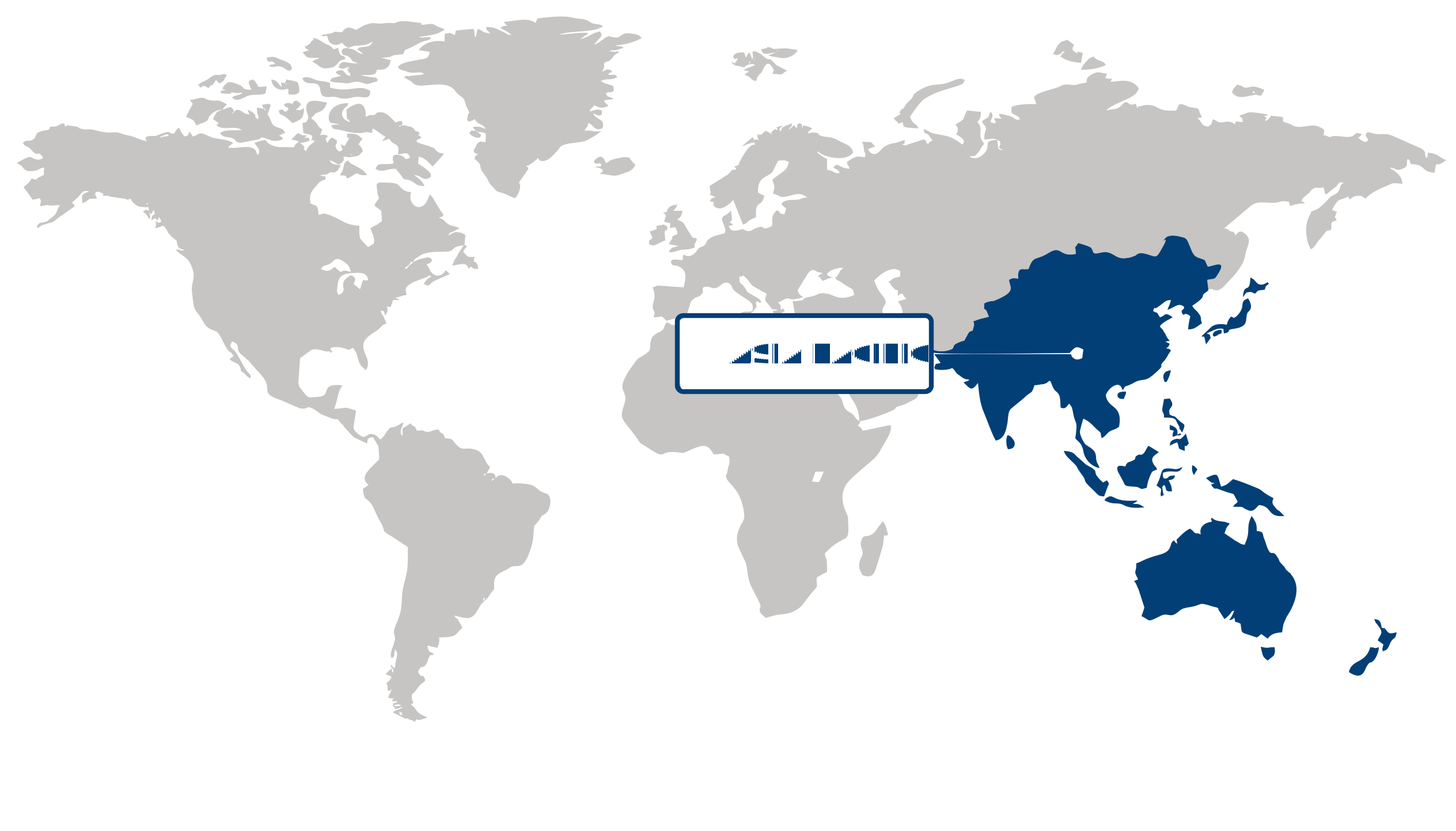
Asia Pacific (Largest & Fastest-Growing Region)
Asia Pacific dominated the track laying equipment market in 2026 and is also expected to remain the fastest-growing regional market, supported by extensive railway expansion and ongoing investment in transportation infrastructure. Rapid urbanization and increasing demand for efficient mass transportation are driving the development and modernization of rail networks across the region. Large-scale railway construction and the expansion of high-speed, urban transit, and freight rail systems are creating sustained requirements for specialized equipment that can improve track installation efficiency and reduce construction time. Infrastructure modernization programs and the replacement of aging rail assets are further supporting equipment demand. In addition, the growing emphasis on mechanized construction and improved workforce productivity is encouraging railway contractors to adopt advanced track laying solutions capable of handling increasingly complex infrastructure projects.
| Parameter | North America | Asia Pacific | Europe | Latin America | MEA |
|---|---|---|---|---|---|
| Innovation Hub i Scale Nascent Developing Advanced | |||||
| Cost-Sensitive Region i Scale Low Medium High | |||||
| Regulatory Environment i Scale Restrictive Neutral Supportive | |||||
| Demand Drivers i Scale Weak Moderate Strong | |||||
| Development Stage i Scale Emerging Developing Developed | |||||
| Adoption Rate i Scale Low Medium High | |||||
| New Entrants / Startups i Scale Sparse Moderate Dense | |||||
| Macro Indicators i Scale Weak Stable Strong |
Key Country Insights
United States 🇺🇸
Rail Infrastructure SupportU.S. investment in rail construction and network renewal supports demand for advanced track laying equipment capable of improving installation productivity. Contractors in the U.S. increasingly value automated systems that reduce project timelines while maintaining installation accuracy.
Germany 🇩🇪
Automated Rail ConstructionGermany continues integrating advanced track laying equipment into railway modernization projects to improve construction efficiency. Rail contractors in Germany prioritize precision placement technologies, digital machine control, and dependable equipment performance for complex infrastructure works.
Japan 🇯🇵
High-Accuracy InstallationJapan emphasizes precise track laying equipment to support high-performance rail infrastructure and minimize construction disruptions. Equipment selection in Japan increasingly focuses on automation, compact operation, and compatibility with maintenance-intensive rail networks.
South Korea 🇰🇷
Transit Expansion EquipmentSouth Korea utilizes modern track laying equipment for urban transit expansion and railway infrastructure development. Construction firms in South Korea increasingly seek versatile machinery that supports efficient installation while reducing labor intensity on project sites.
France 🇫🇷
Network Renewal FocusFrance continues upgrading rail infrastructure through projects requiring efficient and accurate track laying equipment. Contractors in France prioritize machines that improve installation consistency, operational safety, and productivity across conventional and high-speed rail projects.
Italy 🇮🇹
Regional Rail ModernizationItaly supports demand for track laying equipment through ongoing railway upgrades and regional transport improvements. Infrastructure contractors in Italy increasingly favor equipment offering operational flexibility, efficient deployment, and reliable performance across varied rail construction environments.
Segment Leadership and Growth Trends
Track Laying Equipment Market Share (%), by Application, 2026
Go beyond the chart, access full insights & data tables
Request Free Sample ReportApplication Segment Analysis: New Railway Construction (Largest Segment) vs Upgrades and Modernization (Fastest-Growing Segment)
The new railway construction segment accounted for 60.1% of the market share in 2026, making it the largest application segment in the track laying equipment market. Large-scale investments in expanding rail networks, improving regional connectivity, and developing new transportation corridors have sustained demand for specialized track laying equipment. Governments and infrastructure authorities continue to prioritize new rail projects to accommodate increasing passenger and freight movement, driving the widespread deployment of equipment designed for efficient and precise track installation.
The upgrades and modernization segment is expected to witness the fastest growth as railway operators increasingly focus on improving the performance, safety, and efficiency of existing rail infrastructure. Modernization initiatives involving track replacement, alignment improvements, and network electrification require advanced equipment capable of minimizing operational disruptions while enhancing construction accuracy. Continued investment in rail network renewal programs is expected to strengthen demand within this segment.
Technology Segment Analysis: Manual (Largest Segment) vs Fully Automated (Fastest-Growing Segment)
The manual technology segment held 58.3% of the market share in 2026, establishing itself as the largest technology category. Manual track laying equipment remains widely utilized due to its operational flexibility, lower capital requirements, and suitability for projects in locations where highly automated systems may not be practical. Its continued adoption across maintenance work and smaller-scale rail construction projects has reinforced the segment's leading position.
In the track laying equipment market, the fully automated technology segment is projected to record the fastest growth as railway projects increasingly emphasize productivity, precision, and operational efficiency. Automated systems help streamline track installation, reduce manual intervention, and improve consistency across complex construction activities. Growing adoption of digital construction technologies and the need to accelerate project completion timelines are expected to support the expansion of fully automated equipment.
End-Use Segment Analysis: Public Rail Systems (Largest Segment) vs Private Freight Companies (Fastest-Growing Segment)
The public rail systems segment accounted for 54.17% of the market share in 2026, making it the largest end-use segment. Public sector investment in expanding urban transit systems, intercity rail networks, and national transportation infrastructure has consistently driven demand for track laying equipment. Long-term infrastructure development programs and continuous maintenance of public railway assets have further supported the segment's dominant position.
The private freight companies segment is anticipated to experience the fastest growth in the track laying equipment market as logistics providers continue expanding rail freight capacity to improve transportation efficiency. Rising industrial activity, increasing demand for cost-effective cargo movement, and investments in dedicated freight corridors are encouraging private operators to modernize and extend their rail infrastructure. These developments are expected to accelerate equipment adoption across the private freight sector.
| Segment | Sub-Segment | Largest Segment | Fastest Growing |
|---|---|---|---|
| Application | New Railway Construction, Track Maintenance, Upgrades and Modernization | New Railway Construction | Upgrades and Modernization |
| Technology | Manual, Semi-automated, Fully Automated | Manual | Fully Automated |
| End-Use | Public Rail Systems, Private Freight Companies, Private Passenger Operators, Defense | Public Rail Systems | Private Freight Companies |
| Equipment | Track Laying Machines, Sleeper Laying Machines, Ballast Regulators, Tamping Machines, Track Maintenance Equipment, Welding Machines, Others | Track Laying Machines | Tamping Machines |
Competitive Landscape and Market Positioning
Top players in the track laying equipment market:
- Plasser & Theurer (Austria)
- Vossloh AG (Germany)
- CRRC Corporation Limited (China)
- Harsco Rail (United States)
- Matisa SA (Switzerland)
- Alstom SA (France)
- Balfour Beatty plc (United Kingdom)
- Robel Bahnbaumaschinen GmbH (Germany)
- Loram Maintenance of Way, Inc. (United States)
- CRCC High-Tech Equipment Corporation (China)
Infrastructure modernization projects are encouraging equipment manufacturers to compete through higher levels of automation, operational precision, and productivity rather than expanding equipment portfolios alone. Buyers increasingly favor solutions that minimize construction time while maintaining consistent track alignment under demanding site conditions, prompting suppliers to integrate advanced control technologies and improved machine adaptability. Service capabilities, operator support, and lifecycle maintenance are also becoming more influential in procurement decisions, particularly for projects requiring extended equipment availability. These shifts are driving manufacturers to combine robust engineering with comprehensive operational support to strengthen their presence in increasingly specialized rail construction environments.
| Company | Market Share | Company Revenue | Revenue CAGR (%) | Product Portfolio | Geographic Presence | Innovation / R&D Focus | Strategic Developments |
|---|---|---|---|---|---|---|---|
| Plasser & Theurer (Austria) | |||||||
| Vossloh AG (Germany) | |||||||
| CRRC Corporation Limited (China) | |||||||
| Harsco Rail (United States) | |||||||
| Matisa SA (Switzerland) | |||||||
| Alstom SA (France) | |||||||
| Balfour Beatty plc (United Kingdom) | |||||||
| Robel Bahnbaumaschinen GmbH (Germany) | |||||||
| Loram Maintenance of Way Inc. (United States) | |||||||
| CRCC High-Tech Equipment Corporation (China) |
Industry Development/News
| Company Name | Date | Key Development |
|---|---|---|
| Plasser & Theurer | Mar-25 | Plasser & Theurer launched an upgraded track laying machine model integrating semi- and fully automated operations, GPS- and IoT-enabled real-time monitoring, and predictive maintenance systems. This technological advancement aims to enhance operational efficiency, reduce construction delays, and improve track quality for high-speed rail, metro, and freight corridor projects globally. |
| Vossloh | Feb-25 | Vossloh introduced a new digital track management platform featuring real-time equipment monitoring, automated ballast handling, and predictive alignment analytics. The rollout focuses on optimizing project timelines, streamlining track laying and maintenance workflows, and supporting major rail infrastructure initiatives across Europe, Asia-Pacific, and North America. |
| Matisa | Jan-25 | Matisa unveiled an artificial intelligence-driven tamping and track inspection system for industrial and urban rail projects. The platform incorporates automated track alignment, digital performance monitoring, and predictive maintenance alerts to target high-frequency rail construction, enabling faster deployment and enhanced operational reliability. |
| Salfec | Dec-24 | Salfec expanded its product portfolio by introducing internet of things-enabled ballast regulators, automated sleeper laying systems, and cloud-integrated project monitoring tools. The strategic deployment targets rail contractors, government authorities, and industrial operators to improve efficiency, enhance safety, and minimize operational downtime during infrastructure projects. |
| Weihua Group | Oct-24 | Weihua Group, alongside Spenco and Enviri, launched integrated track laying solutions featuring real-time monitoring, artificial intelligence-assisted predictive maintenance, and automated construction workflows. The collaborative introduction emphasizes scalable operations, precise track alignment, and improved project execution efficiency across large-scale railway construction and freight corridor projects globally. |
Customize Your Report
Explore examples of how this report can be tailored to different research needs, including custom segments, additional topics or chapters, and related reports. Click a section of the wheel or its numbered marker to explore the available options.
Track Laying Equipment Market — Custom Segments
| Segment | Sub-Segment |
|---|---|
| Railway Track Type | Ballasted Track, Slab Track, Specialized Track Systems |
| Procurement Model | Direct Purchase, Equipment Leasing/Rental, Equipment-as-a-Service |
| Project Scale | Large-Scale Rail Infrastructure Projects, Regional Rail Projects, Urban Transit Projects |
Track Laying Equipment Market — Custom TOC
| Custom Chapter | Custom Details |
|---|---|
| Railway Project Execution Strategies |
|
| Automated Track Construction Adoption |
|
| Equipment Rental and Service Models |
|
Need a different cut of the data?
Request Custom ResearchWhat is the market size of track laying equipment?
What is the expected industry size of track laying equipment by 2036?
How are rail infrastructure investments influencing track laying equipment procurement?
Why do high-speed rail projects require more advanced track laying equipment?
Why is new railway construction the largest application in the track laying equipment market?
Which technology segment is expected to grow fastest in the track laying equipment market?
Why does Asia Pacific lead the track laying equipment market?
What is driving continued track laying equipment growth in Asia Pacific?
Which organizations are considered leaders in the track laying equipment landscape?
Our Clients
"Your insights on workforce structures were spot-on. The analysis on mid-to-senior level roles validated some of our hiring decisions and highlighted gaps."
Ateliers De France
"The report gave us insights on competitors in the market. It helped our team refine our bidding strategy for upcoming contracts."
Clark Construction
"The reports provided a deep dive into market trends, and competitive landscape. The strategic insights and recommendations have been very helpful."
Rudolph and Sletten
Our Research Team & Methodology
Every Fundamental Business Insights report is built by a dedicated vertical research team, validated through a structured primary-and-secondary methodology, and reviewed for accuracy before it reaches you.
Research Team Overview
Prepared by the Construction & Manufacturing Research Team
Delivery
Published
Demand
Available
Support
Trust & Compliance
Research Intelligence
Research Workflow & Quality Assurance
Data Collection
Verified information gathered through primary and secondary research.
Data Triangulation
Cross-validation using multiple independent data sources.
Forecast Modelling
Market estimates developed using historical trends and analytical models.
Analyst Validation
Findings reviewed by domain experts for accuracy and consistency.
Editorial & Quality Review
Final editorial, quality, and compliance checks before publication.
Final Publication
Released after successful completion of the internal review process.
Report Coverage
📊 Market Assessment
- Market Size & Forecast
- Market Segmentation
- Regional Analysis
- Growth Drivers & Challenges
- Market Dynamics
🏢 Competitive Intelligence
- Competitive Landscape
- Company Profiles
- Competitive Benchmarking
- Mergers & Acquisitions
- Market Share Analysis or Key Company Strategies
🔍 Strategic Analysis
- Value Chain Analysis
- Porter's Five Forces
- PESTLE Analysis
- Pricing Trends
- Supply-Demand Analysis
🚀 Future Outlook
- Technology Landscape
- Regulatory Landscape
- Investment & Funding Landscape
- Emerging Opportunities
- Future Market Outlook
Have a question about this report or need a custom scope?
Request Customization