Torque Sensor Market Size & Growth Forecast 2027–2036, By Segments (Type, Application, Technology), Regional Demand Trends (North America, Asia Pacific, Europe), Key Country Insights (U.S., Japan, South Korea, Germany, France, Italy), and Competitive Landscape
Market Size and Growth Outlook
Torque Sensor Market size was estimated at USD 8.54 Billion in 2026 and is projected to grow at 6.36% CAGR from 2027 to 2036, exceeding USD 15.82 Billion by 2036. The industry revenue for 2027 is calculated at USD 9 Billion.
Get more details on this report
Request Free Sample ReportTorque Sensor Market Intelligence Snapshot
Regional Market Dynamics
- Asia Pacific leads through strong industrial automation, expanding automotive manufacturing, and a broad manufacturing base adopting precision measurement technologies across machinery, robotics, and industrial equipment.
- Production modernization, automated manufacturing, electric mobility investments, advanced machinery, and smart manufacturing are broadening applications and sustaining regional market momentum.
Segment Momentum
- Automotive applications lead the market as torque sensors support power steering, transmission testing, drivetrain development, and electric vehicle component performance optimization.
- Healthcare is the fastest-growing application as precision sensing technologies are increasingly integrated into medical devices requiring accurate motion control, force measurement, and reliability.
Market Expansion Drivers
- Ongoing industrial automation trend increasing demand for precision sensing solutions
- Growing automotive industry supporting wider integration of torque sensing technologies
- Rising adoption of electric vehicles expanding advanced sensor deployment requirements
Leading Market Participants
- Key players in the torque sensor market include Honeywell International Inc. (United States), TE Connectivity Ltd. (Switzerland), ABB Ltd. (Switzerland), Kistler Group (Switzerland), HBM Test and Measurement (Germany), FUTEK Advanced Sensor Technology, Inc. (United States), Crane Electronics Ltd. (United Kingdom), A&D Company, Limited (Japan), KTR Systems GmbH (Germany)
Global Market Forecast Snapshot
Market Outlook
- 2026 Market Size: USD 8.54 Billion
- 2027 Estimated Market Size: USD 9 Billion
- Projected Market Size: USD 15.82 Billion by 2036
- Growth Forecast: 6.36% CAGR (2027-2036)
Regional and Segment Outlook
- Leading Regional Market: Asia Pacific
- High-Growth Regional Hub: Asia Pacific
- Core Revenue Segment: Rotary Torque Sensor (Type) | Automotive (Application) | Strain Gauge (Technology)
- Emerging Opportunity Segment: Rotary Torque Sensor (Type) | Healthcare (Application) | Surface Acoustic Wave (SAW) (Technology)
Market Growth Drivers and Industry Trends
Ongoing industrial automation trend increasing demand for precision sensing solutions
The ongoing shift toward automated production, robotics, and digitally controlled machinery is increasing the need for accurate measurement of mechanical forces throughout industrial operations. The torque sensor market will benefit as manufacturers integrate precision sensing into robotic joints, motors, actuators, assembly equipment, and automated material-handling systems where controlled torque is essential for consistent performance. Torque measurement enables machines to detect overload conditions, regulate applied force, and verify that components are assembled within required tolerances, supporting both productivity and quality control. As factories adopt more interconnected equipment and closed-loop control architectures, demand is also expanding for sensors that can provide reliable real-time feedback while operating under vibration, temperature variation, and continuous-duty conditions.
Growing automotive industry supporting wider integration of torque sensing technologies
Vehicle production and the increasing complexity of automotive systems are broadening applications for torque measurement across powertrain, steering, braking, testing, and manufacturing processes. Growth in the torque sensor market will be supported by automakers and component manufacturers using precision sensing to validate mechanical performance, optimize assembly processes, and improve the reliability of vehicle systems. Torque sensors are particularly valuable in production environments where automated tools must apply controlled fastening forces and detect deviations that could affect vehicle quality. Expanding vehicle manufacturing activity also creates demand for testing equipment capable of evaluating drivetrain and component performance under different operating conditions, increasing the role of torque measurement across both production and validation workflows.
Rising adoption of electric vehicles expanding advanced sensor deployment requirements
The transition toward electric mobility is creating new sensing requirements as vehicle architectures increasingly rely on electric motors, electronically controlled drivetrains, and sophisticated power-management systems. The torque sensor market will gain from this shift as manufacturers use torque measurement to evaluate motor output, drivetrain efficiency, steering response, and other performance characteristics associated with electrified vehicles. Precise torque feedback can support motor control and testing by helping engineers assess how efficiently electrical energy is converted into mechanical power while identifying deviations during development and production. The expanding use of automated manufacturing and validation systems for electric powertrains further increases the need for compact, accurate sensing technologies capable of supporting high-precision measurement.
| Growth Driver | Impact on CAGR | Regulatory Influence | Geographic Relevance | Adoption Rate | Impact Timeline |
|---|---|---|---|---|---|
| Ongoing industrial automation trend increasing demand for precision sensing solutions | 2.1% | Moderate | Asia Pacific, Europe | High | Near Term |
| Growing automotive industry supporting wider integration of torque sensing technologies | 1.9% | Moderate | Asia Pacific, North America | High | Mid Term |
| Rising adoption of electric vehicles expanding advanced sensor deployment requirements | 1.6% | High | Europe, North America | Emerging | Long Term |
Unlock insights tailored to your business with our bespoke market research solutions.
Click to get your customized report now.
Regional Demand Dynamics
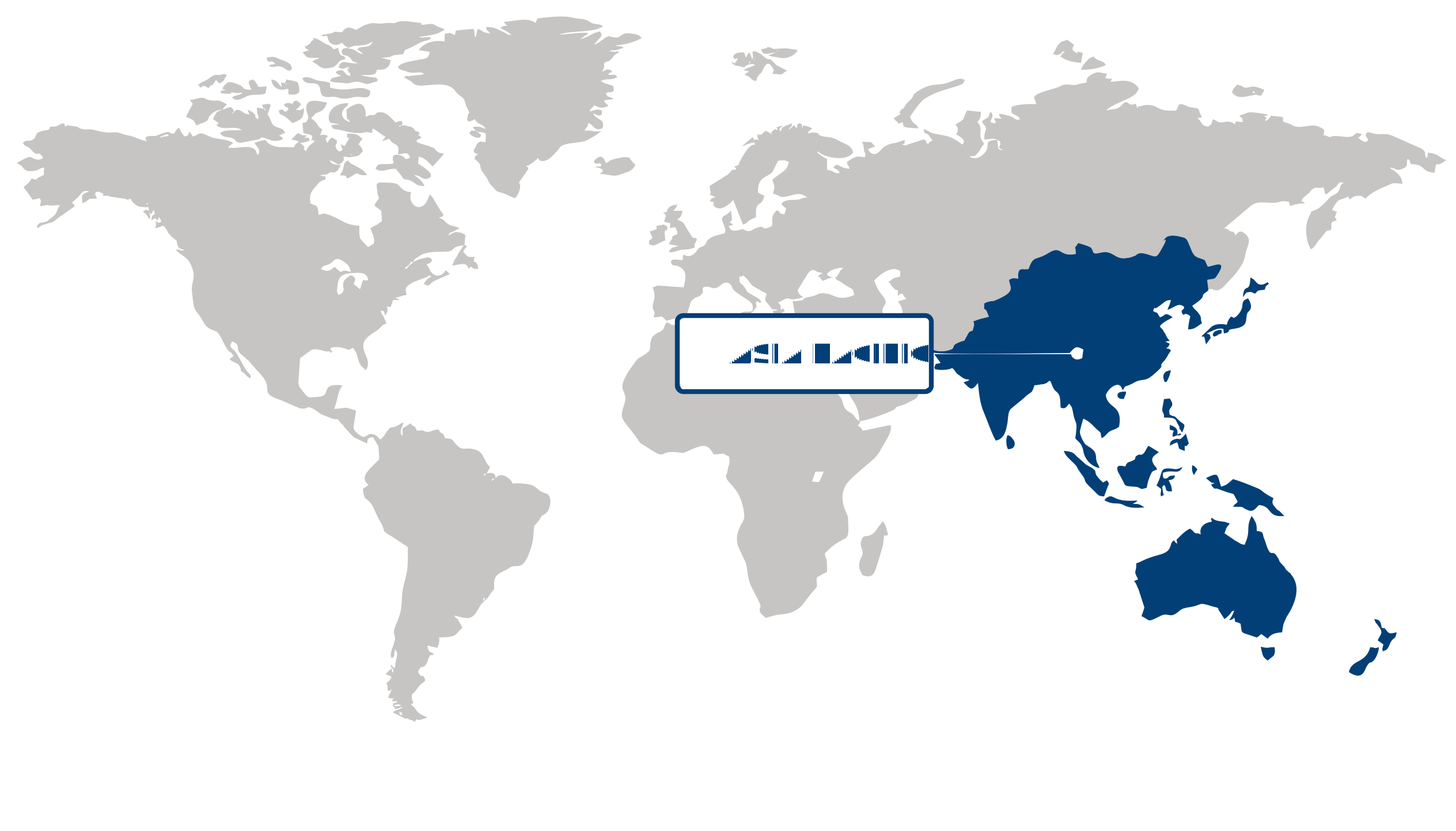
Asia Pacific (Largest & Fastest-Growing Region)
Asia Pacific led the torque sensor market and is also expected to remain the fastest-growing regional market, supported by strong industrial automation, expanding automotive manufacturing, and increasing adoption of precision measurement technologies. The region’s extensive manufacturing base is driving demand for torque sensing solutions across machinery, robotics, automotive systems, and industrial equipment, where accurate measurement is increasingly important for quality control and operational efficiency. Rapid modernization of production facilities and the shift toward automated manufacturing are further strengthening the need for sensors capable of delivering real-time performance data. In parallel, investments in electric mobility, advanced machinery, and smart manufacturing are broadening the application landscape for torque sensors and sustaining regional market momentum.
| Parameter | North America | Asia Pacific | Europe | Latin America | MEA |
|---|---|---|---|---|---|
| Innovation Hub i Scale Nascent Developing Advanced | |||||
| Cost-Sensitive Region i Scale Low Medium High | |||||
| Regulatory Environment i Scale Restrictive Neutral Supportive | |||||
| Demand Drivers i Scale Weak Moderate Strong | |||||
| Development Stage i Scale Emerging Developing Developed | |||||
| Adoption Rate i Scale Low Medium High | |||||
| New Entrants / Startups i Scale Sparse Moderate Dense | |||||
| Macro Indicators i Scale Weak Stable Strong |
Key Country Insights
United States 🇺🇸
Industrial Automation IntegrationThe U.S. is expanding torque sensor deployment across industrial automation, robotics, and electric mobility applications requiring precise force measurement. Manufacturers increasingly integrate smart sensing technologies into connected production systems to improve equipment performance.
Germany 🇩🇪
Precision Manufacturing SystemsGermany emphasizes high-accuracy torque sensors for advanced manufacturing, automotive engineering, and industrial machinery. Equipment suppliers continue developing durable sensor technologies that support automated quality control and high-performance production processes.
Japan 🇯🇵
Robotics Measurement ExpertiseJapan incorporates torque sensors into robotics, precision machinery, and medical equipment where reliable motion control is essential. Domestic manufacturers prioritize compact, high-resolution sensing technologies that enhance system accuracy and operational stability.
South Korea 🇰🇷
Electronics Manufacturing SupportSouth Korea is strengthening torque sensor adoption across semiconductor equipment, robotics, and automated manufacturing facilities. Companies increasingly integrate advanced sensing solutions that improve precision assembly and process control in high-value industries.
France 🇫🇷
Aerospace Testing ApplicationsFrance applies torque sensors across aerospace, industrial equipment, and research environments requiring dependable mechanical measurement. Engineering organizations prioritize sensors that deliver consistent performance under demanding operating conditions and rigorous testing requirements.
Italy 🇮🇹
Machinery Performance MonitoringItaly is expanding torque sensor use within industrial machinery, automation equipment, and specialized manufacturing applications. Equipment builders increasingly adopt integrated sensing technologies that improve machine reliability and optimize production efficiency through continuous performance monitoring.
Segment Leadership and Growth Trends
Torque Sensor Market Share (%), by Type, 2026
Go beyond the chart, access full insights & data tables
Request Free Sample ReportType Segment Analysis: Rotary Torque Sensor (Largest & Fastest-Growing Segment)
The rotary torque sensor segment dominated the torque sensor market in 2026 and also represented the fastest-growing type category. Rotary torque sensors are extensively utilized in applications involving rotating shafts and dynamic torque measurement, making them essential across industrial machinery, automotive systems, testing equipment, and automation processes. Their ability to provide accurate real-time torque data supports performance optimization, quality control, and operational reliability. Growth in the segment is being driven by increasing automation across industries and rising demand for precise measurement technologies in advanced manufacturing environments. The expanding use of electric drive systems, robotics, and high-performance testing applications is further strengthening the adoption of rotary torque sensors. These trends continue to reinforce the segment’s leading position within the market.
Application Segment Analysis: Automotive (Largest Segment) vs Healthcare (Fastest-Growing Segment)
The automotive application segment held the largest share of the torque sensor market in 2026. Torque sensors play a critical role in vehicle systems, including power steering, transmission testing, drivetrain development, and electric vehicle components. The industry's ongoing focus on performance optimization, safety enhancement, and vehicle electrification has sustained strong demand for torque measurement solutions.
The healthcare segment is witnessing the fastest growth due to increasing integration of precision sensing technologies into medical devices and healthcare equipment. Torque sensors are becoming increasingly important in applications requiring accurate motion control, force measurement, and device reliability. Growing investment in advanced medical technologies and the expanding adoption of automated healthcare systems are supporting the rapid development of this segment.
Technology Segment Analysis: Strain Gauge (Largest Segment) vs Surface Acoustic Wave (SAW) (Fastest-Growing Segment)
The strain gauge technology segment accounted for the largest share of the market in 2026. Its dominance is supported by proven measurement accuracy, broad application compatibility, and long-standing use across industrial, automotive, and testing environments. Strain gauge-based torque sensors offer reliable performance and cost-effective implementation, making them a preferred choice for a wide range of torque measurement requirements.
The surface acoustic wave (SAW) technology segment is emerging as the fastest-growing category as industries increasingly seek advanced sensing solutions capable of wireless operation and enhanced measurement capabilities. SAW-based torque sensors offer advantages in environments where conventional wired configurations may be less practical. Continued technological advancements and increasing demand for smart sensing systems are contributing to the accelerated adoption of this technology.
| Segment | Sub-Segment | Largest Segment | Fastest Growing |
|---|---|---|---|
| Type | Rotary Torque Sensor, Reaction Torque Sensor | Rotary Torque Sensor | Rotary Torque Sensor |
| Application | Aerospace & Defense, Automotive, Testing & Measurement, Healthcare, Others | Automotive | Healthcare |
| Technology | Surface Acoustic Wave (SAW), Optical, Strain Gauge, Others | Strain Gauge | Surface Acoustic Wave (SAW) |
Competitive Landscape and Market Positioning
Key companies in the torque sensor market:
- Honeywell International, Inc. (United States)
- TE Connectivity Ltd. (Switzerland)
- ABB Ltd. (Switzerland)
- Kistler Group (Switzerland)
- HBM Test and Measurement (Germany)
- FUTEK Advanced Sensor Technology, Inc. (United States)
- Crane Electronics Ltd. (United Kingdom)
- A&D Company Limited (Japan)
- KTR Systems GmbH (Germany)
The torque sensor market is being transformed by rising demand for precise measurement solutions across industrial automation, mobility, and advanced mechanical systems. Manufacturers are competing through improvements in sensing accuracy, durability, and integration capabilities as end users seek components that support smarter and more efficient operations. While established suppliers leverage technical expertise and application knowledge, specialized developers are creating opportunities through compact designs and solutions tailored to emerging technology platforms. The market increasingly rewards providers capable of adapting sensor performance to increasingly complex engineering requirements.
| Company | Market Share | Company Revenue | Revenue CAGR (%) | Product Portfolio | Geographic Presence | Innovation / R&D Focus | Strategic Developments |
|---|---|---|---|---|---|---|---|
| Honeywell International Inc. (United States) | |||||||
| TE Connectivity Ltd. (Switzerland) | |||||||
| ABB Ltd. (Switzerland) | |||||||
| Kistler Group (Switzerland) | |||||||
| HBM Test and Measurement (Germany) | |||||||
| FUTEK Advanced Sensor Technology Inc. (United States) | |||||||
| Crane Electronics Ltd. (United Kingdom) | |||||||
| A&D Company Limited (Japan) | |||||||
| KTR Systems GmbH (Germany) |
Industry Development/News
| Company Name | Date | Key Development |
|---|---|---|
| Bosch | Jun-26 | Bosch expanded its e-bike drivetrain footprint by entering the hub motor segment with the launch of its Hub Line rear-hub system. This portfolio diversification alters its traditional mid-drive focus, allowing the company to capture new market share in bicycle segments using torque-sensing technologies. |
| Velocomp | Apr-26 | Velocomp commercialized PowerBoost, an alternative rider input detection system designed to challenge conventional e-bike torque sensors. The product launch introduces a differentiated technical approach to performance tracking and system integration, impacting competitive dynamics within electric bicycle drivetrains. |
| Melectric Systems | Nov-25 | Melectric Systems launched a specialized driveshaft torque sensor optimized for real-world automotive validation. The technology bridges laboratory measurement precision with field testing capabilities, directly addressing complex engineering requirements in modern vehicle development programs. |
| BlueDot Touch | Jul-25 | BlueDot Touch secured nearly CNY 100 million in Series B financing to scale its force sensor business. The capital injection accelerates the development and commercialization of six-axis force sensors designed for humanoid robots, strengthening its competitive positioning in high-growth automation segments. |
| Mahle | Jun-25 | Mahle introduced the M40 e-bike motor, integrating a high-precision sensing system that continuously monitors wheel speed and torque input. The technology enables active traction control, representing a material technological innovation in commercial electric bicycle powertrain safety and efficiency. |
| Universal Robots | Jun-24 | Universal Robots and MiR established a shared robotics headquarters in Denmark to capture operational synergies. The joint facility serves to co-locate engineering resources and accelerate technical innovation in collaborative robotic ecosystems that depend heavily on advanced force and torque sensing capabilities. |
| Forcen | Apr-24 | Forcen secured new investment funding dedicated to accelerating the commercialization of its force and torque sensing technologies. The capital supports the deployment of standard and customized tactile sensor solutions aimed at improving precision in complex robotic manipulation tasks. |
| Bota Systems | Mar-24 | Bota Systems launched an upgraded multi-axis force-torque sensor for small collaborative robots, achieving significantly higher sensitivity than its prior SensONE platform. The deployment enhances precision capabilities for small-scale automation, expanding the company's high-performance sensor portfolio. |
| MOD Bikes | Mar-24 | MOD Bikes commercialized its updated 2024 product line featuring redesigned torque sensors alongside dual-battery integration. The portfolio enhancement directly scales the company’s adoption of advanced rider sensing technology to improve overall electric bicycle performance and responsiveness. |
| Rad Power Bikes | Mar-24 | Rad Power Bikes executed its largest portfolio refresh by introducing four electric bicycle models featuring broader integration of torque-sensing pedal assist systems. The strategy marks a shift toward higher-performance configurations, altering competitive dynamics in the premium commuter segment. |
Customize Your Report
Explore examples of how this report can be tailored to different research needs, including custom segments, additional topics or chapters, and related reports. Click a section of the wheel or its numbered marker to explore the available options.
Torque Sensor Market — Custom Segments
| Segment | Sub-Segment |
|---|---|
| Customer Type | OEMs, System Integrators, End Users |
| Integration & Deployment Model | Embedded OEM Integration, Retrofit & Aftermarket Integration, Standalone Measurement Systems |
| Sales Channel | Direct Sales, Distributors & Resellers, Online & E-Commerce |
Torque Sensor Market — Custom TOC
| Custom Chapter | Custom Details |
|---|---|
| Electrification Demand Opportunity Assessment |
|
| Functional Safety and Compliance Landscape |
|
| High-Growth Application Opportunity Mapping |
|
Need a different cut of the data?
Request Custom ResearchWhat is the market valuation of torque sensor?
How is the torque sensor industry size expected to evolve during the forecast period?
How is industrial automation influencing demand for precision torque sensing?
Why are electric vehicle developments creating new torque sensor requirements?
Why does the automotive sector represent the largest demand area for torque sensors?
How are healthcare applications expanding torque sensor adoption?
Why does Asia Pacific lead the torque sensor market?
What is driving continued torque sensor growth in Asia Pacific?
Which companies dominate the torque sensor landscape?
Our Clients
"The team at Fundamental Business Insights & Consulting demonstrated a commitment to excellence, not only in the quality of the report but also in their client-centric approach."
FANUC
"The level of detail in the market segmentation provided were particularly noteworthy. The detailed country-level insights were also very helpful."
B&R Industrial Automation GmbH
"The consultant took the time to understand our specific business objectives, ensuring that the reports were tailored to address our unique challenges and opportunities."
KUKA SE & Co. KGaA
Our Research Team & Methodology
Every Fundamental Business Insights report is built by a dedicated vertical research team, validated through a structured primary-and-secondary methodology, and reviewed for accuracy before it reaches you.
Research Team Overview
Prepared by the Industrial Automation & Equipment Research Team
Delivery
Published
Demand
Available
Support
Trust & Compliance
Research Domains
10 coverage areasResearch Intelligence
| Source | Reference |
|---|---|
| International Society of Automation (ISA) | www.isa.org |
| International Organization for Standardization (ISO) | www.iso.org |
| National Institute of Standards and Technology (NIST) | www.nist.gov |
| IEEE | www.ieee.org |
| VDMA (German Mechanical Engineering Industry Association) | www.vdma.org |
| Association for Advancing Automation (A3) | www.automate.org |
| International Federation of Robotics (IFR) | ifr.org |
| ASME (American Society of Mechanical Engineers) | www.asme.org |
| ASHRAE | www.ashrae.org |
| American Society of Heating, Refrigerating and Air-Conditioning Engineers (ASHRAE) | www.ashrae.org |
| Material Handling Industry (MHI) | www.mhi.org |
| OSHA (Occupational Safety and Health Administration) | www.osha.gov |
| National Fire Protection Association (NFPA) | www.nfpa.org |
| ASTM International | www.astm.org |
| International Electrotechnical Commission (IEC) | www.iec.ch |
| Open Process Automation Forum (The Open Group) | www.opengroup.org/open-process-automation-forum |
| AGMA (American Gear Manufacturers Association) | www.agma.org |
| Association of Equipment Manufacturers (AEM) | www.aem.org |
| Food and Agriculture Organization (FAO) | www.fao.org |
| International Labour Organization (ILO) | www.ilo.org |
Research Workflow & Quality Assurance
Data Collection
Verified information gathered through primary and secondary research.
Data Triangulation
Cross-validation using multiple independent data sources.
Forecast Modelling
Market estimates developed using historical trends and analytical models.
Analyst Validation
Findings reviewed by domain experts for accuracy and consistency.
Editorial & Quality Review
Final editorial, quality, and compliance checks before publication.
Final Publication
Released after successful completion of the internal review process.
Report Coverage
📊 Market Assessment
- Market Size & Forecast
- Market Segmentation
- Regional Analysis
- Growth Drivers & Challenges
- Market Dynamics
🏢 Competitive Intelligence
- Competitive Landscape
- Company Profiles
- Competitive Benchmarking
- Mergers & Acquisitions
- Market Share Analysis or Key Company Strategies
🔍 Strategic Analysis
- Value Chain Analysis
- Porter's Five Forces
- PESTLE Analysis
- Pricing Trends
- Supply-Demand Analysis
🚀 Future Outlook
- Technology Landscape
- Regulatory Landscape
- Investment & Funding Landscape
- Emerging Opportunities
- Future Market Outlook
Have a question about this report or need a custom scope?
Request Customization