Thyristors Devices Market Size & Forecasts 2026-2035, By Segments (Application, Type), Growth Opportunities, Innovation Landscape, Regulatory Shifts, Strategic Regional Insights (U.S., Japan, China, South Korea, UK, Germany, France), and Competitive Dynamics (ON Semiconductor, STMicroelectronics, Infineon Technologies, Toshiba, Littelfuse)
Market Size and Growth Outlook
Thyristors Devices Market size is forecasted to reach USD 2.22 billion by 2035, rising from USD 1.02 billion in 2025, at a CAGR of more than 8.1% between 2026 and 2035. In 2026, revenue is projected at USD 1.1 billion.
Get more details on this report
Request Free Sample ReportThyristors Devices Market Intelligence Snapshot
Regional Market Dynamics
Segment Momentum
Market Expansion Drivers
Leading Market Participants
Global Market Forecast Snapshot
Market Outlook
Regional and Segment Outlook
Market Growth Drivers and Industry Trends
Rising demand for heavy-duty drives, HVDC transmission, and industrial rectifiers is extending the role of thyristors devices market as a backbone component for high-current switching. Evidence from ABB’s HVDC project portfolio and Siemens’ industrial drives line demonstrates continued specification of thyristor-based solutions where robustness and fault tolerance matter, while General Electric’s grid and industrial offerings show complementary converter architectures. Established suppliers can deepen value by bundling systems engineering and lifecycle services; new entrants can compete on modularity, faster time-to-deployment, or localized manufacturing. Given ongoing capital projects and supply-chain diversification at OEMs, procurement-led adoption and retrofits will sustain demand in the near term.
Adoption in renewable energy and smart grid systems
Integration of large-scale renewables and stability services in transmission networks is driving renewed interest in thyristors devices market for FACTS, STATCOMs, and converter stations. The National Renewable Energy Laboratory (NREL) and the International Energy Agency (IEA) have highlighted grid flexibility needs that align with thyristor-equipped reactive power and HVDC platforms, and Siemens Gamesa and GE Renewable Energy reference power-electronics interfaces in project materials. Incumbents can leverage project pipelines to upsell hybrid converter solutions, while specialists can target grid-connection niches and retrofit opportunities. Observable deployments of HVDC links and grid-stabilization projects indicate continued integration of these technologies into utility roadmaps.
Development of high-performance thyristor devices
Advances in semiconductor materials, packaging and thermal management are improving thyristor speed, efficiency and reliability, directly shaping the thyristors devices market through new product tiers. Corporate R&D and product announcements from Infineon Technologies, STMicroelectronics and Mitsubishi Electric, together with technical work in IEEE venues and Fraunhofer institutes, illustrate practical gains in current density and switching characteristics. Legacy manufacturers can monetize upgrades across installed bases; startups and specialty fabs can differentiate on bespoke high-voltage or ultra-fast designs. With manufacturers publicly investing in next-generation modules and academic–industry collaboration ongoing, product performance evolution is a tangible, near-term driver of supplier and end-user strategies.
Industry Restraints:
Supply Chain and Manufacturing Capacity Constraints: Tight availability of specialized wafers, discrete-power fabrication capacity, and long qualification cycles directly slow product introductions and inflate costs. Infineon Technologies AG and STMicroelectronics have publicly announced SiC and power-device capacity expansions, underscoring demand–supply imbalance, while reports from the U.S. Department of Commerce highlight geographic concentration and lead‑time vulnerabilities in semiconductor supply chains. Incumbents face compressed margins and delayed roadmaps as procurement and qualification timelines lengthen; new entrants confront capital- and partner-selection barriers because securing foundry and test-house capacity takes months. Expect this constraint to persist in the near to medium term as fabs scale and SiC adoption rises, sustaining pricing pressure and privileging strategic customer relationships and long-term supply agreements.
Regulatory and Standards Compliance Complexity: Increasingly stringent environmental and grid-interconnection rules extend development cycles and raise certification costs for thyristor devices. The European Chemicals Agency (ECHA) continues to tighten REACH restrictions affecting materials choices, Underwriters Laboratories (UL) and the International Electrotechnical Commission (IEC) (e.g., IEC 60747 series) impose rigorous safety/performance testing, and the North American Electric Reliability Corporation (NERC) enforces grid compatibility requirements that shape device specifications. Large manufacturers can amortize compliance investment, but smaller suppliers and startups face slower market entry and elevated upfront engineering spend. As regulators and standards bodies move toward tougher environmental and resiliency criteria, compliance timelines and verification burdens will remain a meaningful barrier, advantaging well‑capitalized, certified players.
| Growth Driver | Impact on CAGR | Regulatory Influence | Geographic Relevance | Adoption Rate | Impact Timeline |
|---|---|---|---|---|---|
| Demand from power electronics and industrial applications | 3.00% | Short term (≤ 2 yrs) | Asia Pacific, North America | Medium | Fast |
| Adoption in renewable energy and smart grid systems | 2.50% | Medium term (2–5 yrs) | Europe, North America | Medium | Moderate |
| Development of high-performance thyristor devices | 2.00% | Long term (5+ yrs) | North America, Europe | Low | Slow |
Unlock insights tailored to your business with our bespoke market research solutions.
Click to get your customized report now.
Regional Demand Dynamics
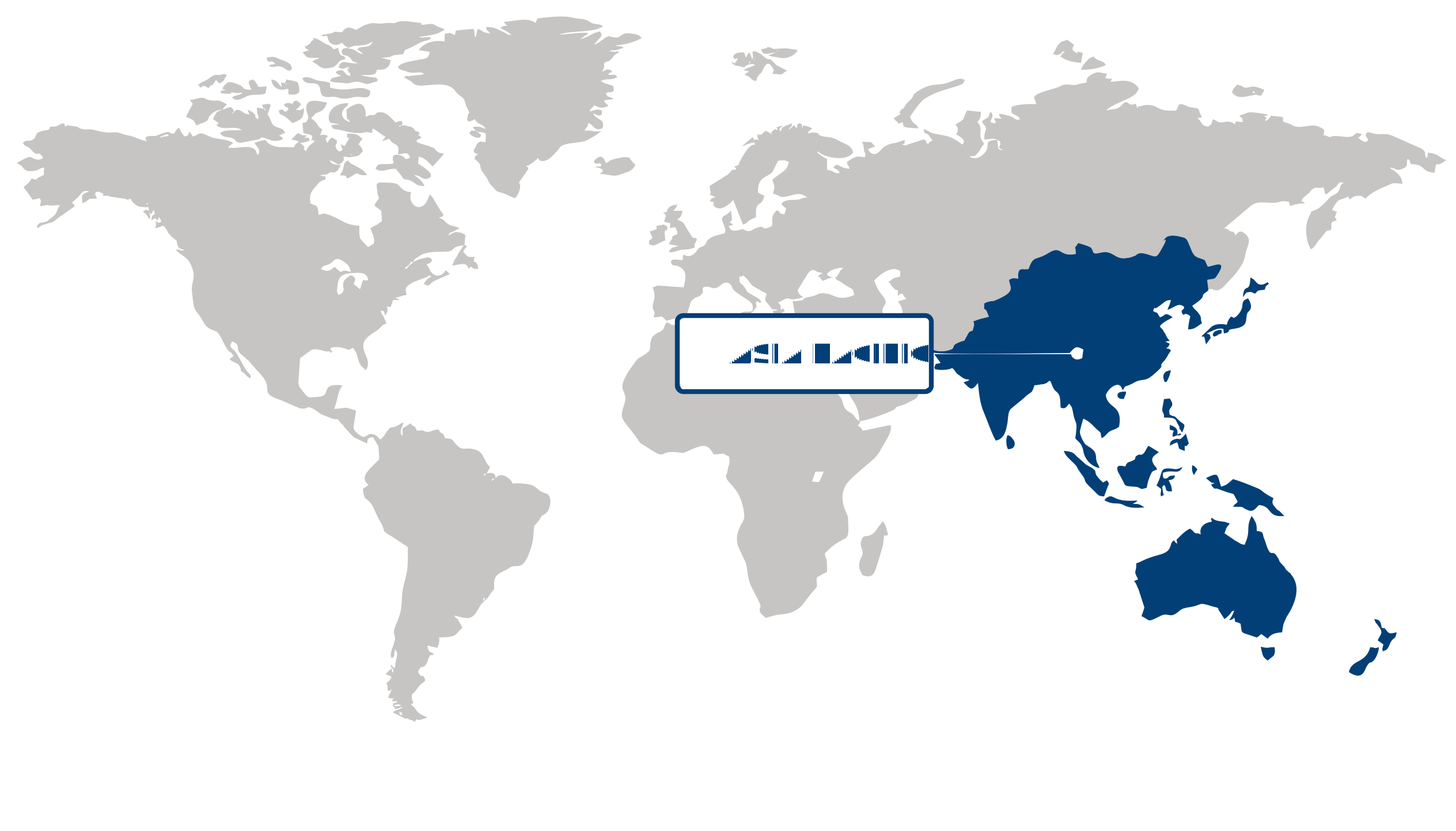
The Asia Pacific captured over 48% of the thyristors devices market in 2025 and, with a 9.72% CAGR, is both the largest and fastest‑growing region; this leadership is driven by accelerating power transmission upgrades and widespread industrial motor drive replacement programs. Rapid grid modernization and UHV transmission projects cited by State Grid Corporation of China, combined with rising electricity demand highlighted in the International Energy Agency (IEA) World Energy Outlook, underpin large-scale procurement of high‑power thyristors. Financing and policy support from the Asian Development Bank for infrastructure and OEM announcements from Mitsubishi Electric and Siemens on power‑electronics roadmaps further validate near‑term commercial demand. These dynamics — from capital projects to industrial electrification — create sustained opportunities for component suppliers, integrators, and service providers across the region.
Japan is positioned as a pivotal hub in Asia Pacific, where the thyristors devices market is concentrated around advanced industrial automation, rail electrification, and grid resilience projects supported by Ministry of Economy, Trade and Industry (METI) initiatives. Japanese OEMs such as Mitsubishi Electric and Toshiba publish product roadmaps and press releases emphasizing high‑reliability power semiconductors and system integration for heavy industry, reflecting local demand for precision and lifecycle service. Strong developer ecosystems and government R&D grants through NEDO channel technical innovation into exportable systems, making Japan a strategic center for high‑margin modules and testing capabilities that reinforce regional supply chains.
China anchors regional expansion as the thyristors devices market scales with large transmission builds and factory automation rollouts driven by national policy. State Grid Corporation of China’s ongoing UHV and grid upgrade projects, together with directives from the National Energy Administration (NEA) to expand electrification and industrial efficiency, generate volume demand for high‑power thyristors and rectifier assemblies. Domestic manufacturers, expanding capacity and publishing new product offerings, lower cost thresholds for system integrators while also intensifying competitive intensity. For investors and strategists, China’s scale and procurement cadence offer near‑term volume opportunities and a testing ground for cost optimization and local partnerships that amplify regional growth.
North America Market Analysis:
North America held a commanding share in the thyristors devices market, supported by accelerating grid modernization, heavy industrial electrification, and a sizable installed base of high-voltage power-conversion infrastructure. Demand for reliable power-control semiconductors has been reinforced by U.S. Department of Energy grid programs and North American Electric Reliability Corporation (NERC) emphasis on resilience, while vendors such as ABB and General Electric have highlighted power-electronics deployments in utility and industrial projects. Supply-chain localization, skilled manufacturing clusters, and adoption in rail traction and large motor drives further anchor regional leadership. Looking ahead, continued utility upgrades, industrial upgrade cycles, and policy-driven electrification create sustained opportunities for thyristor upgrades, retrofit projects, and advanced packaging investments across North America.
The U.S. serves as the primary engine for regional demand in the thyristors devices market, driven by federal incentives, large infrastructure spend, and concentrated R&D and manufacturing capacity. Federal initiatives including Inflation Reduction Act incentives and U.S. Department of Energy funding for grid resilience have spurred procurement and pilot projects, while North American Electric Reliability Corporation (NERC) requirements push utilities toward proven power-control solutions. Domestic suppliers and global vendors with U.S. operations—such as General Electric and ABB—leverage local design centers and service networks to meet procurement preferences and uptime expectations. Strategically, U.S. procurement patterns and regulatory stringency accelerate scale and validation that reinforce North America’s broader market opportunities.
Europe Market Trends:
The North America thyristors devices market maintained a notable presence, underpinned by large-scale transmission and industrial control demand alongside accelerating renewables and storage integration. Investment and policy momentum—illustrated by U.S. Department of Energy grid modernization initiatives and North American Electric Reliability Corporation commentary on resilience—are increasing demand for high-voltage and utility-grade thyristor solutions, while press releases from ABB and GE Renewable Energy underscore ongoing HVDC and converter deployments. Supply-chain reshoring, digital controls adoption, and workforce specialization around power electronics further concentrate competitive intensity and innovation, making the region attractive for capital-efficient product line expansions and long-term service contracts tied to electrification projects.
In the United States, the thyristors devices market serves as the largest innovation and procurement center, driven by industrial automation, large-scale renewables integration and defense/critical-infrastructure modernization. U.S. Department of Energy funding streams and Federal Energy Regulatory Commission actions on grid reliability are channeling procurements toward high-reliability, software-enabled thyristor modules; corporate activity from General Electric and power systems integrators demonstrates commercial uptake. Strategic implication: vendors should prioritize ruggedized, standards-compliant platforms and local support footprints to win utility and industrial contracts and scale regionally.
Canada's thyristors devices market acts as a strategic supplier and testbed for hydro, mining electrification and cross-border power projects. Utility-driven modernization from Hydro-Québec and programs under Natural Resources Canada, alongside project work by Siemens Energy Canada and provincial utilities, create sustained demand for HVDC and heavy-duty thyristor assemblies optimized for cold climates and long maintenance cycles. Strategic implication: niche specialization in low-temperature reliability, long-term service agreements and collaboration with utilities will unlock export and regional aftermarket opportunities.
| Parameter | North America | Asia Pacific | Europe | Latin America | MEA |
|---|---|---|---|---|---|
| Innovation Hub i Scale Nascent Developing Advanced | |||||
| Cost-Sensitive Region i Scale Low Medium High | |||||
| Regulatory Environment i Scale Restrictive Neutral Supportive | |||||
| Demand Drivers i Scale Weak Moderate Strong | |||||
| Development Stage i Scale Emerging Developing Developed | |||||
| Adoption Rate i Scale Low Medium High | |||||
| New Entrants / Startups i Scale Sparse Moderate Dense | |||||
| Macro Indicators i Scale Weak Stable Strong |
Segment Leadership and Growth Trends
Thyristors Devices Market Share (%), by Application, 2026
Go beyond the chart, access full insights & data tables
Request Free Sample ReportIndustrial & Power represented largest share in 2025 of the thyristors devices market, driven by accelerating grid-modernization efforts and rising demand for high-power industrial drives. Across segments, utilities and heavy industries favor high-current, rugged switching solutions; the U.S. Department of Energy Grid Modernization Initiative and Siemens and ABB deployments of modular drive platforms illustrate commercial uptake. Sustainability-driven electrification, regulatory pushes for grid resilience and evolving supply-chain strategies reinforce procurement patterns. The segment creates strategic openings for incumbents to sell long-term service and retrofit programs and for startups to provide compact, digitalized converters. Ongoing electrification and distributed generation make this segment central in the near to medium term.
Analysis by Type
SCR held largest share in 2025 of the thyristors devices market, sustained by industrial automation and demand for energy-efficient power control systems using SCRs for high-voltage rectification in manufacturing and utilities. Across segments, manufacturers such as Infineon, Mitsubishi Electric and ABB continue to promote SCR-based modules for reliability and cost-effectiveness, while energy-efficiency priorities cited by the International Energy Agency and regional regulators support adoption. Familiarity in operations, maintenance ecosystems and proven performance favor SCRs. Established suppliers can optimize legacy portfolios and service offerings, and emerging players can add digital diagnostics or SiC-hybrid solutions. Given persistent rectification needs in utilities and heavy industry, SCRs should remain strategically relevant.
| Segment | Sub-Segment | Largest Segment | Fastest Growing |
|---|---|---|---|
| Application | Industrial & Power, Automotive & Transportation, Computing & Communications, Consumer Goods | ||
| Type | GCTs, SCR, IGCTs, GTO |
Competitive Landscape and Market Positioning
The competitive environment is shaped by portfolio broadening, selective corporate transactions and cross‑sector tie‑ups that accelerate access to end markets, alongside focused product rollouts of higher‑voltage silicon and integrated modules. Leading vendors deepen OEM co‑development and channel alignment and sustain internal technology efforts that improve thermal performance and switching robustness. Collectively, these moves amplify system-level offerings, compress adoption timelines for new device generations, and raise technical entry barriers for smaller suppliers.
Strategic / Actionable Recommendations for Regional Players
North America: Prioritize closer engineering alignment with automotive and industrial system players to embed thyristors into module-level solutions, strengthen domestic manufacturing flexibility, and selectively pursue collaborations that accelerate qualification into transport and energy segments.
Asia Pacific: Leverage proximity to large OEMs by advancing differentiated packaging and high‑voltage device variants, foster supplier alliances across power-electronics ecosystems, and target industrial and renewables segments where volume and local validation shorten commercialization cycles.
Europe: Emphasize grid-grade robustness and long-term service propositions, deepen ties with utility and industrial integrators to co-develop turnkey subsystems, and invest in advanced materials and thermal architectures to preserve premium positioning against low-cost competitors.
| Company | Market Share | Company Revenue | Revenue CAGR (%) | Product Portfolio | Geographic Presence | Innovation / R&D Focus | Strategic Developments |
|---|---|---|---|---|---|---|---|
| No companies available. | |||||||
Industry Development/News
| Company Name | Date | Key Development |
|---|
Customize Your Report
Explore examples of how this report can be tailored to different research needs, including custom segments, additional topics or chapters, and related reports. Click a section of the wheel or its numbered marker to explore the available options.
Thyristors Devices Market — Custom Segments
| Segment | Sub-Segment |
|---|---|
| No segment data available. | |
Thyristors Devices Market — Custom TOC
| Custom Chapter | Custom Details | ||
|---|---|---|---|
| No custom TOC data available. | |||
Need a different cut of the data?
Request Custom ResearchWhat is the current size of the thyristors devices market?
How is the thyristors devices industry size expected to evolve during the forecast period?
Which part of the world represents the largest segment of the thyristors devices market?
Which region is experiencing the fastest growth in the thyristors devices sector?
When did industrial & power sub-segment emerge as the largest sub-segment in the application segment of thyristors devices sector?
Why is the SCR segment leading in the thyristors devices industry?
Who are the leading players in the thyristors devices landscape?
Our Clients
"Working with FBI has been a good experience. The market report provided a holistic view, covering everything from emerging trends to potential risks."
Semtech Corporation
"The experience was highly positive. The team showcased remarkable flexibility in adapting to our specific needs and delivered report that perfectly aligned with all our requirements."
TSMC
"What really stood out to me was how clearly and promptly the Fundamental Business Insights team communicated throughout. It made the collaboration feel effortless."
NXP Semiconductors
Our Research Team & Methodology
Every Fundamental Business Insights report is built by a dedicated vertical research team, validated through a structured primary-and-secondary methodology, and reviewed for accuracy before it reaches you.
Research Team Overview
Prepared by the Electronics & Semiconductors Research Team
Delivery
Published
Demand
Available
Support
Trust & Compliance
Research Domains
10 coverage areasResearch Intelligence
| Source | Reference |
|---|---|
| Semiconductor Industry Association (SIA) | www.semiconductors.org |
| SEMI | www.semi.org |
| JEDEC Solid State Technology Association | www.jedec.org |
| IEEE | www.ieee.org |
| IPC – Association Connecting Electronics Industries | www.ipc.org |
| International Electrotechnical Commission (IEC) | www.iec.ch |
| International Organization for Standardization (ISO) | www.iso.org |
| U.S. Bureau of Industry and Security (BIS) | www.bis.gov |
| U.S. Patent and Trademark Office (USPTO) | www.uspto.gov |
| European Patent Office (EPO) | www.epo.org |
| Taiwan Semiconductor Industry Association (TSIA) | www.tsia.org.tw |
| World Semiconductor Trade Statistics (WSTS) | www.wsts.org |
| International Energy Agency (IEA) | www.iea.org |
| GSMA | www.gsma.com |
| 3GPP | www.3gpp.org |
| ITU (International Telecommunication Union) | www.itu.int |
| Omdia (public insights) | omdia.tech.informa.com |
| Display Supply Chain Consultants (DSCC) | www.displaysupplychain.com |
| U.S. Department of Energy (DOE) | www.energy.gov |
| NIST (National Institute of Standards and Technology) | www.nist.gov |
Research Workflow & Quality Assurance
Data Collection
Verified information gathered through primary and secondary research.
Data Triangulation
Cross-validation using multiple independent data sources.
Forecast Modelling
Market estimates developed using historical trends and analytical models.
Analyst Validation
Findings reviewed by domain experts for accuracy and consistency.
Editorial & Quality Review
Final editorial, quality, and compliance checks before publication.
Final Publication
Released after successful completion of the internal review process.
Report Coverage
📊 Market Assessment
- Market Size & Forecast
- Market Segmentation
- Regional Analysis
- Growth Drivers & Challenges
- Market Dynamics
🏢 Competitive Intelligence
- Competitive Landscape
- Company Profiles
- Competitive Benchmarking
- Mergers & Acquisitions
- Market Share Analysis or Key Company Strategies
🔍 Strategic Analysis
- Value Chain Analysis
- Porter's Five Forces
- PESTLE Analysis
- Pricing Trends
- Supply-Demand Analysis
🚀 Future Outlook
- Technology Landscape
- Regulatory Landscape
- Investment & Funding Landscape
- Emerging Opportunities
- Future Market Outlook
Have a question about this report or need a custom scope?
Request Customization