Thermal Energy Storage Market Size & Growth Forecast 2027–2036, By Segments (Technology, Storage Material, Application, End Use), Regional Demand Trends (North America, Asia Pacific, Europe), Key Country Insights (U.S., Japan, South Korea, Germany, France, Italy), and Competitive Landscape
Market Size and Growth Outlook
Thermal Energy Storage Market size was around USD 65.42 Billion in 2026 and is slated to grow at 5.62% CAGR from 2027 to 2036, crossing USD 113.02 Billion by 2036. The industry revenue for 2027 is calculated at USD 68.54 Billion.
Get more details on this report
Request Free Sample ReportThermal Energy Storage Market Intelligence Snapshot
Regional Market Dynamics
- Asia Pacific held 48.87% in 2026, supported by rising energy demand, renewable deployment, grid flexibility needs, and investments in sustainable energy infrastructure.
- Growing district cooling and industrial energy management investments, alongside decarbonization efforts, are encouraging storage adoption to improve energy utilization and renewable integration.
Segment Momentum
- Sensible heat technology leads the market due to its proven reliability, cost-effectiveness, and broad deployment across commercial and utility-scale systems, delivering stable thermal performance for heating, cooling, and industrial applications.
- Power generation is the fastest-growing application as utilities increasingly deploy thermal energy storage to balance renewable energy, improve grid flexibility, and enhance electricity generation efficiency.
Market Expansion Drivers
- Favorable government mandates accelerating adoption of grid-scale thermal energy storage systems
- Growing renewable energy penetration driving demand for flexible and dispatchable energy storage solutions
- Rising focus on industrial energy efficiency improving adoption of cost-optimized thermal storage systems
Leading Market Participants
- Major companies in the thermal energy storage market include CALMAC Corporation (United States), EVAPCO, Inc. (United States), Baltimore Aircoil Company (United States), DN Tanks, Inc. (United States), Burns & McDonnell (United States), McDermott International, Ltd. (United States), Steffes, LLC (United States), Caldwell Energy Company (United States)
Global Market Forecast Snapshot
Market Outlook
- 2026 Market Size: USD 65.42 Billion
- 2027 Estimated Market Size: USD 68.54 Billion
- Projected Market Size: USD 113.02 Billion by 2036
- Growth Forecast: 5.62% CAGR (2027-2036)
Regional and Segment Outlook
- Leading Regional Market: Asia Pacific
- High-Growth Regional Hub: Asia Pacific
- Core Revenue Segment: Sensible Heat (Technology) | Molten Salt (Storage Material) | District Heating & Cooling (Application) | Utilities (End Use)
- Emerging Opportunity Segment: Latent Heat (Technology) | Molten Salt (Storage Material) | Power Generation (Application) | Utilities (End Use)
Market Growth Drivers and Industry Trends
Favorable government mandates accelerating adoption of grid-scale thermal energy storage systems
Supportive energy policies and regulatory initiatives aimed at improving grid flexibility are encouraging investments in large-scale storage technologies, which will drive the thermal energy storage market growth through wider deployment of grid-connected solutions. Governments are increasingly promoting energy storage systems to enhance reliability, manage peak demand, and improve integration of renewable power sources. Thermal storage technologies provide utilities with the ability to store excess energy and release it when required, helping optimize electricity supply and reduce pressure on conventional generation assets. These policy-driven efforts are creating favorable conditions for broader adoption of thermal storage infrastructure across energy networks.
Growing renewable energy penetration driving demand for flexible and dispatchable energy storage solutions
The rising share of intermittent renewable energy generation is increasing the need for flexible storage solutions, supporting the thermal energy storage market through demand for technologies that improve grid stability. Solar and wind resources often produce electricity according to weather conditions rather than consumption patterns, creating a requirement for systems that can balance supply fluctuations. Thermal energy storage enables energy shifting by capturing available energy during periods of excess generation and delivering usable output during higher-demand periods. This capability helps utilities and energy operators manage variability while improving the overall efficiency of renewable energy integration.
Rising focus on industrial energy efficiency improving adoption of cost-optimized thermal storage systems
Industrial facilities are increasingly prioritizing energy optimization strategies, which will propel the thermal energy storage market growth by encouraging adoption of storage solutions that reduce operating costs and improve resource utilization. Energy-intensive industries require consistent thermal management for processes such as heating, cooling, and temperature regulation, creating opportunities for efficient storage technologies. Thermal storage systems allow facilities to better manage energy consumption by shifting usage away from peak-cost periods and improving equipment utilization. The growing emphasis on reducing energy waste and enhancing operational efficiency is encouraging industries to integrate cost-effective thermal management solutions into their infrastructure.
| Growth Driver | Impact on CAGR | Regulatory Influence | Geographic Relevance | Adoption Rate | Impact Timeline |
|---|---|---|---|---|---|
| Favorable government mandates accelerating adoption of grid-scale thermal energy storage systems | 2.2% | High | Europe, North America | High | Near Term |
| Growing renewable energy penetration driving demand for flexible and dispatchable energy storage solutions | 2% | High | Asia Pacific, Europe | High | Mid Term |
| Rising focus on industrial energy efficiency improving adoption of cost-optimized thermal storage systems | 1.8% | Moderate | North America, Asia Pacific | Medium | Mid Term |
Unlock insights tailored to your business with our bespoke market research solutions.
Click to get your customized report now.
Regional Demand Dynamics
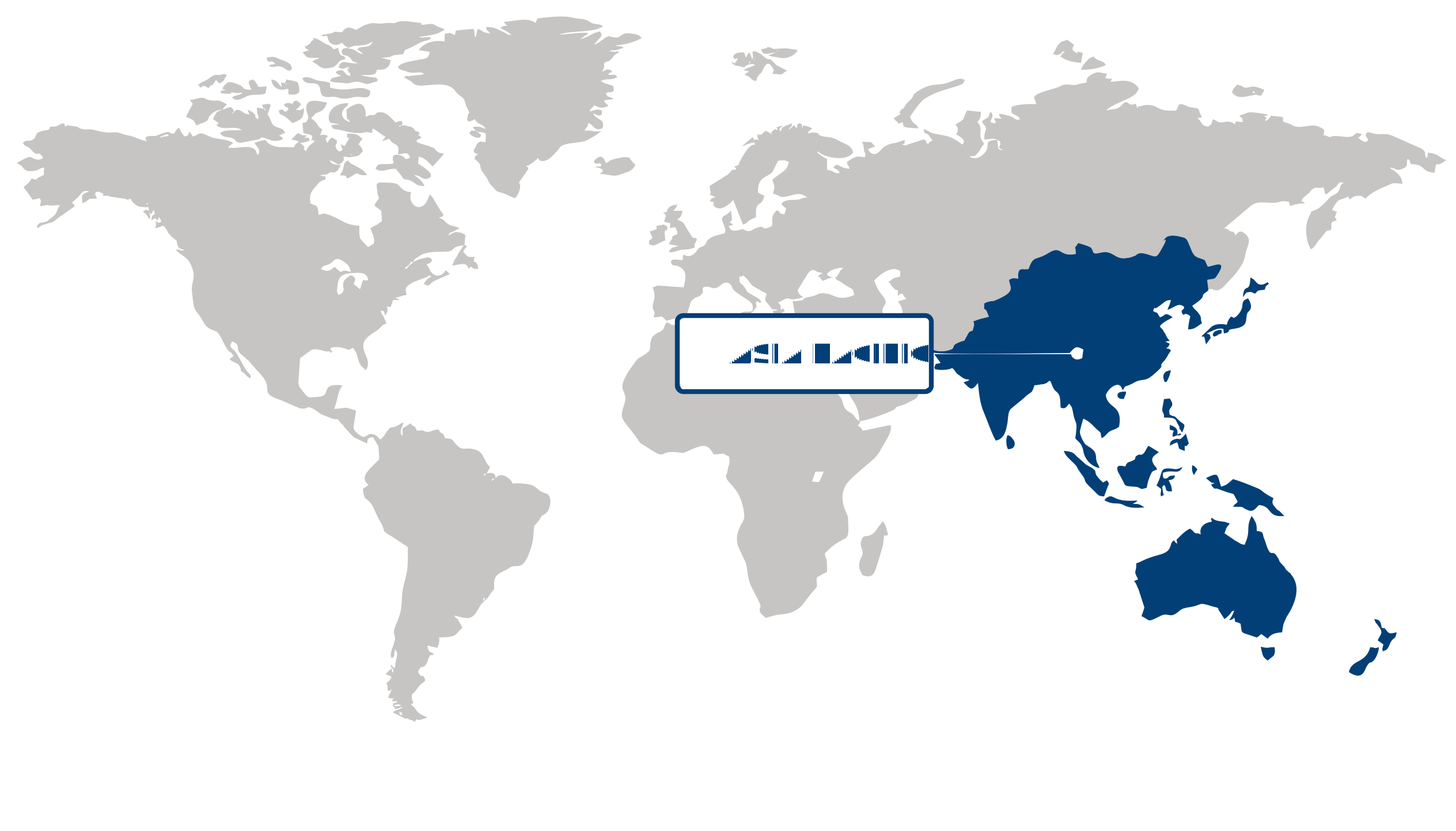
Asia Pacific (Largest & Fastest-Growing Region)
Asia Pacific accounted for 48.87% of the thermal energy storage market in 2026 and is expected to remain the fastest-growing region, driven by rising energy demand, expanding renewable energy deployment, and increasing efforts to improve grid flexibility. Thermal energy storage enables energy to be stored and utilized when required, supporting better integration of intermittent renewable sources and improving the efficiency of energy-intensive systems. Growing investments in district cooling, industrial energy management, and sustainable infrastructure are creating additional opportunities, while government-led decarbonization efforts are encouraging adoption of technologies that improve energy utilization and reduce reliance on conventional power sources.
| Parameter | North America | Asia Pacific | Europe | Latin America | MEA |
|---|---|---|---|---|---|
| Innovation Hub i Scale Nascent Developing Advanced | |||||
| Cost-Sensitive Region i Scale Low Medium High | |||||
| Regulatory Environment i Scale Restrictive Neutral Supportive | |||||
| Demand Drivers i Scale Weak Moderate Strong | |||||
| Development Stage i Scale Emerging Developing Developed | |||||
| Adoption Rate i Scale Low Medium High | |||||
| New Entrants / Startups i Scale Sparse Moderate Dense | |||||
| Macro Indicators i Scale Weak Stable Strong |
Key Country Insights
United States 🇺🇸
Grid flexibility expansionThe U.S. thermal energy storage market is driven by increasing demand for grid flexibility and integration of renewable energy sources. Energy operators in the U.S. focus on large-scale storage systems that support peak load management and improve power system reliability.
Germany 🇩🇪
Industrial heat optimizationGermany emphasizes thermal energy storage in industrial applications to improve energy efficiency and reduce reliance on fossil-based heat systems. German manufacturers and utilities invest in storage technologies that support renewable heat integration.
Japan 🇯🇵
Space-efficient storage systemsJapan focuses on compact thermal energy storage solutions suitable for urban environments and constrained infrastructure. Japanese energy providers prioritize systems that support district heating and cooling efficiency with minimal spatial footprint.
South Korea 🇰🇷
Smart energy integrationSouth Korea advances thermal energy storage adoption through smart grid integration and building energy management systems. Companies in South Korea prioritize solutions that optimize energy consumption across commercial and residential infrastructure.
France 🇫🇷
District energy optimizationFrance integrates thermal energy storage within district heating and cooling networks to improve system efficiency. French energy planners focus on storage solutions that balance renewable supply fluctuations and urban energy demand.
Italy 🇮🇹
Renewable heat utilizationItaly applies thermal energy storage to enhance utilization of renewable heat sources in residential and commercial sectors. Italian energy initiatives prioritize flexible storage systems that improve seasonal energy balancing and efficiency.
Segment Leadership and Growth Trends
Thermal Energy Storage Market Share (%), by Technology, 2026
Go beyond the chart, access full insights & data tables
Request Free Sample ReportTechnology Segment Analysis: Sensible Heat (Largest Segment) vs Latent Heat (Fastest-Growing Segment)
The sensible heat technology segment held the largest share in 2026, supported by its technological maturity, cost-effectiveness, and extensive deployment across commercial and utility-scale thermal storage systems. The technology is widely utilized because of its straightforward operating principles, proven reliability, and compatibility with a broad range of storage media. Its ability to deliver stable thermal performance while integrating efficiently with heating, cooling, and industrial energy systems has reinforced its dominant market position.
In the thermal energy storage market, the latent heat technology segment is anticipated to witness the fastest growth as industries increasingly seek storage solutions with higher energy density and improved thermal efficiency. The growing adoption of advanced phase change materials, combined with rising demand for compact energy storage systems in renewable energy integration and sustainable building applications, is accelerating the deployment of latent heat technologies. Continued innovation in thermal storage materials is expected to further support the segment's expansion.
Storage Material Segment Analysis: Molten Salt (Largest & Fastest-Growing Segment)
The molten salt storage material segment dominated the thermal energy storage market with an 89.77% share in 2026 and also emerged as the fastest-growing storage material category. Its leadership is attributed to its excellent heat retention capability, high operating temperature range, and suitability for large-scale thermal storage applications. Molten salt systems are extensively utilized in renewable energy projects and industrial thermal management due to their ability to store and release heat efficiently over extended periods. Increasing investments in sustainable energy infrastructure and the growing integration of renewable power generation are expected to further strengthen demand for molten salt-based storage solutions.
Application Segment Analysis: District Heating & Cooling (Largest Segment) vs Power Generation (Fastest-Growing Segment)
The district heating & cooling application segment held the largest share in 2026, driven by increasing deployment of centralized heating and cooling networks designed to improve energy efficiency and reduce overall energy consumption. Thermal energy storage plays a critical role in balancing energy demand, enhancing system reliability, and supporting the integration of renewable heat sources within district energy infrastructure. Continued urban development and investments in sustainable energy systems have reinforced the segment's leading position.
The power generation application segment is expected to record the fastest growth in the thermal energy storage market as utilities increasingly integrate renewable energy sources that require efficient energy balancing and dispatch capabilities. Thermal storage technologies enable more reliable electricity generation by storing excess thermal energy for later use, improving grid flexibility and operational efficiency. Growing emphasis on decarbonization and renewable energy integration is expected to accelerate adoption within this application.
| Segment | Sub-Segment | Largest Segment | Fastest Growing |
|---|---|---|---|
| Technology | Sensible Heat, Latent Heat, Thermochemical | Sensible Heat | Latent Heat |
| Storage Material | Water, Molten Salt, PCM, Others | Molten Salt | Molten Salt |
| Application | Power Generation, District Heating & Cooling, Process Heating & Cooling | District Heating & Cooling | Power Generation |
| End Use | Residential & Commercial, Utilities, Industrial | Utilities | Utilities |
Competitive Landscape and Market Positioning
Leading companies in the thermal energy storage market:
- CALMAC Corporation (United States)
- EVAPCO, Inc. (United States)
- Baltimore Aircoil Company (United States)
- DN Tanks, Inc. (United States)
- Burns & McDonnell (United States)
- McDermott International Ltd. (United States)
- Steffes LLC (United States)
- Caldwell Energy Company (United States)
Competitive momentum within the Thermal Energy Storage Market is increasingly shaped by the ability to integrate storage technologies with broader energy management systems rather than offering standalone storage assets. Market participants are advancing material innovation, system efficiency, and modular configurations to address varying industrial, commercial, and utility operating requirements while improving installation flexibility. At the same time, engineering expertise has become a significant competitive factor as customers seek solutions that can be adapted to renewable energy integration, district heating, and process optimization without compromising operational stability. This evolving environment is rewarding suppliers capable of combining technology development with application-specific implementation strategies across diverse end-use sectors.
| Company | Market Share | Company Revenue | Revenue CAGR (%) | Product Portfolio | Geographic Presence | Innovation / R&D Focus | Strategic Developments |
|---|---|---|---|---|---|---|---|
| CALMAC Corporation (United States) | |||||||
| EVAPCO Inc. (United States) | |||||||
| Baltimore Aircoil Company (United States) | |||||||
| DN Tanks Inc. (United States) | |||||||
| Burns & McDonnell (United States) | |||||||
| McDermott International Ltd. (United States) | |||||||
| Steffes LLC (United States) | |||||||
| Caldwell Energy Company (United States) |
Industry Development/News
| Company Name | Date | Key Development |
|---|---|---|
| Brenmiller Energy Ltd | Dec-24 | Brenmiller Energy Ltd announced that its bGen ZERO thermal energy storage system was selected to anchor a clean energy project developed by Recursos de la Biomasa in Spain. The industrial application is configured with 1.4 MWh of charging capacity, 10 MWh of storage, and 33 hours of continuous discharge to support industrial heat decarbonization. |
| State Grid Turfan Power Supply Company | Nov-24 | A 100MW thermal solar and molten salt energy storage system in Xinjiang, China, is scheduled for grid integration. Part of a 1GW solar thermal and photovoltaic integration project in Turfan with a total investment of USD 840 million, the initiative combines 900MW of conventional solar PV with the 100MW thermal storage system. |
| Pacific Gas & Electric Co. | Apr-22 | Pacific Gas & Electric Co. selected Tesla's Megapack battery energy storage system for deployment at the Moss Landing electric substation in Monterey County. The activated system supports renewable energy integration from wind and solar sources to enhance regional energy resilience. |
Customize Your Report
Explore examples of how this report can be tailored to different research needs, including custom segments, additional topics or chapters, and related reports. Click a section of the wheel or its numbered marker to explore the available options.
Thermal Energy Storage Market — Custom Segments
| Segment | Sub-Segment |
|---|---|
| Storage Duration | Short-Duration, Medium-Duration, Long-Duration |
| Charging Source | Renewable Energy, Grid Electricity, Waste Heat, Conventional Thermal Sources |
| System Configuration | Centralized Systems, Distributed Systems, Integrated Systems |
Thermal Energy Storage Market — Custom TOC
| Custom Chapter | Custom Details |
|---|---|
| Thermal Storage Project Economics |
|
| Grid Integration Opportunity |
|
| Industrial Heat Decarbonization Pathways |
|
Need a different cut of the data?
Request Custom ResearchHow big is the thermal energy storage market?
How is the thermal energy storage industry projected to perform over the next decade?
How are renewable energy trends driving the thermal energy storage market?
Why are governments and industries investing in thermal energy storage solutions?
Why does sensible heat technology hold the largest share of the thermal energy storage market?
Which application is growing the fastest in the thermal energy storage market?
What supports Asia Pacific's leadership in thermal energy storage?
How is Asia Pacific driving future thermal energy storage growth?
Who are the major participants shaping the thermal energy storage landscape?
Our Clients
"The information presented in the report was genuinely insightful. The data was clear and easy to understand, which made it much easier to interpret the findings."
Amara Raja Group
"The responsiveness and professionalism exhibited by the team were exemplary. They were readily available to address queries, provide clarifications, and offer additional insights."
ONGC
"The reports offered a comprehensive analysis of various segments within the market. The detailed insights into market trends, and regulatory landscapes were excellent."
TotalEnergies
Our Research Team & Methodology
Every Fundamental Business Insights report is built by a dedicated vertical research team, validated through a structured primary-and-secondary methodology, and reviewed for accuracy before it reaches you.
Research Team Overview
Prepared by the Energy & Power Research Team
Delivery
Published
Demand
Available
Support
Trust & Compliance
Research Domains
10 coverage areasResearch Intelligence
| Source | Reference |
|---|---|
| International Energy Agency (IEA) | www.iea.org |
| U.S. Energy Information Administration (EIA) | www.eia.gov |
| International Renewable Energy Agency (IRENA) | www.irena.org |
| International Electrotechnical Commission (IEC) | www.iec.ch |
| International Organization for Standardization (ISO) | www.iso.org |
| IEEE | www.ieee.org |
| CIGRE (International Council on Large Electric Systems) | www.cigre.org |
| World Energy Council (WEC) | www.worldenergy.org |
| U.S. Department of Energy (DOE) | www.energy.gov |
| International Atomic Energy Agency (IAEA) | www.iaea.org |
| American Petroleum Institute (API) | www.api.org |
| Society of Petroleum Engineers (SPE) | www.spe.org |
| Hydrogen Council | hydrogencouncil.com |
| Battery Council International (BCI) | batterycouncil.org |
| Global Wind Energy Council (GWEC) | gwec.net |
| SolarPower Europe | www.solarpowereurope.org |
| World Bioenergy Association (WBA) | worldbioenergy.org |
| International Hydropower Association (IHA) | www.hydropower.org |
| Edison Electric Institute (EEI) | www.eei.org |
| National Renewable Energy Laboratory (NREL) | www.nrel.gov |
Research Workflow & Quality Assurance
Data Collection
Verified information gathered through primary and secondary research.
Data Triangulation
Cross-validation using multiple independent data sources.
Forecast Modelling
Market estimates developed using historical trends and analytical models.
Analyst Validation
Findings reviewed by domain experts for accuracy and consistency.
Editorial & Quality Review
Final editorial, quality, and compliance checks before publication.
Final Publication
Released after successful completion of the internal review process.
Report Coverage
📊 Market Assessment
- Market Size & Forecast
- Market Segmentation
- Regional Analysis
- Growth Drivers & Challenges
- Market Dynamics
🏢 Competitive Intelligence
- Competitive Landscape
- Company Profiles
- Competitive Benchmarking
- Mergers & Acquisitions
- Market Share Analysis or Key Company Strategies
🔍 Strategic Analysis
- Value Chain Analysis
- Porter's Five Forces
- PESTLE Analysis
- Pricing Trends
- Supply-Demand Analysis
🚀 Future Outlook
- Technology Landscape
- Regulatory Landscape
- Investment & Funding Landscape
- Emerging Opportunities
- Future Market Outlook
Have a question about this report or need a custom scope?
Request Customization