Textile Felt Market Size & Growth Forecast 2027–2036, By Segments (Raw Material, Application), Regional Demand Trends (North America, Asia Pacific, Europe), Key Country Insights (U.S., Japan, South Korea, Germany, France, Italy), and Competitive Landscape
Market Size and Growth Outlook
Textile Felt Market size was assessed at USD 1.52 billion in 2026 and is poised to grow at a 13.77% CAGR between 2027 and 2036, crossing USD 5.52 billion by 2036. The industry revenue for 2027 is calculated at USD 1.72 billion.
Get more details on this report
Request Free Sample ReportTextile Felt Market Intelligence Snapshot
Regional Market Dynamics
- Asia Pacific led the market in 2026 due to its extensive manufacturing base, established textile processing networks, abundant raw materials, and strong demand from diverse industrial applications.
- North America is forecast to grow at a 17.14% CAGR as demand increases for engineered felt solutions across industrial, automotive, and construction applications requiring high-performance materials.
Segment Momentum
- Synthetic raw materials dominate because they provide consistent quality, durability, predictable processing, and reliable supply, making them ideal for high-volume industrial and consumer applications.
- Clothing is the fastest-growing application as apparel manufacturers increasingly use felt to create distinctive textures and designs that differentiate fashion products.
Market Expansion Drivers
- Rising preference for biodegradable and sustainable materials increasing textile felt product adoption.
- Expanding automotive and industrial insulation applications driving demand for thermal resistant felt materials.
- Increasing use of eco-friendly acoustic insulation materials supporting construction sector penetration.
Leading Market Participants
- Top companies in the textile felt market include Aetna Felt Corporation (USA), BWF Group (Germany), Freudenberg Performance Materials SE & Co. KG (Germany), FilzFelt Inc. (USA), Swicofil AG (Switzerland), Pugalia Woolen Mills Private Limited (India), John Hainsworth & Sons Ltd. (United Kingdom), National Felt Company (USA), Felt Industries Inc. (USA).
Global Market Forecast Snapshot
Market Outlook
- 2026 Market Size: USD 1.52 billion
- 2027 Estimated Market Size: USD 1.72 billion.
- Projected Market Size: USD 5.52 billion by 2036
- Growth Forecast: 13.77% CAGR (2027-2036)
Regional and Segment Outlook
- Leading Regional Market: Asia Pacific
- High-Growth Regional Hub: North America
- Core Revenue Segment: Synthetic Raw Materials (Raw Material) | Footwear (Application)
- Emerging Opportunity Segment: Natural (Raw Material) | Clothing (Application)
Market Growth Drivers and Industry Trends
Rising preference for biodegradable and sustainable materials increasing textile felt product adoption
Growing environmental awareness and stronger preference for sustainable material choices will drive the textile felt market growth as manufacturers and end users increasingly evaluate products based on their environmental impact. Felt made from natural, recycled, or biodegradable fibers can provide an alternative to materials associated with higher environmental burdens, making it attractive for applications where sustainability is an important purchasing consideration. Demand is also supported by the broader shift toward circular material usage, recycled content, and resource-efficient manufacturing across consumer and industrial product categories. Textile felt can be incorporated into furnishings, interior products, packaging solutions, crafts, and other applications where manufacturers seek a combination of functionality and environmentally responsible material characteristics, encouraging product developers to expand sustainable felt offerings and incorporate them into new designs.
Expanding automotive and industrial insulation applications driving demand for thermal resistant felt materials
The expansion of automotive manufacturing and industrial equipment applications will propel the textile felt market growth by increasing the requirement for materials capable of providing thermal insulation, sound absorption, vibration control, and protective separation. Felt materials with suitable thermal resistance can be incorporated around engines, exhaust-related components, machinery, equipment enclosures, and other areas exposed to heat or demanding operating conditions. In automotive applications, the emphasis on passenger comfort, component protection, weight management, and improved cabin environments is encouraging wider use of specialized insulation materials. Industrial manufacturers similarly require durable insulating materials for machinery and production environments where temperature management and operational protection are important, creating opportunities for felt products engineered for specific thermal and performance requirements.
Increasing use of eco-friendly acoustic insulation materials supporting construction sector penetration
Increasing demand for environmentally responsible building materials will boost the textile felt market demand as construction projects place greater emphasis on indoor comfort, acoustic performance, and sustainable material selection. Felt-based acoustic products can be used in wall treatments, ceiling systems, partitions, office interiors, educational spaces, hospitality environments, and other areas where controlling unwanted sound is important. The material's flexibility allows manufacturers to develop decorative panels and functional acoustic elements that can complement modern interior designs while addressing sound absorption requirements. As architects, contractors, and building owners increasingly consider materials that combine acoustic functionality with recycled or renewable content, textile felt is gaining relevance in interior construction applications where sustainability credentials and design versatility are valued alongside acoustic performance.
| Growth Driver | Impact on CAGR | Regulatory Influence | Geographic Relevance | Adoption Rate | Impact Timeline |
|---|---|---|---|---|---|
| Rising demand for technical textiles | 5.00% | Short term (≤ 2 yrs) | North America, Europe | Medium | Fast |
| Technological innovations in felt production | 5.20% | Medium term (2–5 yrs) | North America, Asia Pacific | Low | Moderate |
| Expansion of textile industry in emerging markets | 5.10% | Long term (5+ yrs) | Asia Pacific, Latin America | Low | Slow |
| Rising preference for biodegradable and sustainable materials increasing textile felt product adoption | 2.20% | Moderate | Europe, North America | High | Mid Term |
| Expanding automotive and industrial insulation applications driving demand for thermal resistant felt materials | 1.90% | Moderate | Asia Pacific, Europe | High | Near Term |
| Increasing use of eco-friendly acoustic insulation materials supporting construction sector penetration | 1.50% | Moderate | Europe, North America, Asia Pacific | Emerging | Long Term |
Unlock insights tailored to your business with our bespoke market research solutions.
Click to get your customized report now.
Regional Demand Dynamics
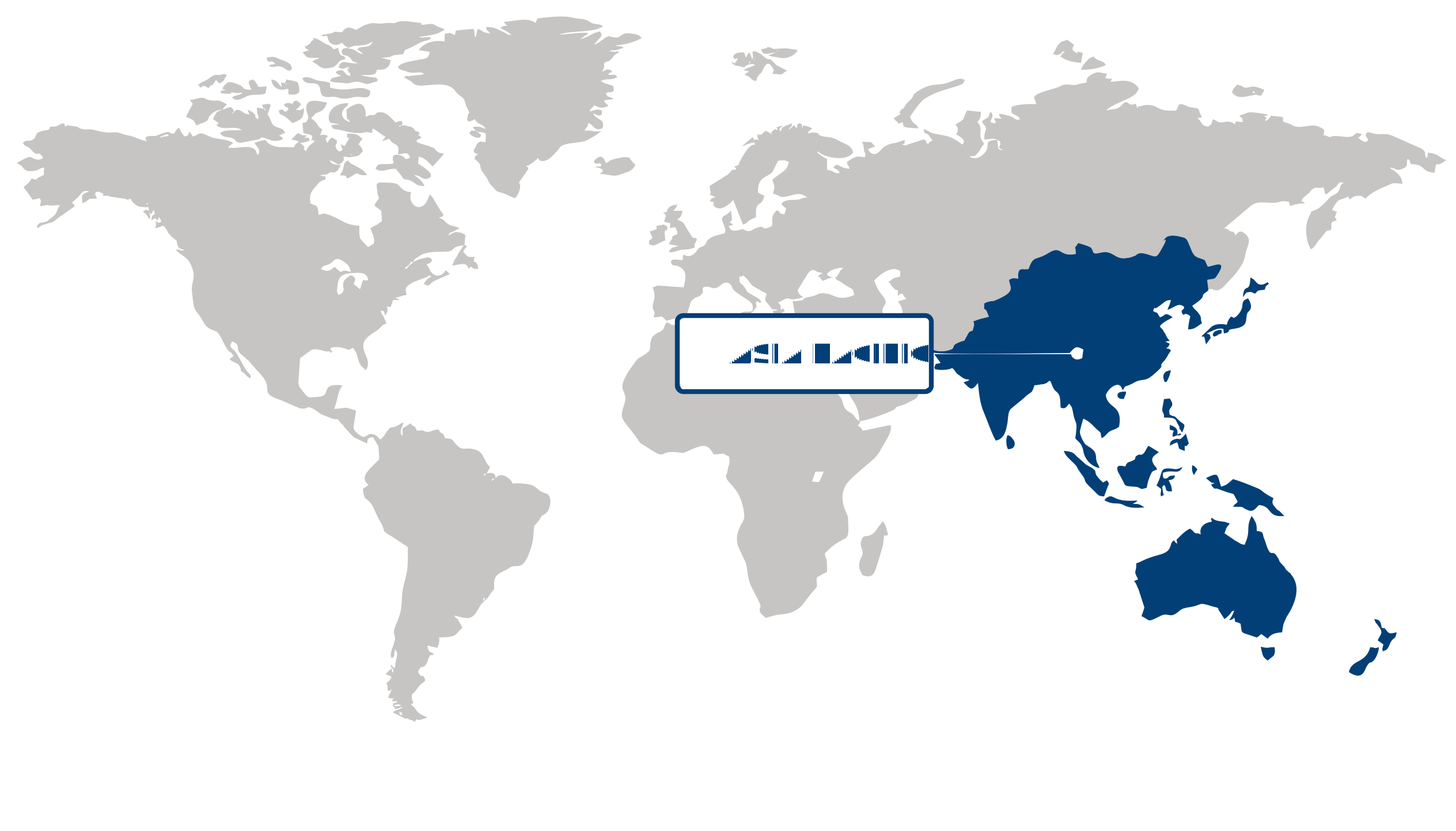
Asia Pacific (Largest Region)
The Asia Pacific region led the textile felt market in 2026, supported by its extensive textile and manufacturing ecosystem, strong demand for industrial materials, and expanding applications of felt across automotive, construction, furniture, filtration, packaging, and consumer products. The region benefits from established textile processing capabilities and broad availability of raw materials and manufacturing infrastructure, enabling producers to serve diverse end-use industries efficiently. Rising industrialization and infrastructure development are increasing the use of felt for insulation, cushioning, sound absorption, polishing, and protective applications. Growing automotive and electronics manufacturing activity is also creating opportunities for specialized technical felt products designed to provide thermal, acoustic, and functional performance. In addition, increasing attention to sustainable materials is encouraging interest in fiber-based products with recyclable or lower-impact characteristics, while the expansion of domestic manufacturing and export-oriented production continues to reinforce regional demand.
North America (Fastest-Growing Region)
North America is positioned as the fastest-growing region for the textile felt market, driven by increasing demand for high-performance materials across automotive, construction, interior design, filtration, and industrial applications. Manufacturers and end users are increasingly seeking materials that provide durability, insulation, acoustic control, and design flexibility, supporting the adoption of engineered felt solutions. The region's emphasis on advanced manufacturing and product innovation is encouraging the development of specialized felt materials tailored to demanding technical applications. Growing construction activity and renovation requirements are also supporting demand for acoustic and thermal insulation products, while interest in sustainable material alternatives is creating additional opportunities for felt-based solutions. Furthermore, established distribution networks and expanding applications in interior furnishings and specialty industrial products are contributing to broader market penetration.
| Parameter | North America | Asia Pacific | Europe | Latin America | MEA |
|---|---|---|---|---|---|
| Innovation Hub i Scale Nascent Developing Advanced | |||||
| Cost-Sensitive Region i Scale Low Medium High | |||||
| Regulatory Environment i Scale Restrictive Neutral Supportive | |||||
| Demand Drivers i Scale Weak Moderate Strong | |||||
| Development Stage i Scale Emerging Developing Developed | |||||
| Adoption Rate i Scale Low Medium High | |||||
| New Entrants / Startups i Scale Sparse Moderate Dense | |||||
| Macro Indicators i Scale Weak Stable Strong |
Key Country Insights
Germany 🇩🇪
Engineering Felt Precision UseIn Germany, textile felt usage is concentrated in precision engineering and industrial manufacturing environments. Germany prioritizes technical specifications, wear resistance, and standardized quality, with applications spanning automotive engineering, machinery systems, and filtration technologies.
France 🇫🇷
Luxury Craft ApplicationsIn France, textile felt demand spans industrial and luxury craft applications. France emphasizes material aesthetics and versatility, with usage in design-led interiors, fashion accessories, and artisanal manufacturing segments alongside technical applications.
Italy 🇮🇹
Fashion and Craft IntegrationIn Italy, textile felt consumption is closely tied to fashion, design, and artisanal craft industries. Italy values material texture and adaptability, with demand supported by footwear, accessories, and creative manufacturing ecosystems.
Japan 🇯🇵
High-grade Industrial MaterialsIn Japan, textile felt demand is driven by high-grade material requirements in electronics, automotive, and precision equipment sectors. Japan emphasizes material purity, compact integration, and consistent performance within advanced manufacturing systems.
South Korea 🇰🇷
Manufacturing Component DemandIn South Korea, textile felt demand is linked to electronics and automotive manufacturing ecosystems. South Korea focuses on supply reliability and functional performance, with applications in insulation, sealing, and industrial processing components.
United States 🇺🇸
Industrial Filtration ApplicationsIn the United States, textile felt demand is strongly tied to industrial filtration, automotive, and insulation applications. The U.S. market emphasizes durability, performance consistency, and scalable supply integration across manufacturing and maintenance-heavy industrial ecosystems.
Segment Leadership and Growth Trends
Textile Felt Market Share (%), by Raw Material, 2026
Go beyond the chart, access full insights & data tables
Request Free Sample ReportRaw Material Segment Analysis: Synthetic Raw Materials (Largest Segment) vs Natural (Fastest-Growing Segment)
Synthetic raw materials held the largest share of the textile felt market in 2026, supported by their consistent physical properties, durability, and suitability for diverse industrial and consumer applications. Synthetic fibers can provide the strength, resilience, and dimensional stability required in products exposed to repeated use or demanding operating conditions. Their versatility across applications such as footwear, automotive components, filtration, and industrial materials continues to underpin their broad adoption.
Natural raw materials are expected to be the fastest-growing segment, driven by increasing interest in renewable and environmentally preferable material options. Natural fibers offer a favorable sustainability profile and can appeal to manufacturers and consumers seeking alternatives to petroleum-based inputs. Growing attention to resource efficiency, biodegradable materials, and environmentally conscious product development is encouraging greater use of natural raw materials in textile felt production.
Application Segment Analysis: Footwear (Largest Segment) vs Clothing (Fastest-Growing Segment)
The footwear segment accounted for the largest share of the textile felt market in 2026, benefiting from the material's cushioning, flexibility, insulation, and durability characteristics. Felt can be incorporated into footwear components to enhance comfort and provide functional support while maintaining lightweight construction. Continued demand for comfortable and durable footwear products supports steady consumption of textile felt in this application.
Clothing is expected to be the fastest-growing application segment, supported by increasing use of felt materials in apparel components, accessories, and functional garments. The material can provide warmth, structure, and design flexibility, making it suitable for applications where both performance and appearance are important. Growing interest in versatile textile materials and evolving apparel designs is creating additional opportunities for felt-based products in clothing applications.
| Segment | Sub-Segment | Largest Segment | Fastest Growing |
|---|---|---|---|
| Raw Material | Natural, Synthetic Raw Materials | Synthetic Raw Materials | Natural |
| Application | Footwear, Clothing, Tents, Rugs, Craft Projects, Others | Footwear | Clothing |
Competitive Landscape and Market Positioning
Leading companies in the textile felt market:
1. Aetna Felt Corporation (USA)
2. BWF Group (Germany)
3. Freudenberg Performance Materials SE & Co. KG (Germany)
4. FilzFelt Inc. (USA)
5. Swicofil AG (Switzerland)
6. Pugalia Woolen Mills Private Limited (India)
7. John Hainsworth & Sons Ltd. (United Kingdom)
8. National Felt Company (USA)
9. Felt Industries Inc. (USA)
The textile felt market is evolving through improvements in fiber processing and material engineering that enhance durability and performance. Continuous development efforts are enabling specialized applications across industrial and consumer segments. Collaborative innovation initiatives are strengthening product versatility, while new material advancements are expanding market applicability.
| Company | Market Share | Company Revenue | Revenue CAGR (%) | Product Portfolio | Geographic Presence | Innovation / R&D Focus | Strategic Developments |
|---|---|---|---|---|---|---|---|
| Aetna Felt Corporation (USA) | |||||||
| BWF Group (Germany) | |||||||
| Freudenberg Performance Materials SE & Co. KG (Germany) | |||||||
| FilzFelt Inc. (USA) | |||||||
| Swicofil AG (Switzerland) | |||||||
| Pugalia Woolen Mills Private Limited (India) | |||||||
| John Hainsworth & Sons Ltd. (United Kingdom) | |||||||
| National Felt Company (USA) | |||||||
| Felt Industries Inc. (USA). |
Industry Development/News
| Company Name | Date | Key Development |
|---|
Customize Your Report
Explore examples of how this report can be tailored to different research needs, including custom segments, additional topics or chapters, and related reports. Click a section of the wheel or its numbered marker to explore the available options.
Textile Felt Market — Custom Segments
| Segment | Sub-Segment |
|---|---|
| Manufacturing Process | Wet-Laid Felt, Needle-Punched Felt, Pressed Felt |
| Product Form | Sheets & Panels, Rolls & Rolls-to-Length, Molded & Formed Felt |
| Distribution Channel | Direct Sales, Specialty Distributors, Industrial & Commercial Retailers, Online Channels |
Textile Felt Market — Custom TOC
| Custom Chapter | Custom Details |
|---|---|
| End-Use Application Expansion Strategy |
|
| Sustainable Felt Material Adoption Analysis |
|
| Nonwoven Material Substitution Assessment |
|
Need a different cut of the data?
Request Custom ResearchWhat is the current revenue of the textile felt market?
What is the forecasted size of the textile felt industry?
How is sustainability-driven material preference influencing demand in the textile felt market?
Why is textile felt gaining traction in automotive and industrial insulation applications?
Why do Synthetic Raw Materials lead the textile felt market?
Which application segment is expanding the fastest in the textile felt market?
Why is Asia Pacific the leading textile felt market?
What is driving rapid textile felt market growth in North America?
Which companies are driving growth in the textile felt landscape?
Our Clients
"The report provided us with a clear direction, and the level of detail was beyond what we expected. I would definitely recommend their services to others."
Haier Appliances
"The collaboration with Fundamental Business Insights has added significant value to our decision-making process, and we look forward to continuing this partnership for our future market research requirements."
Luxottica Group S.p.A.
"The team at FBI delivered an exceptional research report. The insights on industry innovations were particularly impressive and added a lot of value to the overall report."
Nike
Our Research Team & Methodology
Every Fundamental Business Insights report is built by a dedicated vertical research team, validated through a structured primary-and-secondary methodology, and reviewed for accuracy before it reaches you.
Research Team Overview
Prepared by the Consumer Goods & Services Research Team
Delivery
Published
Demand
Available
Support
Trust & Compliance
Research Domains
10 coverage areasResearch Intelligence
| Source | Reference |
|---|---|
| International Organization for Standardization (ISO) | www.iso.org |
| ASTM International | www.astm.org |
| U.S. Consumer Product Safety Commission (CPSC) | www.cpsc.gov |
| European Commission – Consumer Safety | ec.europa.eu/safety-gate |
| Consumer Technology Association (CTA) | www.cta.tech |
| National Retail Federation (NRF) | nrf.com |
| World Retail Congress | www.worldretailcongress.com |
| World Travel & Tourism Council (WTTC) | wttc.org |
| UN Tourism | www.unwto.org |
| Personal Care Products Council (PCPC) | www.personalcarecouncil.org |
| Cosmetics Europe | cosmeticseurope.eu |
| International Housewares Association (IHA) | www.housewares.org |
| American Apparel & Footwear Association (AAFA) | www.aafaglobal.org |
| World Federation of the Sporting Goods Industry (WFSGI) | wfsgi.org |
| Juvenile Products Manufacturers Association (JPMA) | www.jpma.org |
| Pet Industry Joint Advisory Council (PIJAC) | pijac.org |
| International Council of Toy Industries (ICTI) | www.toy-icti.org |
| International Association of Amusement Parks and Attractions (IAAPA) | iaapa.org |
| Organisation for Economic Co-operation and Development (OECD) | www.oecd.org |
| World Bank Data | data.worldbank.org |
Research Workflow & Quality Assurance
Data Collection
Verified information gathered through primary and secondary research.
Data Triangulation
Cross-validation using multiple independent data sources.
Forecast Modelling
Market estimates developed using historical trends and analytical models.
Analyst Validation
Findings reviewed by domain experts for accuracy and consistency.
Editorial & Quality Review
Final editorial, quality, and compliance checks before publication.
Final Publication
Released after successful completion of the internal review process.
Report Coverage
📊 Market Assessment
- Market Size & Forecast
- Market Segmentation
- Regional Analysis
- Growth Drivers & Challenges
- Market Dynamics
🏢 Competitive Intelligence
- Competitive Landscape
- Company Profiles
- Competitive Benchmarking
- Mergers & Acquisitions
- Market Share Analysis or Key Company Strategies
🔍 Strategic Analysis
- Value Chain Analysis
- Porter's Five Forces
- PESTLE Analysis
- Pricing Trends
- Supply-Demand Analysis
🚀 Future Outlook
- Technology Landscape
- Regulatory Landscape
- Investment & Funding Landscape
- Emerging Opportunities
- Future Market Outlook
Have a question about this report or need a custom scope?
Request Customization