Test & Burn-in Socket Market Size & Forecasts 2026-2035, By Segments (Type, End-user Industry, Application), Growth Opportunities, Innovation Landscape, Regulatory Shifts, Strategic Regional Insights (U.S., Japan, China, South Korea, UK, Germany, France), and Competitive Dynamics (Ironwood Electronics, Yamaichi Electronics, Amphenol, Aries Electronics, Signamax)
Market Size and Growth Outlook
Test & Burn-in Socket Market size is anticipated to rise from USD 1.56 billion in 2025 to USD 2.9 billion by 2035, reflecting a CAGR surpassing 6.4% over the forecast horizon of 2026-2035. The estimated revenue for 2026 is USD 1.65 billion.
Get more details on this report
Request Free Sample ReportTest & Burn-in Socket Market Intelligence Snapshot
Regional Market Dynamics
Segment Momentum
Market Expansion Drivers
Leading Market Participants
Global Market Forecast Snapshot
Market Outlook
Regional and Segment Outlook
Market Growth Drivers and Industry Trends
Rising functional complexity and reliability mandates are expanding the role of the test & burn-in socket market as manufacturers push to validate multi-die systems and advanced nodes. SEMI has documented growing test-time complexity across heterogeneous integration workflows, and Intel has emphasized enhanced post-packaging qualification in recent press releases, reflecting industry moves to stricter quality gates. This dynamic creates opportunities for incumbent socket suppliers to upsell integrated thermal and signal-management solutions and for start-ups to capture niche segments with flexible, low-cost prototyping sockets. Given ongoing regulatory focus on supply-chain resilience and product reliability, demand for higher-precision sockets is set to remain anchored in observable qualification programs and advanced-node ramp activity.
Growth in Chip Packaging and High-Volume Production
Expansion of advanced packaging and higher wafer throughput from foundries tightens coupling between packaging lines and the test & burn-in socket market because sockets must support new form factors, fine-pitch I/Os, and automated handler integration. TSMC’s public disclosures on CoWoS and advanced packaging capacity and ASE Technology Holding’s announcements on OSAT scaling illustrate how packaging shifts drive test throughput requirements. Established socket manufacturers can leverage scale and automation partnerships with OSATs, while newcomers can win design-ins by offering rapid turn socket variants for emerging package types. As packaging volumes continue to scale in observable fab and OSAT capacity expansions, sockets that integrate automation readiness will be commercially prioritized.
R&D in High-Performance Socket Materials and Design
Advances in contact materials, thermal interfaces, and miniaturized mechanical architectures are reshaping the test & burn-in socket market as performance and cycle life demands rise. Research centers such as IMEC and Fraunhofer IZM publish work on reliability of high-frequency contacts and thermal management, and companies like FormFactor and Yamaichi have released product updates highlighting novel contact alloys and low-wear mechanisms. This opens strategic avenues for incumbents to protect IP and extend service contracts through durable-material offerings, and for innovators to collaborate with research institutes to commercialize disruptive contact technologies. Observable R&D pipelines and public technology demonstrations indicate a near-term shift toward sockets optimized for longevity and higher signal fidelity.
Industry Restraints:
Supply Chain Vulnerabilities for Critical Components
The test & burn-in socket market is constrained by persistent shortages and long lead times for precision substrates, metal contacts, pogo pins, and high-reliability ceramics that are core to socket assemblies. The Semiconductor Industry Association and the U.S. Department of Commerce have documented ongoing supply-chain fragility across upstream materials and specialty suppliers, while ASE Technology Holding and Amkor Technology have publicly flagged substrate and interposer sourcing pressures in corporate disclosures. Strategically, incumbents with diversified supplier networks or in-house substrate capability can maintain service levels, whereas new entrants and smaller suppliers face higher inventory costs, longer qualification cycles, and delayed customer wins. Near term, reshoring initiatives and CHIPS-era incentives should ease bottlenecks unevenly, but material and supplier concentration will continue to shape capacity and pricing dynamics.
Escalating Test Complexity from Advanced Packaging and Heterogeneous Integration
Rising adoption of 3D stacking, chiplet architectures, and advanced node packaging increases socket design complexity—demanding tighter thermal management, mechanical tolerance, and signal integrity controls that slow standardization and scale-up. Test equipment vendors such as Advantest Corporation and Teradyne have highlighted in product roadmaps and press statements the need for bespoke test solutions to address heterogeneous interfaces, and JEDEC/SEMI have noted gaps in interoperable standards. For market participants, this raises R&D intensity and extends customer qualification timelines: larger vendors can amortize development costs, while smaller suppliers confront margin compression and limited addressable segments. Over the next several quarters, incremental packaging innovation will sustain demand for customized sockets, favoring suppliers that pair engineering depth with collaborative standards engagement to lower total cost of ownership for OEMs.
| Growth Driver | Impact on CAGR | Regulatory Influence | Geographic Relevance | Adoption Rate | Impact Timeline |
|---|---|---|---|---|---|
| Increasing semiconductor testing requirements | 2.00% | Short term (≤ 2 yrs) | North America, Asia Pacific | Medium | Fast |
| Growth in chip packaging and high-volume production | 1.50% | Medium term (2–5 yrs) | Asia Pacific, Europe | Medium | Moderate |
| R&D in high-performance socket materials and design | 0.90% | Long term (5+ yrs) | North America, Europe | Low | Slow |
Unlock insights tailored to your business with our bespoke market research solutions.
Click to get your customized report now.
Regional Demand Dynamics
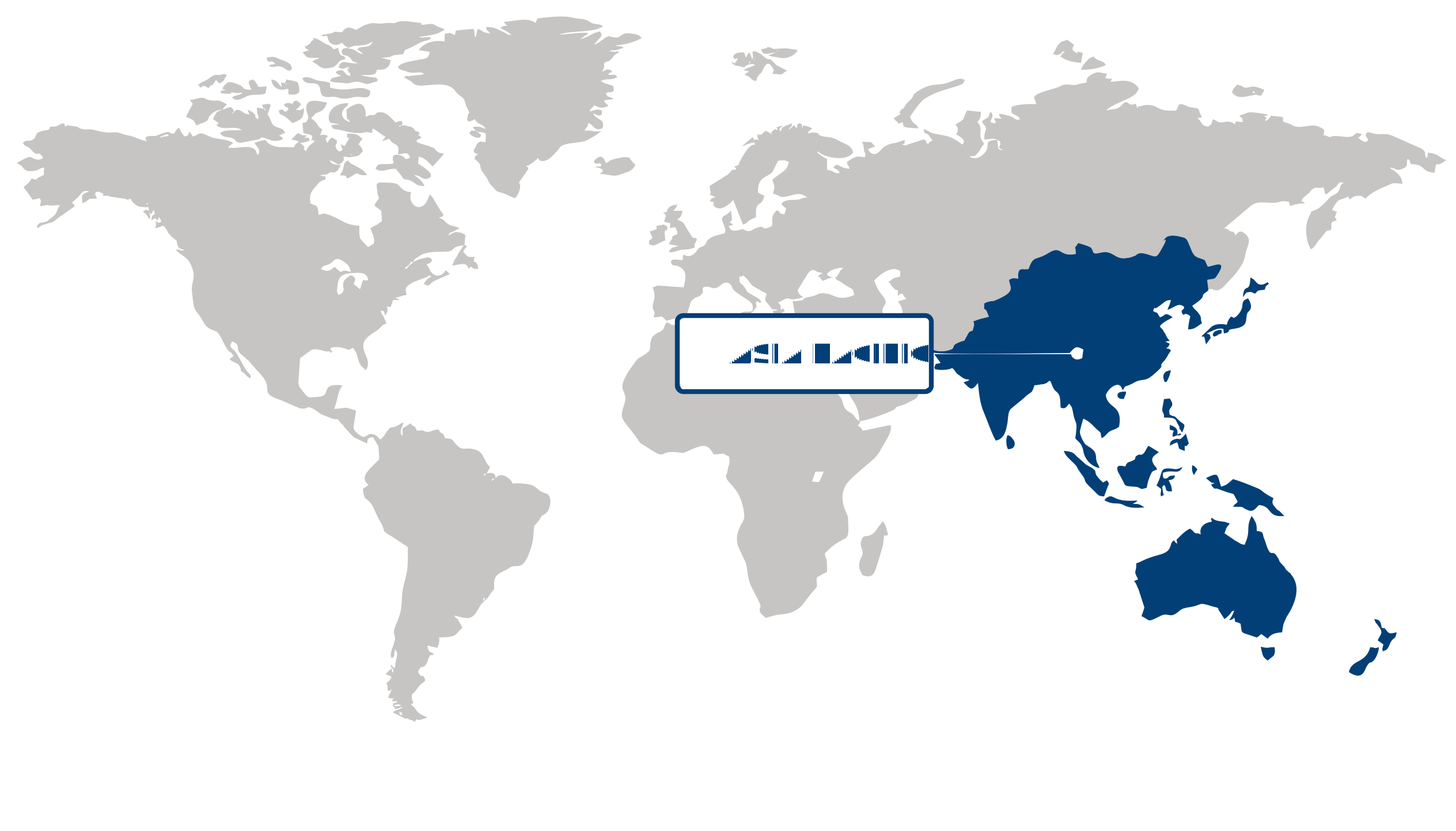
The test & burn-in socket market in Asia Pacific captured over 52% of the global market in 2025 and is the largest and fastest-growing region, expanding at a 7.3% CAGR; this leadership is driven by Asia Pacific’s rapidly growing electronics manufacturing ecosystem that raises demand for burn-in and test sockets to ensure throughput and yield. Robust public and private investment—evidenced by announcements from Taiwan Semiconductor Manufacturing Company (TSMC) and capacity statements by Hon Hai Precision Industry Co., Ltd. (Foxconn)—alongside supportive policy frameworks such as the Ministry of Industry and Information Technology of the People’s Republic of China (MIIT) and Japan’s Ministry of Economy, Trade and Industry (METI) amplify volume and quality requirements. Continued emphasis on high-reliability components for automotive electrification and 5G infrastructure makes the region a focal point for socket innovation and supplier scaling, creating sustained commercial opportunity for test & burn-in socket suppliers.
The test & burn-in socket market in Japan is positioned as a pivotal hub in Asia Pacific for high-reliability and precision testing solutions, where demand skews toward automotive, industrial, and defense-grade applications. Japanese test-equipment and semiconductor companies such as Advantest Corporation and Renesas Electronics Corporation emphasize tight quality controls and advanced test flows in corporate disclosures, and METI policies that encourage domestic supply-chain resilience further push adoption of premium burn-in sockets. For suppliers, Japan’s focus on reliability and process discipline translates into opportunities to commercialize higher-margin, specialized socket designs that strengthen the region’s overall value chain.
The test & burn-in socket market in China anchors regional volume growth through mass-manufacturing scale and accelerating local semiconductor investment, with MIIT reporting sustained electronics output and the China Integrated Circuit Industry Investment Fund backing capacity expansion. Major EMS and manufacturing integrators like Hon Hai (Foxconn) have highlighted increased testing and quality-assurance capacity in press releases, and domestic foundry and packaging activity supports high-throughput socket demand. Strategically, China’s combination of volume, government-backed industrial policy, and growing in-country testing ecosystems amplifies regional demand for cost-efficient, scalable socket solutions that complement Japan’s premium segment and broaden addressable market size.
North America Market Analysis:
North America held a commanding share in the test & burn-in socket market, supported by a dense semiconductor fabrication and assembly base, targeted public funding and escalating demand for high-reliability testing from advanced-node logic, memory and packaging segments. Policy action under the CHIPS and Science Act as implemented by the U.S. Department of Commerce, coupled with capacity expansions cited in SEMI’s fab reports and large-scale investment announcements from Intel and Micron Technology, has increased onshore test volumes and shortened supply chains—raising demand for sophisticated sockets that enable high-throughput, thermal-stressed burn-in. These dynamics, reinforced by sustainability-driven throughput optimization and workforce upskilling initiatives reported in Intel press releases, position the region to capture more value in test engineering, equipment services and aftermarket support over the near term.
The U.S. remains the primary commercial engine for the region’s test & burn-in socket market, where federal incentives and corporate capex translate directly into higher domestic test and assembly activity. U.S. Department of Commerce deployment of CHIPS funds and capacity commitments from firms such as Intel and Micron Technology have driven procurement cycles for test equipment suppliers (see Teradyne and Applied Materials engagements), while hyperscaler and automotive OEM requirements are pushing sockets toward greater thermal and cycle robustness. This creates opportunities for suppliers to co-develop customized sockets and localize service footprints; securing U.S.-based partnerships and certification pathways will be strategically critical for regional market leadership.
Europe Market Trends:
The test & burn-in socket market in North America has experienced moderate growth as regional demand balances onshoring of semiconductor assembly with ongoing needs for advanced-package validation; policy momentum from the U.S. Department of Commerce’s CHIPS and Science Act and industry benchmarking by the Semiconductor Industry Association (SIA) underpin rising capital expenditure and supply-chain diversification. Demand shifts toward heterogeneous integration and stricter reliability targets are prompting socket suppliers to upgrade materials and automation, while corporate announcements from Intel and TSMC about U.S. capacity expansions illustrate procurement pull for test hardware. These dynamics, coupled with stronger logistics corridors and intensified competition, position North America to capture higher-value socket designs and service contracts over the next investment cycle.
The test & burn-in socket market in the United States serves as the region’s primary growth engine, driven by large-scale fab and packaging investments and government incentives that accelerate localized testing capacity. Corporate disclosures from Intel and Samsung on U.S. facility expansions, alongside procurement guidance influenced by the U.S. Department of Commerce, are elevating demand for sockets compatible with advanced test cells; semiconductor OEMs and capital equipment suppliers are shortening qualification cycles and prioritizing domestic suppliers. For investors and strategists, the U.S. market signals opportunity in vertically integrated socket platforms and test automation partnerships that align with facility-level CAPEX.
The test & burn-in socket market in Canada plays a specialized role, concentrating on contract-manufacturing test services and niche engineering support that complements U.S. capacity growth. Company statements from Celestica and government programs under Innovation, Science and Economic Development Canada (ISED) highlight targeted support for advanced manufacturing and workforce development, enabling Canadian providers to win regional test contracts and prototype runs. Canada’s strengths in engineering talent and EMS partnerships create strategic options for socket firms to offer outsourced validation services to U.S. fabs and assembly houses, amplifying North American supply-chain resilience.
| Parameter | North America | Asia Pacific | Europe | Latin America | MEA |
|---|---|---|---|---|---|
| Innovation Hub i Scale Nascent Developing Advanced | |||||
| Cost-Sensitive Region i Scale Low Medium High | |||||
| Regulatory Environment i Scale Restrictive Neutral Supportive | |||||
| Demand Drivers i Scale Weak Moderate Strong | |||||
| Development Stage i Scale Emerging Developing Developed | |||||
| Adoption Rate i Scale Low Medium High | |||||
| New Entrants / Startups i Scale Sparse Moderate Dense | |||||
| Macro Indicators i Scale Weak Stable Strong |
Segment Leadership and Growth Trends
Test & Burn-in Socket Market Share (%), by Type, 2026
Go beyond the chart, access full insights & data tables
Request Free Sample ReportTest socket represented largest share in 2025 of the test & burn-in socket market, leading the Type segment because expanding semiconductor manufacturing and IC validation needs require robust, high-pin-count sockets to verify complex chips. Major foundries and OEMs such as TSMC, Intel, and Samsung Electronics cite rigorous wafer‑level and package testing requirements in technical disclosures, and standards work by JEDEC and SEMI underscores interoperability needs; this drives demand from customers prioritizing throughput, reliability, and lifecycle cost. Established socket suppliers can scale production and offer customization, while niche players can innovate on materials and contact technology, keeping this segment strategically relevant as chip complexity and digital transformation intensify.
Analysis by End-user Industry
IT & Telecommunications held largest share in 2025 of the test & burn-in socket market as telecom equipment makers and data‑center electronics producers ramp testing to support 5G, edge compute, and cloud growth. Vendors like Cisco, Ericsson, Nokia, Microsoft, and Amazon Web Services have publicly outlined accelerated hardware validation programs, pressuring suppliers to provide high-reliability sockets; regulatory compliance and sustainability initiatives in hyperscale operations also favor durable, serviceable solutions. This creates opportunities for incumbent suppliers to win long-term contracts and for agile entrants to supply specialized sockets for optical, switching, and server modules, ensuring sustained relevance as network densification and cloud demand persist.
Analysis by Application
Memory dominated the test & burn-in socket market in 2025 driven by surging demand for DRAM and NAND across consumer electronics, servers, and mobile devices that require intensive burn‑in and validation cycles. Leading memory manufacturers such as Samsung Electronics, SK Hynix, and Micron emphasize production test throughput in their investor and technical communications, and JEDEC memory standards increase interoperability needs for test solutions. Preference for lower failure rates and efficient test flows, along with supply‑chain emphasis on yield optimization, open niches for suppliers offering high‑density, thermally robust sockets; continued memory scaling and data‑centric computing trends will keep this application central in the near to medium term.
| Segment | Sub-Segment | Largest Segment | Fastest Growing |
|---|---|---|---|
| Type | Burn-in Socket, Test Socket | ||
| End-user Industry | IT & Telecommunications, Automotive, Consumer Electronics, Manufacturing & Automation, Aerospace & Defense, Other End-user Industries | ||
| Application | Memory, CMOS Image Sensor, High Voltage, Radio Frequency (RF), Central Processing Unit (CPU), Graphics Processing Unit (GPU), System-on-a-Chip (SoC), Other Applications |
Competitive Landscape and Market Positioning
The competitive environment is characterized by portfolio deepening and capability integration among these leaders: several have widened scope through selective transactions and closer supplier integrations, refreshed offerings to address higher-density packages and tougher thermal cycles, and increased engineering focus on miniaturization and contact reliability. Cross-party technical alignments and quicker product refresh cadences are shifting competition toward speed of iteration and tailored solutions for specific end-market test flows, reinforcing incumbents’ ability to capture complex, higher-margin work.
Strategic / Actionable Recommendations for Regional Players
North America: Leverage proximity to hyperscalers and advanced-node design houses by tightening co-development with test labs and offering rapid-turn, high-reliability socket variants; prioritize engineering investments in thermal management and high-frequency contact technology to remain the preferred supplier for premium verification programs.
Asia Pacific: Exploit regional manufacturing scale and supplier density to offer cost-performance optimized socket platforms for high-volume consumer and mobile segments; pursue closer working arrangements with OSATs and contract manufacturers to shorten qualification cycles and standardize modular interfaces for faster adoption.
Europe: Build on automotive and industrial expertise by emphasizing durability, traceable qualification, and functional-safety aligned test solutions; collaborate with local automation and metrology providers to deliver turnkey verification fixtures tailored to regulated segments and to defend against low-cost commoditization.
| Company | Market Share | Company Revenue | Revenue CAGR (%) | Product Portfolio | Geographic Presence | Innovation / R&D Focus | Strategic Developments |
|---|---|---|---|---|---|---|---|
| No companies available. | |||||||
Industry Development/News
| Company Name | Date | Key Development |
|---|
Customize Your Report
Explore examples of how this report can be tailored to different research needs, including custom segments, additional topics or chapters, and related reports. Click a section of the wheel or its numbered marker to explore the available options.
Test & Burn-in Socket Market — Custom Segments
| Segment | Sub-Segment |
|---|---|
| No segment data available. | |
Test & Burn-in Socket Market — Custom TOC
| Custom Chapter | Custom Details | ||
|---|---|---|---|
| No custom TOC data available. | |||
Need a different cut of the data?
Request Custom ResearchHow large is the test & burn-in socket market?
What is the anticipated CAGR of the test & burn-in socket industry?
Which part of the world represents the largest segment of the test & burn-in socket market?
What is the fastest growing region in the test & burn-in socket sector?
Where is the test socket segment seeing the strongest adoption within the test & burn-in socket industry?
When did IT & telecommunications sub-segment emerge as the largest sub-segment in the end-user industry segment of test & burn-in socket sector?
Why is the memory segment leading in the test & burn-in socket industry?
Who holds a significant market share in the test & burn-in socket landscape?
Our Clients
"Working with FBI has been a good experience. The market report provided a holistic view, covering everything from emerging trends to potential risks."
Semtech Corporation
"The experience was highly positive. The team showcased remarkable flexibility in adapting to our specific needs and delivered report that perfectly aligned with all our requirements."
TSMC
"What really stood out to me was how clearly and promptly the Fundamental Business Insights team communicated throughout. It made the collaboration feel effortless."
NXP Semiconductors
Our Research Team & Methodology
Every Fundamental Business Insights report is built by a dedicated vertical research team, validated through a structured primary-and-secondary methodology, and reviewed for accuracy before it reaches you.
Research Team Overview
Prepared by the Electronics & Semiconductors Research Team
Delivery
Published
Demand
Available
Support
Trust & Compliance
Research Domains
10 coverage areasResearch Intelligence
| Source | Reference |
|---|---|
| Semiconductor Industry Association (SIA) | www.semiconductors.org |
| SEMI | www.semi.org |
| JEDEC Solid State Technology Association | www.jedec.org |
| IEEE | www.ieee.org |
| IPC – Association Connecting Electronics Industries | www.ipc.org |
| International Electrotechnical Commission (IEC) | www.iec.ch |
| International Organization for Standardization (ISO) | www.iso.org |
| U.S. Bureau of Industry and Security (BIS) | www.bis.gov |
| U.S. Patent and Trademark Office (USPTO) | www.uspto.gov |
| European Patent Office (EPO) | www.epo.org |
| Taiwan Semiconductor Industry Association (TSIA) | www.tsia.org.tw |
| World Semiconductor Trade Statistics (WSTS) | www.wsts.org |
| International Energy Agency (IEA) | www.iea.org |
| GSMA | www.gsma.com |
| 3GPP | www.3gpp.org |
| ITU (International Telecommunication Union) | www.itu.int |
| Omdia (public insights) | omdia.tech.informa.com |
| Display Supply Chain Consultants (DSCC) | www.displaysupplychain.com |
| U.S. Department of Energy (DOE) | www.energy.gov |
| NIST (National Institute of Standards and Technology) | www.nist.gov |
Research Workflow & Quality Assurance
Data Collection
Verified information gathered through primary and secondary research.
Data Triangulation
Cross-validation using multiple independent data sources.
Forecast Modelling
Market estimates developed using historical trends and analytical models.
Analyst Validation
Findings reviewed by domain experts for accuracy and consistency.
Editorial & Quality Review
Final editorial, quality, and compliance checks before publication.
Final Publication
Released after successful completion of the internal review process.
Report Coverage
📊 Market Assessment
- Market Size & Forecast
- Market Segmentation
- Regional Analysis
- Growth Drivers & Challenges
- Market Dynamics
🏢 Competitive Intelligence
- Competitive Landscape
- Company Profiles
- Competitive Benchmarking
- Mergers & Acquisitions
- Market Share Analysis or Key Company Strategies
🔍 Strategic Analysis
- Value Chain Analysis
- Porter's Five Forces
- PESTLE Analysis
- Pricing Trends
- Supply-Demand Analysis
🚀 Future Outlook
- Technology Landscape
- Regulatory Landscape
- Investment & Funding Landscape
- Emerging Opportunities
- Future Market Outlook
Have a question about this report or need a custom scope?
Request Customization