Synthetic Turf Market Size & Growth Forecast 2027–2036, By Segments (Application, Material, Distribution Channel), Regional Demand Trends (North America, Asia Pacific, Europe), Key Country Insights (U.S., Japan, South Korea, Germany, France, Italy), and Competitive Landscape
Market Size and Growth Outlook
Synthetic Turf Market size was valued at USD 9.31 Billion in 2026 and is anticipated to grow at 5.62% CAGR from 2027 to 2036, surpassing USD 16.08 Billion by 2036. The industry revenue for 2027 is assessed at USD 9.75 Billion.
Get more details on this report
Request Free Sample ReportSynthetic Turf Market Intelligence Snapshot
Regional Market Dynamics
- Europe led in 2026 through strong adoption across sports, landscaping, residential, and public spaces, supported by water conservation and sustainable urban development.
- North America is expanding rapidly through residential landscaping, sports infrastructure, renovation activity, and rising demand for water-efficient, low-maintenance outdoor surfaces.
Segment Momentum
- Sports fields held 62.54% of the market in 2026 due to demand for durable, low-maintenance playing surfaces that provide consistent performance while reducing water use and upkeep costs.
- Commercial landscaping is the fastest-growing application as businesses adopt synthetic turf to lower maintenance expenses, enhance outdoor aesthetics, and support sustainable landscaping and water conservation goals.
Market Expansion Drivers
- Growing investment in sports infrastructure and recreational facility development boosting turf installations
- Rising water scarcity concerns driving shift from natural grass to synthetic alternatives
- Expanding urban residential landscaping demand increasing synthetic turf adoption in premium housing projects
Leading Market Participants
- Prominent companies in the synthetic turf market include Tarkett S.A. (France), Shaw Industries Group, Inc. (United States), FieldTurf (Canada), AstroTurf Corporation (United States), Polytan GmbH (Germany), SYNLawn (United States), CCGrass (China), TenCate Grass (Netherlands), TigerTurf (United Kingdom), SportGroup Holding (Germany)
Global Market Forecast Snapshot
Market Outlook
- 2026 Market Size: USD 9.31 Billion
- 2027 Estimated Market Size: USD 9.75 Billion
- Projected Market Size: USD 16.08 Billion by 2036
- Growth Forecast: 5.62% CAGR (2027-2036)
Regional and Segment Outlook
- Leading Regional Market: Europe
- High-Growth Regional Hub: North America
- Core Revenue Segment: Sports Fields (Application) | Polyethylene (PE) (Material) | Offline (Distribution Channel)
- Emerging Opportunity Segment: Commercial Landscaping (Application) | Nylon (Material) | Online (Distribution Channel)
Market Growth Drivers and Industry Trends
Growing investment in sports infrastructure and recreational facility development boosting turf installations
Expanding investments in sports complexes, educational institutions, public parks, and recreational facilities are increasing demand for durable playing surfaces that require consistent performance throughout the year. The synthetic turf market benefits from these infrastructure developments because facility operators seek surfaces capable of supporting intensive usage while minimizing maintenance interruptions. Artificial turf also enables greater scheduling flexibility for training sessions, competitions, and community activities, making it an attractive solution for venues that experience frequent and continuous utilization.
Rising water scarcity concerns driving shift from natural grass to synthetic alternatives
Increasing pressure on water resources is encouraging property owners and facility managers to adopt landscaping solutions that significantly reduce irrigation requirements. This transition will propel the synthetic turf market growth as artificial grass provides a practical alternative to natural lawns in regions facing water conservation initiatives or prolonged dry conditions. Reduced dependence on watering, mowing, fertilization, and ongoing landscape maintenance also helps organizations manage operational resources more efficiently while maintaining visually consistent outdoor spaces.
Expanding urban residential landscaping demand increasing synthetic turf adoption in premium housing projects
Urban residential developments are placing greater emphasis on attractive outdoor environments that combine visual appeal with low maintenance requirements. The synthetic turf market is gaining wider acceptance as developers incorporate artificial landscaping into premium housing projects to create green recreational spaces, rooftop gardens, balconies, and private outdoor areas without the upkeep associated with natural grass. Homeowners are likewise adopting synthetic turf to achieve year-round aesthetics while reducing routine lawn care responsibilities in space-constrained urban settings.
| Growth Driver | Impact on CAGR | Regulatory Influence | Geographic Relevance | Adoption Rate | Impact Timeline |
|---|---|---|---|---|---|
| Growing investment in sports infrastructure and recreational facility development boosting turf installations | 2% | Moderate | North America, Middle East | High | Mid Term |
| Rising water scarcity concerns driving shift from natural grass to synthetic alternatives | 1.8% | High | Middle East & Africa, Asia Pacific | High | Near Term |
| Expanding urban residential landscaping demand increasing synthetic turf adoption in premium housing projects | 1.4% | Low | North America, Europe | Medium | Mid Term |
Unlock insights tailored to your business with our bespoke market research solutions.
Click to get your customized report now.
Regional Demand Dynamics
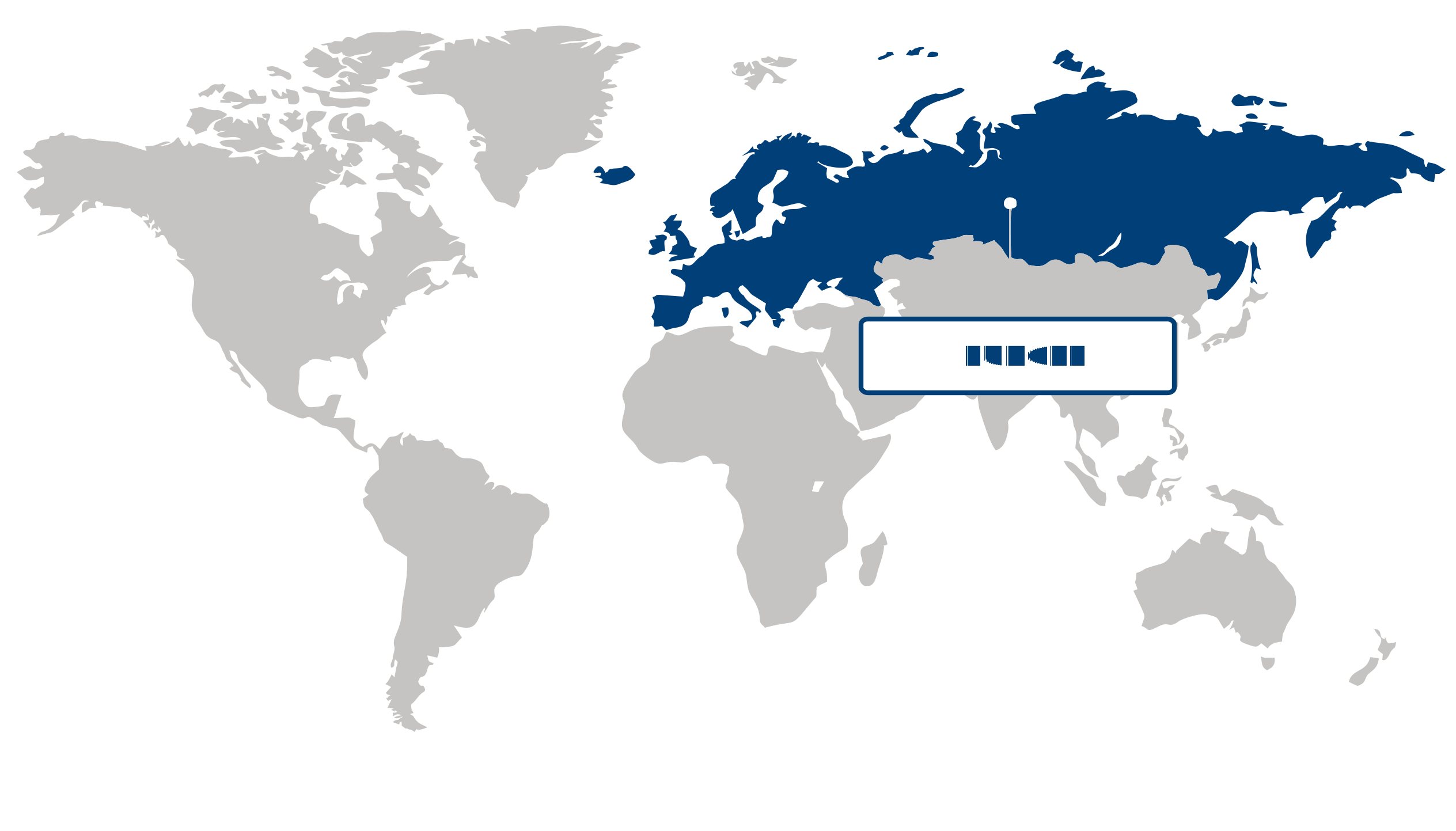
Europe (Largest Region)
Holding the largest share of the synthetic turf market in 2026, Europe benefited from strong adoption across sports facilities, landscaping, residential applications, and public spaces, supported by growing interest in water conservation and lower-maintenance outdoor surfaces. Increasing emphasis on sustainable urban development has encouraged the replacement of natural grass in applications where water availability, maintenance requirements, and year-round usability are important considerations. Established sports infrastructure and continued investment in recreational and commercial landscaping have further strengthened regional demand, while evolving product technologies have improved the durability, appearance, and functional performance of synthetic surfaces.
North America (Fastest-Growing Region)
North America is positioned as the fastest-growing region, supported by expanding applications in residential landscaping, sports infrastructure, commercial properties, and recreational facilities. Rising awareness of water-efficient landscaping is encouraging property owners and institutions to consider synthetic surfaces as an alternative to natural turf, particularly in areas facing water-management pressures. Growing renovation activity, demand for attractive low-maintenance outdoor environments, and improvements in turf design and installation practices are also contributing to market expansion. The region's established construction and landscaping ecosystem provides a favorable foundation for broader adoption across both new developments and replacement projects.
| Parameter | North America | Asia Pacific | Europe | Latin America | MEA |
|---|---|---|---|---|---|
| Innovation Hub i Scale Nascent Developing Advanced | |||||
| Cost-Sensitive Region i Scale Low Medium High | |||||
| Regulatory Environment i Scale Restrictive Neutral Supportive | |||||
| Demand Drivers i Scale Weak Moderate Strong | |||||
| Development Stage i Scale Emerging Developing Developed | |||||
| Adoption Rate i Scale Low Medium High | |||||
| New Entrants / Startups i Scale Sparse Moderate Dense | |||||
| Macro Indicators i Scale Weak Stable Strong |
Key Country Insights
United States 🇺🇸
Multi-Sport InfrastructureThe U.S. synthetic turf market is supported by investments in sports facilities, schools, and recreational infrastructure. Buyers increasingly prioritize durable turf systems with improved player safety, lower maintenance requirements, and enhanced environmental performance.
Germany 🇩🇪
Sustainable Surface DevelopmentGermany encourages synthetic turf solutions that balance sports performance with environmental considerations. Manufacturers are expanding recyclable materials and advanced infill technologies to meet evolving expectations from sports facility operators.
Japan 🇯🇵
Space-Efficient InstallationsJapan adopts synthetic turf across urban sports facilities, schools, and commercial landscapes where efficient land use is essential. The market favors durable surfaces that withstand intensive use while minimizing maintenance demands.
South Korea 🇰🇷
Urban Recreation InvestmentSouth Korea continues expanding synthetic turf installations for community sports facilities and educational institutions. Local demand emphasizes resilient turf products capable of supporting frequent use and consistent playing conditions throughout the year.
France 🇫🇷
Sports Facility ModernizationFrance is upgrading sports infrastructure with synthetic turf systems that reduce maintenance needs and extend field usability. Project developers increasingly evaluate surface quality, drainage performance, and sustainability when selecting turf solutions.
Italy 🇮🇹
Community Sports UpgradesItaly is incorporating synthetic turf into municipal sports grounds and training facilities to improve year-round usability. Italian buyers increasingly value durable installations that offer consistent performance while lowering long-term field maintenance requirements.
Segment Leadership and Growth Trends
Synthetic Turf Market Share (%), by Application, 2026
Go beyond the chart, access full insights & data tables
Request Free Sample ReportApplication Segment Analysis: Sports Fields (Largest Segment) vs Commercial Landscaping (Fastest-Growing Segment)
In the synthetic turf market, the sports fields application segment accounted for the largest share of 62.54% in 2026. Its leadership is supported by the widespread installation of synthetic surfaces in football fields, hockey grounds, training facilities, and multi-purpose sports complexes where durability and consistent playing conditions are essential. The ability of synthetic turf to withstand intensive use while reducing maintenance requirements and water consumption has made it a preferred choice for educational institutions, municipalities, and sports organizations investing in long-lasting athletic infrastructure.
Commercial landscaping is expected to emerge as the fastest-growing application segment due to increasing demand for aesthetically appealing and low-maintenance outdoor spaces in office complexes, hospitality venues, retail centers, and public facilities. Businesses are increasingly adopting synthetic turf to reduce landscaping costs while maintaining an attractive appearance throughout the year. Growing emphasis on sustainable landscaping and water conservation is further supporting expansion within this segment.
Material Segment Analysis: Polyethylene (PE) (Largest Segment) vs Nylon (Fastest-Growing Segment)
The polyethylene (PE) material segment held the largest share in 2026, supported by its soft texture, natural appearance, and excellent durability across a wide range of landscaping and sports applications. Polyethylene fibers provide strong resistance to weather exposure and frequent foot traffic while delivering enhanced comfort and visual appeal. These characteristics have made the material a preferred option for both recreational and decorative installations, reinforcing its market leadership.
The nylon material segment is anticipated to be the fastest-growing segment because of its superior strength, resilience, and ability to withstand heavy usage in demanding environments. Its excellent wear resistance and structural stability make it suitable for applications requiring high-performance turf capable of maintaining its integrity under intensive activity. Continued demand for premium synthetic turf solutions is expected to drive greater adoption of nylon-based products.
Distribution Channel Segment Analysis: Offline (Largest Segment) vs Online (Fastest-Growing Segment)
The offline distribution channel dominated the synthetic turf market in 2026, benefiting from the technical nature of product selection and installation. Customers often prefer purchasing through authorized dealers and specialized distributors who can provide product demonstrations, professional guidance, and installation support. Large commercial and institutional projects also rely on established offline networks to ensure product quality, customization, and project-specific consultation.
The online distribution channel is expected to record the fastest growth as digital platforms make product comparisons, specification reviews, and purchasing more convenient. Expanding online marketplaces, improved logistics capabilities, and greater availability of detailed product information are encouraging more residential and small-scale commercial buyers to procure synthetic turf through e-commerce channels.
| Segment | Sub-Segment | Largest Segment | Fastest Growing |
|---|---|---|---|
| Application | Sports Fields, Residential Landscaping, Commercial Landscaping, Others | Sports Fields | Commercial Landscaping |
| Material | Polyethylene (PE), Polypropylene (PP), Nylon | Polyethylene (PE) | Nylon |
| Distribution Channel | Online, Offline | Offline | Online |
Competitive Landscape and Market Positioning
Leading companies in the synthetic turf market:
- Tarkett S.A. (France)
- Shaw Industries Group, Inc. (United States)
- FieldTurf (Canada)
- AstroTurf Corporation (United States)
- Polytan GmbH (Germany)
- SYNLawn (United States)
- CCGrass (China)
- TenCate Grass (Netherlands)
- TigerTurf (United Kingdom)
- SportGroup Holding (Germany)
Demand for longer-lasting and lower-maintenance surfaces is redefining competitive strategies within the synthetic turf market, encouraging manufacturers to focus on material innovation, installation performance, and lifecycle value. Product development increasingly targets improved durability, realistic appearance, and enhanced environmental performance to address the varied requirements of sports facilities, commercial landscapes, and residential applications. As project specifications become more sophisticated, suppliers are also expanding technical support, installation expertise, and maintenance services to establish stronger relationships with contractors and facility owners seeking dependable long-term performance.
| Company | Market Share | Company Revenue | Revenue CAGR (%) | Product Portfolio | Geographic Presence | Innovation / R&D Focus | Strategic Developments |
|---|---|---|---|---|---|---|---|
| Tarkett S.A. (France) | |||||||
| Shaw Industries Group Inc. (United States) | |||||||
| FieldTurf (Canada) | |||||||
| AstroTurf Corporation (United States) | |||||||
| Polytan GmbH (Germany) | |||||||
| SYNLawn (United States) | |||||||
| CCGrass (China) | |||||||
| TenCate Grass (Netherlands) | |||||||
| TigerTurf (United Kingdom) | |||||||
| SportGroup Holding (Germany) |
Industry Development/News
| Company Name | Date | Key Development |
|---|---|---|
| SRM Concrete | May-26 | SRM Concrete provided funding for the construction of synthetic turf fields across multiple sports disciplines at Eagleville School. By financing these major facility upgrades, the firm demonstrates an active role in regional infrastructure development and the expansion of high-quality, synthetic-surface venues within the K-12 educational sports market. |
| The LandTek Group | Apr-26 | The LandTek Group secured a contract with Hofstra University to modernize synthetic turf surfaces at Bill Edwards and James M. Shuart stadiums. This project exemplifies the ongoing trend of institutional investment in athletic facility upgrades, further consolidating the company's operational role in the modernization of collegiate sports infrastructure. |
| Lonestar Soccer Club | Jan-26 | Lonestar Soccer Club, in partnership with Williamson County, initiated the conversion of four natural grass soccer fields to synthetic turf. This infrastructure project reflects broader market trends toward converting traditional municipal surfaces into high-utility, all-weather synthetic facilities to increase field capacity and extend regional usage. |
| TenCate | Aug-25 | TenCate launched Pivot Performance Turf, a PFAS-free artificial turf system engineered to replicate natural grass characteristics without traditional infill. This product innovation addresses increasing regulatory and environmental pressure regarding synthetic surfaces, positioning the company to capture demand for high-performance, sustainable, and eco-friendly athletic field technology. |
| Shaw Sports Turf | Aug-25 | Shaw Sports Turf opened its PEAK Performance Lab to facilitate dedicated research and development in synthetic surfaces. This investment in internal R&D capabilities, coupled with high-profile stadium installations, reinforces the company's technology-led approach to product innovation and strengthens its market position as a primary provider for elite athletic facilities. |
| FieldTurf | Jun-25 | FieldTurf completed the installation of its proprietary Vertex synthetic turf system at a major U.S. university football stadium. Incorporating advanced shock absorption and enhanced fiber durability, the project highlights the company's focus on high-stakes performance engineering and safety-centric product development within the competitive collegiate sports infrastructure segment. |
| Shaw Sports Turf | Apr-25 | Shaw Sports Turf introduced a sustainable product line manufactured from recycled materials. The launch directly addresses evolving environmental standards and circular economy requirements in the sports and landscaping sectors, demonstrating a strategic shift toward sustainable material sourcing without compromising the performance characteristics required for professional-grade athletic applications. |
| CCGrass | Mar-25 | CCGrass expanded its global manufacturing capacity by opening a new production facility in Southeast Asia. This strategic investment is designed to capitalize on growing demand within the Asia Pacific region, improve supply chain efficiency for international distribution, and strengthen the company's competitive footprint in emerging global markets. |
| SYNLawn | Jan-25 | SYNLawn entered a strategic partnership with a premier sports organization to develop specialized turf for elite training environments. The collaboration focuses on performance optimization and injury risk mitigation, illustrating the industry’s shift toward high-tech, performance-engineered surfaces tailored specifically for professional-level athletic development and training applications. |
| Chesterfield County | Oct-24 | Chesterfield County approved a $9 million contract to expand the River City Sportsplex, including the addition of four new synthetic turf fields. This multi-phase enhancement project highlights the continued municipal demand for large-scale, high-capacity athletic facilities, providing a significant commercial opportunity for regional synthetic turf construction and supply. |
Customize Your Report
Explore examples of how this report can be tailored to different research needs, including custom segments, additional topics or chapters, and related reports. Click a section of the wheel or its numbered marker to explore the available options.
Synthetic Turf Market — Custom Segments
| Segment | Sub-Segment |
|---|---|
| Pile Height | Less Than 20 mm, 20–40 mm, 41–60 mm, Above 60 mm |
| Infill Type | Silica Sand, Crumb Rubber, Organic Infill, Infill-Free |
| Installation Method | Full-Field Installation, Modular/Tile Installation, Carpet-Style Installation |
Synthetic Turf Market — Custom TOC
| Custom Chapter | Custom Details |
|---|---|
| End-Use Conversion Opportunity Assessment |
|
| Replacement Cycle & Installed-Base Opportunities |
|
| Green Building & Sustainability Adoption |
|
Need a different cut of the data?
Request Custom ResearchHow much revenue does the synthetic turf market generate?
What are the growth projections for the synthetic turf industry?
How are sports and recreational infrastructure investments accelerating synthetic turf adoption?
Why is water conservation strengthening the shift toward synthetic landscaping?
Why do sports fields account for the largest share of the synthetic turf market?
How is commercial landscaping driving growth in the synthetic turf market?
Why does Europe lead the synthetic turf market?
How is North America driving faster synthetic turf market growth?
What are the prominent companies operating in the synthetic turf landscape?
Our Clients
"The report provided us with a clear direction, and the level of detail was beyond what we expected. I would definitely recommend their services to others."
Haier Appliances
"The collaboration with Fundamental Business Insights has added significant value to our decision-making process, and we look forward to continuing this partnership for our future market research requirements."
Luxottica Group S.p.A.
"The team at FBI delivered an exceptional research report. The insights on industry innovations were particularly impressive and added a lot of value to the overall report."
Nike
Our Research Team & Methodology
Every Fundamental Business Insights report is built by a dedicated vertical research team, validated through a structured primary-and-secondary methodology, and reviewed for accuracy before it reaches you.
Research Team Overview
Prepared by the Consumer Goods & Services Research Team
Delivery
Published
Demand
Available
Support
Trust & Compliance
Research Domains
10 coverage areasResearch Intelligence
| Source | Reference |
|---|---|
| International Organization for Standardization (ISO) | www.iso.org |
| ASTM International | www.astm.org |
| U.S. Consumer Product Safety Commission (CPSC) | www.cpsc.gov |
| European Commission – Consumer Safety | ec.europa.eu/safety-gate |
| Consumer Technology Association (CTA) | www.cta.tech |
| National Retail Federation (NRF) | nrf.com |
| World Retail Congress | www.worldretailcongress.com |
| World Travel & Tourism Council (WTTC) | wttc.org |
| UN Tourism | www.unwto.org |
| Personal Care Products Council (PCPC) | www.personalcarecouncil.org |
| Cosmetics Europe | cosmeticseurope.eu |
| International Housewares Association (IHA) | www.housewares.org |
| American Apparel & Footwear Association (AAFA) | www.aafaglobal.org |
| World Federation of the Sporting Goods Industry (WFSGI) | wfsgi.org |
| Juvenile Products Manufacturers Association (JPMA) | www.jpma.org |
| Pet Industry Joint Advisory Council (PIJAC) | pijac.org |
| International Council of Toy Industries (ICTI) | www.toy-icti.org |
| International Association of Amusement Parks and Attractions (IAAPA) | iaapa.org |
| Organisation for Economic Co-operation and Development (OECD) | www.oecd.org |
| World Bank Data | data.worldbank.org |
Research Workflow & Quality Assurance
Data Collection
Verified information gathered through primary and secondary research.
Data Triangulation
Cross-validation using multiple independent data sources.
Forecast Modelling
Market estimates developed using historical trends and analytical models.
Analyst Validation
Findings reviewed by domain experts for accuracy and consistency.
Editorial & Quality Review
Final editorial, quality, and compliance checks before publication.
Final Publication
Released after successful completion of the internal review process.
Report Coverage
📊 Market Assessment
- Market Size & Forecast
- Market Segmentation
- Regional Analysis
- Growth Drivers & Challenges
- Market Dynamics
🏢 Competitive Intelligence
- Competitive Landscape
- Company Profiles
- Competitive Benchmarking
- Mergers & Acquisitions
- Market Share Analysis or Key Company Strategies
🔍 Strategic Analysis
- Value Chain Analysis
- Porter's Five Forces
- PESTLE Analysis
- Pricing Trends
- Supply-Demand Analysis
🚀 Future Outlook
- Technology Landscape
- Regulatory Landscape
- Investment & Funding Landscape
- Emerging Opportunities
- Future Market Outlook
Have a question about this report or need a custom scope?
Request Customization