Synthetic Paper Market Size & Growth Forecast 2027–2036, By Segments (Application, Product), Regional Demand Trends (North America, Asia Pacific, Europe), Key Country Insights (U.S., Japan, South Korea, Germany, France, Italy), and Competitive Landscape
Market Size and Growth Outlook
Synthetic Paper Market size was worth USD 1.3 billion in 2026 and is expected to grow at a 5.99% CAGR between 2027 and 2036, surpassing USD 2.33 billion by 2036. The industry revenue for 2027 is assessed at USD 1.37 billion.
Get more details on this report
Request Free Sample ReportSynthetic Paper Market Intelligence Snapshot
Regional Market Dynamics
- Asia Pacific accounted for 39.08% of the market in 2026, supported by its strong manufacturing base, high packaging demand, and broad industrial use across consumer goods and logistics.
- North America is projected to grow at a 6.44% CAGR, driven by increasing demand for durable, recyclable materials across labeling, commercial printing, packaging, healthcare, and logistics applications.
Segment Momentum
- Non-Label applications accounted for a 63% share in 2026 due to strong demand for durable, moisture-resistant, and print-stable materials used in maps, manuals, menus, tags, and other high-handling applications.
- Label is the fastest-growing segment as packaging and identification applications increasingly require materials that resist water, chemicals, abrasion, and temperature changes while maintaining readability and appearance.
Market Expansion Drivers
- Rising demand for durable waterproof labeling in packaging and printing applications.
- Shift toward recyclable and biodegradable synthetic paper materials.
- Expansion of e-commerce logistics boosting durable labeling and packaging demand.
Leading Market Participants
- Leading companies in the synthetic paper market include Formosa Plastics Corporation (Taiwan), Cosmo First Limited (India), Jindal Poly Films Limited (India), Toyobo Co., Ltd. (Japan), Transcendia, Inc. (United States), SIHL GmbH (Germany), B&F Plastics, Inc. (United States), Valéron Strength Films (United States), Granwell Products, Inc. (United States), TechNova Imaging Systems Pvt. Ltd. (India).
Global Market Forecast Snapshot
Market Outlook
- 2026 Market Size: USD 1.3 billion
- 2027 Estimated Market Size: USD 1.37 billion.
- Projected Market Size: USD 2.33 billion by 2036
- Growth Forecast: 5.99% CAGR (2027-2036)
Regional and Segment Outlook
- Leading Regional Market: Asia Pacific
- High-Growth Regional Hub: North America
- Core Revenue Segment: Non-Label (Application) | BOPP (Product)
- Emerging Opportunity Segment: Label (Application) | HDPE (Product)
Market Growth Drivers and Industry Trends
Rising demand for durable waterproof labeling in packaging and printing applications
Demand for labels and printed materials capable of withstanding moisture, abrasion, and demanding handling conditions is supporting the synthetic paper market across packaging and printing applications. Synthetic paper offers durability and resistance characteristics that make it suitable for labels used in environments where conventional paper can deteriorate or lose readability. Applications can include product identification, logistics labels, industrial tags, and packaging materials exposed to humidity or frequent handling. As manufacturers and distributors require printed information to remain legible throughout storage, transportation, and product use, durable synthetic substrates are gaining relevance in applications where performance and print quality must be maintained under challenging conditions.
Shift toward recyclable and biodegradable synthetic paper materials
Environmental considerations are influencing material selection across packaging and printing industries, encouraging the development and adoption of more sustainable synthetic paper alternatives. The synthetic paper market is being shaped by efforts to improve recyclability, incorporate environmentally preferable feedstocks, and reduce the ecological impact associated with conventional material choices. Recyclable and biodegradable formulations can help businesses respond to sustainability objectives while maintaining the durability, moisture resistance, and printability expected from synthetic substrates. Increasing attention to responsible packaging design and material recovery is encouraging manufacturers to improve the environmental characteristics of synthetic paper without compromising its functional performance.
Expansion of e-commerce logistics boosting durable labeling and packaging demand
Rapid expansion of online retail is increasing the volume of products moving through warehouses, fulfillment centers, and transportation networks, creating greater requirements for durable identification and packaging materials. The synthetic paper market will benefit from this logistics activity as shipping labels, handling tags, product identifiers, and other printed materials must remain readable during repeated movement and exposure to varying environmental conditions. Moisture resistance and mechanical durability are particularly valuable in distribution environments where packages may experience friction, handling, and temperature or humidity changes. The need for reliable labeling throughout the fulfillment and delivery process is therefore increasing the use of resilient printed substrates in e-commerce logistics.
| Growth Driver | Impact on CAGR | Regulatory Influence | Geographic Relevance | Adoption Rate | Impact Timeline |
|---|---|---|---|---|---|
| Rising demand for durable waterproof labeling in packaging and printing applications | 2.00% | Moderate | Asia Pacific, North America | Medium | Near Term |
| Shift toward recyclable and biodegradable synthetic paper materials | 1.80% | High | Europe, North America, Asia Pacific | Medium | Mid Term |
| Expansion of e-commerce logistics boosting durable labeling and packaging demand | 1.40% | Low | Asia Pacific, North America | High | Near Term |
Unlock insights tailored to your business with our bespoke market research solutions.
Click to get your customized report now.
Regional Demand Dynamics
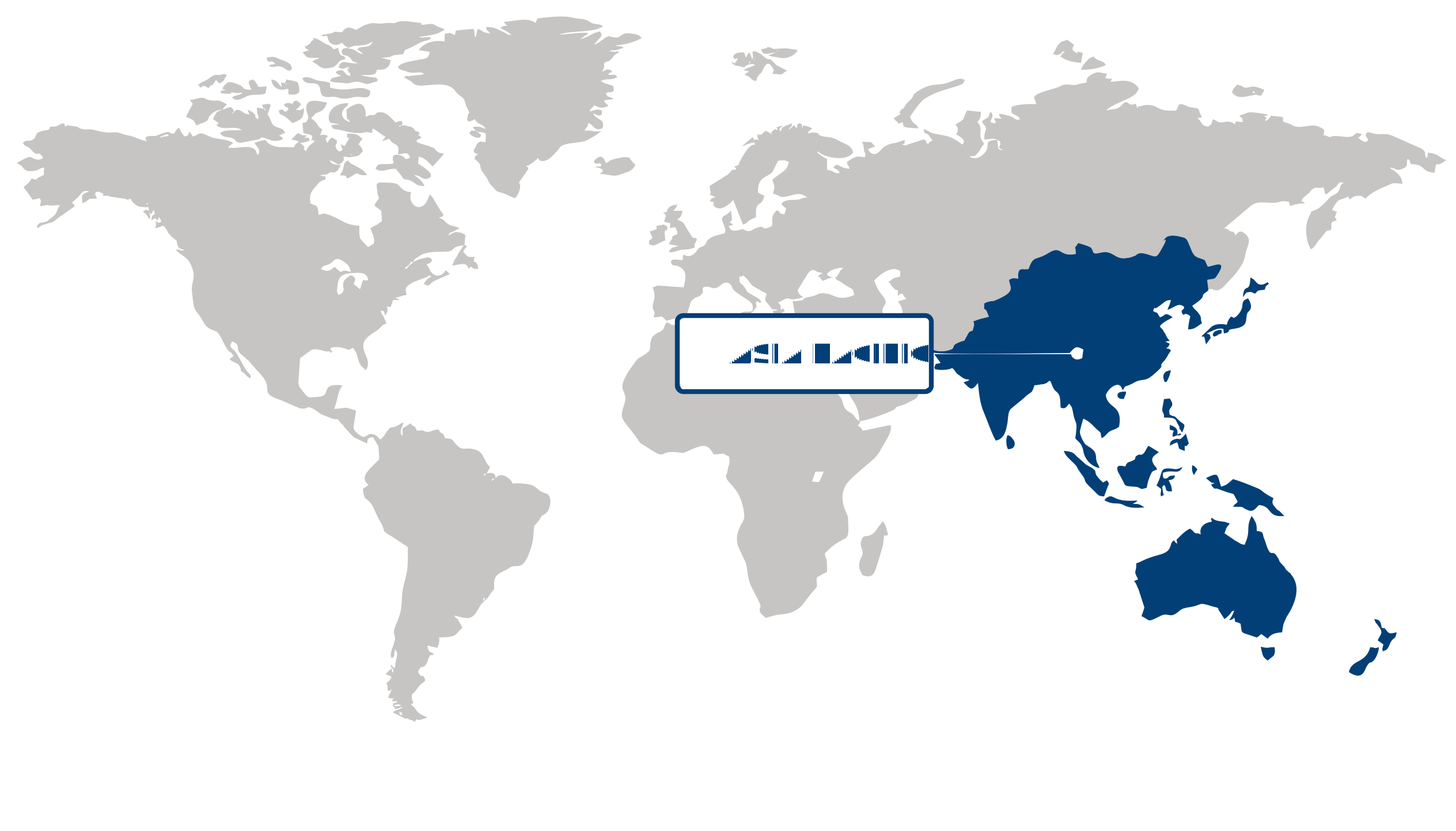
Asia Pacific (Largest Region)
Asia Pacific accounted for a 39.08% share of the synthetic paper market in 2026, supported by strong packaging, printing, labeling, retail, and industrial manufacturing activity across the region. Synthetic paper is increasingly valued for applications requiring durability, moisture resistance, tear resistance, and consistent printability, particularly in environments where conventional paper products may have performance limitations. Expanding consumer goods and packaging industries are creating demand for durable labels, tags, promotional materials, and specialty packaging solutions. The region's large manufacturing base and growing retail activity further support consumption across commercial and industrial applications. Increasing awareness of material durability and the need to reduce waste associated with damaged or frequently replaced printed products are also supporting interest in longer-lasting alternatives. At the same time, improvements in printing technologies are broadening the range of applications for synthetic paper across packaging and communication materials. These industrial and commercial factors underpin Asia Pacific's leading position in the market.
North America (Fastest-Growing Region)
North America is the fastest-growing region in the synthetic paper market, driven by demand for durable printing substrates across packaging, labeling, outdoor communication, logistics, and specialty applications. Businesses are increasingly seeking materials that can withstand moisture, abrasion, handling, and demanding operating environments while maintaining print quality. The expansion of sophisticated packaging formats and the need for reliable product identification are creating additional opportunities for synthetic paper solutions. Sustainability considerations are also influencing material selection, encouraging manufacturers and users to evaluate products with improved lifecycle characteristics and opportunities for resource-efficient production. Technological advances in digital and specialty printing are further enabling customized and high-quality applications, increasing the versatility of synthetic paper across commercial sectors. In addition, demand for durable labels and tags in logistics and industrial operations is supporting wider adoption. These trends are strengthening the market's growth prospects and positioning North America as a rapidly expanding regional market.
| Parameter | North America | Asia Pacific | Europe | Latin America | MEA |
|---|---|---|---|---|---|
| Innovation Hub i Scale Nascent Developing Advanced | |||||
| Cost-Sensitive Region i Scale Low Medium High | |||||
| Regulatory Environment i Scale Restrictive Neutral Supportive | |||||
| Demand Drivers i Scale Weak Moderate Strong | |||||
| Development Stage i Scale Emerging Developing Developed | |||||
| Adoption Rate i Scale Low Medium High | |||||
| New Entrants / Startups i Scale Sparse Moderate Dense | |||||
| Macro Indicators i Scale Weak Stable Strong |
Key Country Insights
Germany 🇩🇪
Industrial Printing SolutionsGermany emphasizes synthetic paper for industrial labeling, logistics, and technical documentation requiring long service life. Producers in Germany are focusing on advanced material performance and compatibility with high-quality commercial printing technologies.
France 🇫🇷
Sustainable Print ApplicationsFrance is encouraging synthetic paper solutions that balance durability with environmental considerations across packaging and commercial printing. Manufacturers in France are expanding recyclable product offerings to address customer sustainability objectives.
Italy 🇮🇹
Premium Packaging SupportItaly utilizes synthetic paper for premium packaging, luxury labeling, and graphic printing where appearance and durability are essential. Producers in Italy are refining material finishes and print performance to meet brand presentation requirements.
Japan 🇯🇵
Specialty Media InnovationJapan continues to develop premium synthetic paper for precision printing, consumer products, and specialty packaging. Manufacturers in Japan are enhancing print quality, moisture resistance, and material consistency for demanding commercial applications.
South Korea 🇰🇷
Advanced Label MaterialsSouth Korea is increasing the use of synthetic paper in consumer goods, electronics, and logistics labeling. Material suppliers in South Korea are improving printable surfaces and durability to support automated packaging and identification systems.
United States 🇺🇸
Durable Packaging DemandThe U.S. synthetic paper market is supported by demand for durable labels, packaging, and industrial printing applications. Manufacturers are developing recyclable and high-performance materials that improve product durability while meeting evolving sustainability expectations.
Segment Leadership and Growth Trends
Synthetic Paper Market Share (%), by Application, 2026
Go beyond the chart, access full insights & data tables
Request Free Sample ReportApplication Segment Analysis: Non-Label (Largest Segment) vs Label (Fastest-Growing Segment)
The non-label segment led the synthetic paper market with a 63% share in 2026, supported by broad use in applications requiring durable, moisture-resistant, and tear-resistant paper alternatives. Its suitability for tags, cards, instructional materials, packaging inserts, and other functional applications strengthens demand where conventional paper can be vulnerable to water, abrasion, or repeated handling. The segment also benefits from the growing preference for materials that combine printability with enhanced durability across commercial and industrial uses.
The label segment is gaining momentum as synthetic paper becomes increasingly attractive for labeling applications that require resistance to moisture, chemicals, and outdoor exposure. Demand from consumer packaging, logistics, retail, and industrial identification is supported by the need for labels that remain legible and intact throughout handling, transportation, and storage. Increasing emphasis on high-quality product presentation and durable labeling solutions is further supporting adoption of synthetic paper in this application.
Product Segment Analysis: BOPP (Largest Segment) vs HDPE (Fastest-Growing Segment)
The BOPP segment accounted for a 60% share of the synthetic paper market in 2026, reflecting its strong combination of clarity, dimensional stability, printability, and resistance to moisture and tearing. These properties make BOPP-based synthetic paper suitable for applications where visual quality and material durability are important, particularly in packaging and labeling environments. Its established processing compatibility and versatility across end-use applications continue to support its broad commercial adoption.
HDPE is emerging as the fastest-growing product segment as demand increases for synthetic paper with strong flexibility, chemical resistance, and durability under demanding operating conditions. Its ability to withstand moisture and rough handling makes it suitable for applications requiring long-lasting printed materials and functional surfaces. Growing interest in durable, lightweight, and performance-oriented alternatives to conventional paper is creating additional opportunities for HDPE-based synthetic paper.
| Segment | Sub-Segment | Largest Segment | Fastest Growing |
|---|---|---|---|
| Application | Label, Non-Label | Non-Label | Label |
| Product | BOPP, HDPE, PET, Others | BOPP | HDPE |
Competitive Landscape and Market Positioning
Major players in the synthetic paper market:
1. Formosa Plastics Corporation (Taiwan)
2. Cosmo First Limited (India)
3. Jindal Poly Films Limited (India)
4. Toyobo Co. Ltd. (Japan)
5. Transcendia Inc. (United States)
6. SIHL GmbH (Germany)
7. B&F Plastics Inc. (United States)
8. Valéron Strength Films (United States)
9. Granwell Products Inc. (United States)
10. TechNova Imaging Systems Pvt. Ltd. (India)
The synthetic paper market is expanding due to rising demand for durable, water-resistant, and recyclable alternatives to conventional paper. Material engineering improvements are enhancing printability and strength. The synthetic paper market is also benefiting from wider adoption in packaging and labeling applications across multiple industries.
| Company | Market Share | Company Revenue | Revenue CAGR (%) | Product Portfolio | Geographic Presence | Innovation / R&D Focus | Strategic Developments |
|---|---|---|---|---|---|---|---|
| Formosa Plastics Corporation (Taiwan) | |||||||
| Cosmo First Limited (India) | |||||||
| Jindal Poly Films Limited (India) | |||||||
| Toyobo Co. Ltd. (Japan) | |||||||
| Transcendia Inc. (United States) | |||||||
| SIHL GmbH (Germany) | |||||||
| B&F Plastics Inc. (United States) | |||||||
| Valéron Strength Films (United States) | |||||||
| Granwell Products Inc. (United States) | |||||||
| TechNova Imaging Systems Pvt. Ltd. (India). |
Industry Development/News
| Company Name | Date | Key Development |
|---|---|---|
| Yupo Corporation | Nov-24 | Yupo Corporation and Huge Paper launched SuperYupo synthetic paper in Canada, enabling double-sided printing with conventional inks while maintaining durability and water resistance. The product broadens application scope for synthetic paper in labeling and high-performance printing markets. |
| Cosmo First | Sep-24 | Cosmo First commissioned a new BOPP film production line at its Aurangabad facility with an investment exceeding ₹400 crore, adding approximately 81,200 MT of annual capacity. The expansion significantly increases production scale and strengthens its specialty films and synthetic paper materials portfolio. |
| Cosmo Films | May-21 | Cosmo Films introduced an opaque, non-tearable synthetic paper for lamination, labeling, and flexible packaging applications. The product expands its synthetic materials portfolio and enhances durability-focused alternatives to conventional paper substrates. |
| AGFA | Jan-21 | AGFA launched SYNAPS XM110 synthetic paper, a 100-micron ultra-thin grade within its SYNAPS XM portfolio. The product expands synthetic paper offerings with enhanced print compatibility and material efficiency for high-performance labeling and printing applications. |
| Yupo Corporation | Sep-20 | Yupo Corporation launched SUPERYUPO Double synthetic paper grade supporting double-sided printing using oil-based inks while retaining durability and water resistance. The development enhances printing flexibility and expands application potential in labeling and industrial printing segments. |
| Arjobex SAS | 2020 | Arjobex SAS acquired MDV Group, a European manufacturer of specialty coated papers and films, strengthening its position in synthetic paper and coated film markets. The acquisition expands production capabilities and reinforces its leadership in specialty coatings solutions across Europe. |
| Yupo Corporation | Jun-19 | Yupo Corporation developed YUPO Green synthetic paper made from alternative resin materials, including biomass-based inputs such as sugarcane bagasse. The innovation supports sustainability-driven product development and expands eco-friendly applications in synthetic paper markets. |
| Agfa-Gevaert Group | 2019 | Agfa-Gevaert Group partnered with Fujitex Co. to distribute SYNAPS synthetic paper in Japan, strengthening market access through established printer distribution channels. The collaboration enhances regional penetration and supports broader commercialization of synthetic paper products. |
Customize Your Report
Explore examples of how this report can be tailored to different research needs, including custom segments, additional topics or chapters, and related reports. Click a section of the wheel or its numbered marker to explore the available options.
Synthetic Paper Market — Custom Segments
| Segment | Sub-Segment |
|---|---|
| End-Use Industry | Retail & Consumer Goods, Healthcare & Pharmaceuticals, Food & Beverage, Industrial & Manufacturing, Logistics & Transportation |
| Printing Technology | Flexographic Printing, Offset Printing, Digital Printing, Gravure Printing, Screen Printing |
| Distribution Channel | Direct Sales, Distributors & Wholesalers, Specialty Paper Suppliers, Online B2B Channels |
Synthetic Paper Market — Custom TOC
| Custom Chapter | Custom Details |
|---|---|
| End-Use Conversion Opportunities |
|
| Sustainable Packaging Substitution |
|
| Printing Industry Adoption Assessment |
|
Need a different cut of the data?
Request Custom ResearchHow much revenue does the synthetic paper market generate?
What is the forecasted size of the synthetic paper industry?
How are durability requirements in packaging and labeling applications reshaping material selection in the synthetic paper market?
Why is the shift toward recyclable and high-performance synthetic substrates influencing procurement decisions in the synthetic paper market?
Why does the non-label segment lead the synthetic paper market?
What is driving the rapid growth of the label segment in the synthetic paper market?
Why is Asia Pacific the leading region in the synthetic paper market?
What is driving synthetic paper market growth in North America?
What are the prominent companies operating in the synthetic paper landscape?
Our Clients
"The report helped us understand emerging consumer trends in our product category. It clarified where to focus innovation for the next product launch."
LyondellBasell
"The regional forecast section was incredibly useful. We were able to identify two new potential partners in Europe thanks to the vendor mapping you included."
SABIC
"We appreciated how actionable the recommendations were. It guided us to improve supply chain resilience."
Olin Corporation
Our Research Team & Methodology
Every Fundamental Business Insights report is built by a dedicated vertical research team, validated through a structured primary-and-secondary methodology, and reviewed for accuracy before it reaches you.
Research Team Overview
Prepared by the Chemicals & Materials Research Team
Delivery
Published
Demand
Available
Support
Trust & Compliance
Research Domains
10 coverage areasResearch Intelligence
| Source | Reference |
|---|---|
| American Chemistry Council (ACC) | www.americanchemistry.com |
| European Chemical Industry Council (Cefic) | cefic.org |
| International Council of Chemical Associations (ICCA) | icca-chem.org |
| European Chemicals Agency (ECHA) | echa.europa.eu |
| U.S. Environmental Protection Agency (EPA) | www.epa.gov |
| ASTM International | www.astm.org |
| International Organization for Standardization (ISO) | www.iso.org |
| National Institute of Standards and Technology (NIST) | www.nist.gov |
| Plastics Industry Association (PLASTICS) | www.plasticsindustry.org |
| European Biplastics | www.european-bioplastics.org |
| The Adhesive and Sealant Council (ASC) | www.ascouncil.org |
| National Association of Corrosion Engineers (AMPP) | www.ampp.org |
| Society of Plastics Engineers (SPE) | www.4spe.org |
| International Fertilizer Association (IFA) | www.fertilizer.org |
| CropLife International | croplife.org |
| Packaging Europe | packagingeurope.com |
| Flexible Packaging Association (FPA) | www.flexpack.org |
| Battery Council International (BCI) | batterycouncil.org |
| International Copper Association (ICA) | internationalcopper.org |
| World Steel Association | worldsteel.org |
Research Workflow & Quality Assurance
Data Collection
Verified information gathered through primary and secondary research.
Data Triangulation
Cross-validation using multiple independent data sources.
Forecast Modelling
Market estimates developed using historical trends and analytical models.
Analyst Validation
Findings reviewed by domain experts for accuracy and consistency.
Editorial & Quality Review
Final editorial, quality, and compliance checks before publication.
Final Publication
Released after successful completion of the internal review process.
Report Coverage
📊 Market Assessment
- Market Size & Forecast
- Market Segmentation
- Regional Analysis
- Growth Drivers & Challenges
- Market Dynamics
🏢 Competitive Intelligence
- Competitive Landscape
- Company Profiles
- Competitive Benchmarking
- Mergers & Acquisitions
- Market Share Analysis or Key Company Strategies
🔍 Strategic Analysis
- Value Chain Analysis
- Porter's Five Forces
- PESTLE Analysis
- Pricing Trends
- Supply-Demand Analysis
🚀 Future Outlook
- Technology Landscape
- Regulatory Landscape
- Investment & Funding Landscape
- Emerging Opportunities
- Future Market Outlook
Have a question about this report or need a custom scope?
Request Customization