Swine Artificial Insemination Market Size & Growth Forecast 2027–2036, By Segments (Solutions, Distribution Channel), Regional Demand Trends (North America, Asia Pacific, Europe), Key Country Insights (U.S., Japan, South Korea, Germany, France, Italy), and Competitive Landscape
Market Size and Growth Outlook
Swine Artificial Insemination Market size was more than USD 2.4 billion in 2026 and is set to grow at a 7.79% CAGR between 2027 and 2036, attaining USD 5.08 billion by 2036. The industry revenue for 2027 is calculated at USD 2.56 billion.
Get more details on this report
Request Free Sample ReportSwine Artificial Insemination Market Intelligence Snapshot
Regional Market Dynamics
- Asia Pacific accounted for 32.12% of the market in 2026 due to its large-scale commercial pig production, routine use of artificial insemination, and sustained demand for breeding services and reproductive management.
- North America is projected to grow at a 7.57% CAGR as producers prioritize herd genetics, reproductive efficiency, and standardized breeding programs to improve conception rates and production planning.
Segment Momentum
- Services held a 47.73% share in 2026 because producers rely on specialized breeding support, semen handling, fertility management, and technical expertise to achieve consistent reproductive performance.
- Public distribution is growing fastest by expanding access to breeding resources and structured artificial insemination support, helping more producers adopt modern reproductive practices across developing farming networks.
Market Expansion Drivers
- Rising demand for high-yield pork production driving adoption of advanced reproductive technologies.
- Expansion of large-scale commercial pig farming accelerating artificial insemination adoption.
- AI-enabled reproductive monitoring improving conception accuracy and herd genetic optimization.
Leading Market Participants
- Prominent companies in the swine artificial insemination market include Genus plc (United Kingdom), IMV Technologies Group (France), Minitüb GmbH (Germany), Neogen Corporation (United States), Hypor B.V. (Netherlands), Swine Genetics International, LLC (United States), GenePro Inc. (United States), Semen Cardona S.L. (Spain), Shipley Swine Genetics (United States), Topigs Norsvin (Netherlands).
Global Market Forecast Snapshot
Market Outlook
- 2026 Market Size: USD 2.4 billion
- 2027 Estimated Market Size: USD 2.56 billion.
- Projected Market Size: USD 5.08 billion by 2036
- Growth Forecast: 7.79% CAGR (2027-2036)
Regional and Segment Outlook
- Leading Regional Market: Asia Pacific
- High-Growth Regional Hub: North America
- Core Revenue Segment: Services (Solutions) | Private (Distribution Channel)
- Emerging Opportunity Segment: Semen (Solutions) | Public (Distribution Channel)
Market Growth Drivers and Industry Trends
Rising demand for high-yield pork production driving adoption of advanced reproductive technologies
Growing emphasis on improving pork production efficiency will drive the swine artificial insemination market as producers seek reproductive approaches that support higher productivity and more predictable breeding outcomes. Artificial insemination enables producers to utilize desirable genetic traits from selected boars across a larger number of sows, helping improve herd quality while reducing the need to maintain large numbers of breeding males. The approach can also support better control over breeding schedules, facilitate the dissemination of superior genetics, and improve reproductive management across commercial operations. Rising consumer demand for pork is encouraging producers to focus on herd productivity and resource efficiency, increasing interest in reproductive technologies that can strengthen breeding performance without proportionately increasing farm inputs.
Expansion of large-scale commercial pig farming accelerating artificial insemination adoption
The expansion of commercial pig farming operations is creating greater demand for standardized and scalable breeding practices, supporting adoption across the swine artificial insemination market. Large-scale farms require reproductive systems that can manage substantial breeding populations while maintaining consistent herd performance and operational efficiency. Artificial insemination allows producers to coordinate breeding programs more systematically and use genetic material from selected animals across multiple production units, reducing dependence on maintaining extensive boar populations at individual facilities. As pig farming becomes increasingly organized around specialized production systems and structured herd management, artificial insemination fits into workflows involving controlled breeding, genetic selection, reproductive scheduling, and herd-level performance monitoring.
AI-enabled reproductive monitoring improving conception accuracy and herd genetic optimization
Advances in artificial intelligence and digital reproductive monitoring are enhancing decision-making within the swine artificial insemination market by enabling producers to assess breeding readiness and reproductive conditions with greater precision. AI-enabled systems can support the analysis of reproductive indicators, helping identify suitable insemination windows and allowing farm personnel to make more informed breeding decisions. Improved monitoring can reduce the risk of poorly timed insemination and support more consistent conception management across herds. At the same time, digital tools can assist producers in evaluating reproductive performance and identifying animals with desirable characteristics, strengthening genetic selection programs and supporting more targeted herd optimization.
| Growth Driver | Impact on CAGR | Regulatory Influence | Geographic Relevance | Adoption Rate | Impact Timeline |
|---|---|---|---|---|---|
| Adoption of AI & Automation in Swine Reproduction | 2.50% | Short term (≤ 2 yrs) | North America, Europe (spillover: Asia Pacific) | Low | Fast |
| Growth of Commercial Swine Farming | 2.00% | Medium term (2–5 yrs) | Asia Pacific, North America (spillover: Europe) | Medium | Moderate |
| Government Livestock Breeding Programs | 1.50% | Long term (5+ yrs) | Europe, Asia Pacific (spillover: MEA) | High | Slow |
| Rising demand for high-yield pork production driving adoption of advanced reproductive technologies | 2.20% | Moderate | Asia Pacific, Latin America | High | Near Term |
| Expansion of large-scale commercial pig farming accelerating artificial insemination adoption | 2.00% | Low | Asia Pacific | High | Mid Term |
| AI-enabled reproductive monitoring improving conception accuracy and herd genetic optimization | 1.60% | Moderate | Asia Pacific, Europe | Emerging | Mid Term |
Unlock insights tailored to your business with our bespoke market research solutions.
Click to get your customized report now.
Regional Demand Dynamics
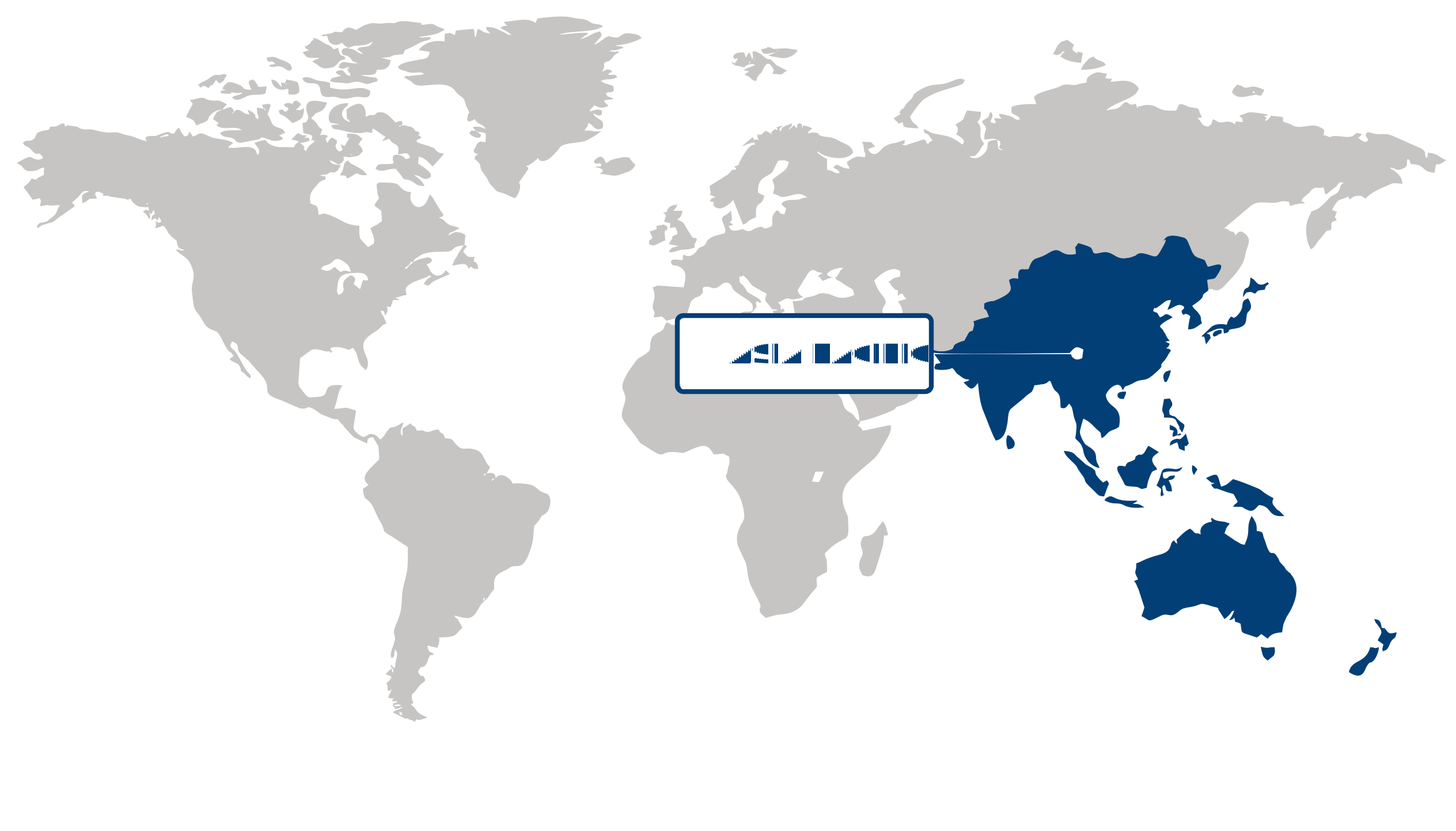
Asia Pacific (Largest Region)
In the swine artificial insemination market, Asia Pacific held the largest share of 32.12% in 2026, supported by the region’s substantial swine production base and growing emphasis on improving breeding efficiency. Producers are increasingly adopting artificial insemination to facilitate controlled mating, enhance genetic selection, and improve herd management while reducing the operational constraints associated with natural breeding. Expansion of commercial pig farming and greater professionalization of livestock production are strengthening demand for reproductive technologies. In addition, improvements in veterinary services, breeding management practices, and access to specialized animal health infrastructure are supporting broader adoption across organized swine operations.
North America (Fastest-Growing Region)
North America is emerging as the fastest-growing region, driven by strong adoption of technology-enabled livestock management and a focus on productivity, genetic improvement, and herd health. Commercial producers are increasingly integrating reproductive technologies into structured breeding programs to improve genetic outcomes and manage production more efficiently. Advances in semen handling, reproductive monitoring, and farm-level data management are creating a more favorable environment for artificial insemination. The region’s established veterinary infrastructure and emphasis on biosecurity further support the integration of controlled breeding practices, while ongoing efforts to improve production efficiency are encouraging greater use of advanced reproductive solutions.
| Parameter | North America | Asia Pacific | Europe | Latin America | MEA |
|---|---|---|---|---|---|
| Innovation Hub i Scale Nascent Developing Advanced | |||||
| Cost-Sensitive Region i Scale Low Medium High | |||||
| Regulatory Environment i Scale Restrictive Neutral Supportive | |||||
| Demand Drivers i Scale Weak Moderate Strong | |||||
| Development Stage i Scale Emerging Developing Developed | |||||
| Adoption Rate i Scale Low Medium High | |||||
| New Entrants / Startups i Scale Sparse Moderate Dense | |||||
| Macro Indicators i Scale Weak Stable Strong |
Key Country Insights
Germany 🇩🇪
Genetic Improvement StrategiesGermany emphasizes swine artificial insemination as part of structured breeding programs aimed at improving herd quality and production efficiency. Producers in Germany invest in genetic selection, reproductive health management, and biosecurity practices that support consistent breeding outcomes.
France 🇫🇷
Quality Genetics AdoptionFrance supports swine artificial insemination through breeding programs emphasizing genetic quality and sustainable livestock production. Producers in France continue adopting reproductive technologies that improve breeding efficiency while aligning with evolving animal welfare and production standards.
Italy 🇮🇹
Modern Breeding OperationsItaly continues expanding the use of swine artificial insemination to improve reproductive efficiency across commercial pig farming operations. Producers in Italy invest in genetic advancement, specialized breeding services, and herd management practices that support consistent production quality.
Japan 🇯🇵
Precision Breeding PracticesJapan applies swine artificial insemination to strengthen breeding precision while maintaining high animal health standards. Swine producers in Japan prioritize superior genetic material, reproductive efficiency, and controlled breeding management to support stable livestock production.
South Korea 🇰🇷
Efficient Herd ManagementSouth Korea integrates swine artificial insemination with modern livestock management practices to improve breeding consistency. Producers in South Korea focus on reproductive technologies, disease prevention measures, and genetics-based herd improvement that enhance operational performance.
United States 🇺🇸
Productivity Enhancement ProgramsThe U.S. swine artificial insemination market focuses on improving herd productivity through advanced genetics and reproductive management. Producers in the U.S. increasingly adopt precision breeding practices, semen quality monitoring, and data-driven herd management to optimize production performance.
Segment Leadership and Growth Trends
Swine Artificial Insemination Market Share (%), by Solutions, 2026
Go beyond the chart, access full insights & data tables
Request Free Sample ReportSolutions Segment Analysis: Services (Largest Segment) vs Semen (Fastest-Growing Segment)
Services held the largest share of the swine artificial insemination market, accounting for 47.73% in 2026, supported by the need for specialized expertise throughout artificial insemination programs. Service providers assist producers with breeding management, insemination procedures, reproductive planning, and related technical requirements, helping improve the efficiency and consistency of herd reproduction. Increasing emphasis on controlled breeding practices and productivity-oriented livestock management sustains demand for professional artificial insemination services.
Semen is expected to be the fastest-growing solution segment as producers increasingly adopt controlled breeding programs to improve reproductive outcomes and herd management. High-quality semen enables the use of selected genetic traits across breeding operations while supporting more systematic reproductive planning. Greater focus on genetic improvement, breeding efficiency, and modern livestock production practices is expected to accelerate the adoption of semen-based artificial insemination solutions.
Distribution Channel Segment Analysis: Private (Largest Segment) vs Public (Fastest-Growing Segment)
The private distribution channel represented the largest share of the swine artificial insemination market in 2026, reflecting the established role of privately operated breeding and veterinary service networks in supplying reproductive solutions to swine producers. Private channels can provide specialized products, technical assistance, and flexible access tailored to producer requirements. Their ability to support breeding programs through dedicated commercial networks strengthens their relevance within the swine reproduction ecosystem.
Public distribution channels are expected to record the fastest growth as institutional livestock services and broader agricultural support systems increasingly contribute to the adoption of reproductive technologies. Public channels can improve access to artificial insemination resources among producers while supporting knowledge dissemination and organized breeding practices. Their expanding role in livestock development and reproductive management is creating additional pathways for wider utilization of artificial insemination solutions.
| Segment | Sub-Segment | Largest Segment | Fastest Growing |
|---|---|---|---|
| Solutions | Equipment & Consumables, Semen, Services | Services | Semen |
| Distribution Channel | Private, Public | Private | Public |
Competitive Landscape and Market Positioning
Prominent players in the swine artificial insemination market:
1. Genus plc (United Kingdom)
2. IMV Technologies Group (France)
3. Minitüb GmbH (Germany)
4. Neogen Corporation (United States)
5. Hypor B.V. (Netherlands)
6. Swine Genetics International LLC (United States)
7. GenePro Inc. (United States)
8. Semen Cardona S.L. (Spain)
9. Shipley Swine Genetics (United States)
10. Topigs Norsvin (Netherlands)
The swine artificial insemination market is witnessing structural shifts driven by intensified focus on genetic quality enhancement and reproductive efficiency. Expansion into new geographies and livestock segments is reshaping adoption patterns, while consolidation activities are strengthening capability pools. New solution introductions tailored to breeding precision are improving outcomes, supported by ongoing research into genetic optimization. Rising demand for productivity gains in livestock farming continues to push the swine artificial insemination market toward more specialized and performance-driven solutions.
| Company | Market Share | Company Revenue | Revenue CAGR (%) | Product Portfolio | Geographic Presence | Innovation / R&D Focus | Strategic Developments |
|---|---|---|---|---|---|---|---|
| Genus plc (United Kingdom) | |||||||
| IMV Technologies Group (France) | |||||||
| Minitüb GmbH (Germany) | |||||||
| Neogen Corporation (United States) | |||||||
| Hypor B.V. (Netherlands) | |||||||
| Swine Genetics International LLC (United States) | |||||||
| GenePro Inc. (United States) | |||||||
| Semen Cardona S.L. (Spain) | |||||||
| Shipley Swine Genetics (United States) | |||||||
| Topigs Norsvin (Netherlands). |
Industry Development/News
| Company Name | Date | Key Development |
|---|---|---|
| Verility Inc. | Apr-25 | Verility Inc. launched Fertile-Eyez AI technology to improve sow conception efficiency in artificial insemination processes. The system reduces insemination cycles, semen usage, and labor requirements while maintaining high conception rates, supporting precision livestock management and accelerating genetic progress in commercial swine breeding operations. |
| Hendrix Genetics (Hypor) | Oct-24 | Hendrix Genetics’ swine division Hypor merged with Danish Genetics to form a strategic alliance combining R&D capabilities and global breeding expertise. The collaboration aims to enhance swine genetics innovation and sustainability while expanding global market reach and strengthening advanced genetic improvement solutions for commercial pig production systems. |
| Axiom | Dec-23 | Axiom acquired Choice Genetics, a multi-species genetics and biopharmaceutical company, to strengthen its position in swine genetics. The acquisition expands Axiom’s technological capabilities and market reach, supporting its strategy to develop advanced genetic solutions and enhance competitiveness in the global swine artificial insemination ecosystem. |
| Magapor | Jun-23 | Magapor launched the BlueLine product range designed to address specific operational challenges in pig farms and insemination centers. The launch expands its artificial insemination technology portfolio and supports improved efficiency and usability in swine breeding operations through targeted product innovation. |
| Magapor | Jun-20 | Magapor introduced iGreen, the first artificial insemination catheter with a biodegradable tube. The product innovation expands sustainable options in swine insemination equipment and enhances environmental performance of reproductive tools used in commercial pig breeding operations. |
Customize Your Report
Explore examples of how this report can be tailored to different research needs, including custom segments, additional topics or chapters, and related reports. Click a section of the wheel or its numbered marker to explore the available options.
Swine Artificial Insemination Market — Custom Segments
| Segment | Sub-Segment |
|---|---|
| Farm Size | Small Farms, Medium Farms, Large Farms |
| Breeding Objective | Genetic Improvement, Herd Productivity Enhancement, Disease Management |
| Breeding Program Type | Independent Farm Programs, Cooperative Breeding Programs, Commercial Genetic Programs |
Swine Artificial Insemination Market — Custom TOC
| Custom Chapter | Custom Details |
|---|---|
| Breeding Program Optimization Strategies |
|
| Swine Reproductive Technology Adoption Roadmap |
|
| Supply Chain Opportunities in Swine Genetics |
|
Need a different cut of the data?
Request Custom ResearchWhat is the current size of the swine artificial insemination market?
How much is the swine artificial insemination industry expected to grow by 2036?
How is the expansion of commercial pig farming shaping adoption of artificial insemination practices?
Why is demand for semen rising faster than other solutions in the swine artificial insemination market?
Why do Services lead the swine artificial insemination market?
Why is Public the fastest-growing distribution channel in the swine artificial insemination market?
Why is Asia Pacific the leading region in the swine artificial insemination market?
What factors are accelerating swine artificial insemination adoption in North America?
Who are the leading players in the swine artificial insemination landscape?
Our Clients
"The team took the time to understand our specific business needs and delivered a report that was well aligned with our objectives. Their expertise and understanding of the industry were clearly reflected in the quality and relevance of the insights provided."
Siemens Healthcare
"Our experience in acquiring the research report has been excellent. The depth of analysis, and actionable insights provided have been extremely valuable in supporting our ongoing R&D efforts."
GC Biopharma
"The report offered a comprehensive view of the market trends. The in-depth segmentation and analysis of emerging opportunities gave us a better understanding of the market."
Medtronic
Our Research Team & Methodology
Every Fundamental Business Insights report is built by a dedicated vertical research team, validated through a structured primary-and-secondary methodology, and reviewed for accuracy before it reaches you.
Research Team Overview
Prepared by the Healthcare & Medical Devices Research Team
Delivery
Published
Demand
Available
Support
Trust & Compliance
Research Domains
10 coverage areasResearch Intelligence
| Source | Reference |
|---|---|
| World Health Organization (WHO) | www.who.int |
| U.S. Food & Drug Administration (FDA) | www.fda.gov |
| European Medicines Agency (EMA) | www.ema.europa.eu |
| Centers for Disease Control and Prevention (CDC) | www.cdc.gov |
| National Institutes of Health (NIH) | www.nih.gov |
| National Center for Biotechnology Information (NCBI) | www.ncbi.nlm.nih.gov |
| PubMed | pubmed.ncbi.nlm.nih.gov |
| ClinicalTrials.gov | clinicaltrials.gov |
| International Organization for Standardization (ISO) | www.iso.org |
| ASTM International | www.astm.org |
| Advanced Medical Technology Association (AdvaMed) | www.advamed.org |
| Medical Device Innovation Consortium (MDIC) | mdic.org |
| Biotechnology Innovation Organization (BIO) | www.bio.org |
| International Federation of Pharmaceutical Manufacturers & Associations (IFPMA) | www.ifpma.org |
| U.S. Pharmacopeia (USP) | www.usp.org |
| European Directorate for the Quality of Medicines & HealthCare (EDQM) | www.edqm.eu |
| World Organisation for Animal Health (WOAH) | www.woah.org |
| American Hospital Association (AHA) | www.aha.org |
| OECD Health | www.oecd.org/health |
| World Bank Data | data.worldbank.org |
Research Workflow & Quality Assurance
Data Collection
Verified information gathered through primary and secondary research.
Data Triangulation
Cross-validation using multiple independent data sources.
Forecast Modelling
Market estimates developed using historical trends and analytical models.
Analyst Validation
Findings reviewed by domain experts for accuracy and consistency.
Editorial & Quality Review
Final editorial, quality, and compliance checks before publication.
Final Publication
Released after successful completion of the internal review process.
Report Coverage
📊 Market Assessment
- Market Size & Forecast
- Market Segmentation
- Regional Analysis
- Growth Drivers & Challenges
- Market Dynamics
🏢 Competitive Intelligence
- Competitive Landscape
- Company Profiles
- Competitive Benchmarking
- Mergers & Acquisitions
- Market Share Analysis or Key Company Strategies
🔍 Strategic Analysis
- Value Chain Analysis
- Porter's Five Forces
- PESTLE Analysis
- Pricing Trends
- Supply-Demand Analysis
🚀 Future Outlook
- Technology Landscape
- Regulatory Landscape
- Investment & Funding Landscape
- Emerging Opportunities
- Future Market Outlook
Have a question about this report or need a custom scope?
Request Customization