Super Absorbent Polymers Market Size & Forecasts 2026-2035, By Segments (Product Type, Application), Growth Opportunities, Innovation Landscape, Regulatory Shifts, Strategic Regional Insights (U.S., Japan, China, South Korea, UK, Germany, France), and Competitive Dynamics (Evonik, BASF, Nippon Shokubai, Sumitomo Seika, LG Chem)
Market Size and Growth Outlook
Super Absorbent Polymers Market size is likely to expand from USD 9.98 billion in 2025 to USD 18.73 billion by 2035, posting a CAGR above 6.5% across 2026-2035. The industry’s revenue potential for 2026 is USD 10.54 billion.
Get more details on this report
Request Free Sample ReportSuper Absorbent Polymers Market Intelligence Snapshot
Regional Market Dynamics
Segment Momentum
Market Expansion Drivers
Leading Market Participants
Global Market Forecast Snapshot
Market Outlook
Regional and Segment Outlook
Market Growth Drivers and Industry Trends
Technological advancements in polymer formulations: Advances in cross-linking chemistry, surface modification and lower-residual-monomer processes are altering competitive dynamics across the super absorbent polymers market, driven by material-science R&D. Nippon Shokubai, BASF and Evonik have public technical notes and product bulletins describing next-generation acrylic-based SAPs and bio-based feedstock initiatives, while regulatory scrutiny from the European Chemicals Agency (ECHA) is accelerating safer formulations. Established players can monetise scale and IP through high-performance grades, while specialists and startups can win share via licensing or niche eco-friendly solutions. Observable patent filings and manufacturer announcements indicate iterative formulation progress will continue.
Expansion of end-use applications in agriculture and industrial sectors: Water-retention needs and industrial absorbency applications are widening demand for SAPs beyond personal care, positioning the super absorbent polymers market for broader application-led growth. The United States Department of Agriculture (USDA) and the Food and Agriculture Organization (FAO) have documented interest in soil moisture management and pilot projects using water-retentive materials, while companies such as Evonik report SAP-based industrial absorbents for spill control and packaging. Large suppliers can leverage distribution networks to scale agricultural and industrial grades, and agile entrants can capture regional remediation and horticulture niches. Ongoing government-funded trials and corporate product announcements point to steady diversification of end uses.
Industry Restraints:
Regulatory Compliance Burdens
Stringent chemical and plastics regulations constrain product design, formulation choices, and time-to-market for super absorbent polymers (SAPs), raising compliance costs and slowing innovation. The European Chemicals Agency (ECHA) REACH framework and the European Commission’s Circular Economy Action Plan have tightened scrutiny on polymers and additives, while the U.S. Food and Drug Administration (FDA) imposes device and material pathways for SAPs used in medical and hygiene applications; UN Environment Programme (UNEP) analyses on plastic pollution amplify reputational pressure. Procter & Gamble and Kimberly‑Clark public sustainability commitments exemplify brand-driven reformulation demands. Strategically, incumbents face rising compliance spend and slower product rollouts, while new entrants confront higher regulatory entry barriers; expect continued prioritization of compliant chemistries, supplier audits, and lifecycle documentation in the near to medium term.
Feedstock and Manufacturing Concentration
Dependence on a narrow set of upstream feedstocks (notably acrylic acid and alkali inputs) and geographically concentrated production creates supply tightness and margin volatility for SAP producers. Major producers such as Nippon Shokubai, Evonik, and BASF dominate capacity, and BASF’s 2022 production adjustments tied to energy costs plus ICIS reporting on acrylic acid tightness illustrate real operational exposure. The International Energy Agency (IEA) energy-market volatility further underscores feedstock risk. For market players, incumbents with integrated feedstock access gain resilience but face capital intensity and input-price risk; new entrants must overcome high capex and secure feed contracts. Near to medium term, expect incremental capacity realignments, strategic upstream integration, and regional reshoring efforts that will preserve concentration-driven pricing dynamics.
| Growth Driver | Impact on CAGR | Regulatory Influence | Geographic Relevance | Adoption Rate | Impact Timeline |
|---|---|---|---|---|---|
| Increasing use of super absorbent polymers in hygiene and personal care | 2.50% | Short term (≤ 2 yrs) | North America, Europe | Medium | Fast |
| Technological advancements in polymer formulations | 2.00% | Medium term (2–5 yrs) | Asia Pacific, Europe | Medium | Moderate |
| Expansion of end-use applications in agriculture and industrial sectors | 2.00% | Long term (5+ yrs) | Asia Pacific, Latin America | Low | Moderate |
Unlock insights tailored to your business with our bespoke market research solutions.
Click to get your customized report now.
Regional Demand Dynamics
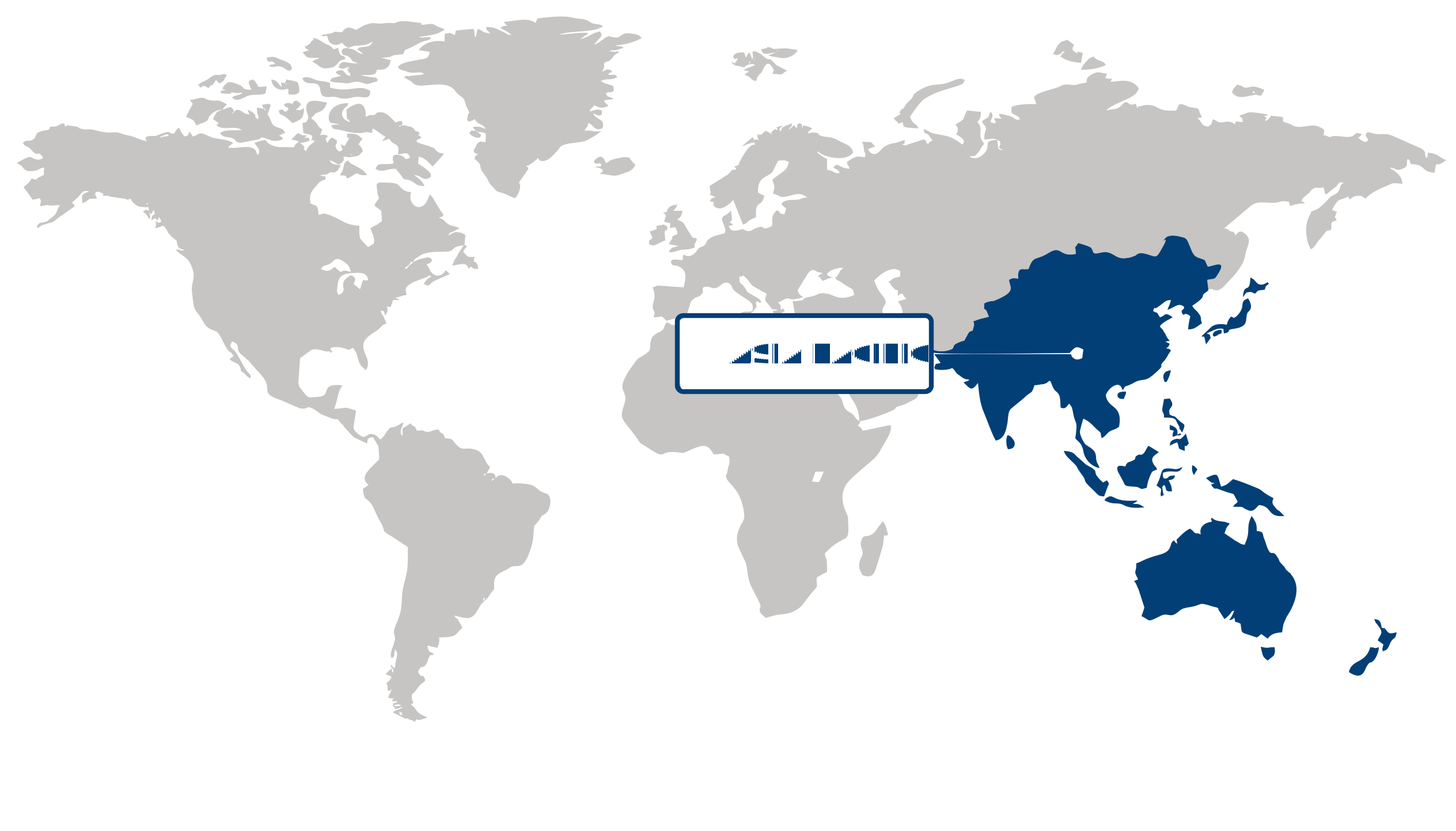
Asia Pacific captured over 33.8% of the global super absorbent polymers market in 2025 as the largest regional share, led primarily by a massive pediatric population and the rapid emergence of personal-care production hubs. Regional child-demographic density documented by UNICEF supports sustained demand for baby-care SAPs, while multinational and regional makers are scaling local capacity—evidenced by Unicharm Corporation press releases on Southeast Asia expansions and Kao Corporation announcements of increased regional investments. Complementary evidence from Procter & Gamble press releases on localized manufacturing and Asian Development Bank analyses of supply-chain investment reinforce why manufacturers favor APAC bases. Together these dynamics create near-term volumetric demand and medium-term opportunity for higher-value, sustainability-focused SAP innovations across the region.
Japan is positioned as a pivotal hub in Asia Pacific for the super absorbent polymers market, leveraging advanced materials R&D, tight quality standards and a dense base of premium personal-care brands. Kao Corporation press releases describing product-development and sustainable-material initiatives, alongside Unicharm Corporation statements on technology licensing, show Japan’s role in pushing higher-performance and bio-based SAP formulations. Japan’s regulatory and industrial support (Ministry of Economy, Trade and Industry policy signals) further accelerates commercialization of specialty SAPs, making the country a center for premiumization and technology transfer that can raise product specs across APAC.
China anchors the Asia Pacific growth trajectory for the super absorbent polymers market, driven by large pediatric cohorts and rapidly scaling personal-care manufacturing hubs that convert demand into local supply. UNICEF demographic data underpins the sizable addressable baby-care segment, while company-level evidence—Hengan International press releases on capacity expansion and Procter & Gamble press releases on China plant investments—illustrates how production scale and cost competitiveness are being realized. Policy support from the Ministry of Industry and Information Technology and visible green-chemistry commitments by major manufacturers signal China’s role as the volume engine that will deepen supplier ecosystems and lower entry barriers for adjacent APAC markets.
North America Market Analysis:
North America emerged as the fastest-growing region in the super absorbent polymers market, registering a CAGR of 8.8%. Growth is driven by rising investments in medical industries and accelerating demand for adult hygiene products; Centers for Medicare & Medicaid Services (CMS) National Health Expenditure data and U.S. Census Bureau population aging projections underline increased healthcare spending and an expanding older-adult cohort that favors adult-care absorbent products. Major hygiene and specialty-chemicals manufacturers have announced capacity and product investments—examples include Kimberly-Clark press releases on expanded adult-care initiatives and corporate statements from Procter & Gamble—and industry groups such as INDA report stronger nonwovens uptake for adult incontinence lines. These dynamics, combined with regional supply-chain resilience and interest in higher-performance, lower-footprint SAPs, create near-term commercial and technical opportunities across medical and personal-care segments.
The U.S. remains the principal demand center for the super absorbent polymers market within North America, concentrated in both healthcare procurement and large-scale consumer adult-care channels. Public healthcare spending trends reported by CMS and demographic data from the U.S. Census Bureau are translating into stronger hospital sourcing for advanced wound-care and disposable medical products that use SAPs; the U.S. Food and Drug Administration (FDA) regulatory framework also incentivizes biocompatible, performance-tested formulations. Corporates are responding—Kimberly-Clark press releases and Procter & Gamble 2023 filings cite strategic investments and portfolio expansion in adult-care categories—while domestic polymer producers and specialty formulators pursue co-development with medical-device OEMs. For regional investors and strategists, the U.S. offers scale, a rigorous regulatory pathway that raises product value, and partnership channels for clinical-grade and sustainability-oriented SAP innovations.
Europe Market Trends:
Europe held a commanding share of the super absorbent polymers market, supported by a mature personal-care sector, concentrated chemical manufacturing, and tightening sustainability policy that is redirecting formulations and procurement. Major consumer-goods buyers such as Procter & Gamble and Kimberly‑Clark sustain steady volume demand while chemical players including BASF and Evonik anchor regional supply; at the same time the European Commission’s Circular Economy Action Plan and oversight by the European Chemicals Agency (ECHA) are nudging suppliers toward recyclability and safer-chemistry choices. Eurostat demographic data and robust healthcare spending patterns underpin growth in adult incontinence and childcare segments, and applied research from Fraunhofer institutes helps accelerate product improvements. These combined structural and policy signals make Europe a high-opportunity market for premium, lower-impact SAP solutions.
Germany plays a leading manufacturing and technology role in the super absorbent polymers market, offering scale, engineering talent, and integrated supply-chain hubs. Industry incumbents such as Evonik and BASF, operational support from the Bundesministerium für Wirtschaft und Klimaschutz, and applied R&D from Fraunhofer organizations have focused investment on specialty grades, production efficiency, and pilot circular initiatives, shortening lead times and enabling higher-margin product variants. A skilled vocational workforce and dense logistics corridors preserve operational resilience and rapid commercialization of innovations disclosed in company materials. Strategically, Germany serves as the region’s production anchor for premium and specialty SAPs, strengthening Europe-wide distribution and capability.
France functions as a prominent demand and innovation test market in the super absorbent polymers market, where consumer sustainability preferences and public policy drive procurement and product design. French agencies such as ADEME (Agence de la transition écologique) and national statistics from INSEE highlight policy incentives and consumer trends toward lower‑footprint products; meanwhile retailers and brands in France are increasingly embedding sustainability criteria in supplier selection. These dynamics have elevated interest in recycled-content and bio‑based SAP formulations and created a strong commercialization runway for consumer-facing innovations. For investors and suppliers, France is a strategic market to validate sustainable SAP concepts before scaling across Europe.
| Parameter | North America | Asia Pacific | Europe | Latin America | MEA |
|---|---|---|---|---|---|
| Innovation Hub i Scale Nascent Developing Advanced | |||||
| Cost-Sensitive Region i Scale Low Medium High | |||||
| Regulatory Environment i Scale Restrictive Neutral Supportive | |||||
| Demand Drivers i Scale Weak Moderate Strong | |||||
| Development Stage i Scale Emerging Developing Developed | |||||
| Adoption Rate i Scale Low Medium High | |||||
| New Entrants / Startups i Scale Sparse Moderate Dense | |||||
| Macro Indicators i Scale Weak Stable Strong |
Segment Leadership and Growth Trends
Super Absorbent Polymers Market Share (%), by Product Type, 2026
Go beyond the chart, access full insights & data tables
Request Free Sample ReportSodium polyacrylate dominated the super absorbent polymers market among product type segments, driven by unmatched absorbency performance and entrenched use in hygiene formulations; this leadership reflects the material’s capacity to deliver fluid management at low fill weights and its broad adoption by manufacturers. Major producers such as Nippon Shokubai and BASF highlight sodium polyacrylate’s technical advantages in product literature and press releases, while formulators in the hygiene supply chain favor its consistency and cost-efficiency, prompting continuous R&D from Evonik and others to optimize particle technology. Supply-chain scale, OEM relationships with diaper makers, and tighter regulatory scrutiny from the European Chemicals Agency are nudging innovation toward safer handling and lower dust grades, creating openings for incumbents to differentiate and for agile entrants to supply niche or bio-modified grades. Given ongoing hygiene demand, established specification momentum, and active corporate development, sodium polyacrylate segments are likely to remain central in the near to medium term.
Analysis by Application
Baby diapers represented largest share in the super absorbent polymers market among application segments, underpinned by rising birth cohorts in key markets and sustained consumer spending on infant hygiene. UN Department of Economic and Social Affairs population data and UNICEF reporting on regional birth trends corroborate higher demand in parts of Asia and Africa, while Procter & Gamble and Kimberly-Clark product roadmaps and sustainability announcements demonstrate continued investment into thinner, higher-absorbency diaper platforms that rely on SAPs. Shifts in consumer preferences for comfort, biodegradability initiatives, retail expansion, and digital channels are reshaping procurement and product design, opening strategic opportunities for suppliers to partner on performance and greener formulations. With manufacturers prioritizing improved absorbency, lighter products, and differentiated SKUs, the baby diaper segment will retain relevance through incremental innovation and geographic market development in the near to medium term.
| Segment | Sub-Segment | Largest Segment | Fastest Growing |
|---|---|---|---|
| Product Type | Sodium Polyacrylate, Polyacrylamide Copolymer, Other Super Absorbent Polymers | ||
| Application | baby diapers, adult incontinence products, feminine hygiene, agriculture, medical, others |
Competitive Landscape and Market Positioning
The competitive environment is characterized by concentrated repositioning among the Top 10, with many broadening capability sets through targeted transactions and tighter co‑development with downstream customers, while others introduce refined product grades and step up process and formulation improvements. Several have localized production to tighten service in key demand corridors and accelerated investments in sustainability‑oriented chemistries and process efficiency. These moves compress the gap between differentiated, high‑margin offerings and large-scale commodity supply, raising competitive thresholds for newcomers and shifting emphasis toward faster product iteration and closer customer integration.
Strategic / Actionable Recommendations for Regional Players
In North America, prioritize deeper downstream arrangements with hygiene and medical manufacturers to secure offtake and co‑develop performance grades; invest selectively in modular capacity and process digitalization to improve responsiveness; pursue linkages with feedstock and recycling specialists to strengthen supply resilience and sustainability credentials.
In Asia Pacific, focus on scalable, flexible capacity that can serve both cost‑sensitive basic grades and higher‑value specialty formulations; deepen technical cooperation with regional OEMs and private label players to capture rising localized demand; embed continuous improvement in processing to preserve margin against scale‑based competitors.
In Europe, lean into differentiated, sustainability‑led chemistries and verified circular solutions to meet stringent regulatory and brand requirements; form pragmatic technical alignments with recyclers and certification bodies to accelerate credible product offers; prioritize premium segments where advanced polymer design and compliance capabilities command stronger positioning.
| Company | Market Share | Company Revenue | Revenue CAGR (%) | Product Portfolio | Geographic Presence | Innovation / R&D Focus | Strategic Developments |
|---|---|---|---|---|---|---|---|
| No companies available. | |||||||
Industry Development/News
| Company Name | Date | Key Development |
|---|
Customize Your Report
Explore examples of how this report can be tailored to different research needs, including custom segments, additional topics or chapters, and related reports. Click a section of the wheel or its numbered marker to explore the available options.
Super Absorbent Polymers Market — Custom Segments
| Segment | Sub-Segment |
|---|---|
| No segment data available. | |
Super Absorbent Polymers Market — Custom TOC
| Custom Chapter | Custom Details | ||
|---|---|---|---|
| No custom TOC data available. | |||
Need a different cut of the data?
Request Custom ResearchHow much is the super absorbent polymers market worth?
How will the super absorbent polymers industry grow in terms of size and CAGR by 2035?
Which region emerges as the top contributor to the super absorbent polymers market revenue?
Where has the super absorbent polymers sector recorded the sharpest year-over-year increase?
What factors give sodium polyacrylate segment a competitive edge in the super absorbent polymers sector?
Which is the largest sub-segment within the application segment for super absorbent polymers industry?
What are the key competitors in the super absorbent polymers landscape?
Our Clients
"The report helped us understand emerging consumer trends in our product category. It clarified where to focus innovation for the next product launch."
LyondellBasell
"The regional forecast section was incredibly useful. We were able to identify two new potential partners in Europe thanks to the vendor mapping you included."
SABIC
"We appreciated how actionable the recommendations were. It guided us to improve supply chain resilience."
Olin Corporation
Our Research Team & Methodology
Every Fundamental Business Insights report is built by a dedicated vertical research team, validated through a structured primary-and-secondary methodology, and reviewed for accuracy before it reaches you.
Research Team Overview
Prepared by the Chemicals & Materials Research Team
Delivery
Published
Demand
Available
Support
Trust & Compliance
Research Domains
10 coverage areasResearch Intelligence
| Source | Reference |
|---|---|
| American Chemistry Council (ACC) | www.americanchemistry.com |
| European Chemical Industry Council (Cefic) | cefic.org |
| International Council of Chemical Associations (ICCA) | icca-chem.org |
| European Chemicals Agency (ECHA) | echa.europa.eu |
| U.S. Environmental Protection Agency (EPA) | www.epa.gov |
| ASTM International | www.astm.org |
| International Organization for Standardization (ISO) | www.iso.org |
| National Institute of Standards and Technology (NIST) | www.nist.gov |
| Plastics Industry Association (PLASTICS) | www.plasticsindustry.org |
| European Biplastics | www.european-bioplastics.org |
| The Adhesive and Sealant Council (ASC) | www.ascouncil.org |
| National Association of Corrosion Engineers (AMPP) | www.ampp.org |
| Society of Plastics Engineers (SPE) | www.4spe.org |
| International Fertilizer Association (IFA) | www.fertilizer.org |
| CropLife International | croplife.org |
| Packaging Europe | packagingeurope.com |
| Flexible Packaging Association (FPA) | www.flexpack.org |
| Battery Council International (BCI) | batterycouncil.org |
| International Copper Association (ICA) | internationalcopper.org |
| World Steel Association | worldsteel.org |
Research Workflow & Quality Assurance
Data Collection
Verified information gathered through primary and secondary research.
Data Triangulation
Cross-validation using multiple independent data sources.
Forecast Modelling
Market estimates developed using historical trends and analytical models.
Analyst Validation
Findings reviewed by domain experts for accuracy and consistency.
Editorial & Quality Review
Final editorial, quality, and compliance checks before publication.
Final Publication
Released after successful completion of the internal review process.
Report Coverage
📊 Market Assessment
- Market Size & Forecast
- Market Segmentation
- Regional Analysis
- Growth Drivers & Challenges
- Market Dynamics
🏢 Competitive Intelligence
- Competitive Landscape
- Company Profiles
- Competitive Benchmarking
- Mergers & Acquisitions
- Market Share Analysis or Key Company Strategies
🔍 Strategic Analysis
- Value Chain Analysis
- Porter's Five Forces
- PESTLE Analysis
- Pricing Trends
- Supply-Demand Analysis
🚀 Future Outlook
- Technology Landscape
- Regulatory Landscape
- Investment & Funding Landscape
- Emerging Opportunities
- Future Market Outlook
Have a question about this report or need a custom scope?
Request Customization