Succinic Acid Market Size & Growth Forecast 2027–2036, By Segments (Type, End-use), Regional Demand Trends (North America, Asia Pacific, Europe), Key Country Insights (U.S., Japan, South Korea, Germany, France, Italy), and Competitive Landscape
Market Size and Growth Outlook
Succinic Acid Market size was around USD 322.35 million in 2026 and is slated to grow at a 9.22% CAGR from 2027 to 2036, attaining USD 778.66 million by 2036. The industry revenue for 2027 is assessed at USD 347.36 million.
Get more details on this report
Request Free Sample ReportSuccinic Acid Market Intelligence Snapshot
Regional Market Dynamics
- Europe held a 37.63% market share in 2026, supported by its established chemicals industry, strong bio-based material adoption, sustainability-focused regulations, and mature downstream manufacturing network.
- Asia Pacific is expected to expand at an 11.07% CAGR as industrial production, bio-based intermediate adoption, processing capacity, and chemicals manufacturing continue to grow across the region.
Segment Momentum
- Petro-based succinic acid accounted for 53.55% of the market in 2026 because established production infrastructure, dependable supply, and cost-efficient manufacturing support high-volume industrial demand.
- Personal Care & Cosmetics is the fastest-growing end-use segment as manufacturers increasingly adopt succinic acid to support evolving formulation preferences and differentiated product offerings.
Market Expansion Drivers
- Expanding demand for bio-based succinic acid in sustainable chemical and polymer production.
- Increasing substitution of petroleum-derived chemicals with eco-friendly bio-based alternatives.
- Rising industrial demand across plastics, coatings, and pharmaceuticals driving derivative consumption.
Leading Market Participants
- Major players in the succinic acid market include BASF SE (Germany), Nippon Shokubai Co., Ltd. (Japan), Succinity GmbH (Germany), Kawasaki Kasei Chemicals Co., Ltd. (Japan), Mitsubishi Chemical Group Corporation (Japan), GC Innovation America (United States), Roquette Frères (France), BioAmber Inc. (Canada), Anhui Sunsing Chemical Co., Ltd. (China).
Global Market Forecast Snapshot
Market Outlook
- 2026 Market Size: USD 322.35 million
- 2027 Estimated Market Size: USD 347.36 million.
- Projected Market Size: USD 778.66 million by 2036
- Growth Forecast: 9.22% CAGR (2027-2036)
Regional and Segment Outlook
- Leading Regional Market: Europe
- High-Growth Regional Hub: Asia Pacific
- Core Revenue Segment: Petro-based (Type) | Industrial (End-use)
- Emerging Opportunity Segment: Bio-based (Type) | Personal Care & Cosmetics (End-use)
Market Growth Drivers and Industry Trends
Expanding demand for bio-based succinic acid in sustainable chemical and polymer production
The growing emphasis on sustainable manufacturing is increasing interest in bio-based feedstocks that can be incorporated into chemical and polymer value chains. For the succinic acid market, demand for bio-based succinic acid is being supported by its potential use as a renewable building block in the production of materials and chemical intermediates while helping manufacturers pursue lower-dependence production pathways based on fossil resources. Its compatibility with applications such as biodegradable materials, polymers, and specialty chemicals makes it relevant to industries seeking more sustainable raw material options. As producers and downstream manufacturers place greater attention on resource efficiency and renewable inputs, bio-based succinic acid can gain relevance in formulation and production processes where environmental considerations influence material selection.
Increasing substitution of petroleum-derived chemicals with eco-friendly bio-based alternatives
The transition away from conventional petroleum-derived raw materials is encouraging chemical manufacturers to evaluate renewable alternatives that can provide suitable functional performance with a lower reliance on fossil-based feedstocks. In the succinic acid market, this substitution trend is strengthening opportunities for bio-based production routes and supporting broader interest in succinic acid as a renewable chemical building block. Manufacturers across downstream industries can incorporate bio-derived inputs into formulations and intermediates as sustainability objectives become more integrated into procurement and production decisions. The availability of fermentation-based and other bio-based manufacturing approaches also supports efforts to diversify raw material sources, particularly for applications where producers are seeking alternatives to traditional petrochemical inputs.
Rising industrial demand across plastics, coatings, and pharmaceuticals driving derivative consumption
Succinic acid serves as an important intermediate across multiple industrial applications, allowing demand from diverse downstream sectors to support consumption of its derivatives. In the succinic acid market, expanding requirements from plastics and polymer production can increase the use of succinic-acid-based intermediates, while coatings applications benefit from its role in producing materials with desired formulation characteristics. Pharmaceutical manufacturing also creates demand through the use of succinic acid and related derivatives in specialized applications and formulations. This broad industrial footprint reduces dependence on a single end-use sector and creates opportunities for producers to serve applications with different performance and formulation requirements, including polymer materials, specialty coatings, and pharmaceutical products.
| Growth Driver | Impact on CAGR | Regulatory Influence | Geographic Relevance | Adoption Rate | Impact Timeline |
|---|---|---|---|---|---|
| Expanding demand for bio-based succinic acid in sustainable chemical and polymer production | 2.10% | High | Europe, North America | High | Mid Term |
| Increasing substitution of petroleum-derived chemicals with eco-friendly bio-based alternatives | 1.80% | High | Europe, Asia Pacific | High | Mid Term |
| Rising industrial demand across plastics, coatings, and pharmaceuticals driving derivative consumption | 1.50% | Moderate | Global | High | Near Term |
Unlock insights tailored to your business with our bespoke market research solutions.
Click to get your customized report now.
Regional Demand Dynamics
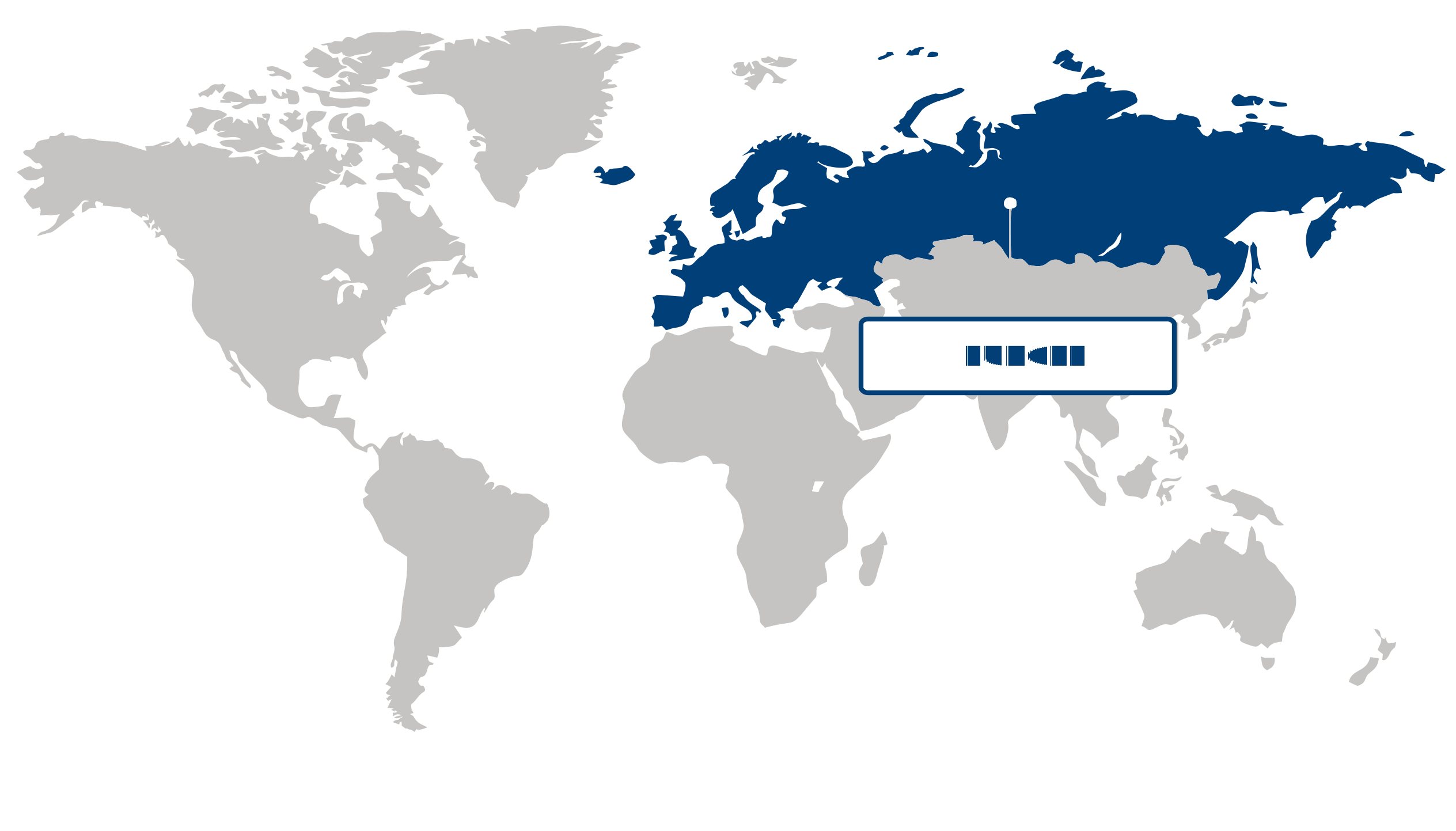
Europe (Largest Region)
Europe accounted for the largest share of the succinic acid market at 37.63% in 2026, underpinned by strong emphasis on sustainable chemical production, advanced industrial capabilities, and increasing interest in bio-based alternatives to conventional petrochemical-derived materials. The region’s established chemical and manufacturing sectors create demand for succinic acid across applications such as polymers, coatings, food ingredients, pharmaceuticals, and specialty chemicals. Sustainability objectives and regulatory attention toward reducing environmental impacts are also encouraging the development and adoption of renewable feedstocks and bio-based production pathways, strengthening the market’s position within Europe.
Asia Pacific (Fastest-Growing Region)
Asia Pacific is the fastest-growing regional market, driven by expanding chemical manufacturing capacity, industrial development, and rising demand for succinic acid across diverse downstream applications. Growing pharmaceutical, food processing, polymer, and specialty chemical industries are broadening the regional consumption base, while investments in sustainable manufacturing are encouraging interest in bio-based chemical intermediates. The expansion of domestic production capabilities and improving industrial infrastructure are further supporting supply availability and enabling manufacturers to respond more efficiently to growing demand from both established and emerging application sectors.
| Parameter | North America | Asia Pacific | Europe | Latin America | MEA |
|---|---|---|---|---|---|
| Innovation Hub i Scale Nascent Developing Advanced | |||||
| Cost-Sensitive Region i Scale Low Medium High | |||||
| Regulatory Environment i Scale Restrictive Neutral Supportive | |||||
| Demand Drivers i Scale Weak Moderate Strong | |||||
| Development Stage i Scale Emerging Developing Developed | |||||
| Adoption Rate i Scale Low Medium High | |||||
| New Entrants / Startups i Scale Sparse Moderate Dense | |||||
| Macro Indicators i Scale Weak Stable Strong |
Key Country Insights
Germany 🇩🇪
Sustainable Chemical IntegrationGermany incorporates succinic acid into advanced chemical manufacturing with strong attention to renewable feedstocks and process efficiency. Industrial users increasingly evaluate bio-based alternatives that align with environmental regulations and circular production strategies.
France 🇫🇷
Green Chemistry AdoptionFrance advances succinic acid adoption through investments in green chemistry and renewable chemical production. Manufacturers increasingly integrate bio-based intermediates into industrial processes to support environmental objectives and product innovation initiatives.
Italy 🇮🇹
Specialty Manufacturing DemandItaly applies succinic acid across specialty chemicals, coatings, and industrial manufacturing where formulation flexibility is important. Producers and downstream users emphasize quality consistency and sustainable sourcing to strengthen value-added product development.
Japan 🇯🇵
Advanced Materials SupplyJapan utilizes succinic acid across specialty materials, electronics-related chemicals, and pharmaceutical manufacturing. Domestic producers emphasize consistent purity, process optimization, and application-specific formulations that support demanding industrial quality requirements.
South Korea 🇰🇷
Industrial Process ApplicationsSouth Korea expands succinic acid utilization in performance chemicals, polymers, and industrial manufacturing. Companies prioritize reliable supply chains and technology partnerships that improve production efficiency while supporting sustainable material development.
United States 🇺🇸
Bio-Based CommercializationThe U.S. succinic acid market focuses on expanding bio-based production for applications in chemicals, coatings, pharmaceuticals, and biodegradable materials. Companies continue investing in sustainable manufacturing technologies that support industrial decarbonization objectives and specialty chemical demand.
Segment Leadership and Growth Trends
Succinic Acid Market Share (%), by Type, 2026
Go beyond the chart, access full insights & data tables
Request Free Sample ReportType Segment Analysis: Petro-based (Largest Segment) vs Bio-based (Fastest-Growing Segment)
Petro-based succinic acid held the largest share of the succinic acid market, accounting for 53.55% in 2026. Its established manufacturing infrastructure, consistent production capabilities, and broad compatibility with downstream industrial processes continue to support widespread use. Petro-based production also benefits from established supply chains and process familiarity among manufacturers, making it well positioned to serve applications requiring reliable availability and consistent material characteristics across industrial uses.
Bio-based succinic acid is expected to register the fastest growth as manufacturers and end users increasingly prioritize renewable feedstocks and lower-impact production pathways. Advances in fermentation and bio-based production technologies are improving the commercial viability of renewable succinic acid while supporting its use in applications seeking alternatives to fossil-derived chemicals. Growing sustainability initiatives, increasing interest in bio-based materials, and pressure to reduce dependence on petroleum feedstocks are strengthening demand for bio-based production routes.
End-use Segment Analysis: Industrial (Largest Segment) vs Personal Care & Cosmetics (Fastest-Growing Segment)
The industrial segment represented the largest share of the succinic acid market at 41.34% in 2026. Succinic acid serves as an important intermediate and functional ingredient across applications including coatings, resins, solvents, polymers, and other chemical processes, providing a broad industrial demand base. Its established role in chemical manufacturing and the continuing need for versatile intermediates in industrial formulations are supporting sustained consumption, while ongoing material development is creating additional opportunities for succinic acid-based products.
Personal care & cosmetics is projected to be the fastest-growing end-use segment as consumers increasingly favor skincare and cosmetic formulations that incorporate functional and sustainability-oriented ingredients. Succinic acid can contribute to formulation performance while fitting into product development trends centered on naturally derived and multifunctional ingredients. Growing demand for innovative personal care formulations and greater attention to ingredient transparency and environmental considerations are encouraging manufacturers to explore succinic acid across cosmetic applications.
| Segment | Sub-Segment | Largest Segment | Fastest Growing |
|---|---|---|---|
| Type | Petro-based, Bio-based | Petro-based | Bio-based |
| End-use | Food & Beverages, Pharmaceutical, Coatings, Industrial, Personal Care & Cosmetics, Others | Industrial | Personal Care & Cosmetics |
Competitive Landscape and Market Positioning
Prominent players in the succinic acid market:
1. BASF SE (Germany)
2. Nippon Shokubai Co. Ltd. (Japan)
3. Succinity GmbH (Germany)
4. Kawasaki Kasei Chemicals Co. Ltd. (Japan)
5. Mitsubishi Chemical Group Corporation (Japan)
6. GC Innovation America (United States)
7. Roquette Frères (France)
8. BioAmber Inc. (Canada)
9. Anhui Sunsing Chemical Co. Ltd. (China)
Process innovation and bio-based production pathways are reshaping competitiveness in the succinic acid market. Efficiency improvements are emerging through optimized fermentation and resource utilization techniques. The succinic acid market is gradually advancing toward more sustainable chemical production models.
| Company | Market Share | Company Revenue | Revenue CAGR (%) | Product Portfolio | Geographic Presence | Innovation / R&D Focus | Strategic Developments |
|---|---|---|---|---|---|---|---|
| BASF SE (Germany) | |||||||
| Nippon Shokubai Co. Ltd. (Japan) | |||||||
| Succinity GmbH (Germany) | |||||||
| Kawasaki Kasei Chemicals Co. Ltd. (Japan) | |||||||
| Mitsubishi Chemical Group Corporation (Japan) | |||||||
| GC Innovation America (United States) | |||||||
| Roquette Frères (France) | |||||||
| BioAmber Inc. (Canada) | |||||||
| Anhui Sunsing Chemical Co. Ltd. (China). |
Industry Development/News
| Company Name | Date | Key Development |
|---|---|---|
| Jantar GmbH | Nov-25 | Jantar GmbH developed dicholine succinate, an over-the-counter therapeutic candidate targeting chronic rhinosinusitis affecting an estimated 10–15% of the global population. The company is pursuing partnerships to advance the compound into Phase III clinical development, reflecting strategic expansion of succinic acid derivatives into pharmaceutical and therapeutic end-use applications beyond traditional industrial uses. |
| Pfanstiehl, Inc. | Oct-24 | Pfanstiehl, Inc. launched High Purity Low Endotoxin Low Metals (HPLE-LMTM) succinic acid designed for pharmaceutical, biopharmaceutical, and injectable applications. The product is positioned for both research and commercial-scale manufacturing, strengthening supply availability of high-specification succinic acid derivatives for regulated healthcare and life sciences markets requiring stringent impurity control. |
| Lygos | Sep-24 | Lygos, in partnership with CJ Bio, initiated development of a 40,000 metric tons per year biobased chemicals facility in Fort Dodge, Iowa, focused on polyaspartates and malonates with potential capacity expansion to 100,000 tons annually. The project supports scaling of bio-based chemical production infrastructure linked to succinic acid value chain diversification and downstream specialty materials. |
| Sustainea | May-24 | Sustainea, a joint venture between Braskem and Sojitz, announced a strategic partnership with Origin Materials to advance development of 100% bio-based materials. The initiative strengthens renewable chemicals production ecosystems and supports broader industrial transition toward bio-based feedstocks, indirectly reinforcing demand pathways for succinic acid-derived intermediates in sustainable materials applications. |
Customize Your Report
Explore examples of how this report can be tailored to different research needs, including custom segments, additional topics or chapters, and related reports. Click a section of the wheel or its numbered marker to explore the available options.
Succinic Acid Market — Custom Segments
| Segment | Sub-Segment |
|---|---|
| Production Route | Maleic Anhydride Hydrogenation, Fermentation-Based Production, Bio-based Fermentation from Renewable Feedstocks |
| Purity Grade | Industrial Grade, Technical Grade, Food Grade, Pharmaceutical Grade |
| Application Function | Plasticizers & Resins, Solvents & Chemical Intermediates, Food & Beverage Ingredients, Pharmaceutical Ingredients, Coatings & Adhesives |
Succinic Acid Market — Custom TOC
| Custom Chapter | Custom Details |
|---|---|
| Bio-based Succinic Acid Commercialization |
|
| End-use Adoption and Application Expansion |
|
| Industrial Procurement and Feedstock Strategy |
|
Need a different cut of the data?
Request Custom ResearchHow large is the succinic acid market?
What is the anticipated CAGR of the succinic acid industry?
Why is bio-based succinic acid gaining strategic importance in the succinic acid market?
How is downstream industrial demand influencing growth in the succinic acid market?
Why is petro-based succinic acid the largest type segment?
Which end-use segment is expanding the fastest in the succinic acid market?
Why is Europe the leading regional market for succinic acid?
What factors are accelerating succinic acid market growth in Asia Pacific?
Who holds a significant market share in the succinic acid landscape?
Our Clients
"The report helped us understand emerging consumer trends in our product category. It clarified where to focus innovation for the next product launch."
LyondellBasell
"The regional forecast section was incredibly useful. We were able to identify two new potential partners in Europe thanks to the vendor mapping you included."
SABIC
"We appreciated how actionable the recommendations were. It guided us to improve supply chain resilience."
Olin Corporation
Our Research Team & Methodology
Every Fundamental Business Insights report is built by a dedicated vertical research team, validated through a structured primary-and-secondary methodology, and reviewed for accuracy before it reaches you.
Research Team Overview
Prepared by the Chemicals & Materials Research Team
Delivery
Published
Demand
Available
Support
Trust & Compliance
Research Domains
10 coverage areasResearch Intelligence
| Source | Reference |
|---|---|
| American Chemistry Council (ACC) | www.americanchemistry.com |
| European Chemical Industry Council (Cefic) | cefic.org |
| International Council of Chemical Associations (ICCA) | icca-chem.org |
| European Chemicals Agency (ECHA) | echa.europa.eu |
| U.S. Environmental Protection Agency (EPA) | www.epa.gov |
| ASTM International | www.astm.org |
| International Organization for Standardization (ISO) | www.iso.org |
| National Institute of Standards and Technology (NIST) | www.nist.gov |
| Plastics Industry Association (PLASTICS) | www.plasticsindustry.org |
| European Biplastics | www.european-bioplastics.org |
| The Adhesive and Sealant Council (ASC) | www.ascouncil.org |
| National Association of Corrosion Engineers (AMPP) | www.ampp.org |
| Society of Plastics Engineers (SPE) | www.4spe.org |
| International Fertilizer Association (IFA) | www.fertilizer.org |
| CropLife International | croplife.org |
| Packaging Europe | packagingeurope.com |
| Flexible Packaging Association (FPA) | www.flexpack.org |
| Battery Council International (BCI) | batterycouncil.org |
| International Copper Association (ICA) | internationalcopper.org |
| World Steel Association | worldsteel.org |
Research Workflow & Quality Assurance
Data Collection
Verified information gathered through primary and secondary research.
Data Triangulation
Cross-validation using multiple independent data sources.
Forecast Modelling
Market estimates developed using historical trends and analytical models.
Analyst Validation
Findings reviewed by domain experts for accuracy and consistency.
Editorial & Quality Review
Final editorial, quality, and compliance checks before publication.
Final Publication
Released after successful completion of the internal review process.
Report Coverage
📊 Market Assessment
- Market Size & Forecast
- Market Segmentation
- Regional Analysis
- Growth Drivers & Challenges
- Market Dynamics
🏢 Competitive Intelligence
- Competitive Landscape
- Company Profiles
- Competitive Benchmarking
- Mergers & Acquisitions
- Market Share Analysis or Key Company Strategies
🔍 Strategic Analysis
- Value Chain Analysis
- Porter's Five Forces
- PESTLE Analysis
- Pricing Trends
- Supply-Demand Analysis
🚀 Future Outlook
- Technology Landscape
- Regulatory Landscape
- Investment & Funding Landscape
- Emerging Opportunities
- Future Market Outlook
Have a question about this report or need a custom scope?
Request Customization