Steel Rebar Market Size & Growth Forecast 2027–2036, By Segments (Application), Regional Demand Trends (North America, Asia Pacific, Europe), Key Country Insights (U.S., Japan, South Korea, Germany, France, Italy), and Competitive Landscape
Market Size and Growth Outlook
Steel Rebar Market size was over USD 250.9 billion in 2026 and is likely to grow at a 5.7% CAGR between 2027 and 2036, reaching USD 436.77 billion by 2036. The industry revenue for 2027 is estimated at USD 262.94 billion.
Get more details on this report
Request Free Sample ReportSteel Rebar Market Intelligence Snapshot
Regional Market Dynamics
- Asia Pacific leads due to extensive residential, commercial, industrial, and infrastructure construction, where steel rebar remains an essential reinforcement material across large-scale projects.
- Asia Pacific is projected to grow at a 5.7% CAGR, driven by ongoing urban development, infrastructure expansion, and sustained construction activity across both mature and emerging markets.
Segment Momentum
- Infrastructure leads due to heavy use of reinforced concrete in bridges, highways, rail, and utilities, driving consistent high-volume steel rebar consumption across long-cycle construction projects.
- Asia Pacific leads growth due to strong urban development, infrastructure expansion, and sustained construction activity across residential, commercial, and public works projects increasing rebar demand.
Market Expansion Drivers
- Expanding infrastructure and urban development projects increasing long steel and rebar consumption.
- Rising investments in downstream construction-grade steel capacity strengthening rebar supply capabilities.
- Growing data center and renewable energy construction creating new demand avenues for structural rebar.
Leading Market Participants
- Major companies in the steel rebar market include ArcelorMittal S.A. (Luxembourg), Nucor Corporation (United States), Tata Steel Limited (India), Nippon Steel Corporation (Japan), POSCO Holdings Inc. (South Korea), JSW Steel Limited (India), Steel Dynamics, Inc. (United States), Steel Authority of India Limited (India), Jiangsu Shagang Group Co., Ltd. (China), Novolipetsk Steel (Russia).
Global Market Forecast Snapshot
Market Outlook
- 2026 Market Size: USD 250.9 billion
- 2027 Estimated Market Size: USD 262.94 billion.
- Projected Market Size: USD 436.77 billion by 2036
- Growth Forecast: 5.7% CAGR (2027-2036)
Regional and Segment Outlook
- Leading Regional Market: Asia Pacific
- High-Growth Regional Hub: Asia Pacific
- Core Revenue Segment: Infrastructure (Application)
- Emerging Opportunity Segment: Infrastructure (Application)
Market Growth Drivers and Industry Trends
Expanding infrastructure and urban development projects increasing long steel and rebar consumption
Rapid urbanization and continued investment in transportation, housing, utilities, and public infrastructure are strengthening construction activity and supporting the steel rebar market. Reinforced concrete remains fundamental to buildings, bridges, roads, tunnels, water infrastructure, and other major projects, creating consistent requirements for reinforcing steel with suitable strength and durability characteristics. Governments and private developers are pursuing infrastructure modernization and urban expansion to accommodate population growth and improve connectivity, increasing the volume of concrete structures requiring reinforcement. Large-scale construction programs also generate demand for different rebar grades, sizes, and configurations, while the need for resilient infrastructure encourages the use of reinforcing materials capable of supporting structural integrity under demanding service conditions.
Rising investments in downstream construction-grade steel capacity strengthening rebar supply capabilities
Investment in downstream steelmaking and processing capacity is improving the ability of producers to manufacture construction-grade products and reinforcing materials, creating a stronger supply base for the steel rebar market. New and upgraded facilities can improve production efficiency, product consistency, rolling capabilities, and the ability to meet varying specifications required by residential, commercial, and infrastructure projects. Greater domestic processing capacity can also support more responsive supply chains by reducing dependence on external sources for construction materials and enabling producers to serve localized demand more effectively. As construction markets expand, investments in modern production equipment and higher-value steel processing are helping manufacturers address requirements for strength, dimensional accuracy, weldability, and compliance with construction standards.
Growing data center and renewable energy construction creating new demand avenues for structural rebar
The rapid development of data centers, renewable power facilities, and associated infrastructure is opening additional applications for reinforcing steel beyond conventional building construction, supporting the steel rebar market growth. Data center campuses require reinforced foundations, structural slabs, equipment areas, and supporting facilities designed to accommodate heavy equipment and stringent reliability requirements. Similarly, renewable energy projects such as solar installations, wind facilities, storage systems, and related grid infrastructure involve concrete foundations and structural works that require reinforcement. Expansion of these capital-intensive projects is creating demand across both established construction markets and emerging development locations, with project specifications often requiring reinforcing products capable of supporting substantial structural loads and long service lives.
| Growth Driver | Impact on CAGR | Regulatory Influence | Geographic Relevance | Adoption Rate | Impact Timeline |
|---|---|---|---|---|---|
| Expanding infrastructure and urban development projects increasing long steel and rebar consumption | 2.10% | Moderate | Asia Pacific, Middle East | High | Near Term |
| Rising investments in downstream construction-grade steel capacity strengthening rebar supply capabilities | 1.80% | Moderate | Asia Pacific, North America | High | Mid Term |
| Growing data center and renewable energy construction creating new demand avenues for structural rebar | 1.50% | Moderate | North America, Europe | Emerging | Long Term |
Unlock insights tailored to your business with our bespoke market research solutions.
Click to get your customized report now.
Regional Demand Dynamics
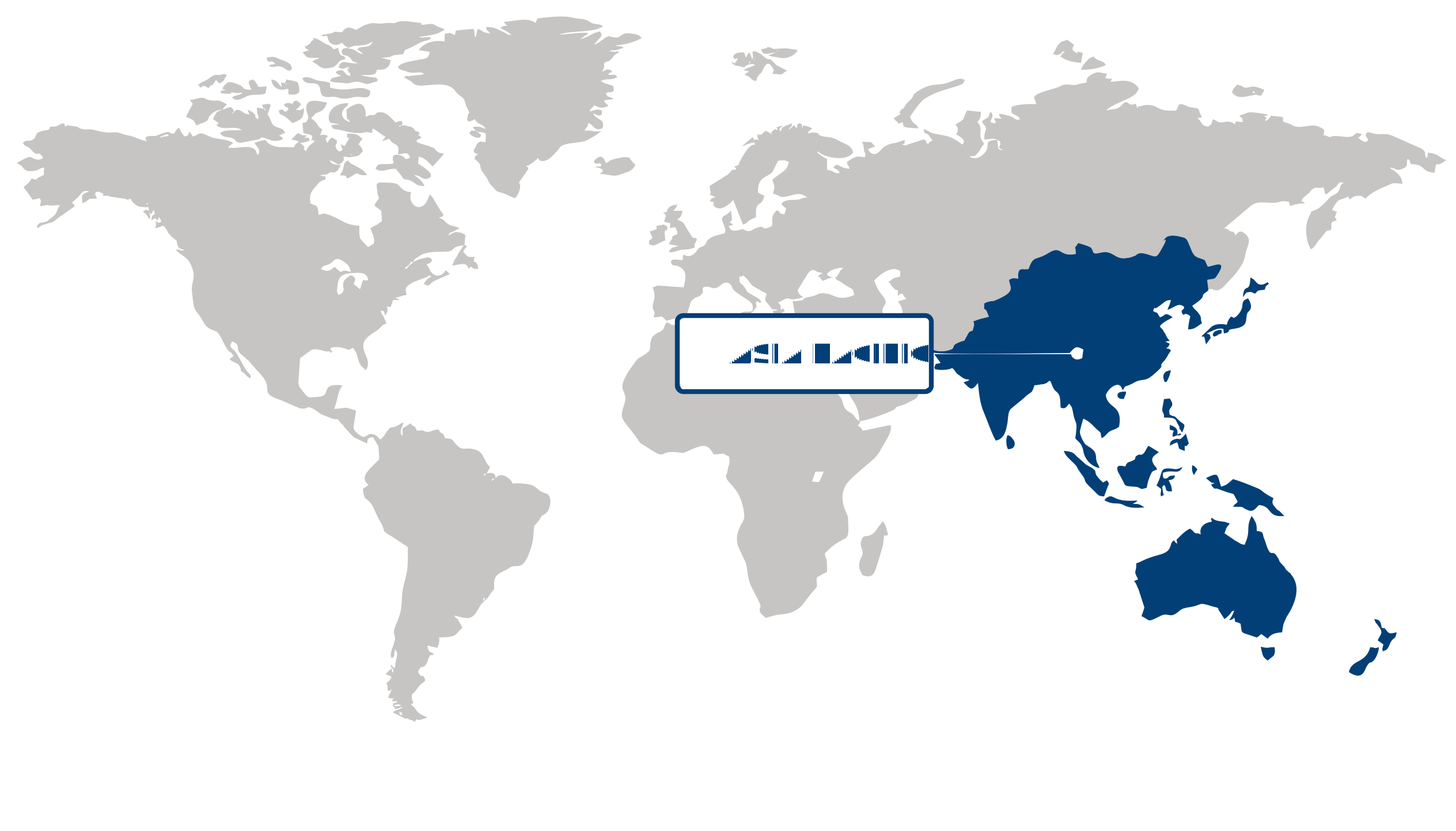
Asia Pacific (Largest & Fastest-Growing Region)
Holding the largest share of the steel rebar market in 2026, Asia Pacific also represents the fastest-growing regional market, underpinned by extensive construction activity and continued infrastructure development. Rapid urbanization, expansion of residential and commercial structures, and investment in transportation and industrial infrastructure sustain demand for reinforcement materials. The region's large construction base and expanding urban centers provide a strong foundation for steel rebar consumption across major building and civil engineering projects.
Growth momentum is further supported by ongoing infrastructure modernization and increasing demand for durable structural materials. Investments in transport networks, urban development, and industrial facilities are encouraging the use of reinforced concrete construction, while efforts to improve construction efficiency and material performance are supporting demand for higher-quality rebar products. These factors reinforce Asia Pacific's combined leadership and growth position in the market.
| Parameter | North America | Asia Pacific | Europe | Latin America | MEA |
|---|---|---|---|---|---|
| Innovation Hub i Scale Nascent Developing Advanced | |||||
| Cost-Sensitive Region i Scale Low Medium High | |||||
| Regulatory Environment i Scale Restrictive Neutral Supportive | |||||
| Demand Drivers i Scale Weak Moderate Strong | |||||
| Development Stage i Scale Emerging Developing Developed | |||||
| Adoption Rate i Scale Low Medium High | |||||
| New Entrants / Startups i Scale Sparse Moderate Dense | |||||
| Macro Indicators i Scale Weak Stable Strong |
Key Country Insights
Germany 🇩🇪
Sustainable Construction FocusGermany emphasizes low-carbon steel rebar and certified production practices as sustainability requirements become more influential in construction procurement. Manufacturers are aligning product portfolios with green building initiatives while maintaining quality for industrial and commercial developments.
France 🇫🇷
Urban Redevelopment MaterialsFrance is experiencing steady demand for steel rebar through urban renewal, residential modernization, and transport infrastructure investments. Market participants increasingly focus on sustainable sourcing and compliance with environmental construction requirements across public and private projects.
Italy 🇮🇹
Industrial Construction SupportItaly maintains demand for steel rebar through industrial facilities, residential renovation, and infrastructure maintenance projects. Manufacturers are strengthening product quality and flexible distribution capabilities to meet diverse regional construction requirements across the country.
Japan 🇯🇵
Seismic Performance SolutionsJapan prioritizes high-performance steel rebar designed for earthquake-resistant construction and infrastructure rehabilitation. Demand is shaped by stringent engineering standards, encouraging suppliers to deliver advanced material specifications and dependable long-term structural performance.
South Korea 🇰🇷
Advanced Manufacturing SupplySouth Korea benefits from an efficient steel production base that supports consistent supply of high-quality steel rebar for domestic construction. Producers continue refining manufacturing efficiency and specialized grades to address infrastructure and commercial building requirements.
United States 🇺🇸
Infrastructure Renewal DemandThe U.S. steel rebar market is supported by ongoing transportation, energy, and public infrastructure upgrades that sustain demand for reinforcing steel. Buyers increasingly prioritize reliable domestic supply, product consistency, and compliance with evolving construction standards across large-scale projects.
Segment Leadership and Growth Trends
Steel Rebar Market Share (%), by Application, 2026
Go beyond the chart, access full insights & data tables
Request Free Sample ReportApplication Segment Analysis: Infrastructure (Largest & Fastest-Growing Segment)
The infrastructure segment led the steel rebar market with the largest share in 2026 and is also the fastest-growing application segment. Steel rebar is essential for reinforcing concrete structures used in roads, bridges, rail systems, utilities, and other major infrastructure projects, providing tensile strength and structural durability. Rising urban development, infrastructure modernization, and continued investment in transportation and public facilities are sustaining demand for reinforced construction materials. The long-term need to improve structural resilience and support expanding infrastructure networks further strengthens the role of steel rebar across large-scale development projects.
| Segment | Sub-Segment | Largest Segment | Fastest Growing |
|---|---|---|---|
| Application | Construction, Infrastructure, Industrial | Infrastructure | Infrastructure |
Competitive Landscape and Market Positioning
Top players in the steel rebar market:
1. ArcelorMittal S.A. (Luxembourg)
2. Nucor Corporation (United States)
3. Tata Steel Limited (India)
4. Nippon Steel Corporation (Japan)
5. POSCO Holdings Inc. (South Korea)
6. JSW Steel Limited (India)
7. Steel Dynamics Inc. (United States)
8. Steel Authority of India Limited (India)
9. Jiangsu Shagang Group Co. Ltd. (China)
10. Novolipetsk Steel (Russia)
Infrastructure development and sustainable manufacturing practices are influencing the steel rebar market, with producers improving production efficiency, resource utilization, and low-carbon steel manufacturing technologies. These advancements are supporting higher product quality and environmental performance.
| Company | Market Share | Company Revenue | Revenue CAGR (%) | Product Portfolio | Geographic Presence | Innovation / R&D Focus | Strategic Developments |
|---|---|---|---|---|---|---|---|
| ArcelorMittal S.A. (Luxembourg) | |||||||
| Nucor Corporation (United States) | |||||||
| Tata Steel Limited (India) | |||||||
| Nippon Steel Corporation (Japan) | |||||||
| POSCO Holdings Inc. (South Korea) | |||||||
| JSW Steel Limited (India) | |||||||
| Steel Dynamics Inc. (United States) | |||||||
| Steel Authority of India Limited (India) | |||||||
| Jiangsu Shagang Group Co. Ltd. (China) | |||||||
| Novolipetsk Steel (Russia). |
Industry Development/News
| Company Name | Date | Key Development |
|---|---|---|
| TCK by Kıraç | May-26 | TCK by Kıraç announced a TRY 1.35 billion investment to expand production capacity. This initiative focuses on scaling operations for long steel and rebar-related products, strengthening the company's manufacturing footprint and enhancing competitive positioning within the sector. |
| Emsteel | May-26 | Emsteel partnered with Gulf Cryo to develop a fully integrated CO2 business model across its steel operations. The initiative focuses on carbon capture and industrial gas utilization to advance decarbonization, improving environmental efficiency throughout the steel manufacturing value chain. |
| SMS Group | May-26 | SMS Group completed a modernization project at Mukand Ltd’s Kalwa facility, featuring an upgraded two-strand bloom caster. The installation of a new 250 x 300 mm bloom section optimizes casting performance, enabling enhanced manufacturing capabilities for stainless steel rebar and wire rods. |
| Optimus Steel USA | Apr-26 | Optimus Steel USA entered a supply agreement with Exiros to support a significant capacity expansion project in Texas. This initiative is designed to strengthen supply chain coordination and increase operational scale to better serve regional demand for long steel and rebar products. |
| Jindal Stainless | Apr-26 | Jindal Stainless entered the retail construction segment with the launch of its Jindal Infinity rebar line. This diversification beyond specialty stainless steel into construction-grade reinforcement materials highlights a strategic effort to expand the company's downstream presence in the infrastructure and building materials value chain. |
| Marcegaglia | Apr-26 | Marcegaglia partnered with Danieli for a low-carbon steel investment project in Fos-sur-Mer. The project modernizes production processes to reduce emissions, aligning with the company's long-term strategy to enhance sustainability and competitiveness within the European steel production market. |
| Tata Steel | Mar-26 | Tata Steel inaugurated a scrap-based electric arc furnace plant in Ludhiana with a ₹3,200 crore investment. The facility increases scrap utilization to lower production carbon intensity, supporting the company's net-zero 2045 goals while expanding domestic steel production capacity. |
| Hybar | Nov-25 | Hybar is commissioning a large-scale recycled steel-based rebar operation in Arkansas with an annual melting capacity of 700,000 tons. Utilizing scrap-fed electric arc furnace technology, the facility strengthens domestic supply resilience and emphasizes the role of recycled materials in construction steel production. |
| Alter Steel | Jul-25 | Alter Steel contracted Danieli to supply electric arc furnace equipment for a new recycled-content rebar mill in Australia. This investment supports the development of domestic, low-emission production capacity, enhancing regional supply resilience for reinforcing bar products. |
| GTB Steel | Mar-25 | GTB Steel launched a rebar manufacturing plant in Armenia with an annual capacity of 112,800 tons. The facility represents a strategic industrial expansion aimed at strengthening regional construction material availability and broadening the company's footprint in the long steel and reinforcement bar market. |
Customize Your Report
Explore examples of how this report can be tailored to different research needs, including custom segments, additional topics or chapters, and related reports. Click a section of the wheel or its numbered marker to explore the available options.
Steel Rebar Market — Custom Segments
| Segment | Sub-Segment |
|---|---|
| Manufacturing Process | Basic Oxygen Furnace (BOF), Electric Arc Furnace (EAF) |
| Steel Grade | Carbon Steel Rebar, Low-Alloy Steel Rebar, High-Strength Steel Rebar |
| Coating Type | Uncoated Rebar, Epoxy-Coated Rebar, Galvanized Rebar, Other Protective Coatings |
Steel Rebar Market — Custom TOC
| Custom Chapter | Custom Details |
|---|---|
| Infrastructure Project Pipeline and Steel Demand Outlook |
|
| Green Steel Adoption and Low-Carbon Procurement Outlook |
|
| Scrap Availability and Electric Arc Furnace Transition Assessment |
|
Need a different cut of the data?
Request Custom ResearchWhat is the current size of the steel rebar market?
What are the growth projections for the steel rebar industry?
Why are infrastructure projects becoming a primary growth engine for the steel rebar market?
How are downstream steel investments improving competitiveness in the steel rebar market?
Why is infrastructure the leading application in the steel rebar market?
Which region is driving fastest growth in the steel rebar market?
Why is Asia Pacific the leading region in the steel rebar market?
What is supporting continued growth of the steel rebar market in Asia Pacific?
Who are the leading players in the steel rebar landscape?
Our Clients
"Your insights on workforce structures were spot-on. The analysis on mid-to-senior level roles validated some of our hiring decisions and highlighted gaps."
Ateliers De France
"The report gave us insights on competitors in the market. It helped our team refine our bidding strategy for upcoming contracts."
Clark Construction
"The reports provided a deep dive into market trends, and competitive landscape. The strategic insights and recommendations have been very helpful."
Rudolph and Sletten
Our Research Team & Methodology
Every Fundamental Business Insights report is built by a dedicated vertical research team, validated through a structured primary-and-secondary methodology, and reviewed for accuracy before it reaches you.
Research Team Overview
Prepared by the Construction & Manufacturing Research Team
Delivery
Published
Demand
Available
Support
Trust & Compliance
Research Domains
10 coverage areasResearch Intelligence
| Source | Reference |
|---|---|
| International Organization for Standardization (ISO) | www.iso.org |
| ASTM International | www.astm.org |
| National Institute of Standards and Technology (NIST) | www.nist.gov |
| International Code Council (ICC) | www.iccsafe.org |
| American Concrete Institute (ACI) | www.concrete.org |
| American Institute of Steel Construction (AISC) | www.aisc.org |
| Construction Industry Institute (CII) | www.construction-institute.org |
| Associated General Contractors of America (AGC) | www.agc.org |
| Association of Equipment Manufacturers (AEM) | www.aem.org |
| Building Owners and Managers Association (BOMA) | www.boma.org |
| American Society of Civil Engineers (ASCE) | www.asce.org |
| National Ready Mixed Concrete Association (NRMCA) | www.nrmca.org |
| International Facility Management Association (IFMA) | www.ifma.org |
| World Green Building Council (WorldGBC) | worldgbc.org |
| International Federation of Consulting Engineers (FIDIC) | fidic.org |
| International Labour Organization (ILO) | www.ilo.org |
| American Society of Mechanical Engineers (ASME) | www.asme.org |
| Society of Manufacturing Engineers (SME) | www.sme.org |
| National Association of Home Builders (NAHB) | www.nahb.org |
| European Construction Industry Federation (FIEC) | www.fiec.eu |
Research Workflow & Quality Assurance
Data Collection
Verified information gathered through primary and secondary research.
Data Triangulation
Cross-validation using multiple independent data sources.
Forecast Modelling
Market estimates developed using historical trends and analytical models.
Analyst Validation
Findings reviewed by domain experts for accuracy and consistency.
Editorial & Quality Review
Final editorial, quality, and compliance checks before publication.
Final Publication
Released after successful completion of the internal review process.
Report Coverage
📊 Market Assessment
- Market Size & Forecast
- Market Segmentation
- Regional Analysis
- Growth Drivers & Challenges
- Market Dynamics
🏢 Competitive Intelligence
- Competitive Landscape
- Company Profiles
- Competitive Benchmarking
- Mergers & Acquisitions
- Market Share Analysis or Key Company Strategies
🔍 Strategic Analysis
- Value Chain Analysis
- Porter's Five Forces
- PESTLE Analysis
- Pricing Trends
- Supply-Demand Analysis
🚀 Future Outlook
- Technology Landscape
- Regulatory Landscape
- Investment & Funding Landscape
- Emerging Opportunities
- Future Market Outlook
Have a question about this report or need a custom scope?
Request Customization