Stationary Hydrogen Energy Storage Market Size & Growth Forecast 2027–2036, By Segments (Method), Regional Demand Trends (North America, Asia Pacific, Europe), Key Country Insights (U.S., Japan, South Korea, Germany, France, Italy), and Competitive Landscape
Market Size and Growth Outlook
Stationary Hydrogen Energy Storage Market size was more than USD 4.75 Billion in 2026 and is set to grow at 10.61% CAGR between 2027 and 2036, exceeding USD 13.02 Billion by 2036. The industry revenue for 2027 is calculated at USD 5.19 Billion.
Get more details on this report
Request Free Sample ReportStationary Hydrogen Energy Storage Market Intelligence Snapshot
Regional Market Dynamics
- Asia Pacific leads through large-scale clean-energy investments, expanding renewable capacity, hydrogen strategies, and growing demand for grid flexibility and energy security.
- North America is gaining momentum from renewable deployment, clean-energy policies, grid resilience priorities, and utility and industrial interest in long-duration hydrogen storage.
Segment Momentum
- Compression held a 76.7% market share in 2026 because it offers proven technology, established infrastructure, operational simplicity, and broad compatibility with hydrogen production, transportation, and distribution systems.
- Material-based storage is expected to grow the fastest as advances in storage materials improve density, safety, and efficiency while supporting commercialization and long-duration hydrogen energy storage applications.
Market Expansion Drivers
- Hydrogen policy frameworks and national roadmaps accelerating long-duration storage deployment
- Rising renewable energy penetration driving need for grid-scale energy storage solutions
- Industrial decarbonization initiatives increasing adoption of hydrogen-based backup energy systems
Leading Market Participants
- Prominent players in the stationary hydrogen energy storage market include Linde plc (Ireland), Air Liquide S.A. (France), Air Products and Chemicals, Inc. (United States), ENGIE S.A. (France), Nel ASA (Norway), ITM Power plc (United Kingdom), McPhy Energy S.A. (France), FuelCell Energy, Inc. (United States), Siemens Energy AG (Germany), Plug Power Inc. (United States)
Global Market Forecast Snapshot
Market Outlook
- 2026 Market Size: USD 4.75 Billion
- 2027 Estimated Market Size: USD 5.19 Billion
- Projected Market Size: USD 13.02 Billion by 2036
- Growth Forecast: 10.61% CAGR (2027-2036)
Regional and Segment Outlook
- Leading Regional Market: Asia Pacific
- High-Growth Regional Hub: North America
- Core Revenue Segment: Compression (Method)
- Emerging Opportunity Segment: Material-Based (Method)
Market Growth Drivers and Industry Trends
Hydrogen policy frameworks and national roadmaps accelerating long-duration storage deployment
National hydrogen strategies and supportive regulatory frameworks are encouraging investments in infrastructure that can strengthen energy security while advancing clean energy transitions. This policy momentum will drive the stationary hydrogen energy storage market growth as governments establish long-term deployment targets, funding mechanisms, and standards that reduce investment uncertainty for utilities and industrial stakeholders. Strategic roadmaps also encourage the development of integrated hydrogen ecosystems that connect renewable generation, storage facilities, and end-use applications, enabling broader commercialization of long-duration energy storage technologies while supporting greater coordination across the hydrogen value chain.
Rising renewable energy penetration driving need for grid-scale energy storage solutions
The growing integration of variable renewable energy sources is increasing the importance of storage technologies capable of balancing electricity supply and demand over extended periods. The stationary hydrogen energy storage market is propelled by the need for grid-scale solutions that can absorb surplus renewable electricity and deliver reliable power when solar and wind generation fluctuate. Hydrogen-based storage provides an effective pathway for storing excess energy over long durations, supporting grid stability, reducing renewable energy curtailment, and improving the operational flexibility of modern electricity systems that increasingly depend on intermittent generation resources.
Industrial decarbonization initiatives increasing adoption of hydrogen-based backup energy systems
Industrial facilities are accelerating decarbonization efforts by adopting cleaner energy technologies that reduce emissions while maintaining operational reliability. These initiatives will boost the stationary hydrogen energy storage market demand as manufacturers, processing facilities, and other energy-intensive industries deploy hydrogen-based backup systems to support resilient and low-carbon operations. Stationary hydrogen storage enables facilities to maintain critical processes during power interruptions while integrating renewable electricity into onsite energy management strategies, allowing industrial operators to improve energy independence without compromising operational continuity.
| Growth Driver | Impact on CAGR | Regulatory Influence | Geographic Relevance | Adoption Rate | Impact Timeline |
|---|---|---|---|---|---|
| Hydrogen policy frameworks and national roadmaps accelerating long-duration storage deployment | 2.8% | High | Europe, Asia Pacific | High | Near Term |
| Rising renewable energy penetration driving need for grid-scale energy storage solutions | 2.5% | High | North America, Europe | High | Mid Term |
| Industrial decarbonization initiatives increasing adoption of hydrogen-based backup energy systems | 2.2% | High | Asia Pacific, Global | High | Mid Term |
Unlock insights tailored to your business with our bespoke market research solutions.
Click to get your customized report now.
Regional Demand Dynamics
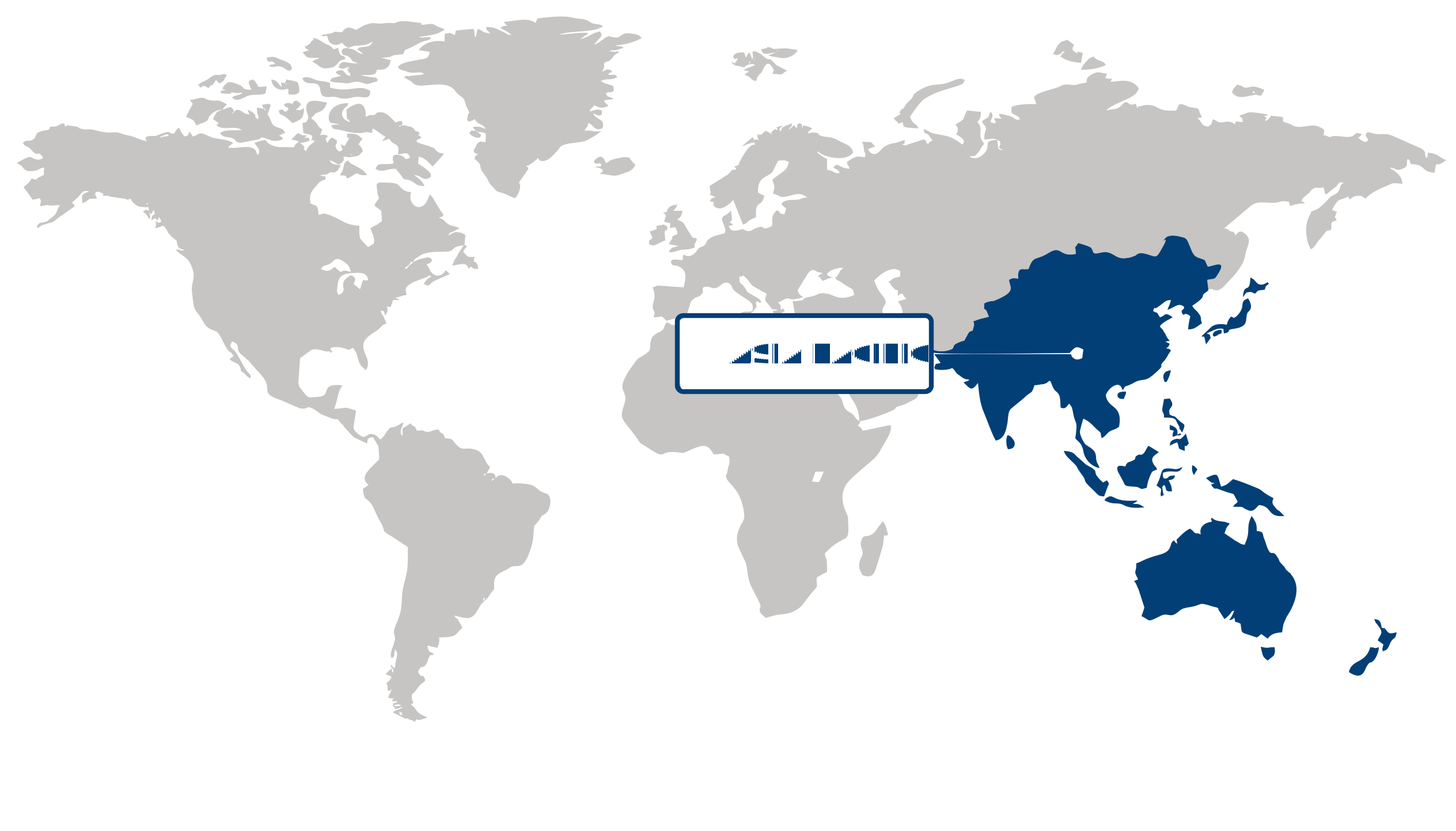
Asia Pacific (Largest Region)
The stationary hydrogen energy storage market was led by Asia Pacific, where large-scale investments in clean energy infrastructure, expanding renewable power capacity, and strong interest in hydrogen-based energy systems are supporting regional adoption. Countries across the region are increasingly pursuing hydrogen as part of broader energy-transition strategies, creating opportunities for stationary storage systems that can help balance intermittent renewable generation and improve grid flexibility. Industrial decarbonization initiatives and efforts to strengthen energy security are also encouraging the development of hydrogen storage infrastructure.
North America (Fastest-Growing Region)
North America is projected to register the fastest growth, supported by increasing emphasis on clean energy, grid resilience, and low-carbon power systems. The region's expanding renewable energy deployment is creating a need for reliable long-duration energy storage technologies, while policy support for hydrogen production and clean-energy infrastructure is improving the investment environment. Growing interest from utilities and industrial users in integrating hydrogen with renewable power and backup applications is expected to accelerate market development.
| Parameter | North America | Asia Pacific | Europe | Latin America | MEA |
|---|---|---|---|---|---|
| Innovation Hub i Scale Nascent Developing Advanced | |||||
| Cost-Sensitive Region i Scale Low Medium High | |||||
| Regulatory Environment i Scale Restrictive Neutral Supportive | |||||
| Demand Drivers i Scale Weak Moderate Strong | |||||
| Development Stage i Scale Emerging Developing Developed | |||||
| Adoption Rate i Scale Low Medium High | |||||
| New Entrants / Startups i Scale Sparse Moderate Dense | |||||
| Macro Indicators i Scale Weak Stable Strong |
Key Country Insights
United States 🇺🇸
Grid Flexibility InvestmentThe U.S. is investing in stationary hydrogen energy storage to strengthen renewable energy integration and improve grid resilience. Utilities and industrial operators are evaluating long-duration storage systems that support reliable electricity supply during demand fluctuations.
Germany 🇩🇪
Renewable Storage IntegrationGermany advances stationary hydrogen energy storage to complement expanding renewable power generation and industrial decarbonization strategies. Projects increasingly focus on balancing intermittent electricity production while supporting flexible energy management.
Japan 🇯🇵
Energy Security StrategyJapan promotes stationary hydrogen energy storage to improve energy security and diversify low-carbon power resources. Deployment priorities include reliable storage technologies that integrate efficiently with distributed energy and hydrogen infrastructure.
South Korea 🇰🇷
Hydrogen Infrastructure ExpansionSouth Korea is expanding stationary hydrogen energy storage alongside broader hydrogen economy investments. Energy companies prioritize scalable storage systems capable of supporting industrial facilities, renewable integration, and stable electricity supply.
France 🇫🇷
Low-Carbon Grid SupportFrance is incorporating stationary hydrogen energy storage into projects designed to enhance renewable electricity utilization and grid stability. Investment emphasizes practical storage solutions that complement national decarbonization and energy transition objectives.
Italy 🇮🇹
Renewable Balancing SolutionsItaly is evaluating stationary hydrogen energy storage for balancing renewable generation and improving electricity system flexibility. Market participants are focusing on storage technologies that strengthen energy reliability while supporting industrial and utility applications.
Segment Leadership and Growth Trends
Stationary Hydrogen Energy Storage Market Share (%), by Method, 2026
Go beyond the chart, access full insights & data tables
Request Free Sample ReportMethod Segment Analysis: Compression (Largest Segment) vs Material-Based (Fastest-Growing Segment)
The compression segment led the stationary hydrogen energy storage market and accounted for 76.7% in 2026. Its dominance is supported by established infrastructure, proven storage technology, and broad compatibility with industrial hydrogen production, transportation, and distribution systems. Compressed hydrogen storage offers operational simplicity, reliable performance, and relatively mature engineering standards, making it the preferred solution for large-scale stationary energy storage installations. Continued investments in hydrogen infrastructure and renewable energy integration further reinforce its leading position.
Material-based storage is expected to experience the fastest growth over the forecast period as research and commercialization efforts advance next-generation hydrogen storage technologies. These systems offer the potential for higher storage density, improved operational safety, and greater efficiency compared with conventional storage approaches. Growing interest in long-duration energy storage, expanding hydrogen economy initiatives, and continuous material science innovations are expected to accelerate adoption across future stationary energy storage applications.
| Segment | Sub-Segment | Largest Segment | Fastest Growing |
|---|---|---|---|
| Method | Compression, Liquefaction, Material-Based | Compression | Material-Based |
Competitive Landscape and Market Positioning
Major players in the stationary hydrogen energy storage market:
- Linde plc (Ireland)
- Air Liquide S.A. (France)
- Air Products and Chemicals, Inc. (United States)
- ENGIE S.A. (France)
- Nel ASA (Norway)
- ITM Power plc (United Kingdom)
- McPhy Energy S.A. (France)
- FuelCell Energy, Inc. (United States)
- Siemens Energy AG (Germany)
- Plug Power, Inc. (United States)
The pace of competition in the stationary hydrogen energy storage market is increasingly shaped by the ability to deliver integrated energy storage solutions rather than standalone system components. Market participants are strengthening expertise across hydrogen production, storage, energy management, and system controls to improve operational efficiency and simplify deployment for end users. Competitive differentiation is also shifting toward lifecycle reliability, safety engineering, and digital optimization capabilities, as customers seek storage platforms that can support variable renewable energy generation while meeting increasingly demanding operational and regulatory requirements.
| Company | Market Share | Company Revenue | Revenue CAGR (%) | Product Portfolio | Geographic Presence | Innovation / R&D Focus | Strategic Developments |
|---|---|---|---|---|---|---|---|
| Linde plc (Ireland) | |||||||
| Air Liquide S.A. (France) | |||||||
| Air Products and Chemicals Inc. (United States) | |||||||
| ENGIE S.A. (France) | |||||||
| Nel ASA (Norway) | |||||||
| ITM Power plc (United Kingdom) | |||||||
| McPhy Energy S.A. (France) | |||||||
| FuelCell Energy Inc. (United States) | |||||||
| Siemens Energy AG (Germany) | |||||||
| Plug Power Inc. (United States) |
Industry Development/News
| Company Name | Date | Key Development |
|---|---|---|
| Air Liquide | Dec-25 | Air Liquide expanded its strategic partnership with Hyundai Motor Group to build out a global hydrogen infrastructure covering production, stationary storage, and distribution. The initiative focuses on developing regional hubs across Europe, North America, and Asia to support grid balancing and large-scale stationary power applications. |
| John Cockerill Hydrogen | Jul-25 | John Cockerill Hydrogen acquired core assets from McPhy Energy, including its Belfort gigafactory in France. The acquisition expands John Cockerill's industrial footprint for pressurized alkaline electrolyzers and compressed hydrogen storage technology targeting large-scale industrial and stationary grid storage applications. |
| ENGIE | Nov-24 | ENGIE entered into a joint development agreement with OCP Group to build integrated renewable power and stationary hydrogen storage infrastructure in Morocco. The co-development project aims to supply continuous, decarbonized industrial power while enhancing national grid flexibility through seasonal hydrogen storage capacity. |
| Air Liquide | Jun-24 | Air Liquide partnered with VINCI Group subsidiary Geostock to co-develop large-scale underground hydrogen storage infrastructure in salt and mined caverns. The joint project targets power-to-power stationary energy storage applications to enable seasonal renewable energy balancing and enhance grid-scale storage economics. |
| Linde plc | Apr-23 | Linde plc signed a Memorandum of Understanding with energy infrastructure operator Snam to jointly develop clean hydrogen projects across Europe. The strategic alliance covers the co-development of hydrogen production, compression, distribution, and large-scale stationary storage systems to support regional energy transition goals. |
| Plug Power Inc. | Oct-21 | Plug Power Inc. acquired Applied Cryo Technologies, Inc. to expand its green hydrogen infrastructure portfolio. The acquisition integrated high-capacity cryogenic storage, transportation, and liquid distribution technologies into Plug Power's broader stationary power and industrial hydrogen storage ecosystem. |
| Linde plc | Aug-21 | Linde plc executed a long-term commercial agreement with Infineon Technologies for the on-site production and stationary storage of high-purity green hydrogen. The infrastructure deployment ensures dedicated, zero-emission industrial gas supply for semiconductor manufacturing operations. |
| ENGIE | Jan-21 | ENGIE collaborated with Total to launch the Masshylia project at Châteauneuf-les-Martigues, developing France’s largest renewable hydrogen production and storage facility. The facility incorporates advanced storage management architecture to handle variable solar power generation for industrial usage. |
Customize Your Report
Explore examples of how this report can be tailored to different research needs, including custom segments, additional topics or chapters, and related reports. Click a section of the wheel or its numbered marker to explore the available options.
Stationary Hydrogen Energy Storage Market — Custom Segments
| Segment | Sub-Segment |
|---|---|
| Storage Duration | Short-Duration, Medium-Duration, Long-Duration |
| Grid Application | Energy Shifting, Renewable Energy Integration, Grid Balancing, Backup Power |
| Deployment Configuration | On-Site, Centralized, Distributed |
Stationary Hydrogen Energy Storage Market — Custom TOC
| Custom Chapter | Custom Details |
|---|---|
| Hydrogen Storage Project Economics |
|
| Grid Integration Strategies |
|
| Infrastructure Deployment Roadmap |
|
Need a different cut of the data?
Request Custom ResearchWhat is the current size of the stationary hydrogen energy storage market?
How much is the stationary hydrogen energy storage industry expected to grow by 2036?
How are national hydrogen strategies influencing investment in stationary hydrogen energy storage?
Why is renewable energy integration increasing demand for stationary hydrogen energy storage systems?
Why is compression the leading storage method in the stationary hydrogen energy storage market?
Which storage method is expected to grow the fastest in the stationary hydrogen energy storage market?
What is driving Asia Pacific's leadership in stationary hydrogen energy storage?
Why is North America expected to achieve the fastest market growth?
Who are the leading players in the stationary hydrogen energy storage landscape?
Our Clients
"The information presented in the report was genuinely insightful. The data was clear and easy to understand, which made it much easier to interpret the findings."
Amara Raja Group
"The responsiveness and professionalism exhibited by the team were exemplary. They were readily available to address queries, provide clarifications, and offer additional insights."
ONGC
"The reports offered a comprehensive analysis of various segments within the market. The detailed insights into market trends, and regulatory landscapes were excellent."
TotalEnergies
Our Research Team & Methodology
Every Fundamental Business Insights report is built by a dedicated vertical research team, validated through a structured primary-and-secondary methodology, and reviewed for accuracy before it reaches you.
Research Team Overview
Prepared by the Energy & Power Research Team
Delivery
Published
Demand
Available
Support
Trust & Compliance
Research Domains
10 coverage areasResearch Intelligence
| Source | Reference |
|---|---|
| International Energy Agency (IEA) | www.iea.org |
| U.S. Energy Information Administration (EIA) | www.eia.gov |
| International Renewable Energy Agency (IRENA) | www.irena.org |
| International Electrotechnical Commission (IEC) | www.iec.ch |
| International Organization for Standardization (ISO) | www.iso.org |
| IEEE | www.ieee.org |
| CIGRE (International Council on Large Electric Systems) | www.cigre.org |
| World Energy Council (WEC) | www.worldenergy.org |
| U.S. Department of Energy (DOE) | www.energy.gov |
| International Atomic Energy Agency (IAEA) | www.iaea.org |
| American Petroleum Institute (API) | www.api.org |
| Society of Petroleum Engineers (SPE) | www.spe.org |
| Hydrogen Council | hydrogencouncil.com |
| Battery Council International (BCI) | batterycouncil.org |
| Global Wind Energy Council (GWEC) | gwec.net |
| SolarPower Europe | www.solarpowereurope.org |
| World Bioenergy Association (WBA) | worldbioenergy.org |
| International Hydropower Association (IHA) | www.hydropower.org |
| Edison Electric Institute (EEI) | www.eei.org |
| National Renewable Energy Laboratory (NREL) | www.nrel.gov |
Research Workflow & Quality Assurance
Data Collection
Verified information gathered through primary and secondary research.
Data Triangulation
Cross-validation using multiple independent data sources.
Forecast Modelling
Market estimates developed using historical trends and analytical models.
Analyst Validation
Findings reviewed by domain experts for accuracy and consistency.
Editorial & Quality Review
Final editorial, quality, and compliance checks before publication.
Final Publication
Released after successful completion of the internal review process.
Report Coverage
📊 Market Assessment
- Market Size & Forecast
- Market Segmentation
- Regional Analysis
- Growth Drivers & Challenges
- Market Dynamics
🏢 Competitive Intelligence
- Competitive Landscape
- Company Profiles
- Competitive Benchmarking
- Mergers & Acquisitions
- Market Share Analysis or Key Company Strategies
🔍 Strategic Analysis
- Value Chain Analysis
- Porter's Five Forces
- PESTLE Analysis
- Pricing Trends
- Supply-Demand Analysis
🚀 Future Outlook
- Technology Landscape
- Regulatory Landscape
- Investment & Funding Landscape
- Emerging Opportunities
- Future Market Outlook
Have a question about this report or need a custom scope?
Request Customization