Soy Sauce Market Size & Growth Forecast 2027–2036, By Segments (Type, Application), Regional Demand Trends (North America, Asia Pacific, Europe), Key Country Insights (U.S., Japan, South Korea, Germany, France, Italy), and Competitive Landscape
Market Size and Growth Outlook
Soy Sauce Market size was worth USD 61.54 billion in 2026 and is expected to grow at a 4.56% CAGR between 2027 and 2036, reaching USD 96.12 billion by 2036. The industry revenue for 2027 is calculated at USD 63.9 billion.
Get more details on this report
Request Free Sample ReportSoy Sauce Market Intelligence Snapshot
Regional Market Dynamics
- Asia Pacific led with 57.75% share in 2026, supported by deeply embedded daily culinary use, strong retail distribution, and widespread household and foodservice consumption.
- North America is growing at 5.59% CAGR, driven by rising adoption of Asian flavors, restaurant demand, and expanded use in packaged foods and foodservice menus.
Segment Momentum
- Blended soy sauce held a 56.49% market share in 2026 because it delivers consistent flavor, stable supply, and cost-effective formulations that meet high-volume demand across food processing, foodservice, and retail applications.
- Household is the fastest-growing application as rising at-home cooking and broader use of Asian flavors increase everyday consumption through greater usage frequency and expanding retail adoption.
Market Expansion Drivers
- Growing global popularity of Asian cuisine increasing soy sauce consumption across foodservice channels.
- Rising demand for organic, gluten-free, and low-sodium condiments supporting premium soy sauce innovation.
- Expanding plant-based food consumption boosting soy sauce usage as a versatile flavor enhancer.
Leading Market Participants
- Major companies in the soy sauce market include Kikkoman Corporation (Japan), Lee Kum Kee Company Limited (Hong Kong), Foshan Haitian Flavouring & Food Co., Ltd. (China), YAMASA Corporation (Japan), Masan Group Corporation (Vietnam), Otafuku Sauce Co., Ltd. (Japan), Guangdong Meiweixian Flavoring Foods Co., Ltd. (China), Nestlé S.A. (Switzerland), Unilever PLC (United Kingdom), Bourbon Barrel Foods (USA).
Global Market Forecast Snapshot
Market Outlook
- 2026 Market Size: USD 61.54 billion
- 2027 Estimated Market Size: USD 63.9 billion.
- Projected Market Size: USD 96.12 billion by 2036
- Growth Forecast: 4.56% CAGR (2027-2036)
Regional and Segment Outlook
- Leading Regional Market: Asia Pacific
- High-Growth Regional Hub: North America
- Core Revenue Segment: Blended (Type) | Food Industry (Application)
- Emerging Opportunity Segment: Brewed (Type) | Household (Application)
Market Growth Drivers and Industry Trends
Growing global popularity of Asian cuisine increasing soy sauce consumption across foodservice channels
The growing international appeal of asian cuisines will drive the soy sauce market growth as restaurants, catering businesses, and other foodservice operators increasingly incorporate familiar asian flavors into diverse menus. Soy sauce is widely used as a seasoning, marinade, dipping sauce, and cooking ingredient, allowing foodservice providers to integrate it across multiple dishes and culinary formats. The expansion of asian-inspired dining beyond traditional markets is also introducing consumers to different soy sauce varieties and flavor profiles, while professional kitchens value the ingredient for its ability to add umami depth and complement vegetables, noodles, rice, meat, and seafood preparations.
Rising demand for organic, gluten-free, and low-sodium condiments supporting premium soy sauce innovation
Changing consumer preferences around healthier and more transparent food choices are creating opportunities for product differentiation, which will propel the soy sauce market growth in premium condiment categories. Increasing attention to sodium intake, dietary restrictions, ingredient sourcing, and clean-label positioning is encouraging manufacturers to develop formulations that address specific nutritional and lifestyle preferences. Organic and gluten-free options can appeal to consumers seeking products aligned with particular dietary requirements, while reduced-sodium formulations provide an alternative for shoppers looking to moderate salt consumption without eliminating savory flavors from meals. These evolving preferences are encouraging innovation in ingredients, fermentation approaches, flavor intensity, and packaging presentation.
Expanding plant-based food consumption boosting soy sauce usage as a versatile flavor enhancer
The growing adoption of plant-based meals is boosting the soy sauce market demand because soy sauce provides a convenient way to add savory depth to foods that may otherwise require more complex seasoning combinations. Its compatibility with vegetables, tofu, legumes, meat alternatives, grains, and plant-based prepared foods makes it suitable for both household cooking and commercial food preparation. As consumers experiment with more plant-forward recipes, soy sauce can be incorporated into marinades, stir-fries, sauces, dressings, and finishing applications, while its umami characteristics help enhance the sensory appeal of plant-based dishes.
| Growth Driver | Impact on CAGR | Regulatory Influence | Geographic Relevance | Adoption Rate | Impact Timeline |
|---|---|---|---|---|---|
| Growing global popularity of Asian cuisine increasing soy sauce consumption across foodservice channels | 1.80% | Low | Asia Pacific, North America | High | Near Term |
| Rising demand for organic, gluten-free, and low-sodium condiments supporting premium soy sauce innovation | 1.60% | Moderate | North America, Europe | Medium | Mid Term |
| Expanding plant-based food consumption boosting soy sauce usage as a versatile flavor enhancer | 1.40% | Low | Europe, Asia Pacific | Medium | Mid Term |
Unlock insights tailored to your business with our bespoke market research solutions.
Click to get your customized report now.
Regional Demand Dynamics
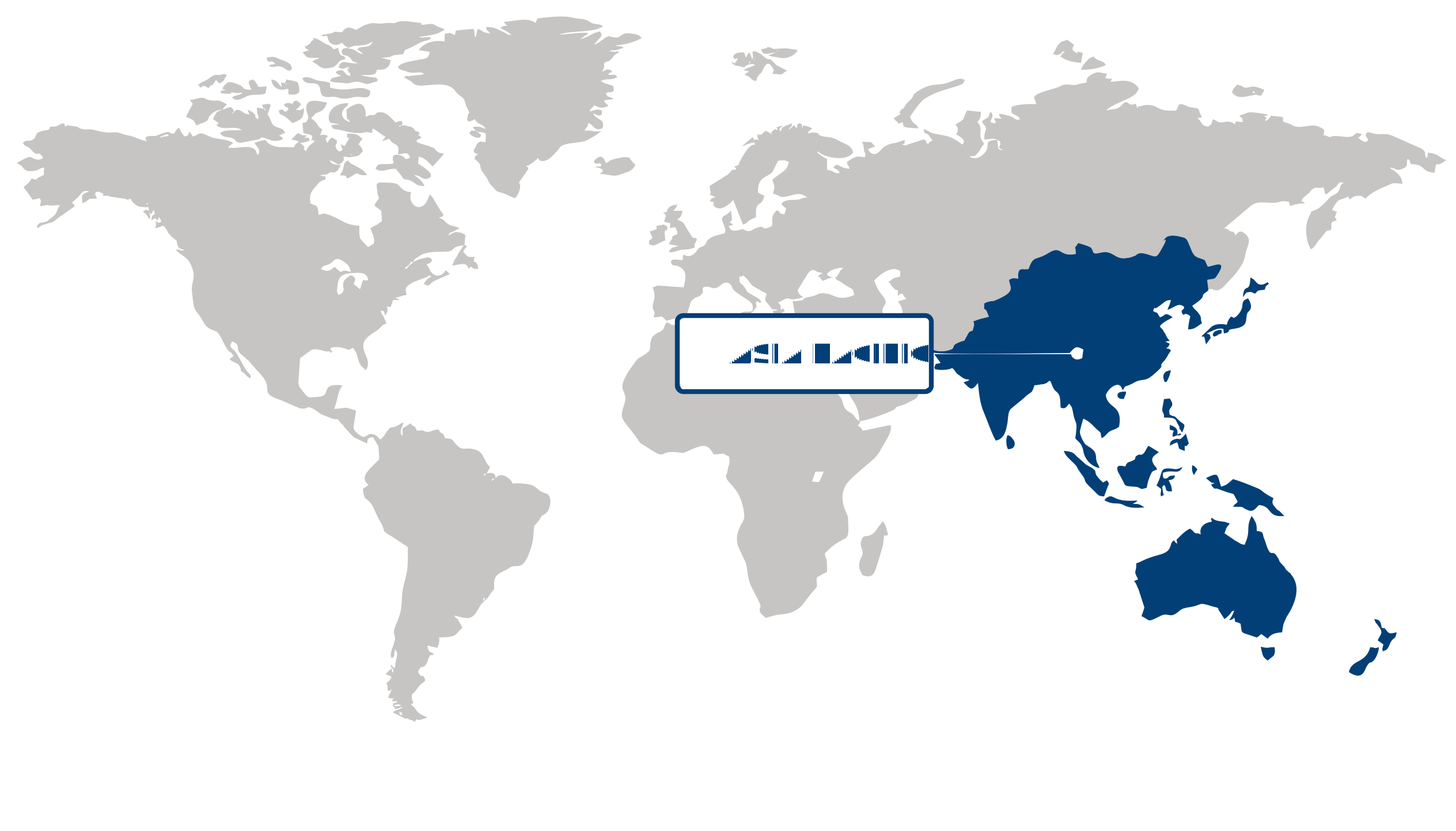
Asia Pacific (Largest Region)
Asia Pacific held the largest share of the soy sauce market, accounting for 57.75% share in 2026, supported by deeply established soy sauce consumption patterns, widespread use across traditional cuisines, and strong demand from households and foodservice establishments. The region benefits from a mature culinary culture centered on fermented condiments, while expanding packaged food consumption and evolving retail channels continue to support product accessibility and market penetration. Strong food manufacturing activity and continued consumer preference for familiar flavor profiles further reinforce the region’s leading position.
North America (Fastest-Growing Region)
North America is emerging as the fastest-growing region for the soy sauce market, driven by rising consumer interest in asian cuisines, greater exposure to international flavors, and broader incorporation of soy sauce into home cooking and prepared foods. Growth in multicultural food consumption, expanding restaurant offerings, and increasing experimentation with sauces and marinades are widening the product’s consumer base. Retail availability and the growing influence of asian-inspired food trends are also supporting stronger adoption across mainstream consumers.
| Parameter | North America | Asia Pacific | Europe | Latin America | MEA |
|---|---|---|---|---|---|
| Innovation Hub i Scale Nascent Developing Advanced | |||||
| Cost-Sensitive Region i Scale Low Medium High | |||||
| Regulatory Environment i Scale Restrictive Neutral Supportive | |||||
| Demand Drivers i Scale Weak Moderate Strong | |||||
| Development Stage i Scale Emerging Developing Developed | |||||
| Adoption Rate i Scale Low Medium High | |||||
| New Entrants / Startups i Scale Sparse Moderate Dense | |||||
| Macro Indicators i Scale Weak Stable Strong |
Key Country Insights
Germany 🇩🇪
Premium Flavor AdoptionGermany is experiencing greater adoption of soy sauce across retail and foodservice channels as international cuisine gains wider acceptance. Consumers increasingly favor premium and naturally brewed products that deliver authentic flavor while supporting clean-label purchasing preferences.
France 🇫🇷
Gourmet Ingredient PreferenceFrance increasingly incorporates soy sauce into both international and fusion cuisine, supporting demand across retail and hospitality sectors. Consumers are showing stronger interest in premium and naturally fermented products that complement high-quality culinary experiences.
Italy 🇮🇹
Fusion Cuisine GrowthItaly is broadening soy sauce consumption through the popularity of Asian cuisine and creative fusion cooking. Food manufacturers and retailers are expanding product selections that emphasize authentic taste, premium ingredients, and convenient packaging for household and professional use.
Japan 🇯🇵
Traditional Brewing ExcellenceJapan maintains strong demand for soy sauce rooted in traditional brewing methods while encouraging product innovation for modern consumption habits. Producers are balancing authentic craftsmanship with premium packaging and convenience formats that appeal to both domestic and export markets.
South Korea 🇰🇷
Foodservice Innovation SupportSouth Korea continues to expand soy sauce applications across restaurants, packaged foods, and home cooking. Manufacturers are developing differentiated formulations suited to contemporary culinary trends while maintaining flavor authenticity valued by consumers.
United States 🇺🇸
Diverse Culinary ApplicationsThe U.S. soy sauce market continues to expand through growing interest in Asian cuisine, home cooking, and foodservice innovation. Manufacturers are introducing premium, reduced-sodium, and specialty varieties that address evolving consumer preferences for flavor and healthier ingredient profiles.
Segment Leadership and Growth Trends
Soy Sauce Market Share (%), by Type, 2026
Go beyond the chart, access full insights & data tables
Request Free Sample ReportType Segment Analysis: Blended (Largest Segment) vs Brewed (Fastest-Growing Segment)
The blended segment led the soy sauce market with a 56.49% share in 2026, supported by its versatility across a broad range of culinary applications. Blended formulations can provide balanced flavor profiles that suit different cooking styles, making them widely applicable in food preparation and seasoning. Their adaptability to varied consumer preferences and use across everyday meals and processed food applications reinforces their established position in the market.
Brewed soy sauce is gaining momentum as consumers and food producers increasingly value traditional preparation methods and distinctive flavor characteristics. Brewing can deliver deeper taste profiles and sensory qualities that appeal to consumers seeking more authentic culinary experiences. Growing interest in traditional foods, ingredient quality, and differentiated flavor profiles is supporting broader adoption of brewed varieties across household and food-service applications.
Application Segment Analysis: Food Industry (Largest Segment) vs Household (Fastest-Growing Segment)
The food industry accounted for the largest share of the soy sauce market in 2026, reflecting extensive use of soy sauce as a flavoring and seasoning ingredient across processed foods, food-service preparations, and diverse culinary products. Its ability to enhance taste while fitting into a wide range of recipes supports consistent industrial demand. Food manufacturers and food-service operators also rely on soy sauce to deliver recognizable flavor profiles across prepared foods, reinforcing the importance of this application.
Household use is expanding as consumers incorporate soy sauce into a broader range of home-cooked meals and international cuisines. Greater experimentation with asian-inspired dishes, convenient meal preparation, and increased interest in versatile cooking ingredients are supporting demand among household users. The growing availability of different formulations and flavor profiles is also enabling consumers to select products that align with their cooking preferences.
| Segment | Sub-Segment | Largest Segment | Fastest Growing |
|---|---|---|---|
| Type | Brewed, Blended | Blended | Brewed |
| Application | Household, Food Industry | Food Industry | Household |
Competitive Landscape and Market Positioning
Top players in the soy sauce market:
1. Kikkoman Corporation (Japan)
2. Lee Kum Kee Company Limited (Hong Kong)
3. Foshan Haitian Flavouring & Food Co. Ltd. (China)
4. YAMASA Corporation (Japan)
5. Masan Group Corporation (Vietnam)
6. Otafuku Sauce Co. Ltd. (Japan)
7. Guangdong Meiweixian Flavoring Foods Co. Ltd. (China)
8. Nestlé S.A. (Switzerland)
9. Unilever PLC (United Kingdom)
10. Bourbon Barrel Foods (USA)
The soy sauce market is evolving through changing consumer demand for authentic flavors, low-sodium alternatives, and clean-label condiments. Producers are focusing on premium fermentation methods, innovative packaging formats, and healthier product variants to strengthen brand positioning. Sustainable sourcing practices and growing interest in Asian cuisine are also contributing to expansion across the soy sauce market.
| Company | Market Share | Company Revenue | Revenue CAGR (%) | Product Portfolio | Geographic Presence | Innovation / R&D Focus | Strategic Developments |
|---|---|---|---|---|---|---|---|
| Kikkoman Corporation (Japan) | |||||||
| Lee Kum Kee Company Limited (Hong Kong) | |||||||
| Foshan Haitian Flavouring & Food Co. Ltd. (China) | |||||||
| YAMASA Corporation (Japan) | |||||||
| Masan Group Corporation (Vietnam) | |||||||
| Otafuku Sauce Co. Ltd. (Japan) | |||||||
| Guangdong Meiweixian Flavoring Foods Co. Ltd. (China) | |||||||
| Nestlé S.A. (Switzerland) | |||||||
| Unilever PLC (United Kingdom) | |||||||
| Bourbon Barrel Foods (USA). |
Industry Development/News
| Company Name | Date | Key Development |
|---|---|---|
| Mahsuri Food Sdn. Bhd. | Mar-25 | Mahsuri Food inaugurated a state-of-the-art production facility in Bandar Enstek, Malaysia. The expansion of manufacturing capacity serves as a strategic pillar for the company’s growth plan within the global halal food and condiment market, enhancing operational scalability for regional and international distribution. |
| Shandong Huangjingfang | Mar-25 | Shandong Huangjingfang announced plans to raise Series A funding to scale its fresh-blended condiment retail operations. The strategy focuses on deploying intelligent fresh-dispensing solutions and standardizing bulk production processes, aimed at professionalizing the commercialization and distribution of soy sauce-related products. |
| Kikkoman Corp. | Feb-25 | Kikkoman commenced construction of a $560 million production facility in Jefferson, Wisconsin. This significant capital investment is designed to substantially increase domestic production capacity and strengthen the company’s supply chain infrastructure to meet rising North American demand for soy sauce and seasoning products. |
| Heliograf | Feb-25 | Heliograf introduced a sustainable, home-compostable soy sauce container developed from plant pulp. This packaging innovation enables food-service operators to comply with tightening regulations regarding single-use plastics, representing a meaningful shift in the distribution value chain toward more environmentally compliant and sustainable logistics. |
| CinSoy | Jan-25 | CinSoy confirmed the closure of its small-batch soy sauce operations, signaling a contraction in the artisanal segment of the market. This exit reflects the operational challenges faced by specialty producers in scaling niche condiment brands within a competitive landscape dominated by larger, integrated manufacturers. |
| Kikkoman Corp. | Feb-24 | Kikkoman launched a dark soy sauce specifically formulated for the Indian market after a four-year R&D cycle. This entry represents a strategic geographic expansion and product customization effort, targeting the growing regional demand for authentic Pan-Asian flavor profiles through localized manufacturing and product innovation. |
Customize Your Report
Explore examples of how this report can be tailored to different research needs, including custom segments, additional topics or chapters, and related reports. Click a section of the wheel or its numbered marker to explore the available options.
Soy Sauce Market — Custom Segments
| Segment | Sub-Segment |
|---|---|
| Packaging Format | Bottles, Pouches, Sachets, Bulk Containers |
| Price Tier | Economy, Mid-Range, Premium, Specialty |
| Flavor Profile | Traditional Soy Sauce, Sweet Soy Sauce, Light Soy Sauce, Dark Soy Sauce, Specialty Flavored Soy Sauce |
Soy Sauce Market — Custom TOC
| Custom Chapter | Custom Details |
|---|---|
| Premium and Artisanal Soy Sauce Opportunity Mapping |
|
| Clean Label and Sodium Reduction Market Outlook |
|
| Foodservice and Institutional Demand Assessment |
|
Need a different cut of the data?
Request Custom ResearchHow big is the soy sauce market?
What is the expected industry size of soy sauce by 2036?
How is the expansion of Asian cuisine influencing demand in the soy sauce market?
How are health-conscious purchasing trends shaping product innovation in the soy sauce market?
Why does the blended type dominate the soy sauce market?
Why is the household application the fastest-growing segment in the soy sauce market?
Why does Asia Pacific lead the soy sauce market?
What is driving North America’s growth in soy sauce demand?
Who are the major participants shaping the soy sauce landscape?
Our Clients
"The report provided a thorough look at market trends, technological advancements, and the competitive landscape. The depth of insights was really valuable."
ITC Limited
"We would highly recommend Fundamental Business Insights & Consulting to anyone looking for reliable, detailed, and comprehensive market research in the Food industry."
Tyson Foods
"The clarity and presentation of the information were commendable. The report was delivered timely, which made the overall experience smooth and convenient."
Mondelēz International
Our Research Team & Methodology
Every Fundamental Business Insights report is built by a dedicated vertical research team, validated through a structured primary-and-secondary methodology, and reviewed for accuracy before it reaches you.
Research Team Overview
Prepared by the Food & Beverage Research Team
Delivery
Published
Demand
Available
Support
Trust & Compliance
Research Domains
10 coverage areasResearch Intelligence
| Source | Reference |
|---|---|
| Food and Agriculture Organization (FAO) | www.fao.org |
| World Health Organization (WHO) | www.who.int |
| U.S. Food & Drug Administration (FDA) | www.fda.gov |
| European Food Safety Authority (EFSA) | www.efsa.europa.eu |
| U.S. Department of Agriculture (USDA) | www.usda.gov |
| Codex Alimentarius Commission | www.fao.org/fao-who-codexalimentarius |
| International Organization for Standardization (ISO) | www.iso.org |
| AOAC INTERNATIONAL | www.aoac.org |
| Institute of Food Technologists (IFT) | www.ift.org |
| International Dairy Foods Association (IDFA) | www.idfa.org |
| International Sweeteners Association (ISA) | www.sweeteners.org |
| International Probiotics Association (IPA) | internationalprobiotics.org |
| Good Food Institute (GFI) | gfi.org |
| American Feed Industry Association (AFIA) | www.afia.org |
| International Feed Industry Federation (IFIF) | ifif.org |
| Specialty Food Association (SFA) | www.specialtyfood.com |
| Brewers Association | www.brewersassociation.org |
| International Bottled Water Association (IBWA) | bottledwater.org |
| International Alliance for Dietary/Food Supplement Associations (IADSA) | www.iadsa.org |
| OECD Agriculture & Food | www.oecd.org/agriculture |
Research Workflow & Quality Assurance
Data Collection
Verified information gathered through primary and secondary research.
Data Triangulation
Cross-validation using multiple independent data sources.
Forecast Modelling
Market estimates developed using historical trends and analytical models.
Analyst Validation
Findings reviewed by domain experts for accuracy and consistency.
Editorial & Quality Review
Final editorial, quality, and compliance checks before publication.
Final Publication
Released after successful completion of the internal review process.
Report Coverage
📊 Market Assessment
- Market Size & Forecast
- Market Segmentation
- Regional Analysis
- Growth Drivers & Challenges
- Market Dynamics
🏢 Competitive Intelligence
- Competitive Landscape
- Company Profiles
- Competitive Benchmarking
- Mergers & Acquisitions
- Market Share Analysis or Key Company Strategies
🔍 Strategic Analysis
- Value Chain Analysis
- Porter's Five Forces
- PESTLE Analysis
- Pricing Trends
- Supply-Demand Analysis
🚀 Future Outlook
- Technology Landscape
- Regulatory Landscape
- Investment & Funding Landscape
- Emerging Opportunities
- Future Market Outlook
Have a question about this report or need a custom scope?
Request Customization