Solar Battery Market Size & Forecasts 2026-2035, By Segments (End User, Product Type), Growth Opportunities, Innovation Landscape, Regulatory Shifts, Strategic Regional Insights (U.S., Japan, China, South Korea, UK, Germany, France), and Competitive Dynamics (Tesla, LG Chem, Panasonic, CATL, BYD)
Market Size and Growth Outlook
Solar Battery Market size is predicted to expand from USD 323.24 million in 2025 to USD 1.41 billion by 2035, with growth underpinned by a CAGR above 15.9% between 2026 and 2035. The industry revenue outlook for 2026 is USD 368.93 million.
Get more details on this report
Request Free Sample ReportSolar Battery Market Intelligence Snapshot
Regional Market Dynamics
Segment Momentum
Market Expansion Drivers
Leading Market Participants
Global Market Forecast Snapshot
Market Outlook
Regional and Segment Outlook
Market Growth Drivers and Industry Trends
The increasing deployment of renewable energy sources like solar and wind necessitates efficient storage solutions, driving significant demand in the solar battery market. As intermittent energy generation challenges grid stability, consumers and utilities are adopting solar batteries to enhance energy reliability and self-consumption. For instance, Tesla’s Powerwall innovation illustrates how end-users are integrating battery storage for home energy management. This shift encourages both established energy companies and new technology entrants to scale production and innovate integration with smart grids. Given the global push towards decarbonization and energy independence, it is evident that expanding renewable storage infrastructure will sustain momentum in the solar battery market, solidifying energy storage’s role in future energy systems.
Policy & Incentive Support for Solar Batteries
Government policies and financial incentives are critical catalysts in the solar battery market’s expansion, reducing upfront costs and accelerating adoption. Programs by entities such as the U.S. Department of Energy, which offer rebates and tax credits for residential and commercial solar battery installations, exemplify this supportive framework. These measures mitigate investment risks and encourage diverse market players—from utilities to startups—to enter and innovate. Policy developments also signal governmental commitment to clean energy goals, aligning market dynamics with broader sustainability agendas. Consequently, companies that proactively align with evolving regulatory environments can capitalize on emerging market opportunities and regulatory resilience in the solar battery market.
R&D in Advanced Solar Battery Technologies
Ongoing research and development in battery chemistry and system design are enhancing the efficiency, durability, and cost-effectiveness of solar batteries, thus transforming market prospects. Corporations such as LG Energy Solution and CATL are pioneering next-generation lithium-ion and solid-state batteries, while government-backed research initiatives focus on improving energy density and lifecycle performance. These innovations cater to increasingly discerning consumers seeking reliable, long-lasting solutions and enable new application segments like electric mobility integration. The solar battery market thus offers strategic differentiation opportunities for firms investing in breakthrough technologies that reduce total cost of ownership and improve user experience, underpinning the sector’s evolution amid intensifying competition.
Industry Restraints:
High Initial Capital Expenditure and Financing Barriers
The substantial upfront costs associated with solar battery systems significantly constrain market growth by limiting adoption, particularly among residential and small commercial consumers. BloombergNEF highlights that despite declining battery prices, the aggregate investment required for integrated solar-plus-storage installations remains a critical barrier, often necessitating complex financing solutions or incentives. This capital intensity deters potential buyers wary of long payback periods and uncertain regulatory incentives, thereby suppressing demand. For market incumbents, high entry costs restrict customer base expansion, while new entrants face challenges securing sufficient funding to scale operations. Moving forward, while cost declines and innovative financing mechanisms—such as leasing and power purchase agreements—are emerging, capital expenditure hurdles will continue to influence competitive dynamics and slow widespread deployment in the near term.
Supply Chain Disruptions and Raw Material Scarcity
Persistent supply chain constraints and raw material shortages, especially of lithium, cobalt, and nickel, pose formidable obstacles to scaling solar battery production. The International Energy Agency (IEA) reports that geopolitical tensions and mining bottlenecks have exacerbated price volatility and extended lead times, directly impacting manufacturers like Tesla and LG Chem. These disruptions elevate production costs and delay project timelines, impeding market expansion and creating operational uncertainties for both established players and startups. Strategically, companies must navigate procurement complexities and invest in supply resilience or alternative chemistries. Given ongoing resource extraction challenges and evolving trade policies, supply chain fragility will remain a critical restraint on the solar battery market’s growth trajectory through the mid-2020s.
| Growth Driver | Impact on CAGR | Regulatory Influence | Geographic Relevance | Adoption Rate | Impact Timeline |
|---|---|---|---|---|---|
| Growth in Renewable Energy Storage Deployment | 5.50% | Short term (≤ 2 yrs) | Europe, North America; Spillover: Asia Pacific | Medium | Fast |
| Policy & Incentive Support for Solar Batteries | 5.20% | Medium term (2–5 yrs) | Europe, Asia Pacific; Spillover: North America | High | Fast |
| R&D in Advanced Solar Battery Technologies | 5.20% | Long term (5+ yrs) | Asia Pacific, Europe; Spillover: North America | Medium | Moderate |
Unlock insights tailored to your business with our bespoke market research solutions.
Click to get your customized report now.
Regional Demand Dynamics
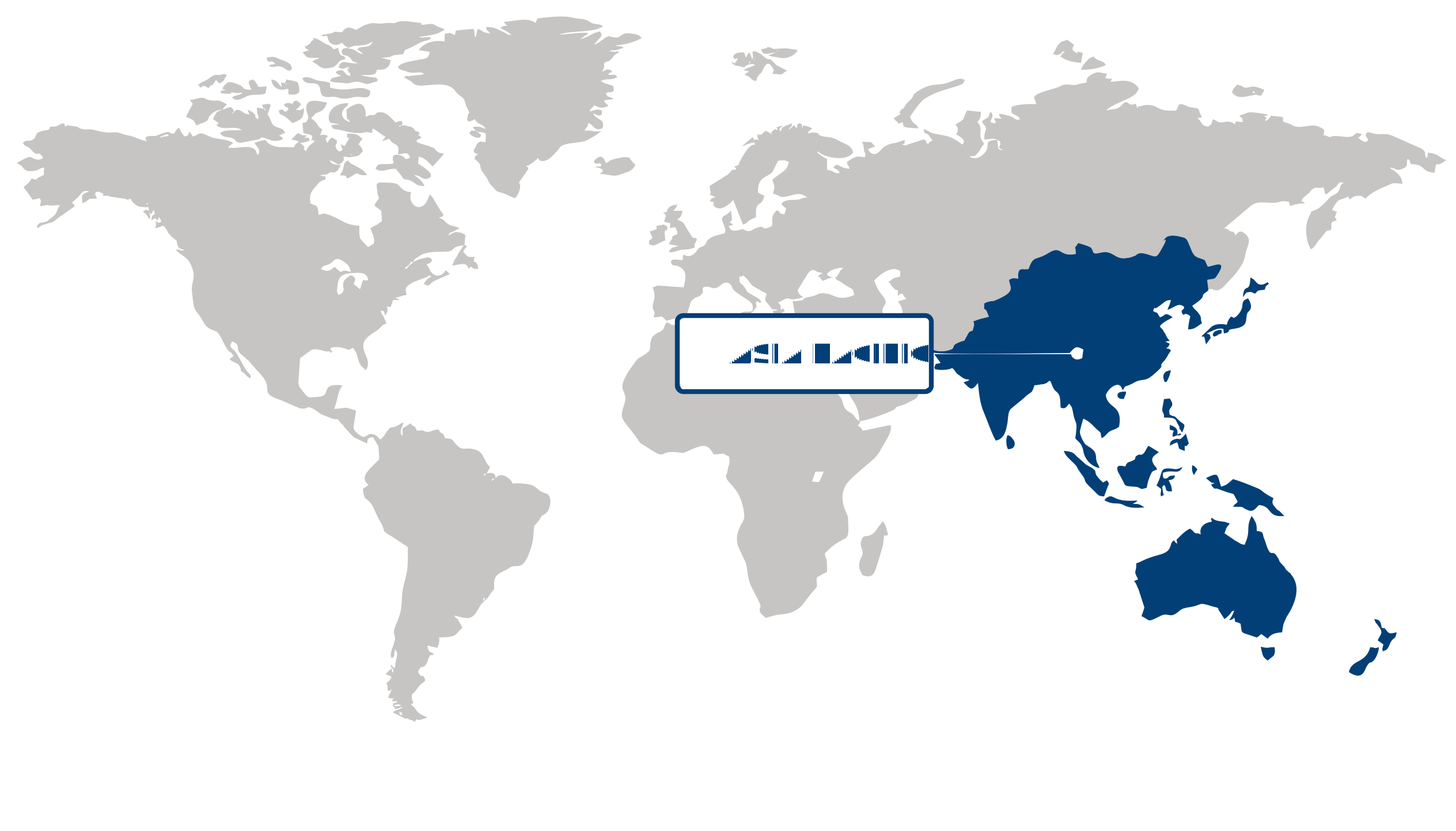
The Asia Pacific solar battery market dominated with a 53.88% share of the global market in 2025, also emerging as the fastest-growing region at a CAGR of 17.5%. This leadership stems largely from the immense energy demand paired with abundant solar resources in China and India, fueling rapid adoption of solar battery solutions. Heightened government support such as China’s National Energy Administration’s targets for renewable integration and India’s Ministry of New and Renewable Energy’s solar capacity expansion programs have catalyzed investments, driving technological advancements and cost reductions. Additionally, increasing consumer preference for energy independence and sustainability aligns with regional socio-economic growth, supported by infrastructure modernization efforts and competitive landscapes with global and local players. According to the International Renewable Energy Agency (IRENA), Asia Pacific’s capacity additions continue to outpace other regions, positioning it as a critical market for solar battery innovation and deployment.
China anchors the Asia Pacific solar battery market by leveraging its vast industrial base and policy incentives like the Renewable Energy Law revisions promoting local manufacturing and grid storage. The country’s surging demand for stable, clean energy solutions is exemplified by major initiatives from State Grid Corporation of China focusing on large-scale solar-plus-storage projects. Additionally, tech giants like CATL are advancing lithium-ion battery technologies, enhancing cost-efficiency and capacity. These dynamics underscore China’s pivotal role in sustaining regional growth, fostering deeper integration of solar batteries into its energy mix, and attracting international investments aiming at technology localization and scaling.
Japan is positioned as a pivotal hub in Asia Pacific’s solar battery market, driven by its focus on energy security and resilient power systems after the 2011 Fukushima incident. The Ministry of Economy, Trade and Industry (METI) has actively promoted residential solar battery adoption combined with smart grid technologies, supported by companies like Panasonic deploying innovative home energy storage systems. Japan’s mature consumer market favors sophisticated, compact battery units integrated with digital controls, reflecting cultural demand for reliability and efficiency. This strategic emphasis on distributed energy systems further complements Asia Pacific’s growth narrative, enhancing interoperability across borders and stimulating new business models in energy management throughout the region.
North America Market Analysis:
North America emerged as the fastest-growing region in the solar battery market, registering a robust CAGR driven primarily by lucrative growth opportunities fueled by heightened investments in renewable energy infrastructure and supportive policy frameworks. The increasing shift towards sustainable energy alternatives has notably influenced consumer and corporate spending patterns, particularly as governments like the U.S. actively implement incentives to encourage solar adoption. Regulatory support from entities such as the U.S. Department of Energy’s Solar Energy Technologies Office has accelerated technological advancements, enhancing battery efficiency and affordability. Additionally, the region’s well-established supply chain networks and innovation hubs have bolstered competitive intensity, fostering rapid deployment of solar battery solutions. This evolving landscape positions North America as a fertile ground for strategic expansion and long-term value creation in the solar battery market.
The U.S. stands at the forefront of North America’s solar battery market, propelled by its dynamic policy environment and increasing consumer demand for energy independence and resilience. Federal incentives, such as the Investment Tax Credit (ITC), alongside state-level mandates like California’s Renewable Portfolio Standards, have catalyzed widespread adoption of solar battery systems. Leading players including Tesla and Sunrun continue to expand their footprint by integrating digital energy management technologies, enhancing user engagement. Moreover, the U.S.’s commitment to reducing carbon emissions, exemplified by the Biden administration’s clean energy goals, has intensified investments in grid-scale battery storage projects, as reported by the U.S. Energy Information Administration. This strategic positioning affirms the country’s role in driving broader regional momentum in the solar battery market.
Europe Market Trends:
Europe has maintained a substantial share in the solar battery market, driven by its robust commitment to renewable energy integration and stringent environmental regulations. The region’s economic resilience and advanced industrial base support significant investments in energy storage solutions, reflecting shifting consumer preferences toward self-sufficiency and grid independence. European Union policies, including the Green Deal and Renewable Energy Directive, have accelerated the adoption of solar batteries by incentivizing sustainable infrastructure and energy efficiency upgrades. Companies like Sonnen and E3/DC, headquartered in Germany, showcase technological strides in home and commercial energy storage. Moreover, Europe’s well-established supply chains and skilled workforce foster competitive innovation, further strengthening market dynamics. This combination of regulatory rigor and technological leadership positions Europe as a fertile ground for expanding solar battery deployment, offering lucrative opportunities for stakeholders focused on long-term sustainable energy solutions.
Germany serves as a pivotal market within Europe’s solar battery landscape, catalyzed by its early adoption of renewable technologies and proactive government subsidies through programs like KfW’s energy storage incentives. The German market benefits from a mature consumer base keen on energy autonomy, complemented by aggressive corporate initiatives from companies such as Tesla’s Gigafactory Berlin and local manufacturers like Senec. This synergy between policy support and industrial capacity propels advancements in battery efficiency and affordability, while fostering competitive intensity among key players. With Germany’s leadership in integrating solar batteries into smart grids and electric vehicle charging networks, the country significantly influences Europe’s broader energy transition. Its innovation-driven environment underscores the strategic imperative to leverage Germany as a bridge to scale solutions regionally and enhance value creation across the European solar battery market.
France plays an increasingly influential role in the European solar battery market, underpinned by its ambitious national targets for carbon neutrality and energy decentralization. Strategic initiatives by the French Environment and Energy Management Agency (ADEME) have stimulated demand for residential and utility-scale storage, aligning with cultural preferences for energy security and environmental responsibility. French market dynamics have been enhanced by recent public-private collaborations, such as those by Engie and EDF, which integrate advanced battery technologies into energy networks and microgrid projects. This ecosystem nurtures innovation in storage capacity and smart energy management, responding to growing digital transformation trends in the energy sector. Given France’s improving regulatory framework and focus on sustainable consumption, it offers a compelling complement to Germany’s market leadership, collectively reinforcing Europe’s position as a hub for solar battery adoption and advancement.
| Parameter | North America | Asia Pacific | Europe | Latin America | MEA |
|---|---|---|---|---|---|
| Innovation Hub i Scale Nascent Developing Advanced | |||||
| Cost-Sensitive Region i Scale Low Medium High | |||||
| Regulatory Environment i Scale Restrictive Neutral Supportive | |||||
| Demand Drivers i Scale Weak Moderate Strong | |||||
| Development Stage i Scale Emerging Developing Developed | |||||
| Adoption Rate i Scale Low Medium High | |||||
| New Entrants / Startups i Scale Sparse Moderate Dense | |||||
| Macro Indicators i Scale Weak Stable Strong |
Segment Leadership and Growth Trends
Solar Battery Market Share (%), by End User, 2026
Go beyond the chart, access full insights & data tables
Request Free Sample ReportThe industrial segment held the largest share in the solar battery market in 2025, driven primarily by the robust demand from industrial users for reliable, large-scale energy storage that supports continuous power operations. This segment benefits from industries' increasing reliance on sustainable power solutions to reduce operational costs and environmental impact, aligning with regulatory incentives from agencies like the U.S. Department of Energy promoting clean energy adoption. Furthermore, the segment's emphasis on uninterrupted energy supply caters to critical manufacturing and processing activities. Leading energy firms such as Siemens and ABB have underscored investments in industrial-scale battery integration, indicating competitive momentum. This creates strategic openings for established players to expand solutions and for new entrants to innovate around scalability and system integration. Given ongoing industrial electrification and grid decentralization trends, this segment is poised to maintain its dominance, supported by evolving energy policies and growing corporate sustainability commitments.
Analysis by Product Type
Lithium ion batteries represented the largest share in the solar battery market in 2025, propelled by their superior energy density and extended lifecycle, which significantly enhance solar energy storage efficiency. Consumer preference for long-lasting and compact storage solutions has elevated lithium ion's appeal across residential, commercial, and industrial applications. Technological advances highlighted by Tesla and LG Energy Solution have further expanded performance and safety parameters of these batteries, reinforcing their market leadership. Additionally, government initiatives, such as the European Battery Alliance's push for domestic lithium ion production, strengthen supply chains and reduce dependency on imports. This environment offers lucrative prospects for established battery manufacturers to scale production and for innovative startups to capitalize on next-generation chemistries. With accelerating digital transformation and growing demands for reliability in distributed energy resources, lithium ion batteries are expected to continue as the backbone of solar energy storage systems in the near to medium term.
| Segment | Sub-Segment | Largest Segment | Fastest Growing |
|---|---|---|---|
| End User | Residential, Industrial, Commercial | ||
| Product Type | Lithium Ion Batteries, Lead Acid Batteries, Sodium Based Batteries, Others |
Competitive Landscape and Market Positioning
The competitive landscape is marked by concentrated efforts to accelerate innovation and expand technological frontiers. Leading firms have intensified collaboration with renewable energy developers to integrate storage seamlessly with solar infrastructure. Acquisitions and joint ventures are prominent, enabling rapid advancement in battery chemistry and system scalability. Product portfolios are diversifying to accommodate residential, commercial, and utility-scale demands, with a sharp focus on enhancing life cycles and energy densities. Investments in R&D underpin attempts to reduce costs while improving safety and environmental footprint. These initiatives allow key players to safeguard their market leadership and respond effectively to evolving consumer expectations and regulatory frameworks.
Strategic / Actionable Recommendations for Regional Players
In North America, players could deepen collaboration with innovative tech companies and leverage advancements in AI and IoT to deliver integrated solar-plus-storage solutions that appeal to residential and commercial segments. Targeting emerging sub-segments such as off-grid and hybrid systems may foster differentiation and market resilience.
Asia Pacific companies should focus on partnerships that enhance supply chain agility and cost efficiency, capitalizing on China, South Korea, and Japan’s manufacturing strengths. Embracing cutting-edge battery chemistries and flexible storage configurations will aid in addressing diverse energy needs, particularly for rapidly urbanizing and industrializing areas.
European players might prioritize development of intelligent energy management platforms and expand alliances with grid operators to optimize distributed storage integration. Emphasizing sustainability credentials and circular economy principles can enhance brand loyalty and unlock new funding opportunities within environmentally conscious markets.
| Company | Market Share | Company Revenue | Revenue CAGR (%) | Product Portfolio | Geographic Presence | Innovation / R&D Focus | Strategic Developments |
|---|---|---|---|---|---|---|---|
| No companies available. | |||||||
Industry Development/News
| Company Name | Date | Key Development |
|---|
Customize Your Report
Explore examples of how this report can be tailored to different research needs, including custom segments, additional topics or chapters, and related reports. Click a section of the wheel or its numbered marker to explore the available options.
Solar Battery Market — Custom Segments
| Segment | Sub-Segment |
|---|---|
| No segment data available. | |
Solar Battery Market — Custom TOC
| Custom Chapter | Custom Details | ||
|---|---|---|---|
| No custom TOC data available. | |||
Need a different cut of the data?
Request Custom ResearchWhat are the growth projections for the solar battery industry?
Which region shows the largest market footprint in the solar battery market?
What is the fastest growing region in the solar battery sector?
What share does industrial segment hold in the solar battery sector as of 2025?
Where is the lithium ion batteries segment seeing the strongest adoption within the solar battery industry?
What are the prominent companies operating in the solar battery landscape?
Our Clients
"The information presented in the report was genuinely insightful. The data was clear and easy to understand, which made it much easier to interpret the findings."
Amara Raja Group
"The responsiveness and professionalism exhibited by the team were exemplary. They were readily available to address queries, provide clarifications, and offer additional insights."
ONGC
"The reports offered a comprehensive analysis of various segments within the market. The detailed insights into market trends, and regulatory landscapes were excellent."
TotalEnergies
Our Research Team & Methodology
Every Fundamental Business Insights report is built by a dedicated vertical research team, validated through a structured primary-and-secondary methodology, and reviewed for accuracy before it reaches you.
Research Team Overview
Prepared by the Energy & Power Research Team
Delivery
Published
Demand
Available
Support
Trust & Compliance
Research Domains
10 coverage areasResearch Intelligence
| Source | Reference |
|---|---|
| International Energy Agency (IEA) | www.iea.org |
| U.S. Energy Information Administration (EIA) | www.eia.gov |
| International Renewable Energy Agency (IRENA) | www.irena.org |
| International Electrotechnical Commission (IEC) | www.iec.ch |
| International Organization for Standardization (ISO) | www.iso.org |
| IEEE | www.ieee.org |
| CIGRE (International Council on Large Electric Systems) | www.cigre.org |
| World Energy Council (WEC) | www.worldenergy.org |
| U.S. Department of Energy (DOE) | www.energy.gov |
| International Atomic Energy Agency (IAEA) | www.iaea.org |
| American Petroleum Institute (API) | www.api.org |
| Society of Petroleum Engineers (SPE) | www.spe.org |
| Hydrogen Council | hydrogencouncil.com |
| Battery Council International (BCI) | batterycouncil.org |
| Global Wind Energy Council (GWEC) | gwec.net |
| SolarPower Europe | www.solarpowereurope.org |
| World Bioenergy Association (WBA) | worldbioenergy.org |
| International Hydropower Association (IHA) | www.hydropower.org |
| Edison Electric Institute (EEI) | www.eei.org |
| National Renewable Energy Laboratory (NREL) | www.nrel.gov |
Research Workflow & Quality Assurance
Data Collection
Verified information gathered through primary and secondary research.
Data Triangulation
Cross-validation using multiple independent data sources.
Forecast Modelling
Market estimates developed using historical trends and analytical models.
Analyst Validation
Findings reviewed by domain experts for accuracy and consistency.
Editorial & Quality Review
Final editorial, quality, and compliance checks before publication.
Final Publication
Released after successful completion of the internal review process.
Report Coverage
📊 Market Assessment
- Market Size & Forecast
- Market Segmentation
- Regional Analysis
- Growth Drivers & Challenges
- Market Dynamics
🏢 Competitive Intelligence
- Competitive Landscape
- Company Profiles
- Competitive Benchmarking
- Mergers & Acquisitions
- Market Share Analysis or Key Company Strategies
🔍 Strategic Analysis
- Value Chain Analysis
- Porter's Five Forces
- PESTLE Analysis
- Pricing Trends
- Supply-Demand Analysis
🚀 Future Outlook
- Technology Landscape
- Regulatory Landscape
- Investment & Funding Landscape
- Emerging Opportunities
- Future Market Outlook
Have a question about this report or need a custom scope?
Request Customization