Soil Stabilization Market Size & Growth Forecast 2027–2036, By Segments (Method, Additive, Application), Regional Demand Trends (North America, Asia Pacific, Europe), Key Country Insights (U.S., Japan, South Korea, Germany, France, Italy), and Competitive Landscape
Market Size and Growth Outlook
Soil Stabilization Market size was over USD 34.82 billion in 2026 and is likely to grow at a 4.75% CAGR between 2027 and 2036, attaining USD 55.38 billion by 2036. The industry revenue for 2027 is estimated at USD 36.21 billion.
Get more details on this report
Request Free Sample ReportSoil Stabilization Market Intelligence Snapshot
Regional Market Dynamics
- Asia Pacific accounted for 39.22% of the market in 2026, driven by extensive road, rail, industrial, and urban infrastructure projects requiring reliable ground improvement solutions.
- North America is projected to grow at a 5.76% CAGR as transport infrastructure upgrades, pavement rehabilitation, and engineered ground improvement become increasingly important for durable construction outcomes.
Segment Momentum
- Mechanical accounted for a 66.83% share in 2026 due to its broad use in road construction, embankments, and site preparation, delivering reliable ground improvement with standard construction equipment.
- Polymer is the fastest-growing additive segment as it offers efficient stabilization, improved moisture control, and adaptable treatment for difficult soil conditions with lower material usage.
Market Expansion Drivers
- Large-scale infrastructure development in roads, railways, and airports driving demand.
- Adoption of eco-friendly stabilizing materials supporting sustainable construction practices.
- Mining and port expansion projects increasing ground reinforcement requirements.
Leading Market Participants
- Prominent companies in the soil stabilization market include Caterpillar Inc. (United States), Wirtgen Group (Germany), FAYAT SAS (France), Volvo Group (Sweden), AggreBind Inc. (United States), SNF Holding Company (United States), Soilworks, LLC (United States), Sibelco NV (Belgium), Adbri Limited (Australia), AltaCrete, Inc. (United States).
Global Market Forecast Snapshot
Market Outlook
- 2026 Market Size: USD 34.82 billion
- 2027 Estimated Market Size: USD 36.21 billion.
- Projected Market Size: USD 55.38 billion by 2036
- Growth Forecast: 4.75% CAGR (2027-2036)
Regional and Segment Outlook
- Leading Regional Market: Asia Pacific
- High-Growth Regional Hub: North America
- Core Revenue Segment: Mechanical (Method) | Mineral Stabilizing Agent (Additive) | Industrial (Application)
- Emerging Opportunity Segment: Mechanical (Method) | Polymer (Additive) | Residential (Application)
Market Growth Drivers and Industry Trends
Large-scale infrastructure development in roads, railways, and airports driving demand
Major investments in transportation infrastructure are creating sustained requirements for stronger and more reliable ground conditions, supporting the soil stabilization market across road, railway, and airport construction projects. Soil stabilization techniques improve the engineering properties of weak or unstable soils, allowing construction activities to proceed on sites where untreated ground may present limitations related to load-bearing capacity, moisture sensitivity, or deformation. As infrastructure projects increasingly involve extensive road corridors, rail networks, runways, and supporting facilities, contractors require efficient methods to prepare large areas of land while controlling construction timelines and material requirements. Stabilization can also reduce dependence on extensive soil replacement by improving existing ground conditions through mechanical and chemical treatment approaches.
Adoption of eco-friendly stabilizing materials supporting sustainable construction practices
The shift toward lower-impact construction methods is encouraging the development and use of stabilizing materials that can reduce environmental burdens associated with conventional ground improvement. Within the soil stabilization market, greater attention to recycled materials, industrial by-products, bio-based additives, and lower-emission binders is creating opportunities for sustainable stabilization approaches. These solutions can help reduce the need to transport and dispose of unsuitable soil while supporting more efficient use of locally available construction materials. Infrastructure developers and contractors are increasingly evaluating stabilization technologies based not only on technical performance but also on resource consumption, waste generation, and compatibility with broader sustainability requirements.
Mining and port expansion projects increasing ground reinforcement requirements
Expansion of mining operations and port infrastructure is generating additional demand for ground improvement solutions capable of supporting heavy equipment, transport corridors, storage areas, and other load-intensive facilities. The soil stabilization market is particularly relevant in these applications because mining and port developments may involve large construction sites with variable soil conditions and demanding operational loads. Stabilized ground can improve bearing capacity and durability in areas exposed to repeated movement from heavy machinery, freight vehicles, and material-handling equipment. As new extraction facilities, access roads, terminals, yards, and supporting infrastructure are developed, the need for dependable ground reinforcement across extensive sites increases.
| Growth Driver | Impact on CAGR | Regulatory Influence | Geographic Relevance | Adoption Rate | Impact Timeline |
|---|---|---|---|---|---|
| Large-scale infrastructure development in roads, railways, and airports driving demand | 2.00% | Moderate | Asia Pacific, Latin America | High | Near Term |
| Adoption of eco-friendly stabilizing materials supporting sustainable construction practices | 1.70% | High | Europe, Asia Pacific | Medium | Mid Term |
| Mining and port expansion projects increasing ground reinforcement requirements | 1.50% | Moderate | Middle East, Africa | Medium | Mid Term |
Unlock insights tailored to your business with our bespoke market research solutions.
Click to get your customized report now.
Regional Demand Dynamics
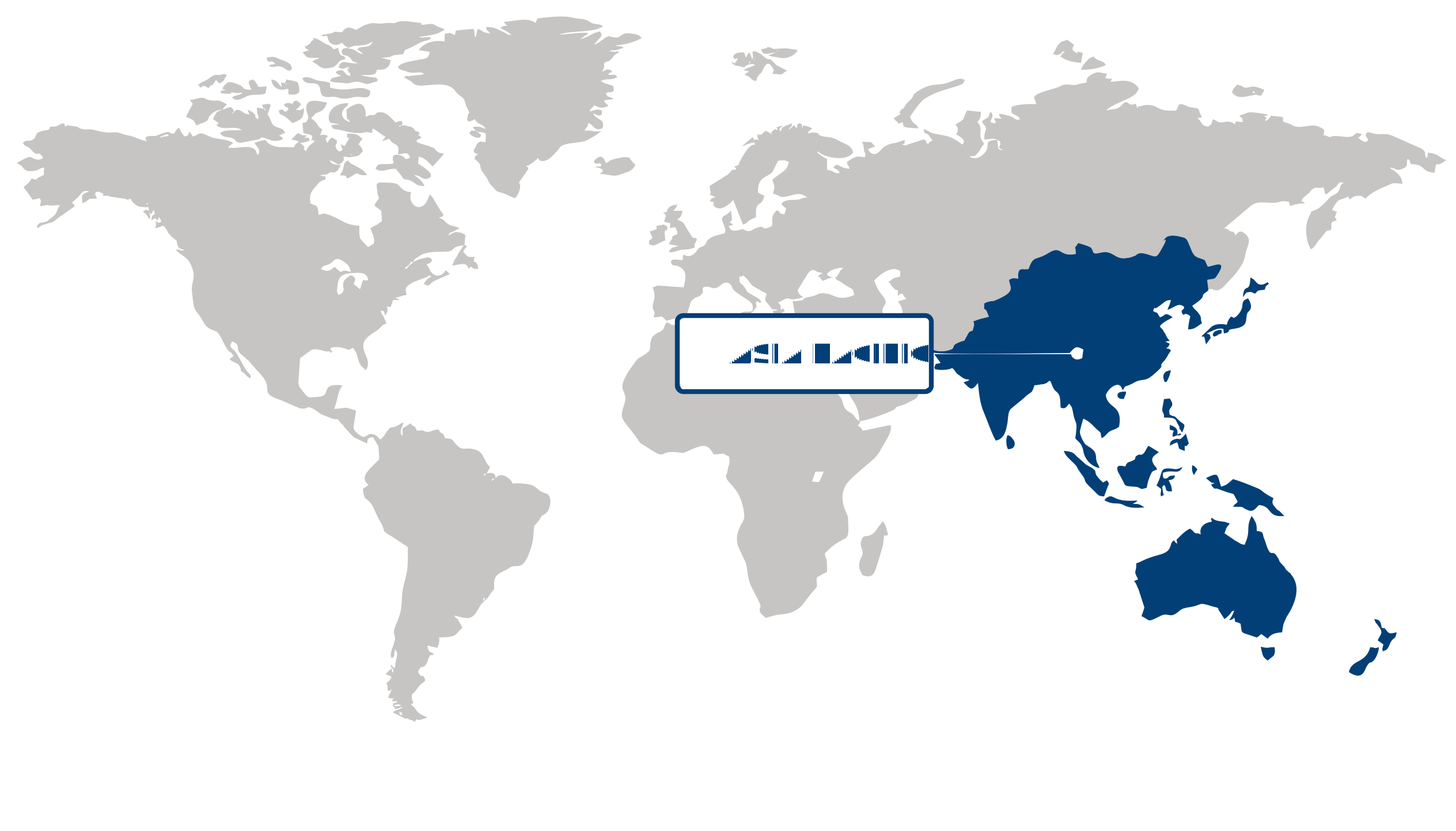
Asia Pacific (Largest Region)
In the soil stabilization market, Asia Pacific held the largest share of 39.22% in 2026, supported by rapid infrastructure development, urban expansion, and extensive construction activity across transportation, industrial, and commercial projects. Growing investment in roads, airports, rail networks, and urban infrastructure is increasing the need for techniques that improve soil strength, durability, and load-bearing performance. The region's varied soil conditions and challenging construction environments further encourage the use of stabilization solutions to improve project reliability. Increasing adoption of modern construction practices and greater focus on infrastructure resilience are also supporting demand across the region.
North America (Fastest-Growing Region)
North America is the fastest-growing region, driven by infrastructure modernization, road rehabilitation, and increasing emphasis on extending the service life of transportation assets. Soil stabilization technologies are being adopted to improve construction efficiency, manage weak or variable soil conditions, and reduce long-term maintenance requirements. Growing attention to sustainable construction practices is also encouraging the use of solutions that can optimize material consumption and improve project performance. Continued investment in transportation infrastructure and resilient construction methods is creating additional opportunities for soil stabilization technologies.
| Parameter | North America | Asia Pacific | Europe | Latin America | MEA |
|---|---|---|---|---|---|
| Innovation Hub i Scale Nascent Developing Advanced | |||||
| Cost-Sensitive Region i Scale Low Medium High | |||||
| Regulatory Environment i Scale Restrictive Neutral Supportive | |||||
| Demand Drivers i Scale Weak Moderate Strong | |||||
| Development Stage i Scale Emerging Developing Developed | |||||
| Adoption Rate i Scale Low Medium High | |||||
| New Entrants / Startups i Scale Sparse Moderate Dense | |||||
| Macro Indicators i Scale Weak Stable Strong |
Key Country Insights
Germany 🇩🇪
Sustainable Civil EngineeringGermany prioritizes soil stabilization methods that align with sustainable construction and stringent engineering standards. Demand is increasing for environmentally responsible additives and in-situ stabilization technologies that improve project efficiency while minimizing material consumption.
France 🇫🇷
Environmental Site ImprovementFrance applies soil stabilization to transportation, environmental remediation, and public infrastructure projects. Market participants increasingly prioritize low-emission stabilization materials and construction practices that comply with evolving environmental standards.
Italy 🇮🇹
Transport Corridor UpgradesItaly utilizes soil stabilization to strengthen roads, railways, and regional infrastructure exposed to varying ground conditions. Contractors are adopting flexible stabilization technologies that improve foundation reliability while optimizing project execution costs.
Japan 🇯🇵
Resilient Foundation EngineeringJapan emphasizes soil stabilization for seismic resilience, urban redevelopment, and transport infrastructure. The market favors reliable ground improvement technologies that enhance structural stability in space-constrained and geologically complex construction environments.
South Korea 🇰🇷
Urban Infrastructure ReinforcementSouth Korea is expanding the use of soil stabilization across highways, industrial developments, and smart city projects. Engineering firms are investing in efficient ground treatment solutions that support faster construction schedules and long-term infrastructure durability.
United States 🇺🇸
Infrastructure Ground SolutionsThe U.S. soil stabilization market is supported by transportation upgrades, energy projects, and resilient infrastructure development. Contractors are adopting advanced binders and geotechnical techniques to improve ground performance while reducing construction delays and maintenance requirements.
Segment Leadership and Growth Trends
Soil Stabilization Market Share (%), by Method, 2026
Go beyond the chart, access full insights & data tables
Request Free Sample ReportMethod Segment Analysis: Mechanical (Largest & Fastest-Growing Segment)
Mechanical stabilization dominated the soil stabilization market in 2026 and represented the fastest-growing method, reflecting its established role in improving soil strength and load-bearing characteristics through physical modification. Mechanical approaches can enhance soil performance through compaction, blending, grading, and other physical techniques without relying primarily on chemical treatment. Their applicability across infrastructure, construction, road development, and other ground-improvement activities supports widespread utilization. Increasing requirements for stable foundations and durable ground conditions continue to reinforce demand for effective mechanical stabilization methods.
Additive Segment Analysis: Mineral Stabilizing Agent (Largest Segment) vs Polymer (Fastest-Growing Segment)
Mineral stabilizing agents accounted for 60.8% share in the soil stabilization market in 2026, supported by their established application in improving soil properties for construction and infrastructure development. Mineral-based additives can enhance strength, stability, and workability by modifying the physical and engineering characteristics of soil. Their suitability for a broad range of ground conditions and established use in infrastructure projects contribute to their strong market position. Continued investment in durable roads, foundations, and other construction applications supports demand for mineral stabilizing agents.
Polymer additives are the fastest-growing segment as demand increases for soil stabilization approaches capable of delivering targeted performance improvements with greater application flexibility. Polymer-based solutions can improve soil cohesion, moisture resistance, erosion control, and structural stability, making them suitable for diverse ground-improvement requirements. Growing attention to efficient construction practices and the need for stabilization solutions adaptable to varying soil conditions are encouraging wider adoption of polymer additives across infrastructure and construction applications.
| Segment | Sub-Segment | Largest Segment | Fastest Growing |
|---|---|---|---|
| Method | Mechanical, Chemical | Mechanical | Mechanical |
| Additive | Polymer, Mineral Stabilizing Agent, Others | Mineral Stabilizing Agent | Polymer |
| Application | Industrial, Agricultural, Residential, Others | Industrial | Residential |
Competitive Landscape and Market Positioning
Prominent players in the soil stabilization market:
1. Caterpillar Inc. (United States)
2. Wirtgen Group (Germany)
3. FAYAT SAS (France)
4. Volvo Group (Sweden)
5. AggreBind Inc. (United States)
6. SNF Holding Company (United States)
7. Soilworks LLC (United States)
8. Sibelco NV (Belgium)
9. Adbri Limited (Australia)
10. AltaCrete Inc. (United States)
The soil stabilization market is advancing through improved construction material formulations and engineering techniques. Enhanced ground reinforcement solutions are supporting infrastructure durability. Innovation in binding agents is improving performance across diverse soil conditions. The soil stabilization market is increasingly focused on sustainable and efficient construction practices.
| Company | Market Share | Company Revenue | Revenue CAGR (%) | Product Portfolio | Geographic Presence | Innovation / R&D Focus | Strategic Developments |
|---|---|---|---|---|---|---|---|
| Caterpillar Inc. (United States) | |||||||
| Wirtgen Group (Germany) | |||||||
| FAYAT SAS (France) | |||||||
| Volvo Group (Sweden) | |||||||
| AggreBind Inc. (United States) | |||||||
| SNF Holding Company (United States) | |||||||
| Soilworks LLC (United States) | |||||||
| Sibelco NV (Belgium) | |||||||
| Adbri Limited (Australia) | |||||||
| AltaCrete Inc. (United States). |
Industry Development/News
| Company Name | Date | Key Development |
|---|---|---|
| Strata Geosystems | May-25 | Strata Geosystems is accelerating its geotechnical engineering strategy through the deployment of advanced geosynthetics, including geogrids and cellular confinement systems. By focusing on high-performance soil reinforcement for large-scale infrastructure, the company is strengthening its market position as a primary provider of sustainable, engineered ground-stability solutions for complex civil construction environments. |
| StableDry Services | Feb-25 | StableDry Services expanded its operational footprint and technical capabilities through the acquisition of United Structural Systems Ltd. and Foundation Services of Central Florida. This strategic consolidation strengthens the company’s structural repair and soil stabilization service offerings while significantly extending its regional market presence and competitive influence across Kentucky and Florida. |
| Standard Industries Company | Oct-23 | Standard Industries (SGI) acquired Panamint Valley Limestone (PVL), a move that integrates a strategic source of high-purity limestone into its supply chain. Given that mineral stabilizing agents are central to soil stabilization, this acquisition enhances the company’s ability to supply critical raw materials for soil conditioning and ground reinforcement across North American building materials markets. |
| AggreBind Inc. | Jan-23 | AggreBind Inc. established a formal presence in India, signaling a strategic intent to capture market share in one of the world's fastest-growing infrastructure sectors. This expansion focuses on deploying specialized soil stabilization and dust control technologies, addressing the rising demand for efficient, long-term ground reinforcement solutions required for rapid highway and industrial development projects in the region. |
Customize Your Report
Explore examples of how this report can be tailored to different research needs, including custom segments, additional topics or chapters, and related reports. Click a section of the wheel or its numbered marker to explore the available options.
Soil Stabilization Market — Custom Segments
| Segment | Sub-Segment |
|---|---|
| Soil Type | Cohesive Soils, Granular Soils, Expansive Soils, Organic and Peaty Soils |
| Project Type | Roads and Highways, Railways and Airports, Commercial and Industrial Infrastructure, Residential and Urban Development, Mining and Energy Infrastructure |
| Procurement Model | Public Infrastructure Procurement, Private Developer Procurement, Engineering-Procurement-Construction (EPC) Contracts, Direct Contractor Procurement |
Soil Stabilization Market — Custom TOC
| Custom Chapter | Custom Details |
|---|---|
| Infrastructure Project Demand Mapping |
|
| Sustainable Soil Stabilization Solutions Assessment |
|
| Soil Stabilization Technology Adoption Roadmap |
|
Need a different cut of the data?
Request Custom ResearchHow large is the soil stabilization market?
How is the soil stabilization industry expected to grow over the next 10 years?
How is large-scale infrastructure development driving demand for soil stabilization solutions?
What is driving the increasing adoption of eco-friendly stabilizing materials in soil stabilization projects?
Why is the Mechanical method the leading segment in the soil stabilization market?
Which additive segment is expanding the fastest in the soil stabilization market?
Why is Asia Pacific the largest regional market for soil stabilization?
What is supporting soil stabilization market growth in North America?
Who holds a significant market share in the soil stabilization landscape?
Our Clients
"Your insights on workforce structures were spot-on. The analysis on mid-to-senior level roles validated some of our hiring decisions and highlighted gaps."
Ateliers De France
"The report gave us insights on competitors in the market. It helped our team refine our bidding strategy for upcoming contracts."
Clark Construction
"The reports provided a deep dive into market trends, and competitive landscape. The strategic insights and recommendations have been very helpful."
Rudolph and Sletten
Our Research Team & Methodology
Every Fundamental Business Insights report is built by a dedicated vertical research team, validated through a structured primary-and-secondary methodology, and reviewed for accuracy before it reaches you.
Research Team Overview
Prepared by the Construction & Manufacturing Research Team
Delivery
Published
Demand
Available
Support
Trust & Compliance
Research Domains
10 coverage areasResearch Intelligence
| Source | Reference |
|---|---|
| International Organization for Standardization (ISO) | www.iso.org |
| ASTM International | www.astm.org |
| National Institute of Standards and Technology (NIST) | www.nist.gov |
| International Code Council (ICC) | www.iccsafe.org |
| American Concrete Institute (ACI) | www.concrete.org |
| American Institute of Steel Construction (AISC) | www.aisc.org |
| Construction Industry Institute (CII) | www.construction-institute.org |
| Associated General Contractors of America (AGC) | www.agc.org |
| Association of Equipment Manufacturers (AEM) | www.aem.org |
| Building Owners and Managers Association (BOMA) | www.boma.org |
| American Society of Civil Engineers (ASCE) | www.asce.org |
| National Ready Mixed Concrete Association (NRMCA) | www.nrmca.org |
| International Facility Management Association (IFMA) | www.ifma.org |
| World Green Building Council (WorldGBC) | worldgbc.org |
| International Federation of Consulting Engineers (FIDIC) | fidic.org |
| International Labour Organization (ILO) | www.ilo.org |
| American Society of Mechanical Engineers (ASME) | www.asme.org |
| Society of Manufacturing Engineers (SME) | www.sme.org |
| National Association of Home Builders (NAHB) | www.nahb.org |
| European Construction Industry Federation (FIEC) | www.fiec.eu |
Research Workflow & Quality Assurance
Data Collection
Verified information gathered through primary and secondary research.
Data Triangulation
Cross-validation using multiple independent data sources.
Forecast Modelling
Market estimates developed using historical trends and analytical models.
Analyst Validation
Findings reviewed by domain experts for accuracy and consistency.
Editorial & Quality Review
Final editorial, quality, and compliance checks before publication.
Final Publication
Released after successful completion of the internal review process.
Report Coverage
📊 Market Assessment
- Market Size & Forecast
- Market Segmentation
- Regional Analysis
- Growth Drivers & Challenges
- Market Dynamics
🏢 Competitive Intelligence
- Competitive Landscape
- Company Profiles
- Competitive Benchmarking
- Mergers & Acquisitions
- Market Share Analysis or Key Company Strategies
🔍 Strategic Analysis
- Value Chain Analysis
- Porter's Five Forces
- PESTLE Analysis
- Pricing Trends
- Supply-Demand Analysis
🚀 Future Outlook
- Technology Landscape
- Regulatory Landscape
- Investment & Funding Landscape
- Emerging Opportunities
- Future Market Outlook
Have a question about this report or need a custom scope?
Request Customization