Sodium Malate Market Size & Growth Forecast 2027–2036, By Segments (Grade, Form, Application), Regional Demand Trends (North America, Asia Pacific, Europe), Key Country Insights (U.S., Japan, South Korea, Germany, France, Italy), and Competitive Landscape
Market Size and Growth Outlook
Sodium Malate Market size was around USD 722.78 Million in 2026 and is slated to grow at 4.32% CAGR from 2027 to 2036, attaining USD 1.1 Billion by 2036. The industry revenue for 2027 is assessed at USD 748.8 Million.
Get more details on this report
Request Free Sample ReportSodium Malate Market Intelligence Snapshot
Regional Market Dynamics
- Asia Pacific leads through expanding food and beverage processing, packaged food consumption, manufacturing capacity, and growing applications across pharmaceutical and personal care sectors.
- North America is projected to grow fastest as food and beverage formulation innovation increases demand for specialized ingredients supporting flavor, stability, and functional attributes.
Segment Momentum
- The food & beverages segment holds the largest share due to sodium malate’s use as an acidity regulator, flavor enhancer, and formulation ingredient supporting product stability and quality.
- The pharmaceuticals segment is the fastest-growing application as demand rises for high-quality functional ingredients, innovative formulations, and improved formulation performance.
Market Expansion Drivers
- Expanding pharmaceutical applications increasing demand for malate-based compounds
- Rising consumer preference for organic and clean-label food additives
- Industrial application expansion across food preservation and chemical processing sectors
Leading Market Participants
- Prominent players in the sodium malate market include Cargill, Incorporated (United States), Tate & Lyle PLC (United Kingdom), Jungbunzlauer Suisse AG (Switzerland), Corbion N.V. (Netherlands), Fuso Chemical Co., Ltd. (Japan), Bartek Ingredients Inc. (Canada), Jost Chemical Co. (United States), Archer Daniels Midland Company (United States)
Global Market Forecast Snapshot
Market Outlook
- 2026 Market Size: USD 722.78 Million
- 2027 Estimated Market Size: USD 748.8 Million
- Projected Market Size: USD 1.1 Billion by 2036
- Growth Forecast: 4.32% CAGR (2027-2036)
Regional and Segment Outlook
- Leading Regional Market: Asia Pacific
- High-Growth Regional Hub: North America
- Core Revenue Segment: Pharmaceutical Grade (Grade) | Powdered (Form) | Food & Beverages (Application)
- Emerging Opportunity Segment: Pharmaceutical Grade (Grade) | Powdered (Form) | Pharmaceuticals (Application)
Market Growth Drivers and Industry Trends
Expanding pharmaceutical applications increasing demand for malate-based compounds
The pharmaceutical industry continues to explore multifunctional ingredients that support formulation stability, compatibility, and product performance across a variety of therapeutic applications. The sodium malate market growth is driven by expanding pharmaceutical applications, where malate-based compounds are increasingly utilized in formulations requiring reliable functional characteristics and high-quality ingredient standards. Ongoing development of advanced pharmaceutical products is also encouraging manufacturers to source ingredients that meet stringent regulatory and quality expectations while supporting efficient production processes.
Rising consumer preference for organic and clean-label food additives
Consumers are becoming more attentive to ingredient transparency, prompting food manufacturers to prioritize formulations that align with clean-label expectations and naturally inspired product positioning. Rising preference for organic and clean-label food additives will propel the sodium malate market growth as producers seek ingredients that contribute desired functional properties while supporting simpler ingredient declarations. This shift is encouraging greater innovation in food and beverage formulations, particularly among manufacturers aiming to satisfy evolving consumer expectations regarding product quality, authenticity, and ingredient sourcing.
Industrial application expansion across food preservation and chemical processing sectors
Broader industrial utilization of multifunctional ingredients is creating new opportunities across food manufacturing and specialty chemical production. Expanding applications in these industries will boost the sodium malate market demand by increasing the use of sodium malate in preservation processes, acidity regulation, and chemical formulations requiring consistent functional performance. Its versatility allows manufacturers to address diverse processing requirements while maintaining product stability and operational efficiency across multiple industrial production environments.
| Growth Driver | Impact on CAGR | Regulatory Influence | Geographic Relevance | Adoption Rate | Impact Timeline |
|---|---|---|---|---|---|
| Expanding pharmaceutical applications increasing demand for malate-based compounds | 2% | High | North America, Europe | Medium | Mid Term |
| Rising consumer preference for organic and clean-label food additives | 1.7% | Moderate | Asia Pacific, North America | High | Near Term |
| Industrial application expansion across food preservation and chemical processing sectors | 1.5% | Low | Europe, Asia Pacific | Medium | Mid Term |
Unlock insights tailored to your business with our bespoke market research solutions.
Click to get your customized report now.
Regional Demand Dynamics
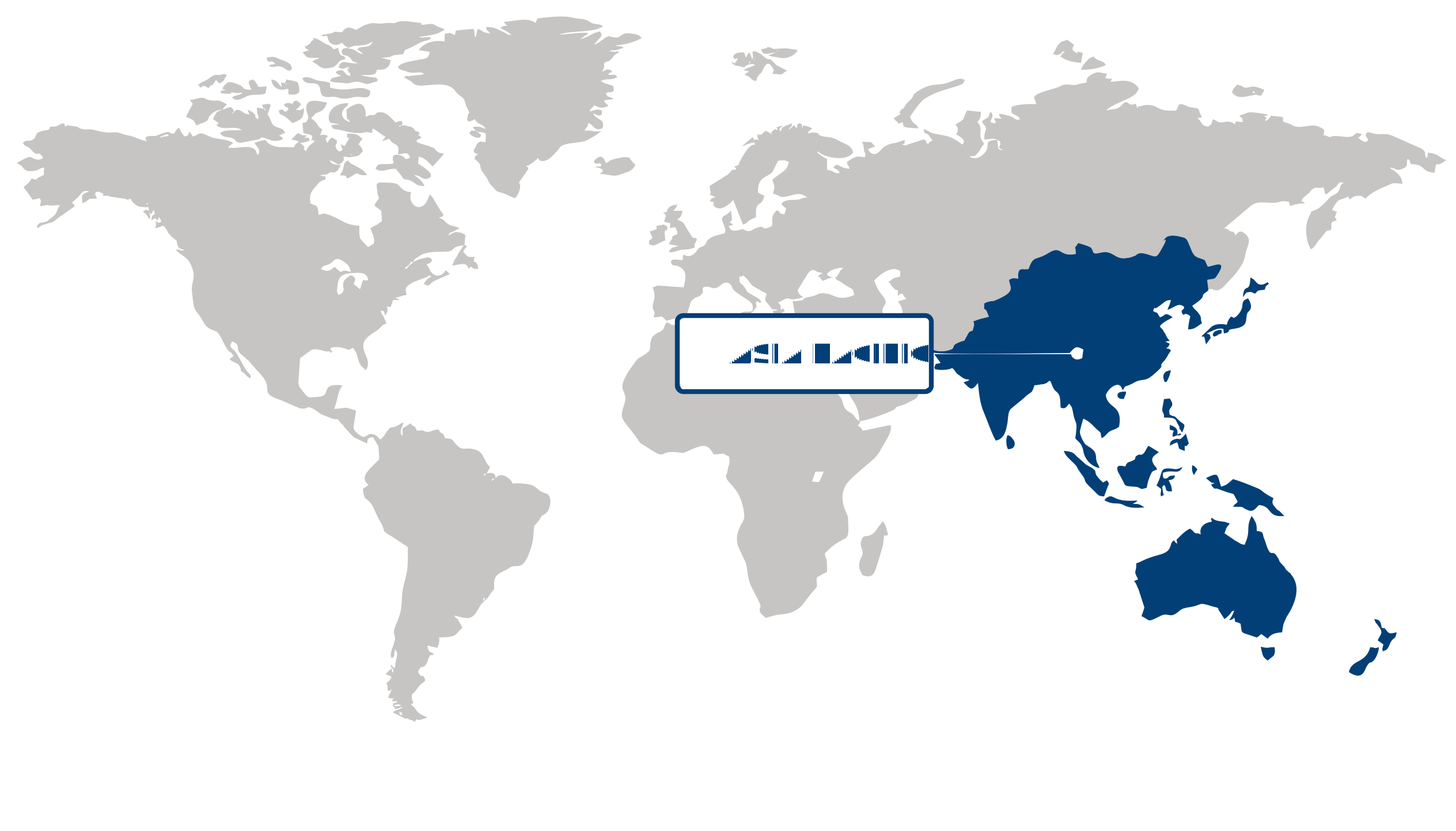
Asia Pacific (Largest Region)
The sodium malate market was led by Asia Pacific in 2026, supported by the region's expanding food and beverage processing industry and growing demand for functional and specialty ingredients. Sodium malate is used in applications requiring acidity regulation, flavor enhancement, and formulation stability, making it relevant to a broad range of processed food and beverage products. Rising urbanization, changing dietary preferences, and the expansion of packaged food consumption are creating favorable conditions for ingredient demand. The region's growing manufacturing capabilities and expanding pharmaceutical and personal care sectors are also broadening potential applications, while increasing investment in food processing infrastructure is strengthening the regional market base.
North America (Fastest-Growing Region)
North America is expected to represent the fastest-growing regional market, encouraged by continued innovation in food and beverage formulations and rising consumer interest in products with distinctive flavor profiles and functional attributes. Manufacturers are increasingly seeking specialized ingredients that can support product stability, taste optimization, and formulation efficiency. Demand from processed foods, beverages, dietary products, and pharmaceutical applications is creating additional opportunities for sodium malate suppliers. A well-developed food processing ecosystem and growing emphasis on formulation innovation are expected to support wider adoption across the region.
| Parameter | North America | Asia Pacific | Europe | Latin America | MEA |
|---|---|---|---|---|---|
| Innovation Hub i Scale Nascent Developing Advanced | |||||
| Cost-Sensitive Region i Scale Low Medium High | |||||
| Regulatory Environment i Scale Restrictive Neutral Supportive | |||||
| Demand Drivers i Scale Weak Moderate Strong | |||||
| Development Stage i Scale Emerging Developing Developed | |||||
| Adoption Rate i Scale Low Medium High | |||||
| New Entrants / Startups i Scale Sparse Moderate Dense | |||||
| Macro Indicators i Scale Weak Stable Strong |
Key Country Insights
United States 🇺🇸
Functional Ingredient DemandThe U.S. sodium malate market is supported by demand for flavor enhancement and acidity regulation in processed foods and beverages. Manufacturers increasingly develop clean-label formulations and functional products where sodium malate contributes to taste optimization and product stability.
Germany 🇩🇪
Precision Formulation HubGermany emphasizes consistent ingredient quality for sodium malate applications across food processing and specialty formulations. Domestic manufacturers focus on reliable sourcing, formulation precision, and regulatory compliance to serve premium beverage, confectionery, and processed food segments.
Japan 🇯🇵
Premium Food ApplicationsJapan utilizes sodium malate in premium food and beverage formulations requiring balanced acidity and refined flavor profiles. Producers prioritize ingredient consistency, product quality, and compatibility with innovative formulations developed for convenience foods and specialty beverages.
South Korea 🇰🇷
Beverage Innovation SupportSouth Korea incorporates sodium malate into innovative beverage and processed food formulations that emphasize flavor differentiation. Food manufacturers continue introducing functional drinks and convenience products where ingredient performance and formulation flexibility remain commercial priorities.
France 🇫🇷
Specialty Food IngredientFrance applies sodium malate across specialty foods, confectionery, and beverage formulations requiring controlled acidity and flavor balance. Ingredient suppliers focus on quality assurance and formulation compatibility to support premium food manufacturing and evolving consumer preferences.
Italy 🇮🇹
Processed Food EnhancementItaly integrates sodium malate into processed foods and beverage applications where flavor consistency and shelf-life performance are important. Food manufacturers increasingly evaluate ingredient functionality alongside evolving formulation standards and consumer expectations for product quality.
Segment Leadership and Growth Trends
Sodium Malate Market Share (%), by Grade, 2026
Go beyond the chart, access full insights & data tables
Request Free Sample ReportGrade Segment Analysis: Pharmaceutical Grade (Largest & Fastest-Growing Segment)
The sodium malate market was led by the pharmaceutical grade segment, which accounted for 43.57% in 2026, while also emerging as the fastest-growing grade. Pharmaceutical-grade sodium malate is widely utilized in formulations requiring high purity, consistency, and stringent quality standards. Increasing demand for high-quality pharmaceutical ingredients, expanding healthcare applications, and continued emphasis on regulatory compliance have strengthened the segment's leadership. Growing investment in pharmaceutical manufacturing and the development of advanced formulations are expected to sustain its strong growth momentum.
Form Segment Analysis: Powdered (Largest & Fastest-Growing Segment)
The powdered segment dominated the sodium malate market, holding a 47.7% share in 2026, while also representing the fastest-growing form. Powdered sodium malate is preferred because of its superior stability, longer shelf life, ease of storage, and compatibility with a broad range of food, pharmaceutical, and industrial formulations. Manufacturers benefit from simplified handling, precise dosing, and efficient transportation, making powdered products suitable for large-scale commercial applications. Continued expansion of end-use industries and increasing demand for versatile ingredient formats are expected to reinforce the segment's market leadership.
Application Segment Analysis: Food & Beverages (Largest Segment) vs Pharmaceuticals (Fastest-Growing Segment)
The food & beverages segment held the largest share in 2026 due to extensive use of sodium malate as an acidity regulator, flavor enhancer, and formulation ingredient across processed foods and beverage products. Its ability to improve taste profiles, maintain product stability, and support consistent quality makes it a valuable ingredient for manufacturers. Growing demand for processed and convenience foods has further contributed to the segment's dominant market position.
The pharmaceuticals segment is expected to witness the fastest growth in the sodium malate market as the compound gains wider application in pharmaceutical formulations requiring high-quality functional ingredients. Increasing healthcare expenditure, expanding pharmaceutical production, and continuous development of innovative drug formulations are encouraging greater utilization of sodium malate. Rising focus on product quality and formulation performance is expected to further support growth within this application segment.
| Segment | Sub-Segment | Largest Segment | Fastest Growing |
|---|---|---|---|
| Grade | Pharmaceutical Grade, Food Grade, Industrial Grade | Pharmaceutical Grade | Pharmaceutical Grade |
| Form | Powdered, Liquid, Granular | Powdered | Powdered |
| Application | Food & Beverages, Pharmaceuticals, Personal Care & Cosmetics, Industrial Applications | Food & Beverages | Pharmaceuticals |
Competitive Landscape and Market Positioning
Prominent players in the sodium malate market:
- Cargill Incorporated (United States)
- Tate & Lyle PLC (United Kingdom)
- Jungbunzlauer Suisse AG (Switzerland)
- Corbion N.V. (Netherlands)
- Fuso Chemical Co., Ltd. (Japan)
- Bartek Ingredients, Inc. (Canada)
- Jost Chemical Co. (United States)
- Archer Daniels Midland Company (United States)
The sodium malate market is evolving as suppliers compete on application versatility, production consistency, and the ability to meet specialized requirements across food, pharmaceutical, and industrial uses. Producers are placing greater attention on quality assurance and formulation support as customers increasingly seek reliable functional ingredients rather than basic chemical supply. Competitive differentiation is emerging through process expertise and the capacity to adapt offerings to changing end-user preferences and regulatory expectations.
| Company | Market Share | Company Revenue | Revenue CAGR (%) | Product Portfolio | Geographic Presence | Innovation / R&D Focus | Strategic Developments |
|---|---|---|---|---|---|---|---|
| Cargill Incorporated (United States) | |||||||
| Tate & Lyle PLC (United Kingdom) | |||||||
| Jungbunzlauer Suisse AG (Switzerland) | |||||||
| Corbion N.V. (Netherlands) | |||||||
| Fuso Chemical Co. Ltd. (Japan) | |||||||
| Bartek Ingredients Inc. (Canada) | |||||||
| Jost Chemical Co. (United States) | |||||||
| Archer Daniels Midland Company (United States) |
Industry Development/News
| Company Name | Date | Key Development |
|---|
Customize Your Report
Explore examples of how this report can be tailored to different research needs, including custom segments, additional topics or chapters, and related reports. Click a section of the wheel or its numbered marker to explore the available options.
Sodium Malate Market — Custom Segments
| Segment | Sub-Segment |
|---|---|
| Buyer Type | Food & Beverage Manufacturers, Pharmaceutical Manufacturers, Personal Care & Cosmetics Manufacturers, Industrial Manufacturers |
| Distribution Channel | Direct Sales, Distributors & Wholesalers, Online B2B Channels |
| Packaging Type | Bags & Sacks, Drums & Barrels, Totes & Bulk Containers |
Sodium Malate Market — Custom TOC
| Custom Chapter | Custom Details |
|---|---|
| End-Use Formulation Opportunity Mapping |
|
| Customer Switching and Procurement Dynamics |
|
| Sustainability and Bio-Based Sourcing Outlook |
|
Need a different cut of the data?
Request Custom ResearchHow much revenue does the sodium malate market generate?
How much is the sodium malate industry expected to grow by 2036?
Which industry trends are driving demand in the sodium malate market?
How are clean-label preferences influencing the sodium malate market?
Why does the food & beverages segment lead the sodium malate market?
How is the pharmaceuticals segment gaining growth momentum in the sodium malate market?
What is driving Asia Pacific’s leadership in the sodium malate market?
Why is North America expected to be the fastest-growing sodium malate market?
What are the prominent companies operating in the sodium malate landscape?
Our Clients
"The report helped us understand emerging consumer trends in our product category. It clarified where to focus innovation for the next product launch."
LyondellBasell
"The regional forecast section was incredibly useful. We were able to identify two new potential partners in Europe thanks to the vendor mapping you included."
SABIC
"We appreciated how actionable the recommendations were. It guided us to improve supply chain resilience."
Olin Corporation
Our Research Team & Methodology
Every Fundamental Business Insights report is built by a dedicated vertical research team, validated through a structured primary-and-secondary methodology, and reviewed for accuracy before it reaches you.
Research Team Overview
Prepared by the Chemicals & Materials Research Team
Delivery
Published
Demand
Available
Support
Trust & Compliance
Research Domains
10 coverage areasResearch Intelligence
| Source | Reference |
|---|---|
| American Chemistry Council (ACC) | www.americanchemistry.com |
| European Chemical Industry Council (Cefic) | cefic.org |
| International Council of Chemical Associations (ICCA) | icca-chem.org |
| European Chemicals Agency (ECHA) | echa.europa.eu |
| U.S. Environmental Protection Agency (EPA) | www.epa.gov |
| ASTM International | www.astm.org |
| International Organization for Standardization (ISO) | www.iso.org |
| National Institute of Standards and Technology (NIST) | www.nist.gov |
| Plastics Industry Association (PLASTICS) | www.plasticsindustry.org |
| European Biplastics | www.european-bioplastics.org |
| The Adhesive and Sealant Council (ASC) | www.ascouncil.org |
| National Association of Corrosion Engineers (AMPP) | www.ampp.org |
| Society of Plastics Engineers (SPE) | www.4spe.org |
| International Fertilizer Association (IFA) | www.fertilizer.org |
| CropLife International | croplife.org |
| Packaging Europe | packagingeurope.com |
| Flexible Packaging Association (FPA) | www.flexpack.org |
| Battery Council International (BCI) | batterycouncil.org |
| International Copper Association (ICA) | internationalcopper.org |
| World Steel Association | worldsteel.org |
Research Workflow & Quality Assurance
Data Collection
Verified information gathered through primary and secondary research.
Data Triangulation
Cross-validation using multiple independent data sources.
Forecast Modelling
Market estimates developed using historical trends and analytical models.
Analyst Validation
Findings reviewed by domain experts for accuracy and consistency.
Editorial & Quality Review
Final editorial, quality, and compliance checks before publication.
Final Publication
Released after successful completion of the internal review process.
Report Coverage
📊 Market Assessment
- Market Size & Forecast
- Market Segmentation
- Regional Analysis
- Growth Drivers & Challenges
- Market Dynamics
🏢 Competitive Intelligence
- Competitive Landscape
- Company Profiles
- Competitive Benchmarking
- Mergers & Acquisitions
- Market Share Analysis or Key Company Strategies
🔍 Strategic Analysis
- Value Chain Analysis
- Porter's Five Forces
- PESTLE Analysis
- Pricing Trends
- Supply-Demand Analysis
🚀 Future Outlook
- Technology Landscape
- Regulatory Landscape
- Investment & Funding Landscape
- Emerging Opportunities
- Future Market Outlook
Have a question about this report or need a custom scope?
Request Customization