Sodium Ion Battery Market Size & Growth Forecast 2027–2036, By Segments (Technology, End Use), Regional Demand Trends (North America, Asia Pacific, Europe), Key Country Insights (U.S., Japan, South Korea, Germany, France, Italy), and Competitive Landscape
Market Size and Growth Outlook
Sodium Ion Battery Market size was worth USD 403.24 Million in 2026 and is expected to grow at 26.62% CAGR between 2027 and 2036, surpassing USD 4.27 Billion by 2036. The industry revenue for 2027 is estimated at USD 497.96 Million.
Get more details on this report
Request Free Sample ReportSodium Ion Battery Market Intelligence Snapshot
Regional Market Dynamics
- Asia Pacific held a 44.52% share in 2026, supported by strong battery manufacturing, energy-storage demand, and its extensive electronics and electric mobility ecosystem.
- Renewable energy deployment, battery infrastructure investment, research activity, and electrification initiatives are accelerating commercialization across storage, mobility, and other applications.
Segment Momentum
- Energy storage accounted for 83.01% of the market in 2026, driven by demand for cost-conscious, scalable storage solutions that support renewable energy integration, grid modernization, and distributed energy infrastructure.
- Automotive is the fastest-growing end-use segment as manufacturers explore sodium-ion batteries to improve cost efficiency, strengthen supply-chain resilience, and diversify battery technologies for electric mobility applications.
Market Expansion Drivers
- Abundant raw material availability reducing cost barriers for battery scaling
- Strong R&D investment accelerating sodium ion performance commercialization
- Grid-scale energy storage demand increasing alternative battery chemistry adoption
Leading Market Participants
- Major players in the sodium ion battery market include CATL (Contemporary Amperex Technology Co. Limited) (China), Farasis Energy (Germany) GmbH (Germany), Northvolt AB (Sweden), Natron Energy, Inc. (United States), HiNa Battery Technology Co., Ltd. (China), Faradion Limited (United Kingdom), SVOLT Energy Technology Co., Ltd. (China), Altris AB (Sweden), Tiamat Energy (France), China BAK Battery, Inc. (China)
Global Market Forecast Snapshot
Market Outlook
- 2026 Market Size: USD 403.24 Million
- 2027 Estimated Market Size: USD 497.96 Million
- Projected Market Size: USD 4.27 Billion by 2036
- Growth Forecast: 26.62% CAGR (2027-2036)
Regional and Segment Outlook
- Leading Regional Market: Asia Pacific
- High-Growth Regional Hub: Asia Pacific
- Core Revenue Segment: Non Aqueous (Technology) | Energy Storage (End Use)
- Emerging Opportunity Segment: Non Aqueous (Technology) | Automotive (End Use)
Market Growth Drivers and Industry Trends
Abundant raw material availability reducing cost barriers for battery scaling
The availability of widely accessible sodium resources is creating opportunities to reduce dependence on constrained battery materials and improve supply chain resilience. The sodium ion battery market will benefit from manufacturers exploring alternative chemistries that use more readily available inputs while addressing cost pressures associated with large-scale energy storage deployment. This material advantage supports broader commercialization efforts by enabling battery producers to evaluate more economical solutions for applications where cost and resource security are critical.
Strong R&D investment accelerating sodium ion performance commercialization
Continuous research efforts are improving energy density, charging capabilities, cycle life, and overall reliability of sodium-based battery technologies. The sodium ion battery market growth is supported by innovation programs focused on overcoming historical performance limitations and adapting the chemistry for commercial applications. Advancements in electrode materials, cell design, and manufacturing processes are helping developers create solutions that can compete more effectively with established battery technologies.
Grid-scale energy storage demand increasing alternative battery chemistry adoption
Growing requirements for reliable energy storage systems are encouraging utilities and energy providers to explore battery technologies beyond conventional chemistries. Rising demand for large-scale storage will propel the sodium ion battery market as sodium-based systems offer potential advantages for stationary applications requiring cost efficiency and long-duration operation. Increasing integration of renewable energy sources further strengthens interest in alternative battery solutions capable of supporting grid stability and energy management.
| Growth Driver | Impact on CAGR | Regulatory Influence | Geographic Relevance | Adoption Rate | Impact Timeline |
|---|---|---|---|---|---|
| Abundant raw material availability reducing cost barriers for battery scaling | 2% | Low | Asia Pacific | High | Mid Term |
| Strong R&D investment accelerating sodium ion performance commercialization | 1.8% | Moderate | North America, Europe | Emerging | Mid Term |
| Grid-scale energy storage demand increasing alternative battery chemistry adoption | 1.5% | Moderate | Asia Pacific, Europe | Emerging | Long Term |
Unlock insights tailored to your business with our bespoke market research solutions.
Click to get your customized report now.
Regional Demand Dynamics
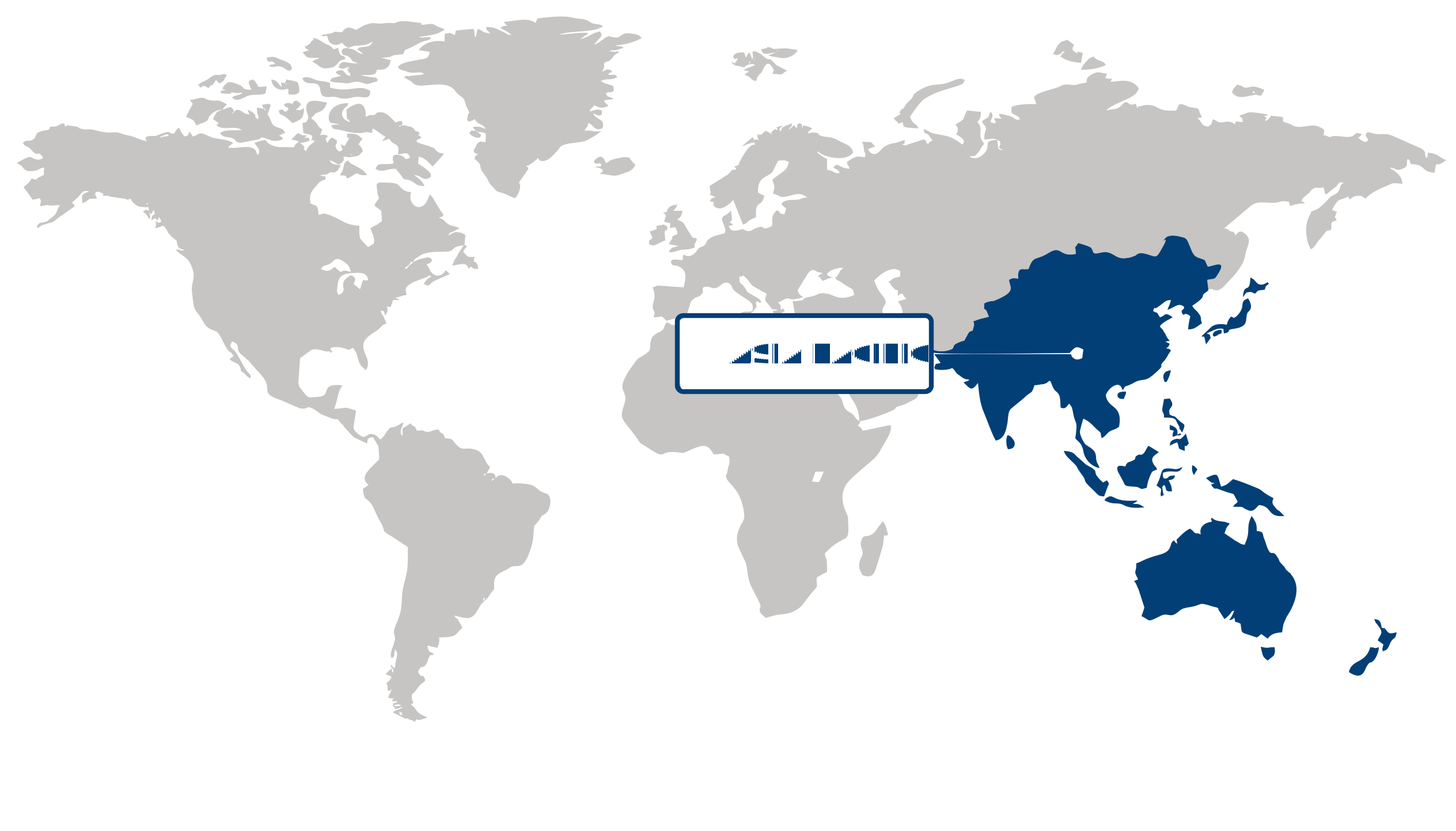
Asia Pacific (Largest & Fastest-Growing Region)
Asia Pacific dominated the sodium ion battery market with a share of 44.52% in 2026 and is also positioned as the fastest-growing region, supported by strong battery manufacturing capabilities, expanding energy-storage requirements, and increasing efforts to diversify battery chemistries. The region's extensive electronics and electric mobility ecosystem provides a strong foundation for scaling sodium-ion technologies, while the wider availability of sodium compared with certain critical battery materials enhances their strategic appeal for cost-sensitive energy-storage applications. Growing renewable energy deployment is also creating demand for storage technologies capable of supporting grid flexibility and balancing intermittent power generation. In addition, ongoing investments in battery research, manufacturing infrastructure, and electrification initiatives are expected to accelerate the commercialization and adoption of sodium-ion batteries across stationary storage, mobility, and other applications.
| Parameter | North America | Asia Pacific | Europe | Latin America | MEA |
|---|---|---|---|---|---|
| Innovation Hub i Scale Nascent Developing Advanced | |||||
| Cost-Sensitive Region i Scale Low Medium High | |||||
| Regulatory Environment i Scale Restrictive Neutral Supportive | |||||
| Demand Drivers i Scale Weak Moderate Strong | |||||
| Development Stage i Scale Emerging Developing Developed | |||||
| Adoption Rate i Scale Low Medium High | |||||
| New Entrants / Startups i Scale Sparse Moderate Dense | |||||
| Macro Indicators i Scale Weak Stable Strong |
Key Country Insights
United States 🇺🇸
Grid Storage DevelopmentThe U.S. is advancing sodium ion battery deployment for stationary energy storage where cost efficiency and material availability are key priorities. Companies are evaluating scalable manufacturing and domestic supply chains to complement existing battery technologies.
Germany 🇩🇪
Industrial Battery DiversificationGermany is integrating sodium ion battery development into broader battery manufacturing strategies focused on reducing dependence on critical minerals. Research and industrial partnerships are accelerating commercialization for energy storage and selected mobility applications.
Japan 🇯🇵
Material Innovation FocusJapan is concentrating on advanced material research to improve sodium ion battery performance and production efficiency. Companies are pursuing reliable cell designs that complement established battery technologies across industrial and energy storage applications.
South Korea 🇰🇷
Cell Manufacturing ExpansionSouth Korea is leveraging its battery manufacturing expertise to evaluate sodium ion technologies for cost-sensitive applications. Producers are optimizing cell production processes while exploring opportunities in stationary storage and commercial energy systems.
France 🇫🇷
Energy Storage IntegrationFrance is encouraging sodium ion battery adoption for renewable energy integration and grid resilience projects. Market participants are prioritizing scalable storage systems, localized manufacturing capabilities, and technologies that support diversified energy infrastructure.
Italy 🇮🇹
Renewable Storage AlignmentItaly is assessing sodium ion battery solutions to strengthen renewable energy storage capacity and improve energy flexibility. Developers are focusing on practical deployment models that balance affordability, reliability, and compatibility with evolving power systems.
Segment Leadership and Growth Trends
Sodium Ion Battery Market Share (%), by Technology, 2026
Go beyond the chart, access full insights & data tables
Request Free Sample ReportTechnology Segment Analysis: Non Aqueous (Largest & Fastest-Growing Segment)
Non aqueous segment dominated the sodium ion battery market and accounted for the largest market share of 75.07% in 2026, while also representing the fastest-growing technology segment. Non-aqueous electrolytes generally support higher electrochemical performance and enable broader operating capabilities, making them well suited to the development of advanced sodium-ion battery systems. The technology is gaining attention as manufacturers and researchers seek alternatives to conventional battery chemistries that can provide reliable energy storage while benefiting from the wider availability of sodium-based materials. Continued innovation in cell design, electrolyte formulation, and battery performance is expected to strengthen the adoption of non-aqueous technology across emerging sodium-ion battery applications.
End Use Segment Analysis: Energy Storage (Largest Segment) vs Automotive (Fastest-Growing Segment)
Energy storage segment held the largest share of the sodium ion battery market, accounting for 83.01% in 2026. Sodium-ion batteries are well suited for stationary energy storage because sodium is widely available and the technology offers potential advantages for applications requiring cost-conscious and scalable storage solutions. Growing integration of renewable energy sources is increasing the need for systems capable of storing electricity and balancing fluctuations in power generation. In addition, the expansion of grid modernization and distributed energy infrastructure is creating broader opportunities for alternative battery technologies, supporting the strong position of energy storage applications.
Automotive segment is anticipated to register the fastest growth over the forecast period. Increasing efforts to diversify battery technologies and reduce dependence on constrained raw materials are encouraging interest in sodium-ion solutions for electric mobility. The technology is particularly gaining attention for vehicle applications where cost efficiency, supply-chain resilience, and dependable battery performance are important considerations. As electric vehicle manufacturers continue evaluating alternative chemistries for different vehicle categories and operating requirements, growing technological development and improving battery system capabilities are expected to accelerate the adoption of sodium-ion batteries in automotive applications.
| Segment | Sub-Segment | Largest Segment | Fastest Growing |
|---|---|---|---|
| Technology | Aqueous, Non Aqueous | Non Aqueous | Non Aqueous |
| End Use | Automotive, Energy Storage, Others | Energy Storage | Automotive |
Competitive Landscape and Market Positioning
Leading companies in the sodium ion battery market:
- CATL (Contemporary Amperex Technology Co. Limited) (China)
- Farasis Energy (Germany) GmbH (Germany)
- Northvolt AB (Sweden)
- Natron Energy, Inc. (United States)
- HiNa Battery Technology Co., Ltd. (China)
- Faradion Limited (United Kingdom)
- SVOLT Energy Technology Co., Ltd. (China)
- Altris AB (Sweden)
- Tiamat Energy (France)
- China BAK Battery, Inc. (China)
The sodium ion battery market is evolving around efforts to establish a viable alternative battery technology that can address supply chain resilience, material availability, and cost pressures associated with conventional energy storage solutions. Competitive positioning is increasingly influenced by advancements in cell performance, manufacturing scalability, and integration across applications where resource availability and sustainability considerations are important. As the technology moves toward broader commercialization, participants are differentiating through improvements in energy efficiency, production processes, and application-specific designs rather than relying solely on material advantages.
| Company | Market Share | Company Revenue | Revenue CAGR (%) | Product Portfolio | Geographic Presence | Innovation / R&D Focus | Strategic Developments |
|---|---|---|---|---|---|---|---|
| CATL (Contemporary Amperex Technology Co. Limited) (China) | |||||||
| Farasis Energy (Germany) GmbH (Germany) | |||||||
| Northvolt AB (Sweden) | |||||||
| Natron Energy Inc. (United States) | |||||||
| HiNa Battery Technology Co. Ltd. (China) | |||||||
| Faradion Limited (United Kingdom) | |||||||
| SVOLT Energy Technology Co. Ltd. (China) | |||||||
| Altris AB (Sweden) | |||||||
| Tiamat Energy (France) | |||||||
| China BAK Battery Inc. (China) |
Industry Development/News
| Company Name | Date | Key Development |
|---|---|---|
| Guangde Qingna Technology Co., Ltd. | Nov-25 | Guangde Qingna Technology Co., Ltd. executed an agreement to establish a major 20 GWh sodium-ion battery manufacturing facility in Suining Economic and Technological Development Zone, Sichuan Province. The project represents a substantial expansion in gigawatt-scale production capacity, supporting the commercial scalability of sodium-ion technology across energy storage and mobility sectors in China. |
| CATL | Oct-24 | Contemporary Amperex Technology Co., Ltd. introduced the Freevoy Super Hybrid Battery, combining sodium-ion and lithium-ion technologies into a single battery architecture for EREVs and PHEVs. The innovation provides ultra-fast 4C charging and a pure electric range exceeding 400 km, enhancing low-temperature performance and expanding dual-chemistry adoption in passenger electric vehicles. |
| Jiangsu Zoolnasm Energy Technology Co. Ltd. | Sep-24 | Jiangsu Zoolnasm Energy Technology Co. Ltd. partnered with Suzhou Jiaofa Baige Digital Energy Technology to launch Suzhou's first sodium-ion battery charging and swapping demonstration project. Utilizing sodium iron sulfate battery technology and AIoT-connected swapping cabinets, the initiative establishes commercial validation for two-wheeled urban micro-mobility and swapping network infrastructure. |
| Stora Enso | Jun-24 | Stora Enso partnered with Swedish battery developer Altris to adapt Lignode, a renewable hard carbon material derived from lignin, for use as an anode in sodium-ion battery cells. The collaboration strengthens the sustainable raw material supply chain by replacing traditional synthetic anodes with bio-based alternatives tailored for sodium-ion cell manufacturing. |
| Altris | May-24 | Altris signed a Joint Development Agreement with Clarios to create complete sodium-ion battery systems for low-voltage mobility applications. Under the partnership, Altris develops high-performance sodium-ion cells while Clarios provides battery management systems, software, and system integration expertise, driving sodium-ion commercialization across automotive low-voltage electrical architectures. |
| Natron Energy | Apr-24 | Natron Energy initiated commercial-scale production of sodium-ion batteries at its upgraded facility in Holland, Michigan, achieving an annual capacity of 600 megawatts. Backed by over USD 40 million in facility investments, this milestone establishes domestic US manufacturing capability for high-power, fast-charging sodium-ion cells targeting data centers, industrial mobility, and telecom infrastructure. |
| Sodion Energy | Feb-24 | Sodion Energy introduced India's first commercially available sodium-ion battery technology, offering a versatile energy storage solution designed for electric vehicles and home appliances. The release marks an important step toward establishing localized, lithium-free energy storage alternatives in high-growth emerging markets facing supply chain and raw material cost constraints. |
| JAC Group | Jan-24 | JAC Group launched China's first mass-produced electric vehicle powered by sodium-ion batteries under its Yiwei brand, utilizing cylindrical sodium-ion cells supplied by HiNa Battery Technology. The commercial vehicle deployment marks a critical milestone in proving the real-world operational viability and cost-competitiveness of sodium-ion chemistries in passenger automotive applications. |
| Northvolt | Nov-23 | Northvolt announced a major technological breakthrough in sodium-ion battery development, reaching an energy density of 160 watt-hours per kilogram. This achievement brings non-lithium battery chemistries closer to energy density parity with lithium iron phosphate (LFP) cells, creating a commercially viable, sustainable alternative for energy storage systems and regional transportation networks. |
| HiNa Battery Technology | Dec-22 | HiNa Battery Technology inaugurated a gigawatt-hour scale production line for sodium-ion batteries, launched a comprehensive product portfolio, and demonstrated an electric vehicle prototype. This achievement transitioned sodium-ion technology from laboratory development into commercial-scale manufacturing, positioning the Chinese Academy of Sciences spin-off as a pioneer in mass-market battery commercialization. |
Customize Your Report
Explore examples of how this report can be tailored to different research needs, including custom segments, additional topics or chapters, and related reports. Click a section of the wheel or its numbered marker to explore the available options.
Sodium Ion Battery Market — Custom Segments
| Segment | Sub-Segment |
|---|---|
| Cell Format | Cylindrical, Prismatic, Pouch |
| Energy Density | Below 100 Wh/kg, 100–150 Wh/kg, Above 150 Wh/kg |
| Charging Speed | Standard Charging, Fast Charging, Ultra-Fast Charging |
Sodium Ion Battery Market — Custom TOC
| Custom Chapter | Custom Details |
|---|---|
| Stationary Storage Adoption Roadmap |
|
| Sodium-Ion vs. Lithium-Ion Economics |
|
| Cell Manufacturing Scale-Up Readiness |
|
Need a different cut of the data?
Request Custom ResearchWhat is the market size of sodium ion battery?
How will the sodium ion battery industry grow in terms of size and CAGR by 2036?
Why are sodium ion batteries gaining strategic interest for large-scale energy storage?
How is research and development accelerating commercialization of sodium ion batteries?
Why is energy storage the largest end-use segment in the sodium ion battery market?
Which end-use segment is expected to grow the fastest in the sodium ion battery market?
Why does Asia Pacific lead the sodium ion battery market?
What is driving the fastest growth of sodium ion batteries in Asia Pacific?
Which organizations are considered leaders in the sodium ion battery landscape?
Our Clients
"The information presented in the report was genuinely insightful. The data was clear and easy to understand, which made it much easier to interpret the findings."
Amara Raja Group
"The responsiveness and professionalism exhibited by the team were exemplary. They were readily available to address queries, provide clarifications, and offer additional insights."
ONGC
"The reports offered a comprehensive analysis of various segments within the market. The detailed insights into market trends, and regulatory landscapes were excellent."
TotalEnergies
Our Research Team & Methodology
Every Fundamental Business Insights report is built by a dedicated vertical research team, validated through a structured primary-and-secondary methodology, and reviewed for accuracy before it reaches you.
Research Team Overview
Prepared by the Energy & Power Research Team
Delivery
Published
Demand
Available
Support
Trust & Compliance
Research Domains
10 coverage areasResearch Intelligence
| Source | Reference |
|---|---|
| International Energy Agency (IEA) | www.iea.org |
| U.S. Energy Information Administration (EIA) | www.eia.gov |
| International Renewable Energy Agency (IRENA) | www.irena.org |
| International Electrotechnical Commission (IEC) | www.iec.ch |
| International Organization for Standardization (ISO) | www.iso.org |
| IEEE | www.ieee.org |
| CIGRE (International Council on Large Electric Systems) | www.cigre.org |
| World Energy Council (WEC) | www.worldenergy.org |
| U.S. Department of Energy (DOE) | www.energy.gov |
| International Atomic Energy Agency (IAEA) | www.iaea.org |
| American Petroleum Institute (API) | www.api.org |
| Society of Petroleum Engineers (SPE) | www.spe.org |
| Hydrogen Council | hydrogencouncil.com |
| Battery Council International (BCI) | batterycouncil.org |
| Global Wind Energy Council (GWEC) | gwec.net |
| SolarPower Europe | www.solarpowereurope.org |
| World Bioenergy Association (WBA) | worldbioenergy.org |
| International Hydropower Association (IHA) | www.hydropower.org |
| Edison Electric Institute (EEI) | www.eei.org |
| National Renewable Energy Laboratory (NREL) | www.nrel.gov |
Research Workflow & Quality Assurance
Data Collection
Verified information gathered through primary and secondary research.
Data Triangulation
Cross-validation using multiple independent data sources.
Forecast Modelling
Market estimates developed using historical trends and analytical models.
Analyst Validation
Findings reviewed by domain experts for accuracy and consistency.
Editorial & Quality Review
Final editorial, quality, and compliance checks before publication.
Final Publication
Released after successful completion of the internal review process.
Report Coverage
📊 Market Assessment
- Market Size & Forecast
- Market Segmentation
- Regional Analysis
- Growth Drivers & Challenges
- Market Dynamics
🏢 Competitive Intelligence
- Competitive Landscape
- Company Profiles
- Competitive Benchmarking
- Mergers & Acquisitions
- Market Share Analysis or Key Company Strategies
🔍 Strategic Analysis
- Value Chain Analysis
- Porter's Five Forces
- PESTLE Analysis
- Pricing Trends
- Supply-Demand Analysis
🚀 Future Outlook
- Technology Landscape
- Regulatory Landscape
- Investment & Funding Landscape
- Emerging Opportunities
- Future Market Outlook
Have a question about this report or need a custom scope?
Request Customization