Smart Finance Connectivity Market Size & Growth Forecast 2027–2036, By Segments (End-use, Connectivity Type), Regional Demand Trends (North America, Asia Pacific, Europe), Key Country Insights (U.S., Japan, South Korea, Germany, France, Italy), and Competitive Landscape
Market Size and Growth Outlook
Smart Finance Connectivity Market size was over USD 268.42 million in 2026 and is likely to grow at a 3.8% CAGR between 2027 and 2036, reaching USD 389.75 million by 2036. The industry revenue for 2027 is calculated at USD 277.01 million.
Get more details on this report
Request Free Sample ReportSmart Finance Connectivity Market Intelligence Snapshot
Regional Market Dynamics
- Asia Pacific held a 37.10% market share in 2026, supported by extensive digital payment activity, large-scale connected banking infrastructure, and continued investment in secure, interoperable financial ecosystems.
- North America is projected to grow at a 4.67% CAGR as financial institutions modernize legacy systems, expand API-based services, and strengthen real-time connectivity across digital banking and payment networks.
Segment Momentum
- Banks & Financial Institutions accounted for 67.9% of the market in 2026 because they operate extensive ATM, branch, and kiosk networks that require secure, reliable, and continuously connected infrastructure.
- Wireless is both the largest and fastest-growing connectivity type, with a 63% share in 2026, as it enables faster deployment, flexible coverage, and dependable connectivity without fixed-line installation constraints.
Market Expansion Drivers
- 5G-enabled IoT connectivity improving ATM network performance and real-time banking services.
- Growing deployment of wireless banking infrastructure enhancing remote financial service delivery.
- Expansion of smart city initiatives accelerating connected ATM and banking ecosystem growth.
Leading Market Participants
- Major companies in the smart finance connectivity market include Diebold Nixdorf, Incorporated (U.S.), Digi International Inc. (U.S.), TELTONIKA NETWORKS (Lithuania), InHand Networks, Inc. (China), OptConnect Management, LLC (U.S.), Xiamen Milesight IoT Co., Ltd. (China), Datablaze LLC (U.S.), Benison Technologies Pvt. Ltd. (India), NCR Corporation (U.S.).
Global Market Forecast Snapshot
Market Outlook
- 2026 Market Size: USD 268.42 million
- 2027 Estimated Market Size: USD 277.01 million.
- Projected Market Size: USD 389.75 million by 2036
- Growth Forecast: 3.8% CAGR (2027-2036)
Regional and Segment Outlook
- Leading Regional Market: Asia Pacific
- High-Growth Regional Hub: North America
- Core Revenue Segment: Banks & Financial Institutions (End-use) | Wireless (Connectivity Type)
- Emerging Opportunity Segment: Independent ATM Deployer (End-use) | Wireless (Connectivity Type)
Market Growth Drivers and Industry Trends
5G-enabled IoT connectivity improving ATM network performance and real-time banking services
The adoption of 5G-enabled IoT connectivity is strengthening the smart finance connectivity market by enabling faster, more reliable communication between ATMs, financial institutions, and connected banking systems. Higher network responsiveness allows ATMs to process transactions, authenticate users, monitor equipment conditions, and exchange operational data with centralized platforms with reduced latency. IoT-enabled connectivity also supports continuous device monitoring, remote diagnostics, and intelligent cash management, helping financial institutions improve ATM uptime and optimize maintenance activities. The ability to transmit real-time information across distributed banking infrastructure is particularly valuable as financial institutions seek more responsive and digitally integrated service environments, while 5G networks provide the connectivity foundation required for increasingly connected ATM operations.
Growing deployment of wireless banking infrastructure enhancing remote financial service delivery
Growing investment in wireless banking infrastructure is expanding the smart finance connectivity market as financial institutions increasingly deploy connected systems that can deliver banking services beyond traditional branch environments. Wireless connectivity enables ATMs, self-service kiosks, mobile banking points, and other distributed financial terminals to remain connected across locations where fixed network infrastructure may be limited or costly to establish. Such infrastructure supports remote transaction processing, centralized system management, software updates, and operational monitoring, allowing banks to extend service availability while reducing dependence on physical branch networks. The flexibility of wireless networks is also supporting financial service access in geographically dispersed areas, where remotely managed banking infrastructure can provide customers with convenient access to essential transactions and account services.
Expansion of smart city initiatives accelerating connected ATM and banking ecosystem growth
Smart city development is creating new opportunities for connected financial infrastructure by integrating digital services across transportation, retail, public facilities, and other urban environments. Within this ecosystem, the smart finance connectivity market benefits as municipalities and financial institutions increasingly require networked ATMs and self-service banking systems that can operate as part of broader connected infrastructure. Smart city platforms can facilitate data exchange, centralized monitoring, location-based service management, and improved connectivity for financial terminals positioned in high-traffic public areas. The integration of banking services with digitally enabled urban environments also encourages deployment of connected payment and transaction points in locations such as transit hubs, commercial districts, and public service centers, increasing the need for reliable communication between financial devices and backend platforms.
| Growth Driver | Impact on CAGR | Regulatory Influence | Geographic Relevance | Adoption Rate | Impact Timeline |
|---|---|---|---|---|---|
| 5G-enabled IoT connectivity improving ATM network performance and real-time banking services | 2.00% | High | Asia Pacific, North America | High | Near Term |
| Growing deployment of wireless banking infrastructure enhancing remote financial service delivery | 1.40% | Moderate | Europe, Asia Pacific | High | Mid Term |
| Expansion of smart city initiatives accelerating connected ATM and banking ecosystem growth | 1.20% | High | Asia Pacific, Europe | Medium | Mid Term |
Unlock insights tailored to your business with our bespoke market research solutions.
Click to get your customized report now.
Regional Demand Dynamics
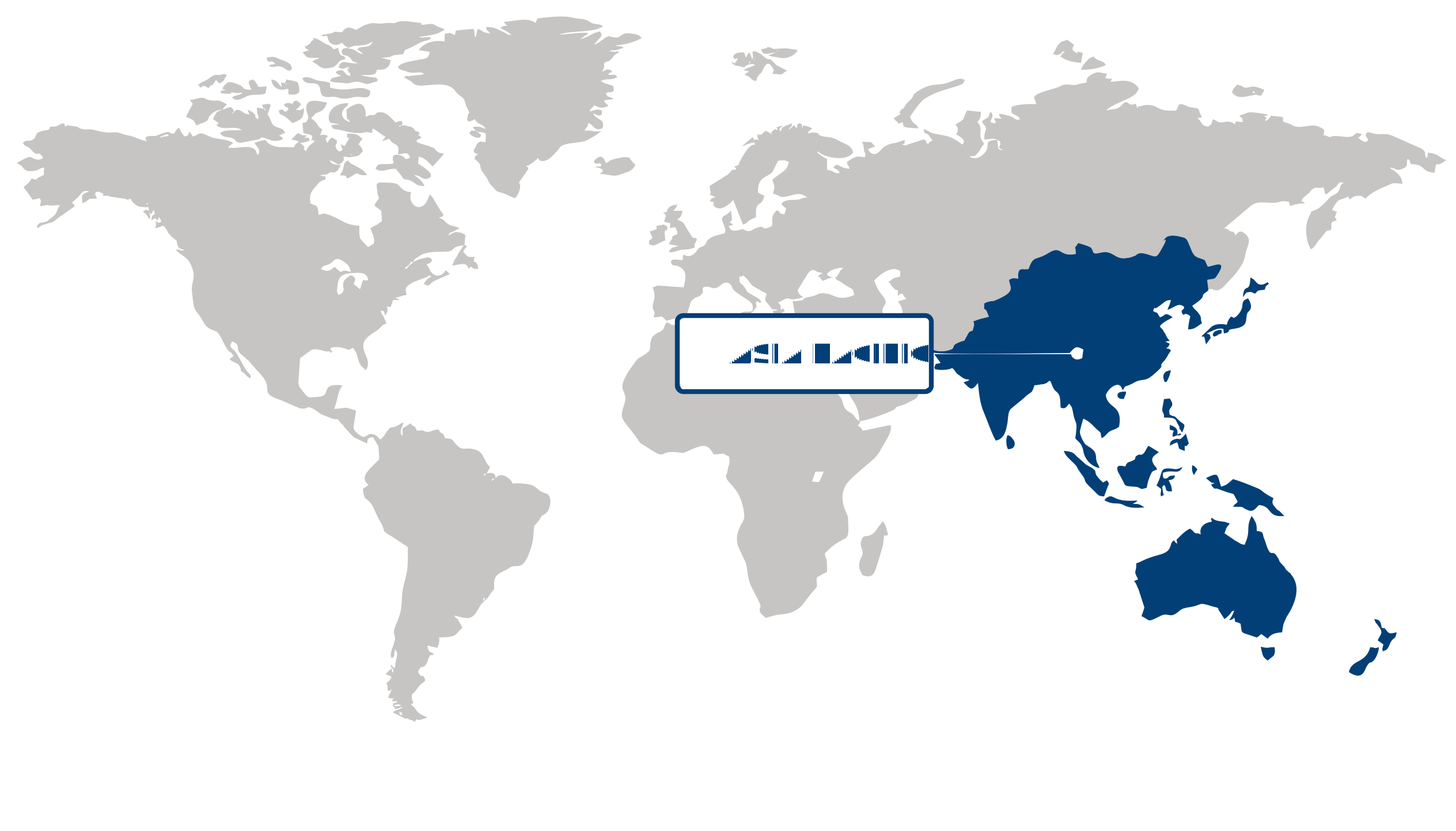
Asia Pacific (Largest Region)
In the smart finance connectivity market, Asia Pacific held the largest share of 37.10% in 2026, supported by rapid digitalization of financial services, widespread mobile connectivity, and expanding adoption of integrated digital payment and banking platforms. Financial institutions across the region are investing in connected technologies to improve transaction processing, customer engagement, data exchange, and access to financial services. The growth of digital banking ecosystems, increasing smartphone penetration, and ongoing financial inclusion initiatives are creating strong demand for interoperable connectivity solutions. In addition, the region's diverse and rapidly evolving financial technology landscape encourages institutions to modernize legacy infrastructure and adopt cloud-based, API-enabled, and real-time financial connectivity capabilities.
North America (Fastest-Growing Region)
North America is positioned as the fastest-growing region in the smart finance connectivity market, driven by continued modernization of financial infrastructure and strong demand for seamless, data-driven financial experiences. Banks and other financial institutions are increasingly integrating digital channels, automated services, open banking capabilities, and advanced data-sharing technologies to improve operational efficiency and customer convenience. Strong investment in financial technology, cloud infrastructure, cybersecurity, and artificial intelligence is creating a supportive environment for connected finance solutions. Furthermore, growing expectations for real-time financial services and greater interoperability across banking and payment ecosystems are encouraging institutions to expand connectivity capabilities and accelerate digital transformation.
| Parameter | North America | Asia Pacific | Europe | Latin America | MEA |
|---|---|---|---|---|---|
| Innovation Hub i Scale Nascent Developing Advanced | |||||
| Cost-Sensitive Region i Scale Low Medium High | |||||
| Regulatory Environment i Scale Restrictive Neutral Supportive | |||||
| Demand Drivers i Scale Weak Moderate Strong | |||||
| Development Stage i Scale Emerging Developing Developed | |||||
| Adoption Rate i Scale Low Medium High | |||||
| New Entrants / Startups i Scale Sparse Moderate Dense | |||||
| Macro Indicators i Scale Weak Stable Strong |
Key Country Insights
Germany 🇩🇪
Secure Data IntegrationGermany is emphasizing secure connectivity frameworks that allow financial institutions to exchange information while maintaining stringent data governance standards. The country's smart finance connectivity initiatives increasingly support cross-platform banking services and enterprise financial integration.
France 🇫🇷
Regulatory Connectivity FrameworksFrance is promoting smart finance connectivity solutions that improve secure information sharing and support digital financial innovation. Market participants in France are implementing standardized interfaces and identity management tools to facilitate connected banking environments.
Italy 🇮🇹
Banking Modernization InterfacesItaly is adopting smart finance connectivity solutions to improve communication between traditional banks, fintech firms, and payment providers. Financial institutions in Italy are prioritizing interoperable platforms that streamline service delivery and accelerate digital transformation initiatives.
Japan 🇯🇵
Interoperable Payment NetworksJapan is strengthening smart finance connectivity through modernization of payment infrastructures and digital transaction networks. Financial organizations in Japan are focusing on interoperability solutions that connect legacy systems with emerging digital finance platforms and services.
South Korea 🇰🇷
Real-Time Financial NetworksSouth Korea is investing in smart finance connectivity that enables real-time payments, mobile banking integration, and seamless digital commerce transactions. Connectivity providers in South Korea are prioritizing scalable network infrastructures to support increasingly interconnected financial ecosystems.
United States 🇺🇸
Open Banking InfrastructureThe U.S. smart finance connectivity market is driven by demand for secure data exchange between banks, fintech companies, and digital platforms. Institutions in the U.S. are expanding API ecosystems and cloud connectivity solutions to support interoperable and real-time financial services.
Segment Leadership and Growth Trends
Smart Finance Connectivity Market Share (%), by End-use, 2026
Go beyond the chart, access full insights & data tables
Request Free Sample ReportEnd-use Segment Analysis: Banks & Financial Institutions (Largest Segment) vs Independent ATM Deployer (Fastest-Growing Segment)
Banks & financial institutions held the largest share of the smart finance connectivity market, representing 67.9% share in 2026. Their leading position is supported by the need to maintain reliable communication between financial infrastructure, transaction systems, and customer-facing services across extensive banking networks. Increasing reliance on connected financial technologies is encouraging institutions to strengthen network reliability, data exchange, remote monitoring, and service continuity, making connectivity an essential component of modern banking operations.
Independent ATM deployers are experiencing the fastest growth as operators expand self-service banking infrastructure and seek dependable connectivity for geographically distributed machines. Connected ATM networks enable remote status monitoring, transaction management, security oversight, and timely maintenance, reducing operational complexity while supporting consistent service availability. The broader expansion of automated financial access points is therefore creating stronger demand for flexible connectivity solutions among independent deployers.
Connectivity Type Segment Analysis: Wireless (Largest & Fastest-Growing Segment)
The wireless connectivity segment represented 63% share of the smart finance connectivity market in 2026 while also emerging as the fastest-growing connectivity type. Its strong adoption is driven by the flexibility of wireless networks, which can simplify ATM deployment where fixed communication infrastructure is limited or costly to establish. Wireless connectivity also supports remote monitoring and real-time communication, enabling financial service operators to manage distributed infrastructure more efficiently. Continued expansion of self-service financial facilities and demand for scalable network solutions are reinforcing the role of wireless connectivity across smart finance applications.
| Segment | Sub-Segment | Largest Segment | Fastest Growing |
|---|---|---|---|
| End-use | Banks & Financial Institutions, Independent ATM Deployer | Banks & Financial Institutions | Independent ATM Deployer |
| Connectivity Type | Wired, Wireless | Wireless | Wireless |
Competitive Landscape and Market Positioning
Top players in the smart finance connectivity market:
1. Diebold Nixdorf Incorporated (U.S.)
2. Digi International Inc. (U.S.)
3. TELTONIKA NETWORKS (Lithuania)
4. InHand Networks Inc. (China)
5. OptConnect Management LLC (U.S.)
6. Xiamen Milesight IoT Co. Ltd. (China)
7. Datablaze LLC (U.S.)
8. Benison Technologies Pvt. Ltd. (India)
9. NCR Corporation (U.S.)
The smart finance connectivity market is driven by stronger integration between financial systems and communication infrastructures. Interoperability enhancements are enabling smoother data exchange across platforms. The smart finance connectivity market is also evolving through advanced connectivity frameworks that support faster and more secure financial interactions.
| Company | Market Share | Company Revenue | Revenue CAGR (%) | Product Portfolio | Geographic Presence | Innovation / R&D Focus | Strategic Developments |
|---|---|---|---|---|---|---|---|
| Diebold Nixdorf Incorporated (U.S.) | |||||||
| Digi International Inc. (U.S.) | |||||||
| TELTONIKA NETWORKS (Lithuania) | |||||||
| InHand Networks Inc. (China) | |||||||
| OptConnect Management LLC (U.S.) | |||||||
| Xiamen Milesight IoT Co. Ltd. (China) | |||||||
| Datablaze LLC (U.S.) | |||||||
| Benison Technologies Pvt. Ltd. (India) | |||||||
| NCR Corporation (U.S.). |
Industry Development/News
| Company Name | Date | Key Development |
|---|---|---|
| Visa | Feb-26 | Visa completed the acquisition of Prisma Medios de Pago and Newpay to enhance its multi-rail payment capabilities in Argentina. The transaction strengthens Visa’s regional infrastructure and expands its connectivity across payment networks, improving interoperability and reinforcing its strategic positioning in Latin American financial ecosystems. |
| Fiserv | Jan-26 | Fiserv and Affirm formed an exclusive partnership to integrate pay-over-time functionality into debit programs. The collaboration expands embedded credit capabilities across merchant networks, enhancing payment flexibility and supporting broader adoption of alternative financing solutions within retail transaction ecosystems. |
| Fiserv | Jan-26 | Fiserv and Sumitomo Mitsui announced the upcoming launch of Clover in Japan to serve small-business merchants. The initiative expands Fiserv’s point-of-sale ecosystem into new geographic markets, strengthening merchant acquiring infrastructure and supporting SME digital payment adoption in the Japanese market. |
| Abu Dhabi Islamic Bank | Jan-26 | Abu Dhabi Islamic Bank implemented open-finance APIs under the UAE AlTareq scheme, becoming the first Islamic bank to comply. The deployment enhances interoperability across financial systems and supports broader open banking adoption, improving data connectivity and enabling ecosystem-driven financial service innovation. |
Customize Your Report
Explore examples of how this report can be tailored to different research needs, including custom segments, additional topics or chapters, and related reports. Click a section of the wheel or its numbered marker to explore the available options.
Smart Finance Connectivity Market — Custom Segments
| Segment | Sub-Segment |
|---|---|
| Network Technology | Cellular, Wi-Fi, Ethernet, LPWAN |
| Application Environment | ATMs & Self-Service Terminals, Point-of-Sale Systems, Branch Banking Infrastructure, Mobile & Remote Banking Devices |
| Connectivity Management Model | Direct Carrier Connectivity, Managed Connectivity Services, Private Network Connectivity |
Smart Finance Connectivity Market — Custom TOC
| Custom Chapter | Custom Details |
|---|---|
| Financial Connectivity Transformation Roadmap |
|
| Embedded Finance Integration Opportunities |
|
| Open Banking Ecosystem Development |
|
Need a different cut of the data?
Request Custom ResearchWhat is the current size of the smart finance connectivity market?
What are the growth projections for the smart finance connectivity industry?
How is wireless connectivity accelerating deployment across the smart finance connectivity market?
Why are 5G-enabled IoT networks becoming strategically important in the smart finance connectivity market?
Why do banks and financial institutions dominate the smart finance connectivity market?
Why is wireless the fastest-growing connectivity type in the smart finance connectivity market?
Why does Asia Pacific lead the smart finance connectivity market?
What is driving the rapid growth of the smart finance connectivity market in North America?
Who are the leading players in the smart finance connectivity landscape?
Our Clients
"The team demonstrated a great understanding of our business needs, and the reports were tailored to address our specific concerns and objectives."
Infosys
"The report was up-to-date with the latest industry trends and technological advancements. The detailed competitive landscape analysis was quite helpful."
Zebra Technologies
"The data presented in the report was accurate and well-researched. I also found the market dynamics section particularly useful."
Arlo Technologies
Our Research Team & Methodology
Every Fundamental Business Insights report is built by a dedicated vertical research team, validated through a structured primary-and-secondary methodology, and reviewed for accuracy before it reaches you.
Research Team Overview
Prepared by the Smart Technologies Research Team
Delivery
Published
Demand
Available
Support
Trust & Compliance
Research Domains
10 coverage areasResearch Intelligence
| Source | Reference |
|---|---|
| National Institute of Standards and Technology (NIST) | www.nist.gov |
| International Organization for Standardization (ISO) | www.iso.org |
| Institute of Electrical and Electronics Engineers (IEEE) | www.ieee.org |
| Internet Engineering Task Force (IETF) | www.ietf.org |
| World Wide Web Consortium (W3C) | www.w3.org |
| Cloud Security Alliance (CSA) | cloudsecurityalliance.org |
| Open Source Initiative (OSI) | opensource.org |
| Linux Foundation | www.linuxfoundation.org |
| FinOps Foundation | www.finops.org |
| PCI Security Standards Council | www.pcisecuritystandards.org |
| SWIFT | www.swift.com |
| Financial Stability Board (FSB) | www.fsb.org |
| GSMA | www.gsma.com |
| International Telecommunication Union (ITU) | www.itu.int |
| OWASP Foundation | owasp.org |
| MITRE | www.mitre.org |
| World Economic Forum (WEF) | www.weforum.org |
| OECD Digital Economy | www.oecd.org/digital |
| World Bank Data | data.worldbank.org |
| U.S. Census Bureau | www.census.gov |
Research Workflow & Quality Assurance
Data Collection
Verified information gathered through primary and secondary research.
Data Triangulation
Cross-validation using multiple independent data sources.
Forecast Modelling
Market estimates developed using historical trends and analytical models.
Analyst Validation
Findings reviewed by domain experts for accuracy and consistency.
Editorial & Quality Review
Final editorial, quality, and compliance checks before publication.
Final Publication
Released after successful completion of the internal review process.
Report Coverage
📊 Market Assessment
- Market Size & Forecast
- Market Segmentation
- Regional Analysis
- Growth Drivers & Challenges
- Market Dynamics
🏢 Competitive Intelligence
- Competitive Landscape
- Company Profiles
- Competitive Benchmarking
- Mergers & Acquisitions
- Market Share Analysis or Key Company Strategies
🔍 Strategic Analysis
- Value Chain Analysis
- Porter's Five Forces
- PESTLE Analysis
- Pricing Trends
- Supply-Demand Analysis
🚀 Future Outlook
- Technology Landscape
- Regulatory Landscape
- Investment & Funding Landscape
- Emerging Opportunities
- Future Market Outlook
Have a question about this report or need a custom scope?
Request Customization