Smart Elevator Market Size & Growth Forecast 2027–2036, By Segments (Component, Application), Regional Demand Trends (North America, Asia Pacific, Europe), Key Country Insights (U.S., Japan, South Korea, Germany, France, Italy), and Competitive Landscape
Market Size and Growth Outlook
Smart Elevator Market size stood at USD 12.88 billion in 2026 and is predicted to grow at a 6.84% CAGR from 2027 to 2036, attaining USD 24.96 billion by 2036. The industry revenue for 2027 is assessed at USD 13.62 billion.
Get more details on this report
Request Free Sample ReportSmart Elevator Market Intelligence Snapshot
Regional Market Dynamics
- Asia Pacific held a 45.90% market share in 2026, supported by its extensive installed elevator base and sustained demand for modernization, predictive maintenance, and energy-efficient connected systems.
- Asia Pacific is projected to grow at an 8.25% CAGR as ongoing urban construction and wider adoption of digital monitoring and destination dispatch technologies improve operational efficiency.
Segment Momentum
- The Communication System held a 38.9% market share in 2026 because it enables real-time coordination between elevators, users, and building management systems, supporting efficient traffic management, passenger experience, and operational visibility.
- Industrial applications are expanding fastest as manufacturing sites and warehouses increasingly adopt smart elevators to improve workflow reliability, movement efficiency, and operational continuity across connected facilities.
Market Expansion Drivers
- IoT and AI integration enhancing elevator automation and operational efficiency.
- Rapid high-rise construction and urbanization driving advanced vertical mobility demand.
- Predictive maintenance and biometric access systems improving safety and user experience.
Leading Market Participants
- Major players in the smart elevator market include Otis Worldwide Corporation (United States), KONE Corporation (Finland), Schindler Holding AG (Switzerland), TK Elevator GmbH (Germany), Hitachi, Ltd. (Japan), Mitsubishi Electric Corporation (Japan), Fujitec Co., Ltd. (Japan), Hyundai Elevator Co., Ltd. (South Korea), Toshiba Elevator and Building Systems Corporation (Japan), Siemens AG (Germany).
Global Market Forecast Snapshot
Market Outlook
- 2026 Market Size: USD 12.88 billion
- 2027 Estimated Market Size: USD 13.62 billion.
- Projected Market Size: USD 24.96 billion by 2036
- Growth Forecast: 6.84% CAGR (2027-2036)
Regional and Segment Outlook
- Leading Regional Market: Asia Pacific
- High-Growth Regional Hub: Asia Pacific
- Core Revenue Segment: Communication System (Component) | Commercial (Application)
- Emerging Opportunity Segment: Maintenance System (Component) | Industrial (Application)
Market Growth Drivers and Industry Trends
IoT and AI integration enhancing elevator automation and operational efficiency
The integration of IoT connectivity and artificial intelligence is transforming elevator systems into intelligent mobility platforms, which will drive the smart elevator market growth. Connected elevators can collect and transmit operational information related to usage patterns, equipment performance, traffic conditions, and system status, allowing building operators to make more informed decisions. AI-based algorithms can analyze this information to optimize elevator dispatching, adjust service according to passenger demand, and improve energy management. Integration with building management systems further enables elevators to operate as part of a connected infrastructure rather than as standalone equipment, while real-time monitoring supports improved coordination across multiple elevators in commercial, residential, and mixed-use buildings.
Rapid high-rise construction and urbanization driving advanced vertical mobility demand
Accelerating urbanization and the continued development of high-rise residential, commercial, and mixed-use buildings are increasing requirements for efficient vertical transportation, strengthening demand in the smart elevator market. As cities accommodate growing populations within increasingly dense urban environments, taller structures require elevator systems capable of managing high passenger volumes while minimizing waiting times and improving movement between floors. Smart elevators provide capabilities such as destination-based dispatching, adaptive traffic management, and integration with other building systems, making them well suited to modern high-density developments. The increasing complexity of vertical buildings is also encouraging developers to prioritize mobility systems that can support efficient passenger circulation alongside broader objectives for building connectivity and energy management.
Predictive maintenance and biometric access systems improving safety and user experience
The adoption of predictive maintenance technologies and biometric access controls is enhancing elevator reliability, security, and convenience, contributing to smart elevator market demand. Predictive maintenance systems use operational and equipment data to identify abnormal conditions and potential component issues before they develop into disruptive failures, helping building operators schedule maintenance more efficiently. At the same time, biometric technologies can authenticate users and restrict elevator access to authorized floors, supporting security requirements in offices, residential buildings, hotels, and other controlled environments. These capabilities are increasingly being combined with mobile credentials, access management platforms, and centralized building systems, creating elevator experiences that are more responsive to individual users while providing facility managers with greater control over equipment and access operations.
| Growth Driver | Impact on CAGR | Regulatory Influence | Geographic Relevance | Adoption Rate | Impact Timeline |
|---|---|---|---|---|---|
| IoT and AI integration enhancing elevator automation and operational efficiency | 2.00% | Moderate | Asia Pacific, Europe | High | Near Term |
| Rapid high-rise construction and urbanization driving advanced vertical mobility demand | 1.80% | Moderate | Asia Pacific, North America | High | Mid Term |
| Predictive maintenance and biometric access systems improving safety and user experience | 1.60% | Moderate | North America, Europe | High | Mid Term |
Unlock insights tailored to your business with our bespoke market research solutions.
Click to get your customized report now.
Regional Demand Dynamics
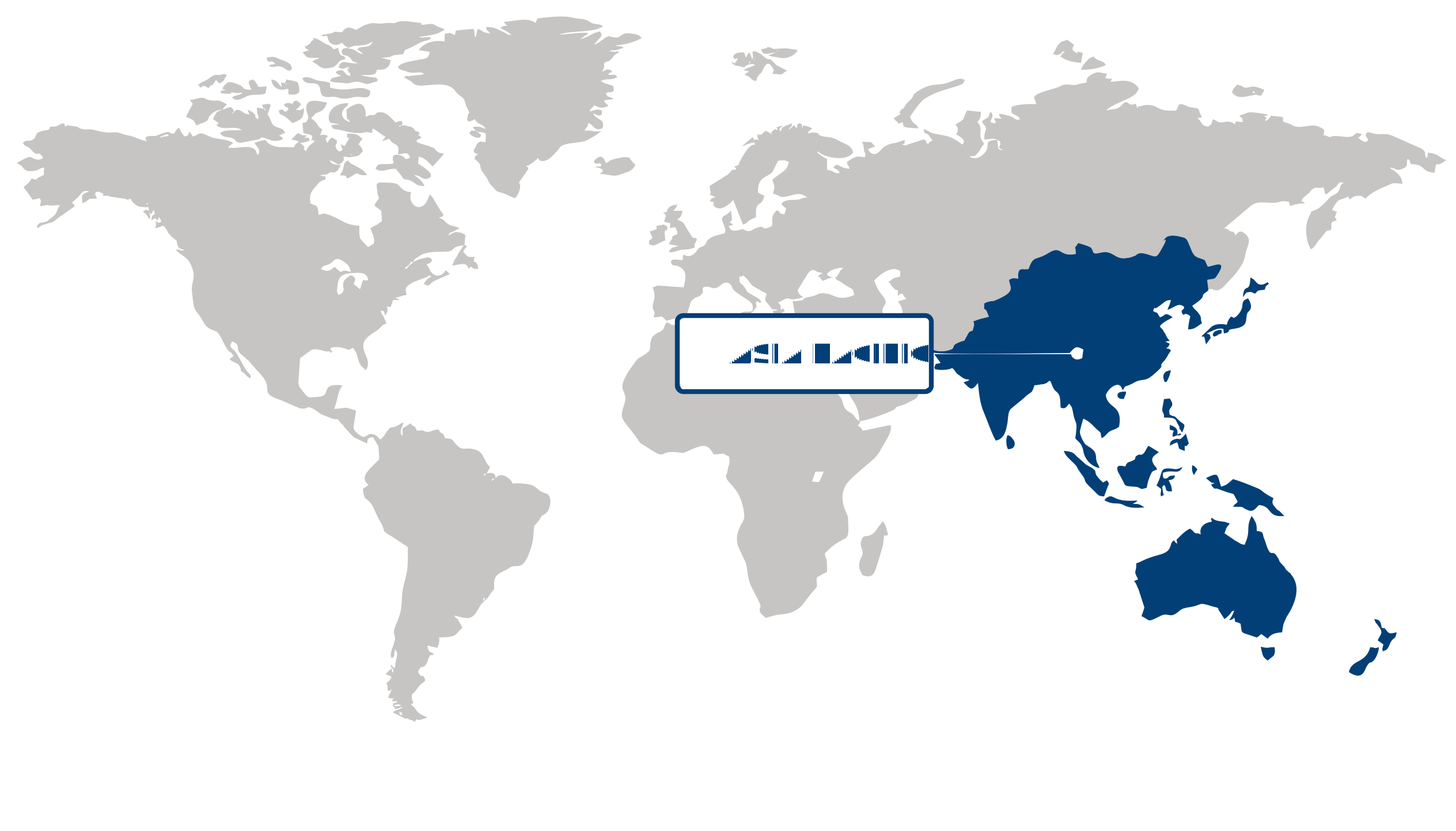
Asia Pacific (Largest & Fastest-Growing Region)
The Asia Pacific smart elevator market led globally with a 45.90% share in 2026 and is also the fastest-growing regional market, supported by rapid urbanization, extensive high-rise construction, and increasing investment in intelligent building infrastructure. Expanding commercial complexes, residential towers, transportation hubs, and mixed-use developments are creating strong demand for elevators equipped with connected controls, destination management, energy optimization, and predictive maintenance capabilities. The region's growing focus on smart cities and digitally integrated buildings is further accelerating adoption, as developers seek technologies that improve passenger flow, operational efficiency, safety, and energy performance. Rising investment in modernization and replacement of conventional elevator systems is adding another layer of demand for connected and automation-enabled solutions.
| Parameter | North America | Asia Pacific | Europe | Latin America | MEA |
|---|---|---|---|---|---|
| Innovation Hub i Scale Nascent Developing Advanced | |||||
| Cost-Sensitive Region i Scale Low Medium High | |||||
| Regulatory Environment i Scale Restrictive Neutral Supportive | |||||
| Demand Drivers i Scale Weak Moderate Strong | |||||
| Development Stage i Scale Emerging Developing Developed | |||||
| Adoption Rate i Scale Low Medium High | |||||
| New Entrants / Startups i Scale Sparse Moderate Dense | |||||
| Macro Indicators i Scale Weak Stable Strong |
Key Country Insights
Germany 🇩🇪
Energy-Efficient ModernizationGermany focuses on upgrading existing elevator infrastructure with energy-efficient smart technologies and advanced monitoring systems. German building operators are investing in digital modernization projects that align with sustainability objectives and long-term maintenance optimization.
France 🇫🇷
Sustainable Building UpgradesFrance is expanding smart elevator adoption through renovation projects focused on digital building management and energy optimization. French facility managers increasingly prioritize connected elevator systems that improve maintenance efficiency and occupant convenience.
Italy 🇮🇹
Retrofit Technology DemandItaly is witnessing greater demand for retrofitting conventional elevators with smart monitoring and control technologies. Building owners across Italy are modernizing aging infrastructure to improve safety compliance, maintenance planning, and operational reliability.
Japan 🇯🇵
Intelligent Mobility SystemsJapan continues integrating AI-enabled elevator controls and destination dispatch technologies within high-density commercial and residential buildings. Smart elevator deployment in Japan reflects demand for efficient passenger flow, accessibility improvements, and reliable urban mobility solutions.
South Korea 🇰🇷
Smart City ConnectivitySouth Korea is aligning smart elevator deployments with intelligent building and smart city initiatives. Developers in South Korea are adopting cloud-connected elevator management platforms that enhance remote monitoring, security functions, and operational performance.
United States 🇺🇸
Digital Building IntegrationThe U.S. smart elevator market is driven by demand for connected building infrastructure and predictive maintenance solutions. Property owners in the U.S. increasingly deploy IoT-enabled elevators that improve operational efficiency, passenger experience, and building management integration.
Segment Leadership and Growth Trends
Smart Elevator Market Share (%), by Component, 2026
Go beyond the chart, access full insights & data tables
Request Free Sample ReportComponent Segment Analysis: Communication System (Largest Segment) vs Maintenance System (Fastest-Growing Segment)
The communication system segment led the smart elevator market in 2026 with a 38.9% share, reflecting the central role of connected communication infrastructure in enabling intelligent elevator operations. Communication systems facilitate data exchange among elevators, control platforms, building management systems, and monitoring interfaces, supporting coordinated operation and real-time status visibility. Increasing adoption of connected buildings and demand for remote monitoring, traffic optimization, and enhanced passenger safety are strengthening the importance of reliable communication capabilities.
The maintenance system segment is advancing at the fastest pace as elevator operators increasingly prioritize predictive and condition-based maintenance. Connected sensors and monitoring technologies can identify equipment abnormalities, support proactive servicing, and reduce the risk of unexpected downtime. The broader shift toward digitally managed buildings is encouraging facility operators to adopt maintenance solutions that improve asset reliability, simplify service planning, and extend equipment performance.
Application Segment Analysis: Commercial (Largest Segment) vs Industrial (Fastest-Growing Segment)
Commercial applications accounted for 50.03% of the smart elevator market in 2026, making this the leading application segment. Office buildings, shopping centers, hotels, and other commercial properties increasingly require elevator systems capable of handling variable passenger flows while improving energy efficiency and user convenience. Integration with building management platforms, destination control, access management, and real-time monitoring further enhances the value of smart elevator technologies in modern commercial facilities.
Industrial applications are growing at the fastest pace as manufacturing facilities, warehouses, and other industrial properties adopt automation and connected infrastructure. Smart elevators can support efficient movement of personnel and materials while enabling centralized monitoring and maintenance management. Increasing modernization of industrial facilities and the need to improve operational safety, equipment availability, and energy performance are contributing to greater adoption.
| Segment | Sub-Segment | Largest Segment | Fastest Growing |
|---|---|---|---|
| Component | Control System, Maintenance System, Communication System, Others | Communication System | Maintenance System |
| Application | Residential, Commercial, Institutional, Industrial | Commercial | Industrial |
Competitive Landscape and Market Positioning
Prominent players in the smart elevator market:
1. Otis Worldwide Corporation (United States)
2. KONE Corporation (Finland)
3. Schindler Holding AG (Switzerland)
4. TK Elevator GmbH (Germany)
5. Hitachi Ltd. (Japan)
6. Mitsubishi Electric Corporation (Japan)
7. Fujitec Co. Ltd. (Japan)
8. Hyundai Elevator Co. Ltd. (South Korea)
9. Toshiba Elevator and Building Systems Corporation (Japan)
10. Siemens AG (Germany)
The smart elevator market is evolving through increasing integration of connected systems, predictive maintenance, and intelligent control mechanisms. Buildings are increasingly adopting automation-driven mobility solutions to enhance energy efficiency and user experience. New system deployments emphasize safety, responsiveness, and real-time monitoring capabilities. Industry consolidation and capability expansion efforts are also reshaping competitive structures, enabling more integrated vertical transportation solutions.
| Company | Market Share | Company Revenue | Revenue CAGR (%) | Product Portfolio | Geographic Presence | Innovation / R&D Focus | Strategic Developments |
|---|---|---|---|---|---|---|---|
| Otis Worldwide Corporation (United States) | |||||||
| KONE Corporation (Finland) | |||||||
| Schindler Holding AG (Switzerland) | |||||||
| TK Elevator GmbH (Germany) | |||||||
| Hitachi Ltd. (Japan) | |||||||
| Mitsubishi Electric Corporation (Japan) | |||||||
| Fujitec Co. Ltd. (Japan) | |||||||
| Hyundai Elevator Co. Ltd. (South Korea) | |||||||
| Toshiba Elevator and Building Systems Corporation (Japan) | |||||||
| Siemens AG (Germany). |
Industry Development/News
| Company Name | Date | Key Development |
|---|---|---|
| Hitachi Elevator Asia Pte. Ltd. | Jul-24 | Hitachi Elevator Asia secured its largest contract in Singapore to supply and install 450 elevators for Housing & Development Board high-rise residential projects. The award significantly strengthens the company's market position and expands its installed base in a key urban infrastructure market. |
| FUJITEC CO., LTD. | Jul-24 | FUJITEC opened a new sales office in Ahmedabad, India, to strengthen its regional commercial presence and support a multi-brand strategy. The expansion enhances the company's distribution network and reinforces its long-term growth strategy in the Indian elevator market. |
| Otis | Jun-21 | Otis launched the Smart Gen3™ elevator featuring cloud-based IoT technology to expand its smart elevator portfolio. The company targeted China's growing green construction sector, strengthening its position through connected elevator solutions that improve operational efficiency and user experience. |
| Hyundai Elevator | Jun-21 | Hyundai Elevator signed a memorandum of understanding with KT to accelerate digital transformation by integrating AI, voice recognition, and autonomous robot technologies into elevator systems. The partnership advances development of next-generation smart elevators with enhanced intelligent building capabilities. |
| KONE Elevator India | Mar-21 | KONE Elevator India introduced digitally connected elevators equipped with built-in connectivity to improve passenger flow management. The launch expanded the company's smart elevator portfolio and strengthened its competitive position in India's rapidly growing elevator market. |
Customize Your Report
Explore examples of how this report can be tailored to different research needs, including custom segments, additional topics or chapters, and related reports. Click a section of the wheel or its numbered marker to explore the available options.
Smart Elevator Market — Custom Segments
| Segment | Sub-Segment |
|---|---|
| Building Height | Low-Rise Buildings, Mid-Rise Buildings, High-Rise Buildings, Supertall Buildings |
| Installation Type | New Construction, Retrofit and Modernization |
| Service Model | Equipment Sale, Maintenance Contracts, Managed Elevator Services, Subscription-Based Smart Services |
Smart Elevator Market — Custom TOC
| Custom Chapter | Custom Details |
|---|---|
| Smart Building Integration Opportunity Assessment |
|
| Digital Services Revenue Opportunity Assessment |
|
| Retrofit Market Potential Assessment |
|
Need a different cut of the data?
Request Custom ResearchHow much revenue does the smart elevator market generate?
What are the growth projections for the smart elevator industry?
How is IoT and AI integration reshaping procurement priorities and service models in smart elevator deployments?
Why is rapid high-rise urban development accelerating adoption of advanced elevator systems?
Why is the Communication System the largest component segment in the smart elevator market?
Why is the Industrial application segment growing fastest in the smart elevator market?
Why does Asia Pacific lead the smart elevator market?
What is driving smart elevator market growth in Asia Pacific?
What are the prominent companies operating in the smart elevator landscape?
Our Clients
"The team demonstrated a great understanding of our business needs, and the reports were tailored to address our specific concerns and objectives."
Infosys
"The report was up-to-date with the latest industry trends and technological advancements. The detailed competitive landscape analysis was quite helpful."
Zebra Technologies
"The data presented in the report was accurate and well-researched. I also found the market dynamics section particularly useful."
Arlo Technologies
Our Research Team & Methodology
Every Fundamental Business Insights report is built by a dedicated vertical research team, validated through a structured primary-and-secondary methodology, and reviewed for accuracy before it reaches you.
Research Team Overview
Prepared by the Smart Technologies Research Team
Delivery
Published
Demand
Available
Support
Trust & Compliance
Research Domains
10 coverage areasResearch Intelligence
| Source | Reference |
|---|---|
| National Institute of Standards and Technology (NIST) | www.nist.gov |
| International Organization for Standardization (ISO) | www.iso.org |
| Institute of Electrical and Electronics Engineers (IEEE) | www.ieee.org |
| Internet Engineering Task Force (IETF) | www.ietf.org |
| World Wide Web Consortium (W3C) | www.w3.org |
| Cloud Security Alliance (CSA) | cloudsecurityalliance.org |
| Open Source Initiative (OSI) | opensource.org |
| Linux Foundation | www.linuxfoundation.org |
| FinOps Foundation | www.finops.org |
| PCI Security Standards Council | www.pcisecuritystandards.org |
| SWIFT | www.swift.com |
| Financial Stability Board (FSB) | www.fsb.org |
| GSMA | www.gsma.com |
| International Telecommunication Union (ITU) | www.itu.int |
| OWASP Foundation | owasp.org |
| MITRE | www.mitre.org |
| World Economic Forum (WEF) | www.weforum.org |
| OECD Digital Economy | www.oecd.org/digital |
| World Bank Data | data.worldbank.org |
| U.S. Census Bureau | www.census.gov |
Research Workflow & Quality Assurance
Data Collection
Verified information gathered through primary and secondary research.
Data Triangulation
Cross-validation using multiple independent data sources.
Forecast Modelling
Market estimates developed using historical trends and analytical models.
Analyst Validation
Findings reviewed by domain experts for accuracy and consistency.
Editorial & Quality Review
Final editorial, quality, and compliance checks before publication.
Final Publication
Released after successful completion of the internal review process.
Report Coverage
📊 Market Assessment
- Market Size & Forecast
- Market Segmentation
- Regional Analysis
- Growth Drivers & Challenges
- Market Dynamics
🏢 Competitive Intelligence
- Competitive Landscape
- Company Profiles
- Competitive Benchmarking
- Mergers & Acquisitions
- Market Share Analysis or Key Company Strategies
🔍 Strategic Analysis
- Value Chain Analysis
- Porter's Five Forces
- PESTLE Analysis
- Pricing Trends
- Supply-Demand Analysis
🚀 Future Outlook
- Technology Landscape
- Regulatory Landscape
- Investment & Funding Landscape
- Emerging Opportunities
- Future Market Outlook
Have a question about this report or need a custom scope?
Request Customization